Week-4 Challenge WOT Condition Part-2
AIM: To perform the tasks using the powertrain Blockset model.
OBJECTIVES:
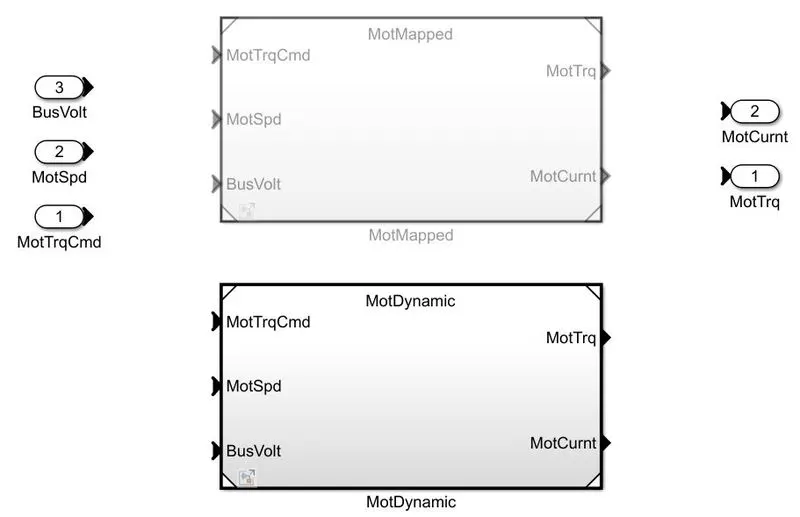
- What is the difference between the mapped and dynamic models of engine, motor, and generator? How can you change the model type?
- How does the model calculate miles per gallon? Which factors are considered to model fuel flow?
- Run the HEV ReferenceApplication with WOT drive cycle. Change the grade and wind velocity in the environment block. Comment on the results.
- Keeping all other parameters the same, compare the simulated results of hybrid and pure electric powertrains.
INTRODUCTION
Powertrain Blockset provides fully assembled reference application models of automotive powertrains, including gasoline, diesel, hybrid, and electric systems. It includes a component library for simulating engine subsystems, transmission assemblies, traction motors, battery packs, and controller models. Powertrain Blockset also includes a dynamometer model for virtual testing. MDF file support provides a standards-based interface to calibration tools for data import.
Powertrain Blockset provides a standard model architecture that can be reused throughout the development process. You can use it for design tradeoff analysis and component sizing, control parameter optimization, and hardware-in-the-loop testing. You can customize models by parameterizing components in a reference application with your own data or by replacing a subsystem with your own mode
1. What is the difference between the mapped and dynamic engine, motor, and generator models? How can you change the model type?
- Mapped model - The mapped model is a type of model in which the data is loaded through a lookup table. The output values are stored for the corresponding input values for the engine, motor, and generator. These simulations do not run on real-time data, hence the accuracy of these models is not very high. The time required for the completion of this simulation is very low as not many of the high calculations are involved. This model can be used for design trade-off analysis, sizing of the components, control parameters optimization, and hardware in the loop testing. You can customize the model using the reference example and customize the model according to your own data.
- Mapped Motor - This model is mostly used when the user needs the results quickly, and the user doesn't have information about the motor parameters. The mapped motor use in the torque control mode. The output torque and the reference torque are compared and the changes are made.
- Mapped Engine - This model is based on the lookup table data. This setting is the default setting in the power train Blockset. These models are less accurate and the lookup table data are based on the brake torque, commanded torque, and engine speed.
- Mapped Generator - This is also the same as the other Block sets. Most of the data is taken from the input tables and they required less time and are less accurate.
- Dynamic models - Dynamic models are the models that used data from various subsystems to generate the output. It runs in the real-time simulation where the required input is taken from the drive cycle and the simulation is run. The accuracy of the system is very high as the data is taken for the real-time simulation, but the time taken for the simulation to run is very high.
- Dynamic Motor - In this model the three-phase interior permanent magnets synchronous motor is used. This model uses a three-phase input to regulate the single-phase current allowing the control of torque and speed. This model is used when the user knows all the parameters of the motor for the simulation.
- Dynamic Engine - This type of model used the real-time data fed by the user during the run time of simulations. This model is more accurate than the mapped engine model and is mostly used when the subsystem data is required.
- Dynamic generator - The dynamic generator block involves the user entering the parameter manually during the run time of the simulations for their particular applications.
TO CHANGE THE MODEL FROM MAPPED TO DYNAMIC
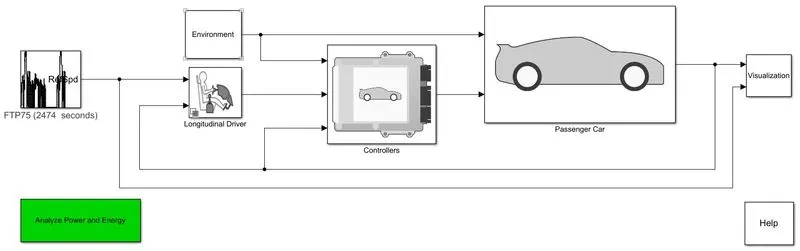
- To change the model in Simulink we first need to open the HVE model in the Simulink. Then double-click on the passenger car block.
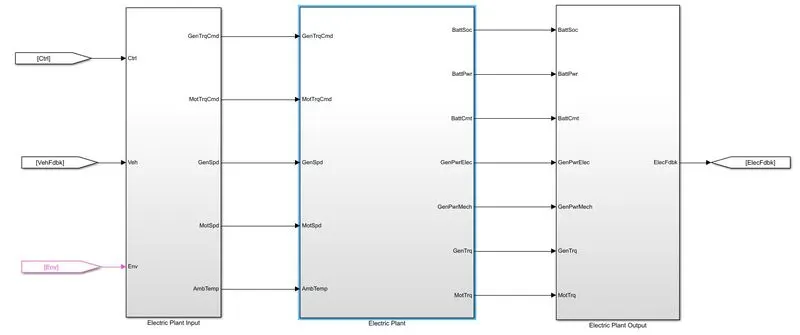
- Then open the Electric plant block.
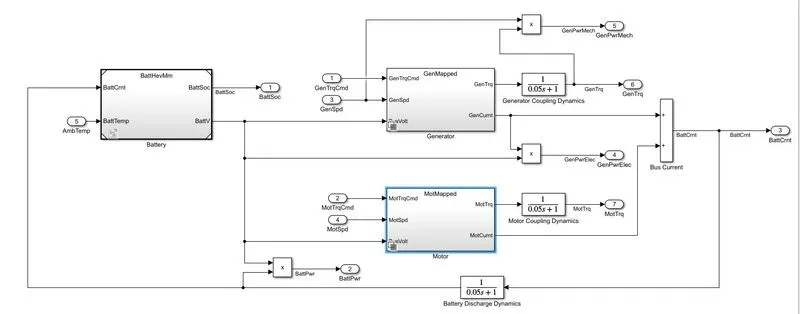
- Inside that, you will find the motor and generator block. Double click on any block to open the MApped and the dynamic model.
- Double click on the blank space to open the side menu.
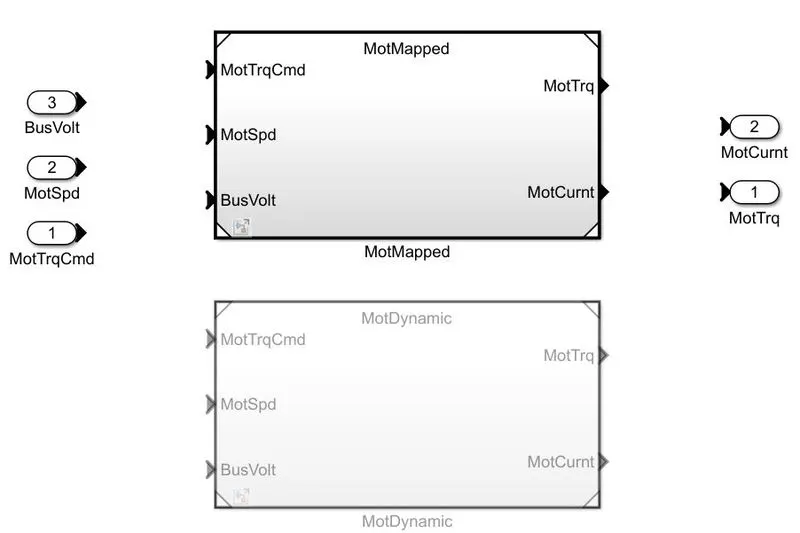
- Got to Variant --> label motor active choice their you can see both the models just click on any model that you need to select to activate it.
2. How does the model calculate miles per gallon? Which factors are considered to model fuel flow?
- To calculate the fuel efficiency first, the automobile is filled with a full tank capacity the distance in the odometer is noted and the vehicle is derived to the full tank capacity till the tank is empty.
- Once the tank is empty the distance in the odometer is recorded and the difference in the reading is calculated, this is the total distance traveled in the full tank capacity of the vehicle.
- Then the distance is divided by the capacity of the tank and the average mileage of the vehicle is calculated.
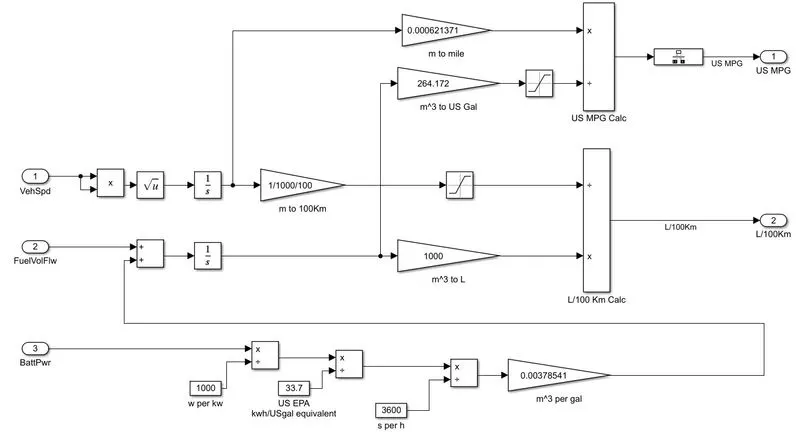
- In the above model, we can observe that factors that are needed as input to the model are vehicle speed, fuel Volume floe, and battery power. As value changes performance of the vehicle also changes.
- here 1st the velocity is converted into the distance by integrating the velocity values and then the distance is converted from meter to miles and Km.
- Then similarly battery power is converted to volume by multiplying and dividing by constant conversion value. Then the battery and fuel volume flow are added and integrated to get the total volume of fuel consumed. Now, this volume is converted from cubic meters to gallons and liters.
- Now the distance and volume of the fuel are divided to get performance results in miles per gallons.
FACTORS CONSIDER TO MODEL FULE FLOW.
- WEIGHT- The weight of the vehicle is considered as it plays an important role in determining the amount of fuel consumed as the weight increases the tractive efforts required to overcome the vehicle rest inertia will increase.
- DRIVE CYCLE- At a certain speed engine is able to operate at an RPM that provides maximum efficiency, driving at an irregular pace or higher speed makes the engine provide lower efficiency. Aggressive accelerating and braking drive cycle decrease the fuel economy of the Drivetrain.
- RESISTANCE- IF the vehicle is subjected to high opposing wind speed road grade then there is a higher force acting on a body in particular Aerodynamic drag and hill-climbing force. These forces increase the power needed to overcome the tractive efforts in turn making the engine consume more fuel.
3. Run the HEV ReferenceApplication with WOT drive cycle. Change the grade and wind velocity in the environment block.
- The HVE model consists of a Drive cycle block, Environment block, Longitudinal block, Controllers, and passenger car. This block makes the complete circuits of the Drive train model.
We change the drive cycle to WOT and set the parameters as
Nominal velocity - 60 mph
Time to start deceleration - 40 sec
Saturation time - 100 seconds
Wind velocity - 10 m/s
Grade - 5
RESULTS
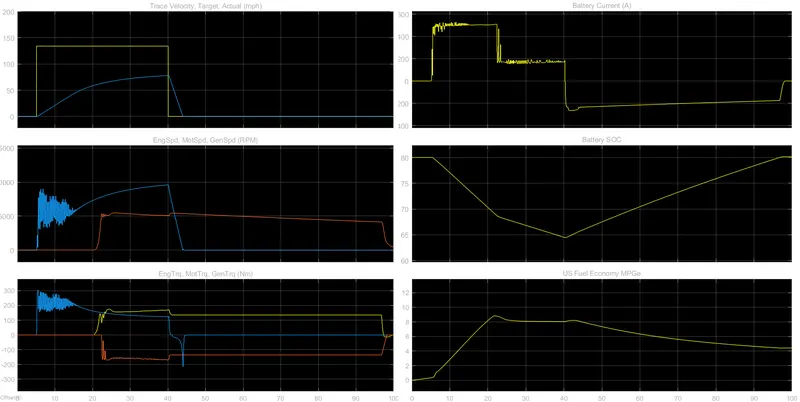
Trace and Actual Velocity- We see here trace velocity is given as input and actual velocity is the output, Top velocity achieved = 74 Mph, time taken to attempt maximum acceleration = 40.30 sec, and time taken to decelerate = 4.242 sec
Engine, Motor, Generator Torque - The maximum engine speed recorded is 54577.57 RPM, maximum Motor Speed = 9571 RPM. We see whenever the SOC falls below 70% the engine gets activated by providing torque as well as charging the battery.
Engine, motor, generator torque - The maximum torque of engine = 163.3 Nm, Maximum torque of motor = 287.8 Nm.
Battery Current - The maximum current provided by the battery is around 570 amp and after reaching a certain point the value is constant and is the maximum amp limit of the battery. As soon as the engine and generator get started the battery current drops as the load is shared by the engine and current goes negative because of the occurrence of regenerative braking.
4. Keeping all other parameters the same, compare the simulated results of hybrid and pure electric powertrains.
Fully Electric Vehicle
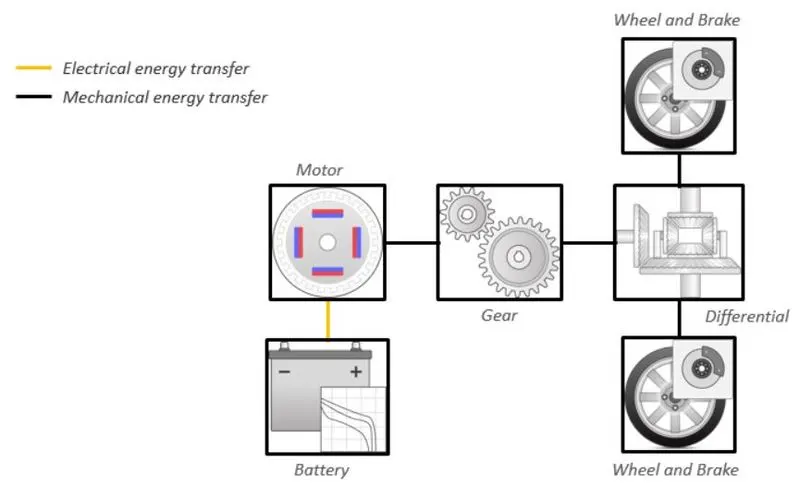
Hybrid Electric Vehicle
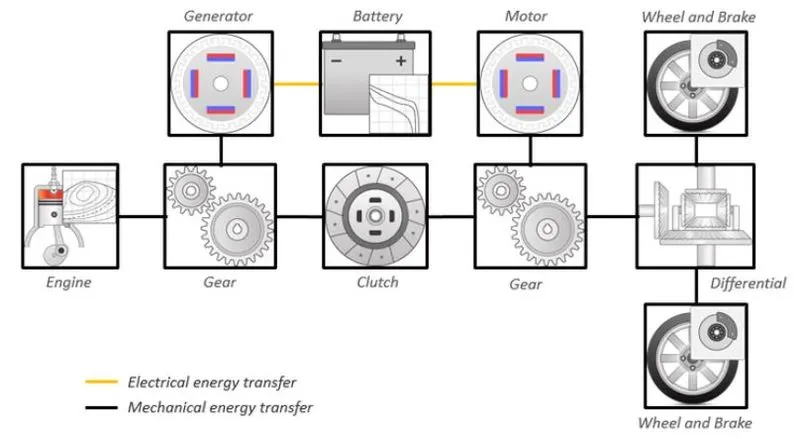
SIMULATION PARAMETERS
Grade angle = 10 degree
Wind velocity = 15 m/s
Total simulation time = 100 sec
nominal speed = 45 m/s
Deceleration time = 40 seconds
EV RESULTS
HEV RESULTS
EXPLANATION:-
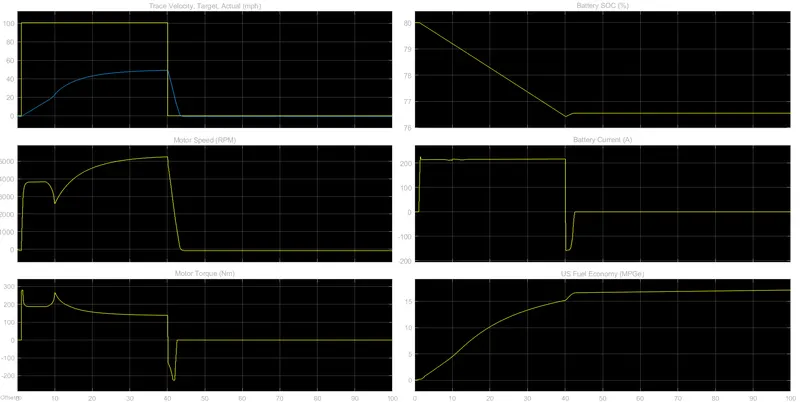
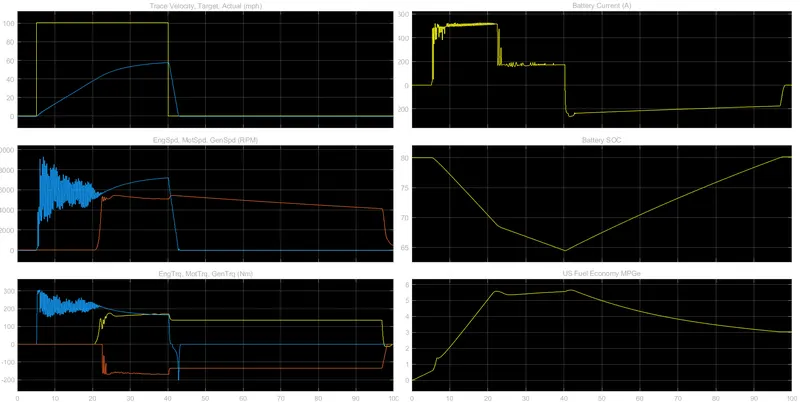
- Here in the above figure in the 1st graph, we can see the top speed is achieved at 14 seconds which is very quick as compared to the HVE model graph the time taken to come to zero velocity from top speed is nearly 5 seconds so totally it takes 19 seconds to achieve top speed and come back to rest which is quick in HVE model.
- In the 2nd graph, we can observe that the graph is much smoother than the HVE model. Thus in the electric vehicle, the motor speed is much smoother than the HVE.
- In the 3rd graph, here also the torque of the motor is much smoother than the HVE model and we can observe that while the vehicle is decelerating, it is in regenerative braking mode that why torque is negative while deceleration.
- In the 4th graph, the SOC of battery decrease slowly link the HEV model but here it decreases much more than the HEV model. Since in electric vehicles only battery is used so the battery is consumed more thus while achieving top speed the SOC line in the graph falls down more than the HEV model graph.
- In the 5th Graph, we can observe that the current consumed by the EV is less than that of HEV as the mass of the Ev is less as compared to HEV so less current to used compared to HEV.
- In the 6th Graph, we can see that the fuel economy of the vehicle is very high than that of HVE. Thus concluding that EV is now Fuel-efficient than HEV.
CONCLUSION
- The pure EV drive achieve less top speed compared to HEV
- The motor used in Ev must be of more capacity than HEV.
- EV Drive all power from motor alone hence EV developed more Torque Whereas in HEV motor and engine combined produces more Torque and propels the system.
- Instantaneous torque at the start is more is EV compare to HEV.