Week 4 Challenge
Q1
The Nernst equation for fuel cell is
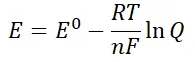
The impact of variables, such as temperature and pressure, on fuel cell performance needs to be assessed to predict how the cells interact with the power plant system supporting it.
First we will have a look at the impact of temperature on cell voltage
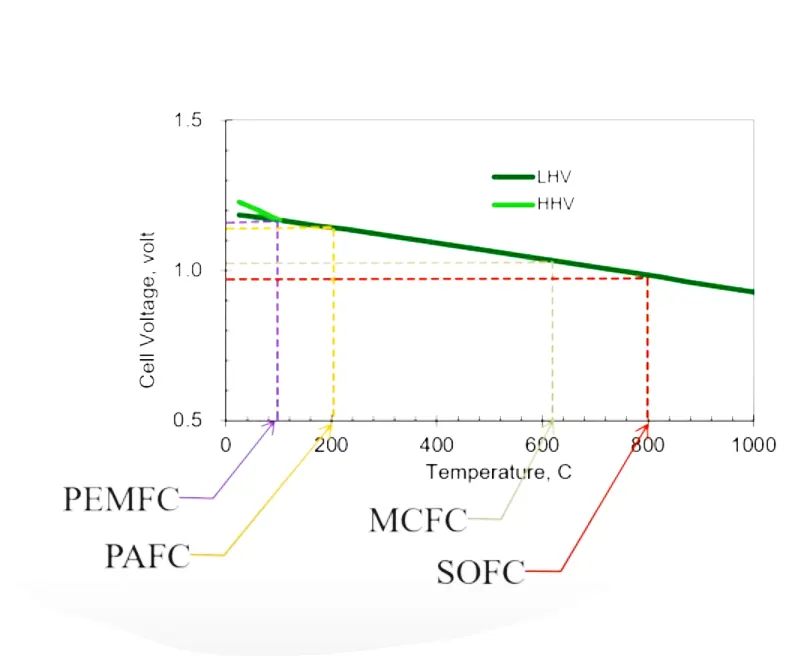
From the above graph if we see the cell voltage will reduce as temperature increases. At approximately 80°C the cell voltage is maximum around 1.5V.
Mathematically in the above equation if we increase the T value it will automatically reduce the standard cell potencial (E^0) thats mean cell votage (E) will reduce.
To get the maximum cell voltage it is impartant to operate the fuel cell at optimum temperature.
Next we will have a look at the impact of pressure on cell voltage
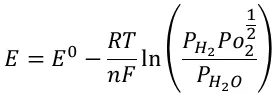
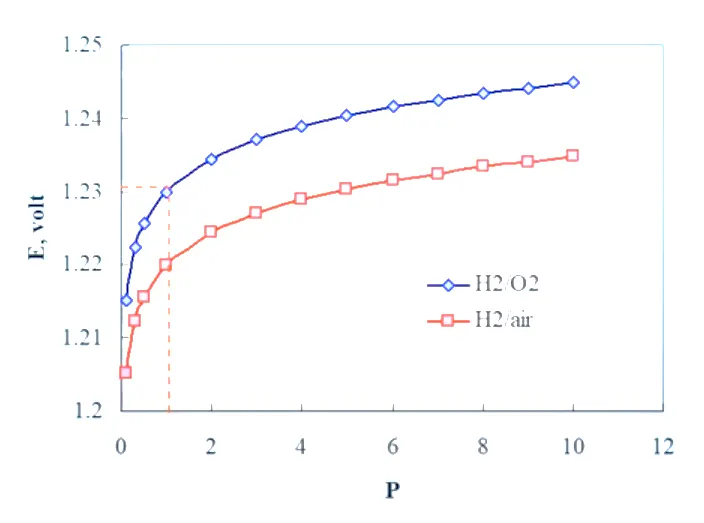
From the above graph if we see the cell voltage increases more faster as we start increasing the pressure and then later the voltage will increase gradually. To get more cell voltage it is impotant that fuel cell works at high pressure but in pratical it can be operated at certain pressure from which we get sufficient voltage. To get more pressure we are using air compressor in the intake system.
Q2.
The relationshp between Cell voltage, Current density & Power density is shown in the image below.
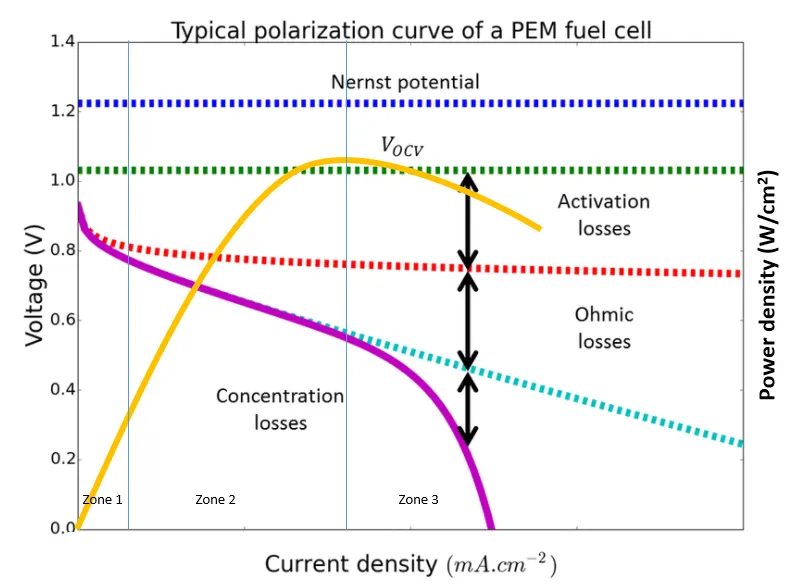
As shown in the image above at the lower value of current density i.e. zone 1 we have two types of losses gas crossover loss and activstion loss. In this region at very lower current density values voltage will drop till it get saturated due to the gases crossover from cathode and anode without making any workdone and in activation loss at low current density the reaction takes place slowly and this causes increase in resistance in charge transfer.
The power density of 3W/cm2 will lie in this zone 1. If we see the orange curve the power generated at lower current density is less.
Coming to the zone 2 where ohmic losses take place as in every electrical system due to resistance. The fuel cell stack consists of metalic elements like bipolar plate and current collectors and also the membrane will offer the resistance to the protons to flow through it.
The power density of 15W/cm2 will lie in this zone 2.
Zone 3 is all about the concentration loss. Where the current is drawin too much due to which the cell voltage drops. When the current demand is more only oxygen available for the reaction is the one which is in the catalyst so the demand to supply will not be fullfilled due to the gas diffusion layer provide the resistance to the flow of oxygen.
The power density of 27W/cm2 will lie in this zone 3.
Q3.
The best operating point is amoung the three point is 15W/cm2 which will fall in zone 2.
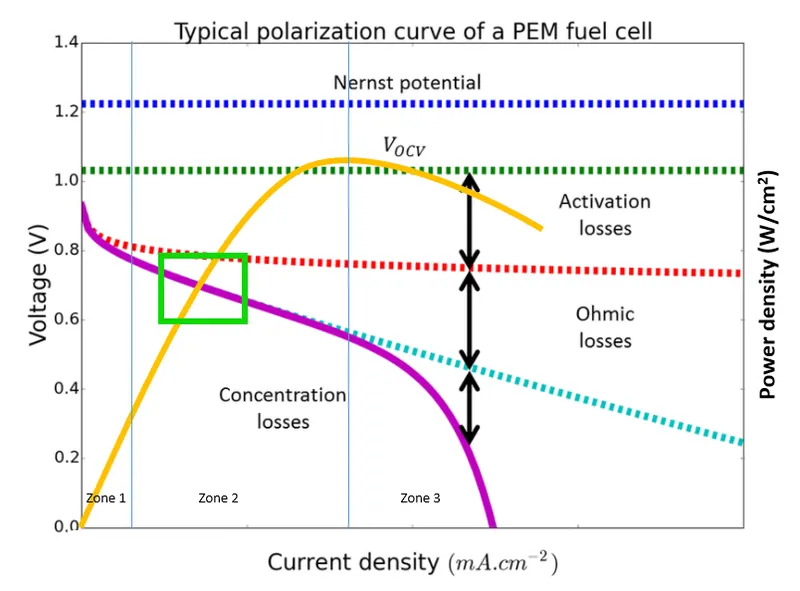
The best practise to operate the fuel cell is at higher voltage so that we get more power output. But at the same time we cannot ask for more power output this wil leads to the oxygen starvation leading to the formation of harmful gas that is CO2 which will be emitted from the catalyst. And at the same time the efficiency of the fuel cell will also reduce.
In order to get more power with more efficiency the green box shown in the above image is the sweet spot.