Week 2 Challenge
1.
|
Sl No |
Fuel Cell Types |
Application |
|
1 |
Proton exchange membrane fuel cell (PEMFC) |
The major application of PEM fuel cells are stationary power, portable power, and transportation. PEM fuel cells are lighter weight, uses solid electrolyte to reduce corrosion & also works at low temperature so it suitable to use in transportation application. Since the emission norms are getting more stringent, PEMFC can be more suitable to achieve the CARB & GHG norms. |
|
2 |
Solid Oxide fuel cell (SOFC) |
The application of SOFC are stationary power & portable power. The efficiency of SOFC is more compared to the PEMFC. Mainly SOFCs are well suited to stationary power generation for homes and businesses. Because the by-product of this is heat and this heat can be used as the heater during cold condition. SOFC can accept multiple fuels. |
|
3 |
Alkaline fuel cell (AFC) |
AFC is the first fuel cell technology developed. AFC technology is used in space application. AFC component cost is less due its wide range of stable materials. AFC works at lower temperature as well. The high performance of AFCs is due to the rate at which electro-chemical reactions take place in the cell. They have also demonstrated efficiencies above 60% in space applications. |
|
4 |
Direct methanol fuel cell (DMFC) |
DMFCs are used to provide power for portable fuel cell applications such as cell phones or laptop computers. DMFC has no storage problem because methanol has a higher energy density than hydrogen. And the operating cost is also less. DMFC works at lower temperature & pressure as well. |
|
5 |
Phosphoric acid fuel cell (PAFC) |
The application of PAFC are stationary power and transportation. PAFC need higher loading of catalyst that is platinum in this case which is costlier. Due to which the operating cost increases. The efficiency of PAFC is less. |
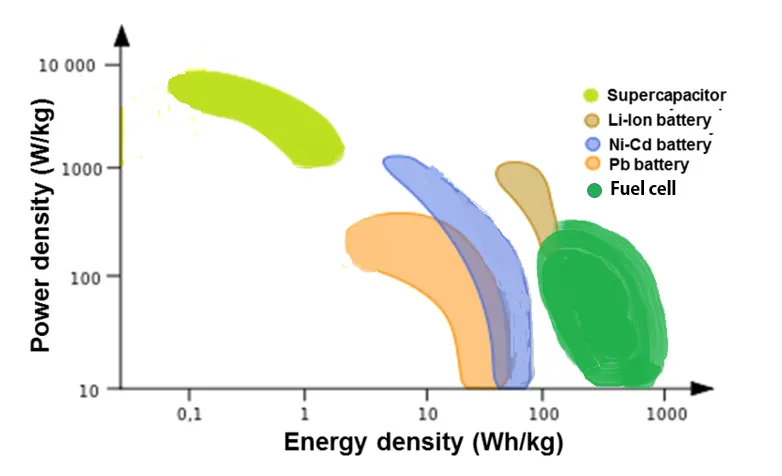
2. The graph shown below tells us that super capacitor(ultra capacitors) offer very high power density but low energy density. Super capacitor is good for short burst of very high current.
But lithium ion batteries have more energy density and less power density and are good at providing lower currents for extended periods of time.
That means device with a higher energy density can supply an electronic load for longer than one with a low energy density but devices with higher power density can quickly deliver energy.