Week - 4 - 2D meshing for Plastic components
AIM
For the given Plastic Bottle Cap model, check for the geometrical errors and take the mid surface by suitable mid surfacing techniques. PID and Thickness assignment has to be done for all the mid surfaces. Mesh the same with the given element Quality criteria. (Refer to the table below for the Quality criteria)
|
S.No |
Quality Criteria |
Value |
|
1 |
Target/Average length |
1 |
|
2 |
Minimum Length |
0.5 |
|
3 |
Maximum Length |
3 |
|
4 |
Aspect |
3 |
|
5 |
Warpage |
15 |
|
6 |
Skewness |
45 |
|
7 |
Jacobian |
0.7 |
|
8 |
Minimum Quad Angle |
45 |
|
9 |
Maximum Quad Angle |
135 |
|
10 |
Minimum Tria Angle |
30 |
|
11 |
Maximum Tria Angle |
120 |
|
10 |
Tria Percentage |
15 |
OBJECTIVE
Meshing of mid surface of given plastic component with given elemental qualuty criteria
BODY OF CONTENT
- create mid surface of the given component using
faces-->offset
for curved surface use middle option and project it to base and create a new face for mid surfacing
CURVES-->MIDDLE,-->NEW
CURVES-->MIDDLE,-->PROJECT -->NEW
FACES-->MIDDLE
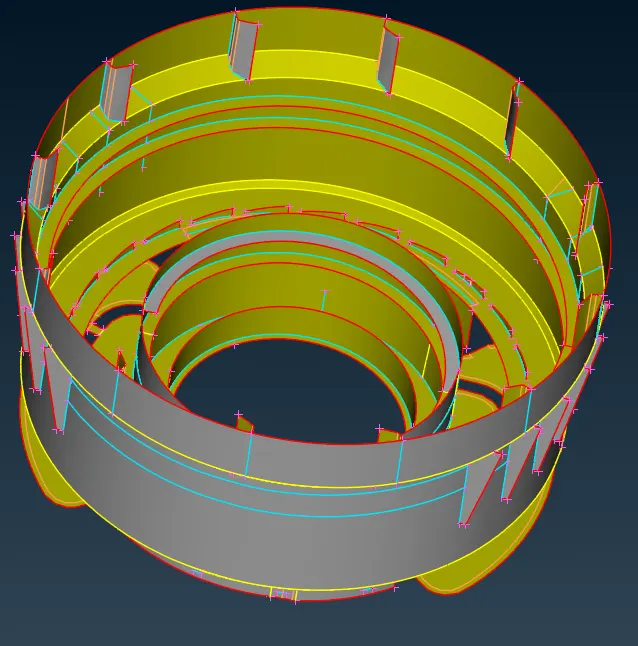
- for teeth area
- create mid surface of one teeth using face-->middle
- cons-->project
- faces-->new
- create cog 1 and cog2 with different heights points-->on cog
- transform the created midsurface of the teeth transform-->copy-->rotate
- enter value for cog1= X, cog2=dx selecting cog, enter number of teeth needed and enter divided angle created by single teeth
angle =360/number of teeth
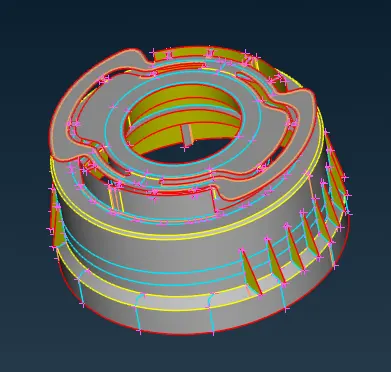
- for thread
- take curves-->middle(join curves if needed)
- cons-->project
- faces-->new
- FACES-->EXTENT(JOIN TO BASE )
- FACES-->INTERSECT(DELETE EXCESS PART FROM INTERSECTING SURFACE)
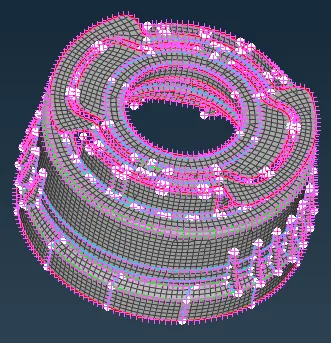
- mesh the prepared mid surface
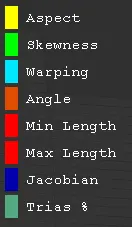
- input given quality criteria
- classic mesh-->mesh generation-->best(for meshing parts)
- shell mesh-->reconstruct,smooth (for organising the mesh)
- make sure there is no off elements other than the ones failing for minimum length due to cad geometry
- reduce formation of trias
- in perimeter,
- opposite trias
- after making a proper mesh pattern make note of thickness of different parts and set PID based on their thickness
- take average of thickness on parts having varying thickess throughout and set their PID
- save the file
-
Conclusion
Mid surface of all components has been made and meshing has been done and saved as different pids
Trias has been kept to minimum to avoid failure due to stress concentration