Week 4.2 - Combustion Efficiency Calculation after Preheating
import cantera as ct
import numpy as np
import matplotlib.pyplot as plt
gas_1 =ct.Solution("gri30.yaml")

A =ct.Quantity(gas_1)
T =np.linspace(298.15,600,40)
Tad =[]
B =ct.Quantity(gas_1)
B.TPX = 298.15,101325,"CH4:1"

for i in T:
    A.TPX = i,101325,"O2:1,N2:7.52"
    A.moles =2
    M=A+B
    M.equilibrate('HP')
    M.T
    Tad.append(M.T)

print(Tad)
plt.plot(T,Tad)

plt.xlabel("Preheat Temperature"),
plt.ylabel("Adiabatic Flame Temperature")
plt.show()
result
[1060.9244106396777, 1067.2536598945458, 1073.5803224151214, 1079.9044503767561, 1086.226105200012, 1092.5453580513474, 1098.8622885266786, 1105.176984777445, 1111.4895430420531, 1117.8000672829567, 1124.1086688191067, 1130.4154659727362, 1136.720583704554, 1143.0241532606983, 1149.3263118125772, 1155.6272021128698, 1161.9269721961866, 1168.2257746530495, 1174.5237670999884, 1180.8211109766225, 1187.1179716367424, 1193.4145179138789, 1199.7109217772993, 1206.0073579893078, 1212.3040037639907, 1218.6010384272622, 1224.898643078298, 1231.19700025238, 1237.4962935858698, 1243.7967075239335, 1250.0984271016916, 1256.4016363824967, 1262.7065210369042, 1269.0132648776319, 1275.3220511692123, 1281.6330619655953, 1287.9464777858482, 1294.2624772913725, 1300.5812369645503, 1306.9029307890078]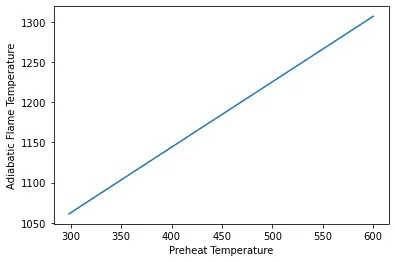
- In the above program we vary the preheat temperature from 298.15 to 600 K , using the linspace options with 40 divisions between them, for the same temperature of preheat we calculate the Adiabatic flame temperature using the equilibrate method, for the air + fuel mixture given by the object "M" for the constant pressure using the "HP".
- The result shows that as we increase the preheat temperature the adiabatic flame temperature also increases , its evident that as the increase in preheat increases the enthalpy of products due to the increase in dissociation.
- As we change the Preheat temperature from 298.15 to 600 , the AFT changes from 1060 to1306 K
2.
By preheating the fuel we are making the fuel closer to the self-ignition temperature hence the combustion requires very less triggering or ignition to combust properly, Hence the mass of fuel consumed for the same output is lesser than low preheated fuel and air mixture
for the same code we add the combustion efficiency which is given by the ratio of (energy released during combustion ) to the Lower heating value of the fuel.
`eta_(combustion) =(Q/(LHV*m_f))`
Now we use cantera for the comparison of combustion efficiency to preflame temperature and we will get the reduction in mass flow rate of fuel for comparision of
`(m_f^600 - m_f^298.15 )/m_f^298.15`
The equation of combustion can be rearranged by substituting the rate of heat transfer in terms of enthalpy change between products and reactants,
`-([(A/F)-1]*h_(PROD)-[(A/F)]*h_(A)-[(A/F)]*h_(F))/(LHV)`
where the LHV is lower heating value of the fuel.
import cantera as ct
import numpy as np
import matplotlib.pyplot as plt
gas_1 =ct.Solution("gri30.yaml")

A =ct.Quantity(gas_1)

T =np.linspace(298.15,600,40)
Tad =[]
B =ct.Quantity(gas_1)
B.TPX = 298.15,101325,"CH4:1"
B.moles =1
print(B.mass)
#stoichometric air to fuel ratio
A_F = 17.232;
#lower heating value of the fuel in KJ
LHV = 50000000;
#declaration of efficiency list
eff=[]
for i in T:
    A.TPX = i,101325,"O2:1,N2:7.52"
    A.moles =2
    M=A+B
    M.equilibrate('HP')
    #creating a product object
    P = ct.Quantity(gas_1)
    P.TPX = 1700,101325,"CO2:1,H2O:2,N2:7.52"
    M.T
    Tad.append(M.T)
    J =-((A_F+1)*P.enthalpy - (A_F)*A.enthalpy + B.enthalpy)/(B.mass*LHV)
    eff.append(J)
print(Tad)
plt.plot(T,eff)

plt.xlabel("Preheat Temperature"),
plt.ylabel("combustion efficiency")
plt.show()
The result of the above code
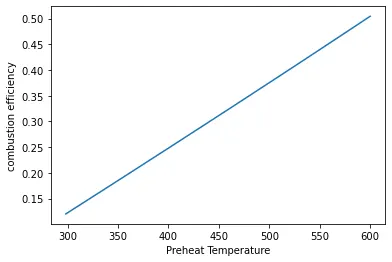
It shows that for the same exhaust temperature by increasing the preheat temperature the efficiency increases, The temperature at the exhaust is been fixed at 1700 K due to this the mass flow rate of the fuel can be reduced for the same amount of heat generation.