Week 4.2 - Combustion Efficiency Calculation after Preheating
1. Effect of preheating temperature on AFT:
Code:
import matplotlib.pyplot as plt
import cantera as ct
import numpy as np

gas = ct.Solution('gri30.cti')

# Fuel(CH4)
C = ct.Quantity(gas)
C.TPX = 298.15,ct.one_atm,{'CH4':1}
C.moles = 1

# Initializing given pre heating air temperature range
T_pre = np.linspace(298,600,50)

# Air
for T in T_pre:
	B = ct.Quantity(gas)
	B.TPX = T,ct.one_atm,{'O2':0.21,'N2':0.79}
	B.moles = 9.52
	M = B+C
	M.equilibrate('HP')
	print(M.T)
	plt.plot(T,M.T,'o',color='red')

plt.xlabel('Preheating Temperature')
plt.ylabel('AFT')
plt.title('Effect of Preheating on AFT')
plt.show()
Code logic:
- A Line ‘gas = ct.Solution('gri30.cti')’ is the Class Solution: A class for chemically-reacting solutions. Instances can be created to represent any type of solution. The most common way to instantiate ‘Solution’ objects is by using a phase definition, species and reactions defined in an input file. That’s how the program has started and stored in the variable name called ‘gas’.
- Then, create ‘Class Quantity’ of variable gas for fuel which is stored in the variable ‘C’.
- Next, create the instant ‘TPX’ for C which is data descriptors inherited from cantera thermo phase. This inbuilt format TPX represents ‘Get/Set temperature [K], pressure [Pa], and mole fractions’.
- Create the instant ‘moles’ for C which is mole of the fuel and can be calculate it simply from the chemical reaction. Here, mole of the fuel (CH4) is 1.
- Repeat the process for air too but within the ‘for loop’ due to the variation of pre heating temperature. Here, air is stored in the variable ‘B’.
- Add the mixture of air and fuel and create the instant ‘equilibrium’ of ‘HP’ for it to get the adiabatic flame temperature (AFT).
- Finally, plot the graph for preheating temperature and AFT.
Result:
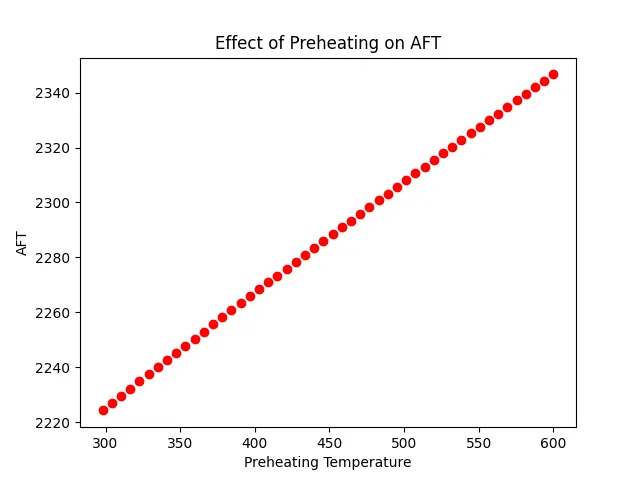
From the result obtained, we can say that AFT increases when preheating temperature increases because it helps to increase the temperature of the system which leads to use less fuel without any cause for the efficiency.
2. Effect of preheating temperature on combustion efficiency:
Formula for combustion efficiency:
Qout = Qu + Qloss
If Qloss is 0, then
Qout = Qu = Qrec – Qpro
ɳ = Qout/(mass of the fuel*LHV)
Code:
import matplotlib.pyplot as plt
import cantera as ct
import numpy as np

gas = ct.Solution('gri30.cti')

# Fuel(CH4)
C = ct.Quantity(gas)
C.TPX = 298.15,ct.one_atm,{'CH4':1}
C.moles = 1
mass_C = C.mass
h_C = C.h

# Initializing given pre heating air temperature range and LHV for CH4
T_pre = np.linspace(298,600,50)
T_fur_e = 1700
LHV = 50e6

# Product combustion
E = ct.Quantity(gas)
E.TPX = T_fur_e,ct.one_atm,{'CO2':0.095,'H2O':0.1901,'N2':0.7148}
E.moles = 10.52
mass_E = E.mass
h_E = E.h

# Air
for T in T_pre:
	B = ct.Quantity(gas)
	B.TPX = T,ct.one_atm,{'O2':0.21,'N2':0.79}
	B.moles = 9.52
	mass_B = B.mass
	h_B = B.h

	Q = (mass_B*h_B) + (mass_C*h_C) - (mass_E*h_E)
	Q_sp = Q/mass_C
	eff = (Q_sp/LHV)

	plt.plot(T,eff,'o',color='red')

plt.xlabel('Preheating Temperature')
plt.ylabel('Combustion efficiency')
plt.title('Effect of Preheating on combustion efficiency')
plt.show()
Coding logic is similar to the effect of preheating temperature on AFT but Instead of class equilibrate create instant mass and enthalpy for both reactant and product as well as for fuel and air to obtain combustion efficiency. Also assume the furnace exit temperature as 1700K for the combustion products of CO2, H2O & N2. Finally, plot the graph for preheating temperature and combustion efficiency.
Result:
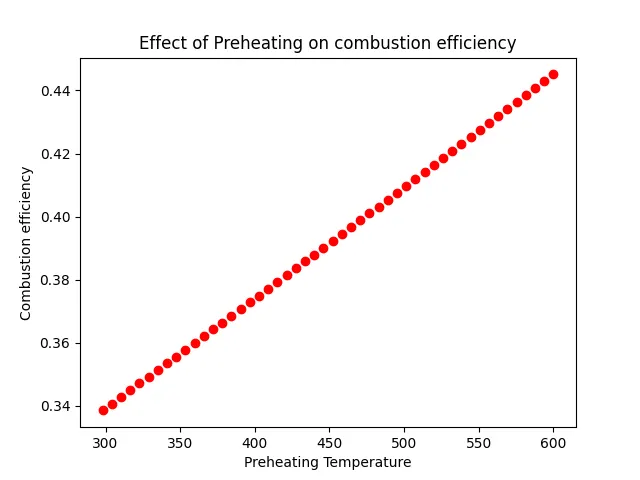
From the result obtained, we can say that the efficiency increases when preheating temperature increases.
Yes, maintaining the furnace exit temperature as fixed is necessary because high temperature at the exit of the furnace may lead to spoil the recuperator whereas low temperature at the exit leads to affect the efficiency.