Week 4.2 - Combustion Efficiency Calculation after Preheating
Theory:-
Recuperator is a type of heat exchanger that has separate flow paths for each fluid along its passages and heat is transferred through the separating walls. Recuperators are usually used in power engineering, to increase the overall efficiency of thermodynamic cycles. For example, in a gas turbine engine. The recuperator transmits some of the waste heat in the exhaust to the compressed air, thus preheating it before entering the combustion chamber. Many recuperators are developed as counter-flow heat exchangers.
1. Effect of preheating on the adiabatic flame temperature:-
"""
Effect of preheating on Adiabetic Flame Temperature

"""
import cantera as ct
import matplotlib.pyplot as plt

gas = ct.Solution('gri30.cti')

for Temp in range (298,600,5):
	air = ct.Quantity(gas)
	air.TPX = Temp,ct.one_atm,{'O2':0.21, 'N2':0.79}
	air.moles = 2/0.21


	fuel = ct.Quantity(gas)
	fuel.TPX = 298.15,ct.one_atm,'CH4:1546'
	fuel.moles = 1
	products = ct.Quantity(gas)
	products.TPX = 1700,ct.one_atm,{'CO2':0.095, 'H2O':0.1901, 'N2':0.7148}
	products.moles = 10.52

	Combustion = air + fuel
	Combustion.equilibrate('HP')
	print
	plt.plot(Temp,Combustion.T,'*', color='blue')
plt.xlabel('Preheat Temperature in K')
plt.ylabel('Adiabetic Flame Temperature')
plt.title('Effect of preheating on Adiabetic Flame Temperature')
plt.show()
Plot:-
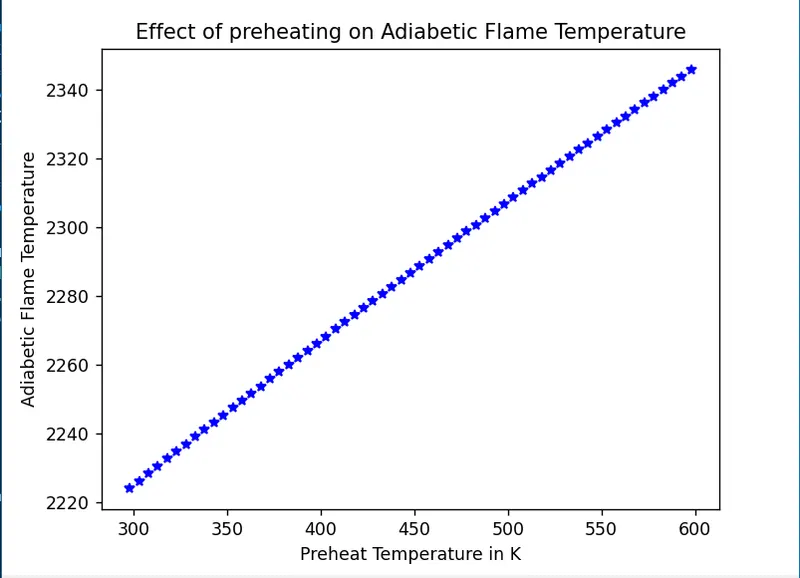
Figure:- Effect of preheating on Adiabetic Flame Temperature
From the above plot, it can be observed that as inlet air temperature increases it proportionally increases the adiabatic flame temperature, as inlet temperature increases its enthalpy of air also increases, increasing adiabatic flame temperature.
2. Combustion Efficiency:-
Combustion Efficiency = `etacombustion = (Qreactants - Qexhaust)/( mf * LHV)`
Code:-
"""
Program for calculating efficiency

"""
import cantera as ct
import matplotlib.pyplot as plt

gas = ct.Solution('gri30.cti')

fuel = ct.Quantity(gas)
fuel.TPX = 298.15,ct.one_atm,'CH4:1546'
fuel.moles = 1
mass_fuel = fuel.mass
H_fuel = fuel.h

products = ct.Quantity(gas)
products.TPX = 1700,ct.one_atm,{'CO2':0.095, 'H2O':0.1901, 'N2':0.7148}
products.moles = 10.52
mass_products = products.mass
H_products = products.h

air = ct.Quantity(gas)
air.TPX = 298.15,ct.one_atm,{'O2':0.21, 'N2':0.79}
air.moles = 9.52
mass_air = air.mass
H_air = air.h

Q = (mass_air*H_air) + (mass_fuel*H_fuel) - (mass_products*H_products)
LHV = 50e6

# calculating efficiency without preheating
efficiency_STP = (Q/((mass_fuel)*(LHV)))*100


for Temp in range (298,600,5):
	air = ct.Quantity(gas)
	air.TPX = Temp,ct.one_atm,{'O2':0.21, 'N2':0.79}
	air.moles = 9.52
	mass_air = air.mass
	H_air = air.h

	Q = (mass_air*H_air) + (mass_fuel*H_fuel) - (mass_products*H_products)
	LHV = 50e6

	# calculating efficiency after preheating
	efficiency = (Q/((mass_fuel)*(LHV)))*100

	fuel_saving = ((efficiency/efficiency_STP)-1)*100

	#plotting
	plt.figure(1)
	plt.plot(Temp,efficiency,'o',color= 'red')
	plt.xlabel('Preheat Temperature in K')
	plt.ylabel('Combustion Efficiency')


	plt.figure(2)
	plt.plot(Temp,fuel_saving,'*',color= 'blue')
	plt.xlabel('Preheat Temperature in K')
	plt.ylabel('Percentage of fuel saving')
plt.show()
Plot-1:-
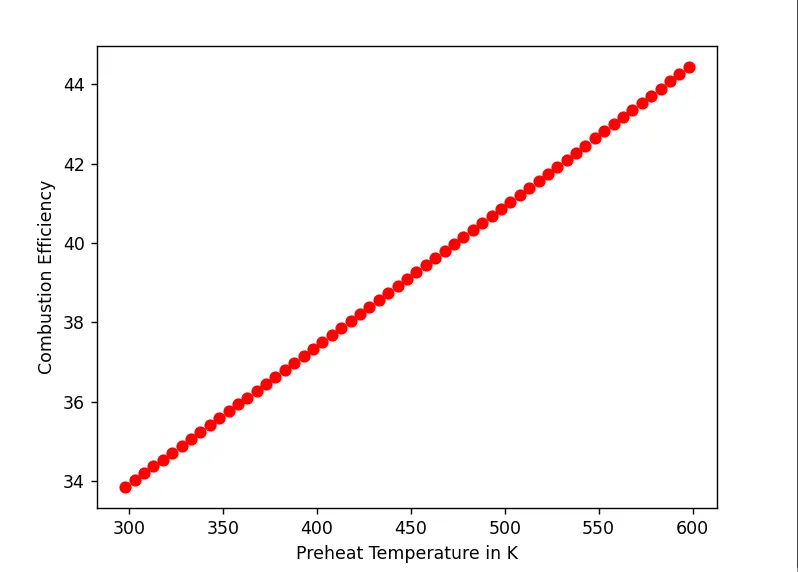
Figure(1):- Combustion Efficiency
Plot-2:-
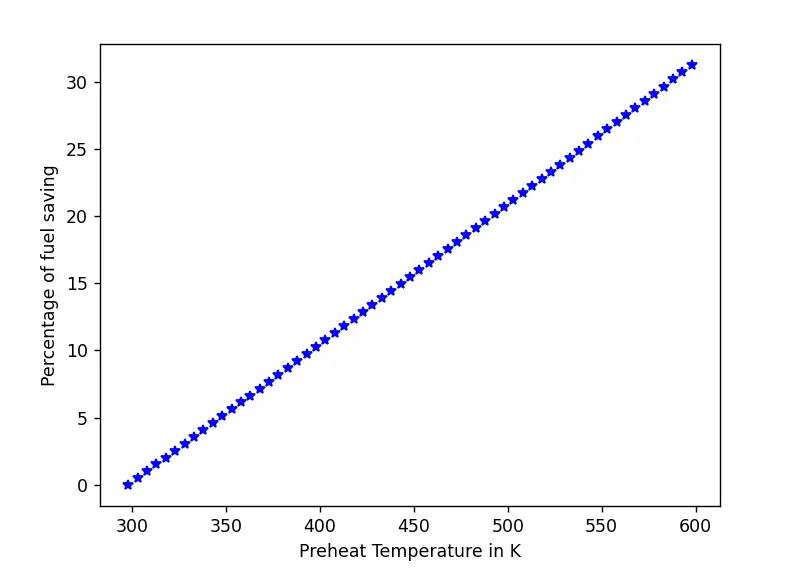
Figure(2): Percentage of fuel saving
From the above plots, we can observe that as the temperature of inlet air increases, combustion efficiency and fuel-saving percentage also increase.
It is good to maintain the standard output temperature, this will limit the maximum requirement of energy for a particular model. If output temperature is maintained it also increases the life span of the recuperator.