Week 4.2 - Combustion Efficiency Calculation after Preheating
Assignment no.03 (Cantera)
Assignment Name-Combustion efficiency after preheating
Aim-to study the effect of preheating temperature on adiabatic flame temperature and combustion efficiency and also saving fuel
Introduction-
Recuperator-
A recuperator is a special purpose counter-flow energy recovery heat exchanger positioned within the supply and exhaust air streams of an air handling system, or in the exhaust gases of an industrial process, in order to recover the waste heat. Generally, they are used to extract heat from the exhaust and use it to preheat air entering the combustion system. In this way they use waste energy to heat the air, offsetting some of the fuel, and thereby improve the energy efficiency of the system as a whole.
In many types of processes, combustion is used to generate heat, and the recuperator serves to recuperate, or reclaim this heat, in order to reuse or recycle it. The term recuperator refers as well to liquid-liquid counter flow heat exchangers used for heat recovery in the chemical and refinery industries and in closed processes such as ammonia-water or LiBr-water absorption refrigeration cycle.
Recuperators are often used in association with the burner portion of a heat engine, to increase the overall efficiency. For example, in a gas turbine engine, air is compressed, mixed with fuel, which is then burned and used to drive a turbine. The recuperator transfers some of the waste heat in the exhaust to the compressed air, thus preheating it before entering the fuel burner stage. Since the gases have been pre-heated, less fuel is needed to heat the gases up to the turbine inlet temperature. By recovering some of the energy usually lost as waste heat, the recuperator can make a heat engine or gas turbine significantly more efficient.
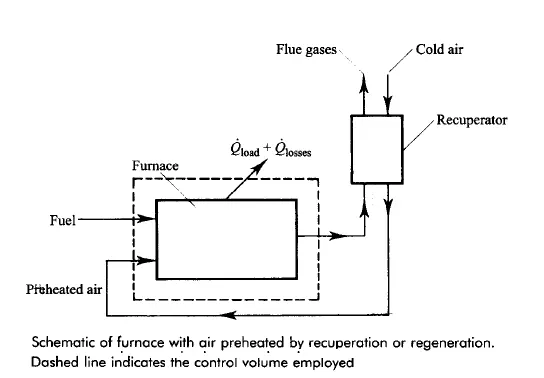
Objective-
1.prehaeting temperature is changes from 298k to 600k and check effect on adiabatic temperature
2.combustion efficiency is function of pre-heating temperature & exit furnace temperature (1700K) and check the effect on combustion efficiency and saving fuel
CODE 1-
The combustion reaction of methane at constant pressure system are as follows:
CH4 + 2(O2+3.76N2) = CO2 + 2H2O + 7.52 N2
Coding approach
- Import matplotlib.pyplot ,numpy,and cantera libraries
- import solution class and also create quantity class for handling mixture
- assign condition for air and fuel
- calculate adiabatic flame temperature and plot graph of adiabatic flame temperature against preheating temperature
"""
furnace is used to burn methane and Air
recupertor is used for this problem
date-05-1-2022
cantera
"""

###preheating effect on adiabatic temperture 298-600k

import matplotlib.pyplot as plt
import cantera as ct
import numpy as np
#initial condition of fuel
T_fuel=298
P_fuel=101325

gas = ct.Solution('gri30.cti')

#we have used quantity class for handling mixture

fuel = ct.Quantity(gas)
fuel.TPX =T_fuel,P_fuel,{"CH4":1}
fuel.moles=1

# pre heating condition of air
T_air_initial=298
T_air_final=601
P_air=101325
T_air= np.arange(298,601)
T_adaibatic_temp=[]
for T in T_air:
	air= ct.Quantity(gas)
	air.TPX = T,P_air,{"O2":0.21,"N2":0.79}
	air.moles=9.52
	mix = fuel + air
	mix.equilibrate('HP','auto')
	T_adaibatic_temp.append(mix.T)

plt.plot(T_air,T_adaibatic_temp,color='blue',label='effect of prehaeating temperture')
print(T_air)
print(T_adaibatic_temp)
plt.grid ()
plt.xlabel('preheating temperture')
plt.ylabel('adiabatic flame tempertaure')
plt.title('effect of prehaeting temperture')
plt.legend()
plt.show()
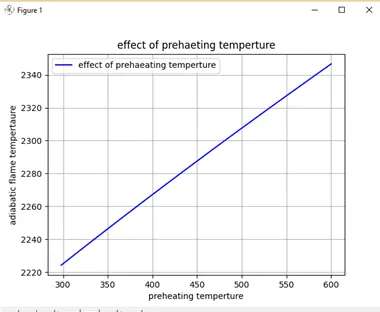
it is clearly saw that AFT increase linearly with respect to preheating temperature of the air.
preheating and fuel saving
it can be seen that adiabatic flame (AFT) for the same amount of air and fuel mixture into the system when preheated air is fed into the chamber. Considering a constant work output by the system, the amount of fuel required to the produce the corresponding thermal output decreases with an increasing preheating temperature at inlet. Thus, it can have said that a recupertor can be used to save fuel or reduce fuel consumption by the combustion system
- effect of preheating on combustion efficiency and saving fuel
1.formula for combustion efficiency
For combustion reaction, the maximum heat output at STP condition can be defined as
Q_STP=m_fuel*LHV
m_fuel=mass flow rate of fuel,LHV=lower heating value of fuel
For the given system equipped with a recuperator, the net heat output can be written as
Q=H_reactant-H_productHence combustion efficiency can be written as
ŋ=Q/Q_stp
ŋ=〖(H〗_reactant-H_product)/(m_fuel*LHV)
coding approach-
- Import matplotlib.pyplot ,numpy,and cantera libraries
- import solution class and also create quantity class for handling mixture
- assign condition for air and fuel and product and there is give exhaust temperature is 1700 k
- use the formula of combustion efficiency in code and calculate the combustion efficiency at different preheating temperature by using necessary loop
- plot graph of combustion efficiency and fuel saving against preheating temperature
""
prehaeting effect combustion efficiency

date=06/01/2022
"""
"""
assume furnace exit temperture is 1700 k

and combustion product are CO2,H2O,N2)
LHV of combustion of methane =50 MJ/KG
"""
import cantera as ct
import matplotlib.pyplot as plt
import numpy as np
gas = ct.Solution('gri30.cti')
# fuel
fuel = ct.Quantity(gas)

fuel.TPX = 298,101325,{"CH4":1}

fuel.moles=1

fuel_mass=fuel.mass

h_fuel=fuel.h

#product

product=ct.Quantity(gas)

product.TPX=1700,101325,{"CO2":0.095,"N2":0.7148,"H2O":0.1901}

product.moles=10.52

product_mass=product.mass

h_product=product.h

LHV= 50e6 #j/kg given value in assignment is MJ/kg so coverted in j/kg


#air in range of 298 to 600


# pre heating condition of air
T_air= np.arange(298,601)
n=[]
saving=[]

for T in T_air:
	air= ct.Quantity(gas)
	air.TPX = T,101325,{"O2":0.21,"N2":0.79}
	air.moles=9.52
	air_mass=air.mass
	h_air=air.h
	Q = (fuel_mass*h_fuel) +(air_mass*h_air) -(product_mass*h_product)
	n.append((Q/(fuel_mass*LHV)) *100)
	if T == 298:
		Q_298 = Q
	saving.append((1-Q_298/Q) *100)

plt.figure(1)
plt.plot(T_air,n,color = 'red', label='efficiency')
plt.grid()
plt.xlabel('preheating temperture')
plt.ylabel('efficiency')
plt.show()


plt.figure(2)
plt.plot(T_air,saving,color='blue',label='saving')
plt.grid()
plt.xlabel('preheating temperture')
plt.ylabel('saving')
plt.show()

plt.figure(3)
plt.plot(T_air,n,color = 'red', label='effect')
plt.plot(T_air,saving,color='blue',label='saving')
plt.grid()
plt.xlabel('preheating temperture')
plt.legend()
plt.show()
print(saving)
print(n)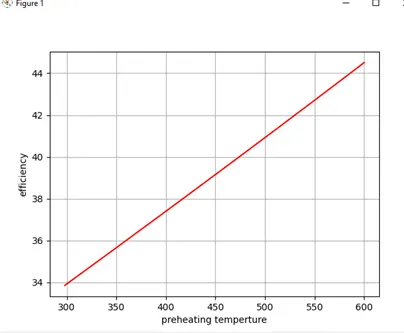
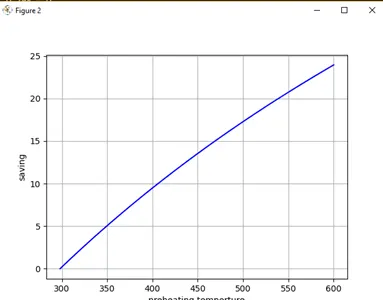
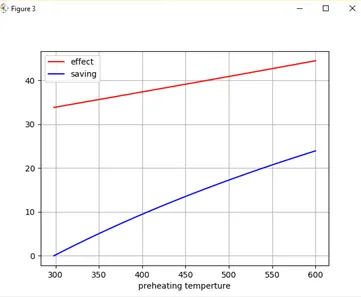
AS per above graph, the fuel is saved when preheating using exhaust gas is done. About 23.9% fuel can be saved by preheating inlet air up to 600k
The efficiency increases from 33.8% to 44.5%
Conclusion
The effect of preheating on combustion efficiency and adiabatic flame temperature were studied