Week 4.2 - Combustion Efficiency Calculation after Preheating
STUDY ON COMBUSTION EFFICIENCY OF FURNACE
AFTER PREHEATING INLET AIR
AIM:
A furnace is used to burn Methane and Air Mixture. A recuperator is connected to this furnace to recover some energy.
⦁ To study the effect of Preheating of inlet air in combustion process against Adiabatic Flame Temperature(AFT).
⦁ To analyze the effect of Preheating of inlet air on Combustion Efficiency and to determine Fuel Savings.
THEORY:
RECUPERATOR:
A recuperator is a heat exchange system that can recover heat energy through a high temperature metallic heat exchanger which gets heated up on the inside by the Flue exhaust and this heat is imparted to the Inlet air which flows outside known as Preheating.
COMBUSTION EFFICIENCY(`eta`):
Since this system Preheats the Inlet air, in this study experiment, we can find out the effect of it on Combustion Efficiency, `eta`. Combustion efficiency is defined as the measurement of how well an equipment (in this case; Furnace) is burning a specific fuel. For our experiment, we take the combustion of Methane fuel, for which the generalized combustion equation for a Stoichiometric mixture is;
`CH_4 + 2(O_2 + 3.76N_2) = CO_2 + 2H_2O + 7.52N_2`
So, for this, the Combustion efficiency is given by the ratio of heat output rate of the furnace to the rate of fuel input, i.e.,
`eta = Q/(m_f.LHV)`
where, Q is the heat available in the furnace
`m_f` is the mass of fuel
LHV is the Lower Heating Value of the Fuel
PROCEDURE:
⦁ In this study, since we have two aims, we are splitting the procedure into two parts. In this first part, we are going to Preheat the Air from standard atmospheric conditions , i.e., 298 K, upto 600 K using a Recuperator and observing the effect of that on AFT.
⦁ For both parts of the procedure, we use Canter Module in Python to program a solution. In the coding part, we access Solution class of the module with 'gri30cti'. Also, since we vary the inlet temperature of air, we need to provide separate values for the properties of air and fuel, and then combine it to form the Air-Fuel mixture. For this, we need to access the Quantity class separately and define the Temperature, Pressure and Composition of both air and fuel separately. Finally, we use 'For' loop to generate a set of AFT for different values of Preheated air Temperature. Also, it should be noted that for complete combustion, we need 2 moles of Air for 1 mole of Fuel, so we define that as well.
'''
   Analyzing the effect of Pre Heating of Air using Recuperator
   Generalized combustion equation of CH4(Stoichiometric) :
	CH4 + 2(O2 + 3.76N2) = CO2 + 2H2O + 7.52N2
'''
import cantera as ct
import numpy as np
import matplotlib.pyplot as plt

# Initializing Temperature and Pressure for inlet Air & Fuel
T_infuel = 298 #K
T_inair = np.linspace(298,600,100) #K, this shows that at each step, air preheating is increased
P_std = 101325 #Pa

# Using Cantera to access solution module
gas = ct.Solution('gri30.cti')

# Defining the fuel Object with the required parameters
fuel = ct.Quantity(gas)
fuel.TPX = T_infuel,ct.one_atm,{'CH4':1}

# To capture the values of AFT for each value of preheated air;
for T_preheated in T_inair:

	# Defining the air Object with the required parameters
	air = ct.Quantity(gas)
	air.TPX = T_preheated,ct.one_atm,{'O2':1, 'N2':3.76}

	# Since we know that for complete combustion of 1 mole of fuel, we need 2 moles of air:
	air.moles = 2

	mixture = air + fuel

	mixture.equilibrate('HP',solver='auto')
	print(mixture.T)
	plt.plot(T_preheated, mixture.T, '.', color = 'red')

# Capturing all values of AFT and plotting it against Preheated Air Temperature;
plt.xlabel('Air Preheating Temperature, Tp')
plt.ylabel('Adiabatic Flame Temperature, AFT')
plt.title('Effect of Combustion Air preheating on AFT')
plt.grid()
plt.show()
⦁ For the second part of the program, we are going to analyze the effect of Preheating on the Combustion efficiency. Also, we are going to prove that Preheatng helps with fuel efficiency with the results that we obtain from this program. In this program, we are going to assume the Furnace exit temperature as 1700 K for the combustion of Methane fuel which produces 3 products CO2, H2O and N2. The LHV is assumed for Methane combustion as 50 MJ/Kg, which helps us determine the Combustion efficiency given by ;
`eta = Q/(m_f.LHV)`
In this, the rate of heat generation is given by;
`Q/m_f = -{[(A/F + 1)h_(Prod)] - A/F.h_(air) - h_(fuel)}`
Using this formula, we calculate the Combustion efficiency for varios of values of Preheated air and based on which the Fuel Savings can be calculated.
'''
   Establishing the importance of Recuperator for increasing the efficiency of a Furnace
   Generalized combustion equation of CH4(Stoichiometric) :
	CH4 + 2(O2 + 3.76N2) = CO2 + 2H2O + 7.52N2
'''
import cantera as ct
import numpy as np
import matplotlib.pyplot as plt

# Initializing Temperature for inlet Air & Fuel and Outlet products;
T_infuel = 298 #K
T_inair = np.linspace(298,600,100) #K, this shows that at each step, air preheating is increased
T_outlet = 1700 #K, Fixed furnace outlet temperature
LHV = 50*pow(10,6) #Lower heating value
A_F = 17.1 #Air/Fuel ratio is taken by assuming phi as 1
Eta = [] #List of values to store Eta for different values of Preheated Temperature

# Using Cantera to access solution module
gas = ct.Solution('gri30.cti')

# Defining the fuel Object with the required parameters
fuel = ct.Quantity(gas)
fuel.TPX = T_infuel,ct.one_atm,{'CH4':1}

# Defining the products Object with the required parameters
products = ct.Quantity(gas)
products.TPX = T_outlet,ct.one_atm,{'CO2':1, 'H2O':2, 'N2':7.52}

# To capture the values of AFT for each value of preheated air;
for T_preheated in T_inair:

	# Defining the air Object with the required parameters
	air = ct.Quantity(gas)
	air.TPX = T_preheated,ct.one_atm,{'O2':1, 'N2':3.76}

	# Since we know that for complete combustion of 1 mole of fuel, we need 2 moles of air:
	air.moles = 2

	# Calculation for energy Q:
	Q = -(((A_F + 1)*products.h) - A_F*air.h - fuel.h)

	# Calculation for efficiency Eta:
	efficiency = (Q/LHV)*100
	Eta.append(efficiency)

	print(efficiency)
	plt.plot(T_preheated, efficiency, 'o', color = 'blue')

# Determining the Fuel Savings;
fuel_saving = (1 - (Eta[0] / Eta[len(T_inair) - 1]))*100
print('Fuel Savings for Preheated Air is '+str(round(fuel_saving,2))+' %')

# Capturing all values of AFT and plotting it against Preheated Air Temperature;
plt.xlabel('Air Preheating Temperature, Tp')
plt.ylabel('Combustion Efficiency, Eta')
plt.title('Effect of Combustion Air preheating on Combustion Efficiency')
plt.grid()
plt.show()
RESULTS:
⦁ For the 1st part of the program, the results obtained are as follows:
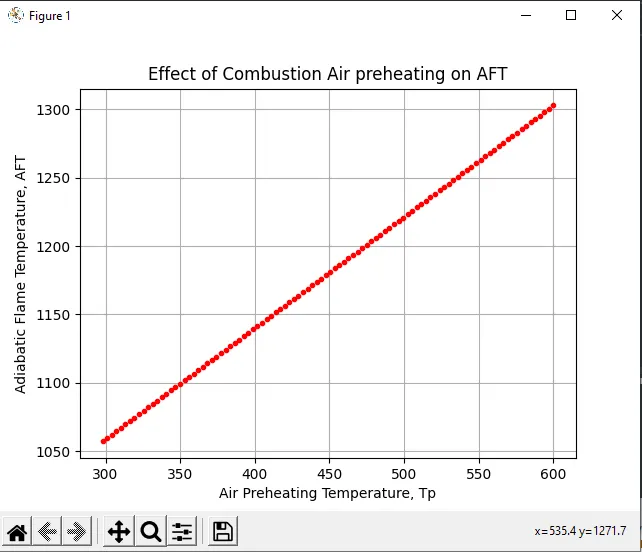
From the above plot, we can see that the AFT increases linearly with increase in the Temperature of Inlet Air. This is due to the fact that, during the combustion process the heat generated is effectively utilized by each and every molecules of the reactants to heat up the products known as AFT, in which case if we preheat the air, we provide the combustion process with an additional boost of heat energy source which inturn will be utilized by the reactants to produce higher AFT products.
⦁ For the 2nd part of the program, the results obtained are as follows:
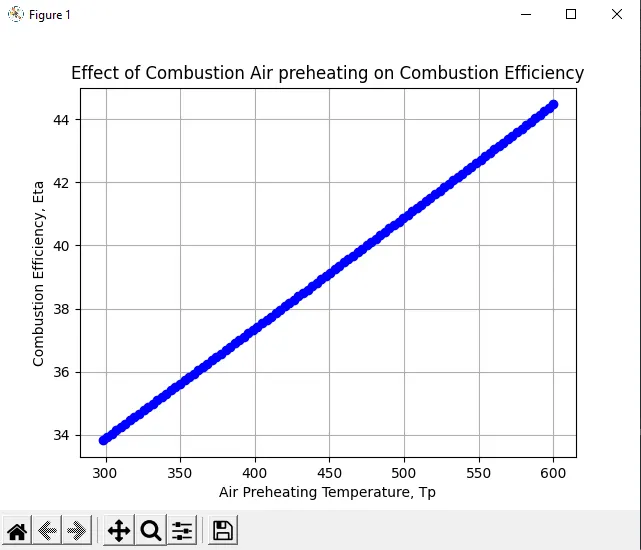
From the above plot,we can see that the Combustion Efficiency increases with increase in the Temperature of Inlet Air. As explained above, since AFT increases as a function of Preheating, so does the efficiency since it is related to the rate of heat energy output from the system which increases the Combustion efficiency of the process. Also, as the Combustion efficiency increases, we can predict that the Fuel will be saved which is in fact correct. As the combustion process is more effective with Preheating than without Preheating, the amount of Fuel required to raise the temperature of a furnace to a particular temperature will be less in case of with Preheating. This indicated that the Fuel gets saved when compared to without Preheating by a small percentage, in our case 23.94%.
However, for our simplicity, we assumed the Exit temperature of the furnace as a fixed value of 1700 K which is "wrong" as we know that the Exit Temperature depends on several other factors in real-time such as the composition of exhaust, type of fuel used, combustion reactions involved and so on. Moreover, since we Preheat the Inlet Air, that can also be considered as a factor for the above assumption.