Week 4.2 - Combustion Efficiency Calculation after Preheating
Aim: To find the effect of Recuperator on the Adiabatic Flame Temperature and the combustion efficiency
Introduction:
A furnace is used to burn Methane and Air Mixture.
A recuperator is an energy recovery heat exchanger placed within the supply and exhaust air streams of an air handling system, or in the exhaust gases of an industrial process, to recover the waste heat. The heat recovered from the recuperator connected to the exhaust of a furnace is utilized to increase the temperature of the combustion air to the furnace. A recuperator is connected to the furnace to recover some energy.
Case 1:Effect of pre-heating on the Adiabatic Flame Temperature
Adiabatic temperature is directly proportional to the enthalpy of the fuel and the combustion air. The enthalpy of gas can be increased by heating. Enthalpy of the combustion air can be increased by preheating them with the exhaust gases heat using the recuperator. Thus increasing the enthalpy of the combustion air.
CODE main lines:
- Import the required classes.
- assign the data of the gases which are predefined to the variable gas.
- Define the number of moles of the fuel and air.
- for loop is used to vary the temperature from 298 to 600k.
- Calculate the total number of moles and AFT, plot the required graph.
Python code for calculating the AFT
"""
Sample code to vary the temperature of air and oxidizer individually
"""
import cantera as ct
import matplotlib.pyplot as plt

gas = ct.Solution('gri30.cti')

# To find the AFT
B = ct.Quantity(gas)
B.TPX = 298,ct.one_atm,'CH4:1'
B.moles = 1
print('Mass of Fuel:',B.mass,'kg')

AFT = []
Preheating = []
for pre in range(298,600):
	#Air
	A = ct.Quantity(gas)
	A.TPX = pre,ct.one_atm,{'O2':0.21,'N2':0.79}
	A.moles = 9.56
	M=A+B
	M.equilibrate('HP',solver ='auto')
	AFT.append(M.T)
	Preheating.append(pre)


print('Adiabatic Flame Temperature',M.T)
plt.plot(Preheating,AFT,color ='blue')
plt.title('Preheating effect on the AFT')
plt.xlabel('Preheating temperature')
plt.ylabel('AFT')
plt.show()
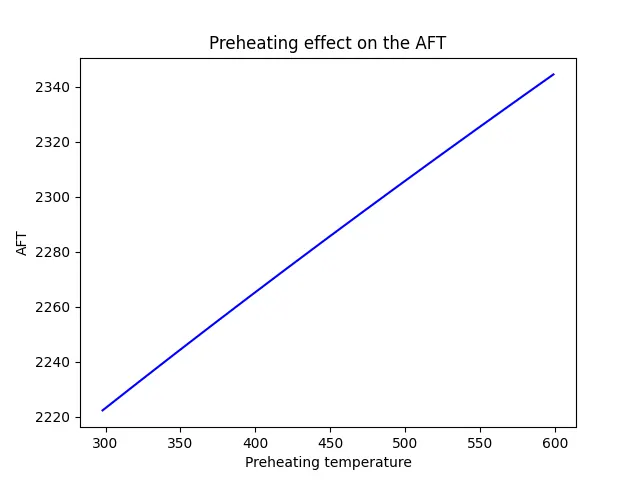
Plot showing Effect of pre-heating on the Adiabatic Flame Temperature:
Observation case 1:
- With the increase in the preheating temperature, the Adiabatic Flame Temperature increases linearly.
Case 2: Effect of Pre-heating on the combustion efficiency
Assumptions made in this case:
- Assume the LHV of combustion of Methane as 50 MJ/KG.
- Assume that the furnace exit temperature is 1700K and assume that the combustion products are CO2, H20, and N2.
In this case preheating is done to see how it affects the combustion efficiency
- The enthalpy of the inlet gases depends on the temperature of the gases. Some amount of heat is utilized to heat the gases so Adiabatic Flame temperature decreases. So if the inlet gases are preheated the work done to increase the temperature of the inlet gases decreases. This increases the total heat which is directly proportional to the combustion efficiency.
- Yes, Preheating does save fuel as the heat required to increase the temperature of the inlet gases is given by preheating. The amount of fuel required to increase the temperature of the inlet gases is reduced, thus saving fuel.
Combustion Efficiency calculation formula:
H - enthalpy
LHV - Latent heat of vapourization
Q = (M_air*H_air +M_Fuel*H_Fuel) - M_Exhaust*H_Exhaust
Q - Total heat in the combustion chamber
QS = Q/M_Fuel
QS - Specific heat in the combustion chamber
efficiency = QS/LHV
Important code Lines:
- Basic code lines for importing classes and initiating and inputting the number of moles are common.
- for loop is used to vary the temperature from 298 to 600k.
- The efficiency formula is defined after calculating the specific heat and require plots are plotted.
Python code for calculating combustion efficiency:
import cantera as ct
import matplotlib.pyplot as plt
import math

gas = ct.Solution('gri30.cti')

Fuel = ct.Quantity(gas)
Fuel.TPX = 298,ct.one_atm,'CH4:1'
Fuel.moles = 1
M_Fuel = Fuel.mass

Exhaust = ct.Quantity(gas)
Exhaust.TPX = 1700,ct.one_atm,'CO2:0.095,H2O:0.1901,N2:0.7148'
Exhaust.moles = 10.52
M_Exhaust = Exhaust.mass

LHV = 50e6
T_pre =[]
effi = []
for T in range (298,600):
	Air = ct.Quantity(gas)
	Air.TPX = T,ct.one_atm,{'O2':0.21,'N2':0.79}
	Air.moles = 9.52
	M_air = Air.mass

	H_air = Air.enthalpy_mass
	H_Fuel = Fuel.enthalpy_mass
	H_Exhaust = Exhaust.enthalpy_mass

        #Heat produced
	Q = (M_air*H_air +M_Fuel*H_Fuel) - M_Exhaust*H_Exhaust
	QS = Q/M_Fuel
	efficiency = QS/LHV
	effi.append(efficiency)
	T_pre.append(T)
plt.plot(T_pre,effi,color ='blue')

plt.title('Preheating effect on the Combustion efficiency')
plt.xlabel('Pre-heating Temperature')
plt.ylabel('Combustion efficiency')
plt.show()
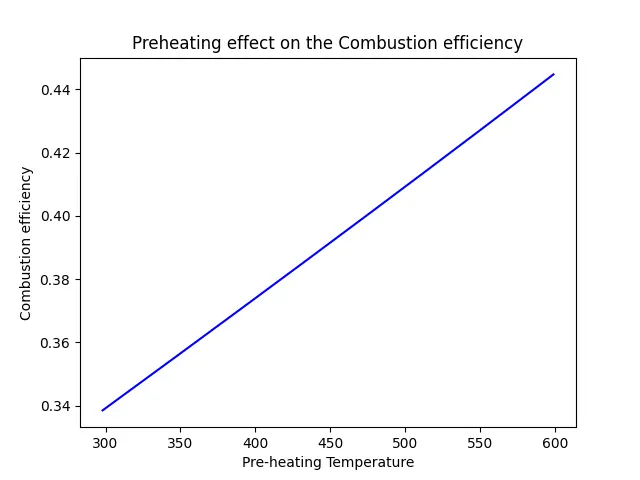
Plot showing the effect of pre-heating on the combustion efficiency:
observation case 2:
- preheating increases the combustion efficiency and the increase is linear with the preheating temperature.
- The fuel is also saved as the heat required to increase the temperature of the gases is taken from the preheating.
The exhaust Temperature should be maintained at a safe temperature to avoid accidents or malfunctions as the exhaust temperature is dependant on the combustion. By maintaining the exhaust temperature we can find the optimal functioning of the combustor. So keeping the exhaust temperature constant is right.
Conclusion:
Preheating increases the combustion efficiency and Adiabatic Flame Temperature also reduces fuel consumption.