Week 4.2 - Combustion Efficiency Calculation after Preheating
COMBUSTION EFFICIENCY CALCULATION AFTER PREHEATING
AIM: To Find the Combustion Efficiency of the Furnace with respect to Preheating.
OBJECTIVE:
- What is the effect of preheating on the adiabatic flame temperature?
- Change pre-heating from 298 to 600K
- Explain your results
- Does preheating help with fuel-saving? If yes, how does combustion efficiency go up as a function of pre-heating temperature? Assume that the furnace exit temperature is 1700K (For this case assume that the combustion products are CO2, H20, and N2).
- Write the formula for combustion efficiency
- Plot the effect of pre-heat temperature on combustion efficiency
- Is it right or wrong to assume a fixed furnace exit temperature? Explain your answer.
THEORY:
Recuperator
It is a type of heat exchanger that has separate flow paths for each fluid along their own passages and heat is transferred through the separating walls. Recuperators are often used in power engineering, to increase the overall efficiency of thermodynamic cycles. For example, in a gas turbine engine. The recuperator transfers some of the waste heat in the exhaust to the compressed air, thus preheating it before entering the combustion chamber. Many recuperators are designed as counter-flow heat exchangers.
Combustion Efficiency of Recuperator:
We are going to write an energy balance for the control volume, assuming both the heat transferred to the load and the heat losses are the same, with and without preheating.
Assuming steady flow, heat us transferred out of the control volume.
`-dotQ= -dotQ_"load"-dotQ_"loss"=dotm*(h_"prod"-h_"react")`
`-dotQ= (dotm_A+dotm_F)h_"prod"-dotm_F*h_F-dotm_A*h_A`
`A/F=dotm_A/dotm_F`
Above equation will be rewrite as,
`-dotQ=[(A/F+1)*h_"prod"-(A/F)*h_A-h_F]`
fuel utlization energy will be defined as,
`eta= dotQ/(dotm_F*LHV)`
Therefore,
`eta=[(A/F+1)*h_"prod"-(A/F)*h_A-h_F]/(LHV)`
Assuming equivalence ratio is 1.
`A/F=(A/F)_"stoich"/phi`
`A/F=17.1`
Fuel-saving defined as,
`"Fuel_Saving"= 1-(eta_298/eta_600)`
SOLUTION AND CODE:
First Case
- What is the effect of preheating on the adiabatic flame temperature?
- Change pre-heating from 298 to 600K
- Explain your results
For the first question:
The code for determining the effect of preheating on the AFT is given below:
"""
What is the effect of preheating on the adiabatic flame temperature?
Change pre-heating from 298 to 600K
Explain your results

"""
import cantera as ct
import matplotlib.pyplot as plt


gas = ct.Solution('gri30.cti')

A = ct.Quantity(gas)
B = ct.Quantity(gas)

B.TPX = 298.15,ct.one_atm,{'CH4':1}
B.moles = 1


P_T =[] #Preheating Temperature
AFT = []


for T in range(298,601):
	A.TPX = T,ct.one_atm,{'O2':0.21,'N2':0.79}
	A.moles = 9.52
	P_T.append(T)

	Mixture = B + A
	Mixture.equilibrate('HP')

	AFT.append(Mixture.T)

print(AFT)
print(P_T)

plt.plot(P_T,AFT)
plt.title('PreHeating Vs Adiabatic_flame_temperature')
plt.xlabel('P_T(K)')
plt.ylabel('AFT (K)')
plt.grid(True)
plt.show()
Result plot
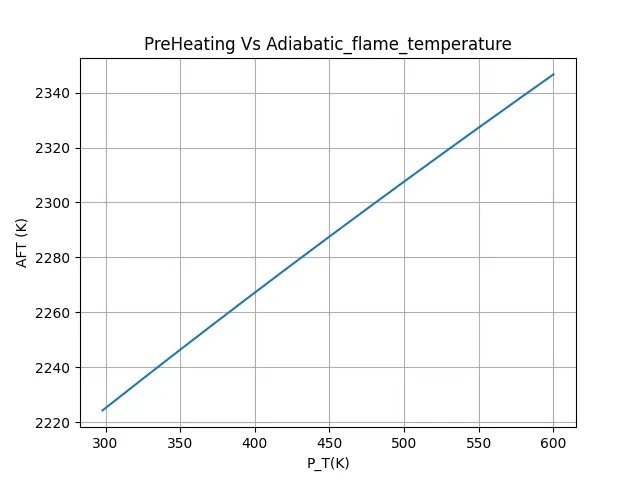
From the above plot, we can see that AFT increases linearly with respect to the Preheating Temperature of the air. This means that as the varying temperature of the Air gets heated the AFT also increases. And when the temperature of the air decreases the Adiabatic flame temperature also decreases i.e, the temperature of the air is low.
Second Case
Does preheating help with fuel-saving? If yes, how does combustion efficiency go up as a function of pre-heating temperature? Assume that the furnace exit temperature is 1700K (For this case assume that the combustion products are CO2, H20, and N2).
- Write the formula for combustion efficiency
- Plot the effect of pre-heat temperature on combustion efficiency
- Is it right or wrong to assume a fixed furnace exit temperature? Explain your answer.
For the second code
"""
Does preheating help with fuel saving? If yes, how does combustion efficiency go up as a function of pre-heating temperature? Assume that the furnace exit temperature is 1700K (For this case assume that the combustion products are CO2, H20, and N2).
Write the formula for combustion efficiency
Plot the effect of pre-heat temeprature on combustion efficiency
Is it right or wrong to assume a fixed furnace exit temperature?

For the formula
CH4 + 2(O2+3.76N2)  -> CO2 + 2H2O + 7.52N2
"""

import cantera as ct
import matplotlib.pyplot as plt


gas = ct.Solution('gri30.cti')

# For Air
A = ct.Quantity(gas)
A.TPX = 298.15,ct.one_atm,{'O2':0.21,'N2':0.79}
A.moles = 9.52
mass_A = A.mass
H_A = A.enthalpy_mass


# For Fuel
B = ct.Quantity(gas)
B.TPX = 298.15,ct.one_atm,{'CH4': 1}
B.moles = 1
mass_B  = B.mass
H_B = B.enthalpy_mass

LHV = 50e6 #Methane Lower Heating Value

Product = ct.Quantity(gas)
Product.TPX = 1700,ct.one_atm,{'CO2':1/10.52,'H2O':2/10.52,'N2':7.52/10.52}
Product.moles= 10.52
mass_Product = Product.mass
H_Product = Product.enthalpy_mass

M = mass_A/mass_B

# Combustion Efficiency
Q = (M*H_A + H_B - (M + 1)*H_Product )/(LHV)
print("Combustion Effciency at STP = ",Q)


preheat_T = [] #PreHeat Temperature
Efficiency = [] # Combustion Efficiency with respect to varying Preheat Temperature
B_saving = [] # Fuel saving

for T in range(298,601):
	A.TPX = T,ct.one_atm,{'O2':0.21,'N2':0.79}
	A.moles = 9.52
	mass_A = A.mass
	H_A = A.enthalpy_mass
	M = mass_A/mass_B

	eff = (M*H_A + H_B - (M + 1)*H_Product )/(LHV)
	B_savings = abs(1- (Q/eff))

	preheat_T.append(T)
	B_saving.append(B_savings)
	Efficiency.append(eff)

print("Combustion Effciency at varied PreHeating Conditions =",Efficiency)
print("PreHeating Temperatures(K) =",preheat_T)
plt.plot(preheat_T,Efficiency)
plt.plot(preheat_T,B_saving,color= 'orange')
plt.xlabel('PreHeating')
plt.ylabel('Efficiency')
plt.legend(['Combustion Efficiency','B Saving'])
plt.title('Combustion Efficiency with PreHeating',size = 20)
plt.grid(True)

print("B Saved = ",B_saving)

plt.show()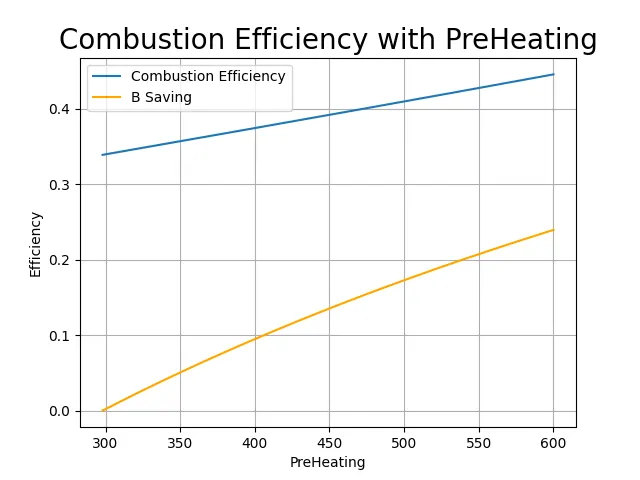
For the above plot, we see that the combustion efficiency is increased with Temperature and which saves the fuel as well. Initially, the fuel-saving is negligible but as the temperature of the air is increased the fuel-saving is also increased.
At 298.15 K the Fuel saved is 0.00015312320481752906 kg but at the temperature 608 K the fuel saved is 0.23923117747906109 kg giving a 199.74% increase in fuel-saving with respect to the preheating temperature
Similarly for the Combustion Efficiency at 298K is 0.33873306622138993 and combustion efficiency at 608 K is 0.44531916146543044 giving a 27.188% increase in combustion efficiency.
- Yes, Preheating helps the fuel-saving and it increases the combustion efficiency of the furnace. As the temperature of the air increases the combustion efficiency is also increased simultaneously with respect to the preheating temperature assigned to the air.
- Combustion Efficiency
Combustion Efficiency `eta = ((A/F)*H_(air) + H_(fuel) - (A/F + 1) * H_(pro duct) )/ (LHV)`
where
A/F= Mass of Air/ Mass of Fuel
H_air = Air Enthalpy
H_fuel = Fuel Enthalpy
H_product = Product Enthalpy
LHV = Lower Heating Value of Fuel
- Fuel Saving
`Fuel Savi ng = 1- (eta_(STP)/ eta_(PreheatTemperature))`
- The Exit temperature depends upon the Product temperature of the reaction which is necessary for the recuperator to preheat the air. If the Exist temperature the high then the preheating of the air will be faster which will help in increasing the thermal efficiency or the combustion efficiency which in turn helps in saving the fuel. This means that the Exist Temperature is directly proportional to the Preheat Temperature of the air.
Conclusion
From the above result, we can conclude that preheating helps in increasing the Combustion Efficiency of the Furnace and also increases Fuel Saving.