Week 3 Verification of Weld Joints
OBJECTIVE:-
Simulate three different types of welding using three different weld materials.The weld materials which are to be used are as follows:-
- Stainless steel
- Aluminium alloy
- Bronze
PROCEDURE FOLLOWED:-
Create a new static structural model, Edit the engineering data and add a new material stainless steel, Aluminium alloy and bronze, according to the three cases in 3 different workbench file, each individually. By default the structural steel is their. Now go to space-claim and check for any geometry errors. After checking for any errors and found ok, proceed towards, mechanical workbench and assign the required properties step by step.
First of all the geometry has to be checked and renamed according to the component name. After renaming select all the weld joints and assign material stainless steel, aluminum alloy and bronze in 3 different workbench files according to the simulation case required.
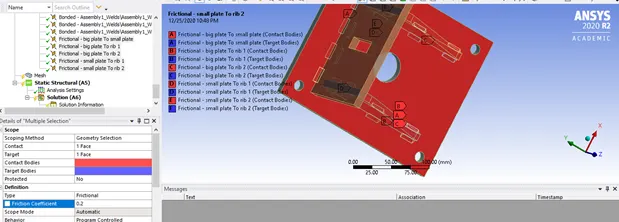
Then, in contacts the contacts in between the plates and ribs are to be renamed based on definition.
Contacts in between the plates and ribs has to be assigned the frictional contact and frictional coefficient to be given 0.2, rest all the contacts has to be bonded as default already set.
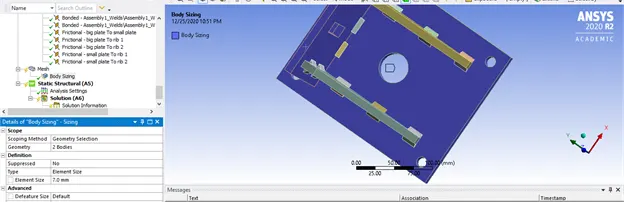
Sizing introduced for both the plates(small and big) and the mesh size is given as 7 mm.
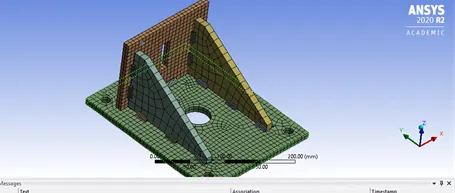
Generating the mesh for all the components
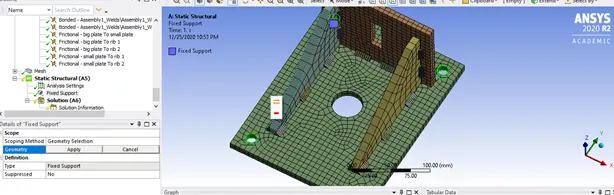
Inserting the fixed support at the holes of the big plate as it will be hanged with some support.
Now applying a load of 15000 N as per the requirement on the small plate rectangular vacant area.
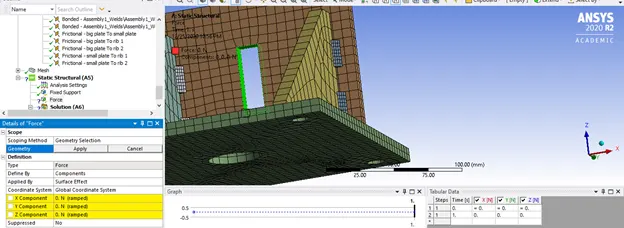
Defining it by component and giving a load at the small plate in the positive Y- direction.
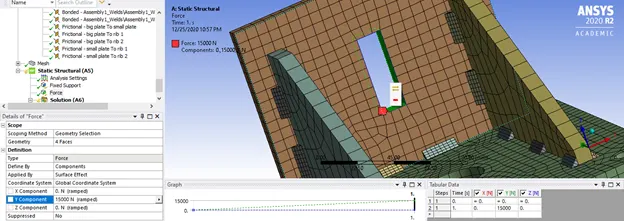
Also in analysis setting the large deflection has to be turned ON.
The solution requirement parameters has to be given. In our model we will be obtaining the Directional deformation, Equivalent elastic strain for all the components, also the Maximum Von mises stress has to be obtained for the weld joints. So giving all the solution requirements command.
After running the simulation, following results are obtained.
STAINLESS STEEL:-
Directional deformation:-
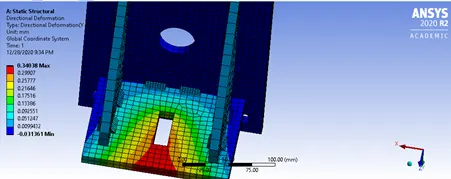
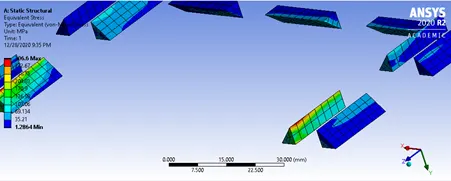
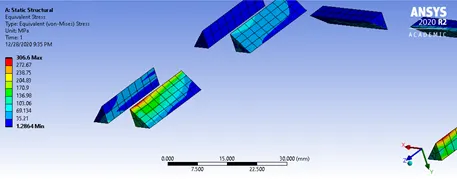
Maximum Von mises stress at weld joints
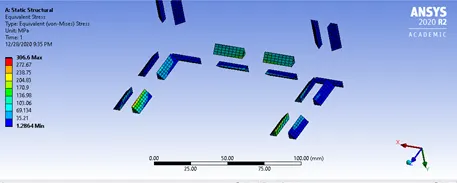
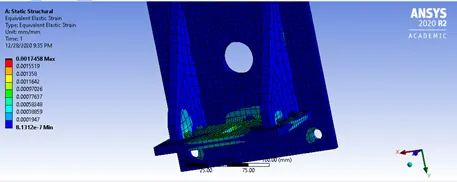
Equivalent elastic strain
ALUMINIUM ALLOY:-
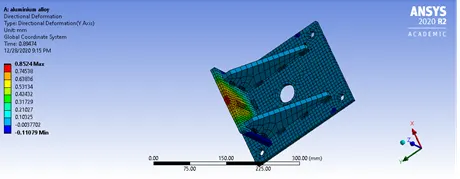
Directional deformation
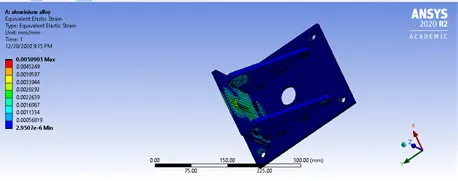
Equivalent elastic strain
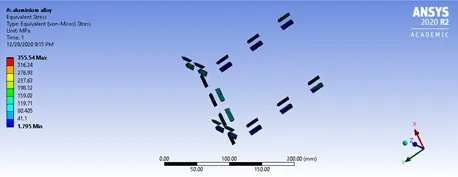
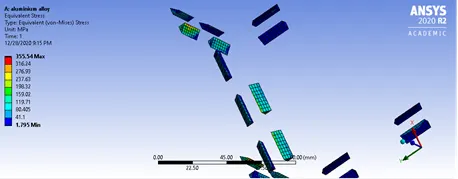
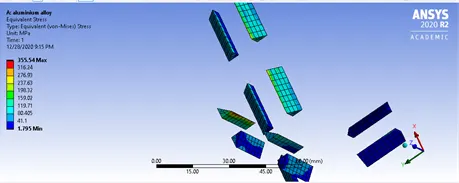
Von-Mises stress at weld joints,
BRONZE:-
Von mises
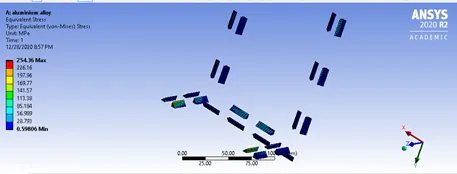
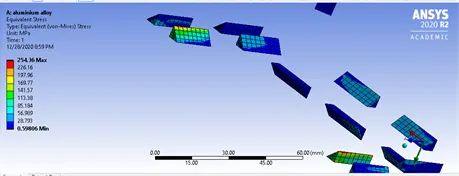
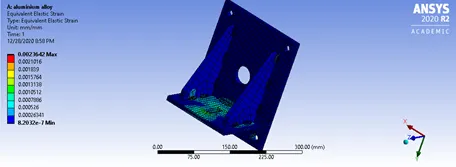
Equivalent elastic strain
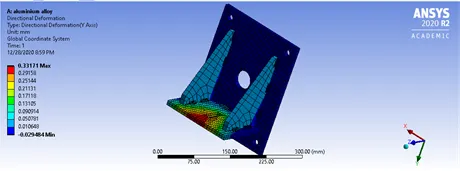
Directional deformation
CONCLUSION:-
The final comparison of all the weld joint materials are tabulated below:-
|
Directional deformation (mm) |
Elastic strain (mm/mm) |
Von-Mises stress at weld joints. (MPa) |
|
|
Stainless steel |
0.34038 |
0.0017458 |
306.6 |
|
Aluminium alloy |
0.8524 |
0.0050901 |
355.54 |
|
Bronze |
0.33171 |
0.0023642 |
254.36 |
From the above tabulated data it can be seen that the Directional deformation and Von-mises stress at weld joints are minimum for the bronze weld joints, whereas the elastic strain is minimum for stainless steel.
The weld joint which will experience the highest equivalent stress is of material ALUMINIUM ALLOY.
The simulation of the weld materials for three different cases are successfully done.