Week 3 Verification of Weld Joints
AIM: To verify weld joints by the using of static structural analysis/Simulation.
OBJECTIVE:
- To simulate the weld joint using three different weld materials.
- To find out the directional deformation and equivalent strain experienced by the setup
- To identify the weld joint that experiences the highest equivalent stress in each case and compare the results for all three material cases.
THEORY:
- Welding is a process that involves joining two or more pieces of metal or thermoplastics using heat, pressure, or both. Welding is an essential process in the manufacturing and construction industries, as it allows for the creation of strong and permanent bonds between materials.
- There are many different welding techniques, including arc welding, gas welding, laser welding, and resistance welding. Each of these techniques uses different equipment and processes to achieve the desired result.
- Welding requires a high level of skill and expertise, as the process can be dangerous if not performed correctly. Proper safety equipment, including gloves, masks, and protective clothing, is necessary to prevent injuries from heat, sparks, and radiation.
- In addition to manufacturing and construction, welding is used in a wide range of industries, including automotive, aerospace, and shipbuilding. Welding is also used in the repair and maintenance of machinery and equipment.
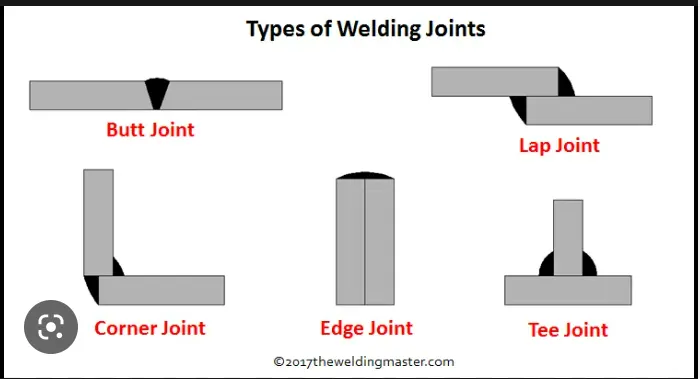
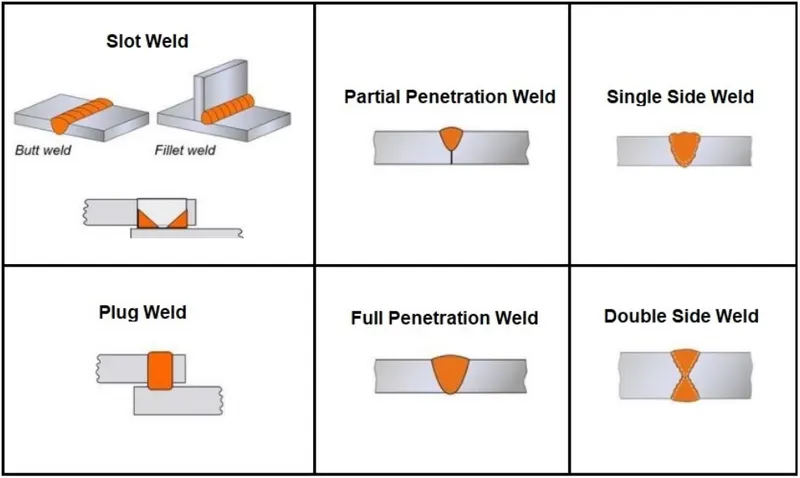
Brazing:-
- Brazing is a joining process that involves the use of a filler metal to bond two or more materials together. Unlike welding, which involves melting the base metals and adding a filler material, brazing involves heating the base metals to a temperature below their melting point and melting the filler metal, which then flows into the joint by capillary action. When the filler metal cools and solidifies, it creates a strong, permanent bond between the base metals.
- Brazing is commonly used in manufacturing and repair applications to join materials such as metals, ceramics, and certain plastics. It is often preferred over welding because it can be used to join dissimilar metals and materials with different melting points, and it does not typically cause distortion or warping of the base metals.
- There are several types of brazing processes, including torch brazing, furnace brazing, induction brazing, and resistance brazing. The specific process used depends on the materials being joined, the size and shape of the parts, and the desired strength and appearance of the joint.
ANALYSIS SETUP:
Here Structural verification of Weld Joints Model will be categorized in three different cases with some changes of Material for Weldments, Plates and Ribs as given below:
- CASE: 1 {Stainless Steel (for Plates, Ribs and Weldments)}
- CASE: 2: {Aluminium Alloy high strength, wrought for Weldments, Stainless Steel for Plates & Ribs}
- CASE: 3: {Bronze Cast for Weldments Stainless Steel for Plates, Copper Cast for Ribs}
- Given Geometry:
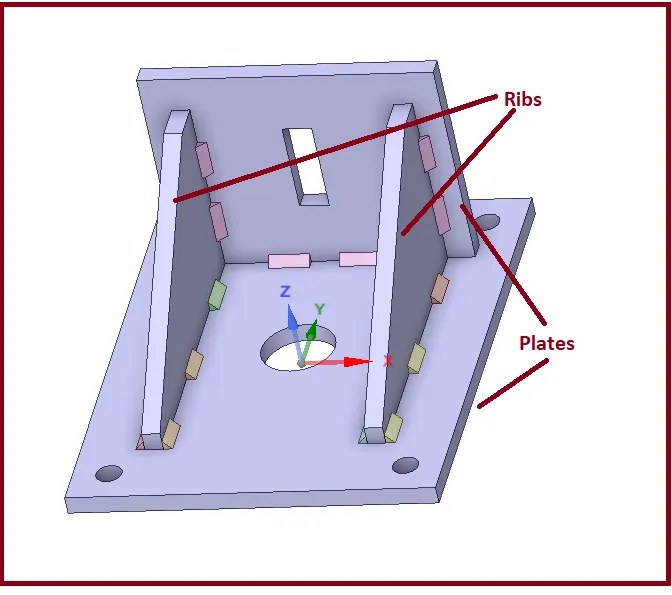
- Mesh:
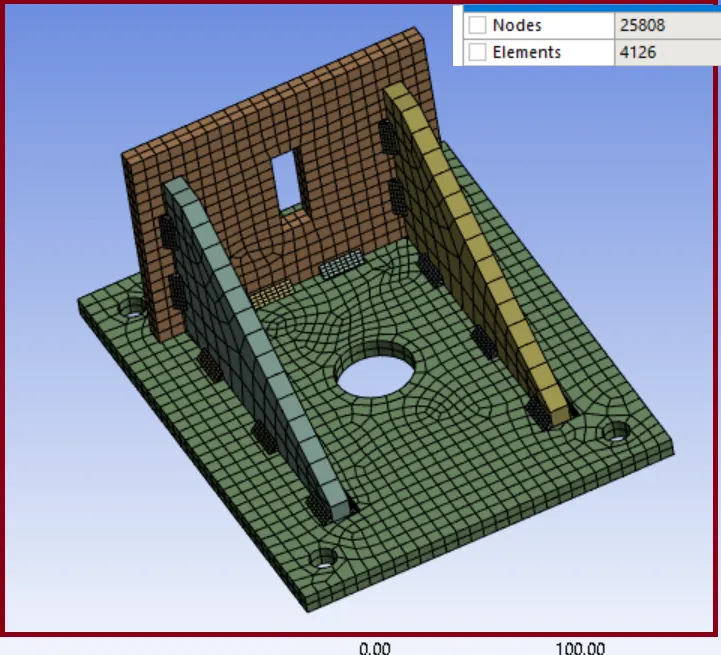
Mesh Details:
Global Element Size: Default
Body Sizing: Ribs
Element Size = 7 mm
Body Sizing: Big Plate & Small Plate
Element Size = 7 mm
- Material:
Stainless Steel:
Density: 7750 Kg/m3
Young’s Modulus: 193000 MPa
Poisson’s Ratio: 0.31
Tensile Yield Strength: 207 MPa
Tensile Ultimate Strength: 586 MPa
Aluminium Alloy (high strength, wrought):
Density: 2770 Kg/m3
Young’s Modulus: 73800 MPa
Poisson’s Ratio: 0.337
Tensile Yield Strength: 363 MPa
Tensile Ultimate Strength: 449 MPa
Copper Alloy
Density: 8300 Kg/m3
Young’s Modulus: 110000 MPa
Poisson’s Ratio: 0.34
Tensile Yield Strength: 280 MPa
Tensile Ultimate Strength: 430 MPa
Bronze
Density: 8810 Kg/m3
Young’s Modulus: 80000 MPa
Poisson’s Ratio: 0.345
Tensile Yield Strength: 144 MPa
Tensile Ultimate Strength: 267 MPa
Initial Steps
- Import the model in Static Structural named as “Skill_lync_Welding.stp” in Geometry section.
- Then go to Mechanical model section.
- Rename plates and ribs as Big Plate, Small Plate, Rib 1 and Rib 2.
- Connections:
- Contact: 1st one
Contact Body = Big_Plate
Target Body = Small_Plate
- Contact: 2nd one
Contact Body = Big_Plate
Target Body = Rib_1
- Contact: 3rd one
Contact Body = Big_Plate
Target Body = Rib_2
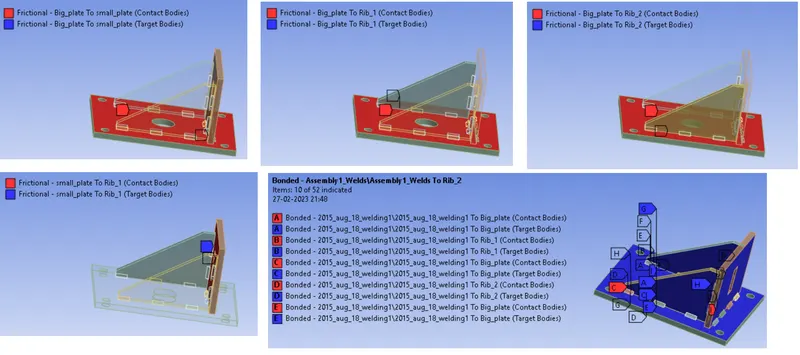
- Contact:4th
Contact Body = Small_Plate
Target Body = Rib_1
- Contact: 5th
Contact Body = Small_Plate
Target Body = Rib_2
Settings - Plates and Ribs Contacts:
- Type: Frictional
- Friction Coefficient: 0.2
- Other Contacts:
Contact Body = Assembly
Target Body = Welds
Settings for Weld Contacts:
Type: Bonded
- Boundary Conditions settings
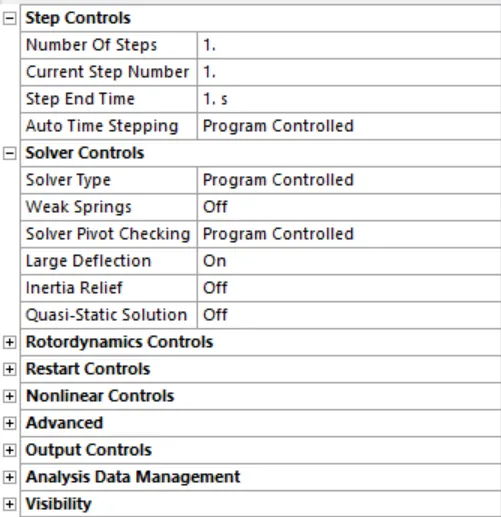
Analysis Settings:
- Auto Time Stepping: Program Controlled
- Solver Type: Program Controlled
- Large Deflection: ON
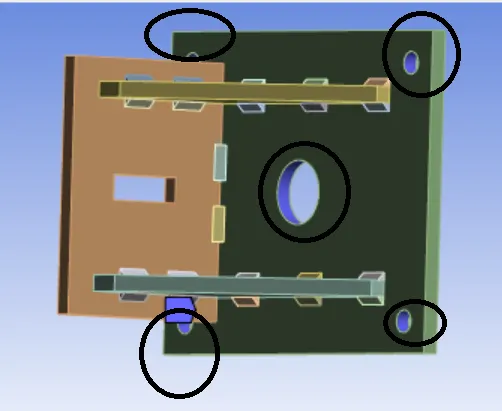
Fixed Support:
Apply fixed support to 4 small round holes and 1 big hole as shown in below.
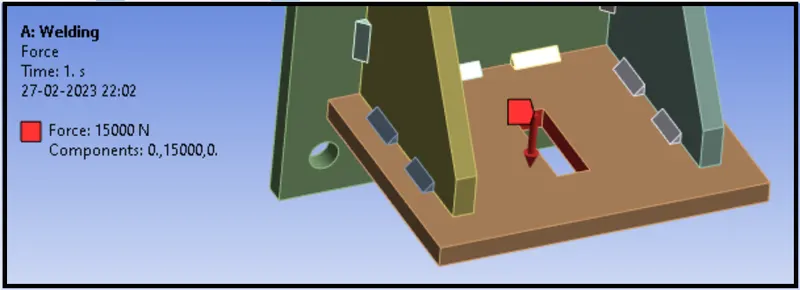
Force:
Here we Apply force to the square hole in Small Plate of 15kN (Ramped) in Y-Direction as shown in below.
SOLUTION
After giving proper boundary conditions, create desired solutions for output results. Create Solutions for Equivalent (Von Mises) Strain, Directional Deformation in Y-axis and identify the weld joint that experiences the highest equivalent stress.
Now we observe results with comparison.
CASE: 1 {Stainless Steel for Plates, Ribs and Weldments}
CASE: 2: {Aluminium Alloy high strength, wrought for Weldments, Stainless Steel for Plates & Ribs}
CASE: 3: {Bronze Cast for Weldments Stainless Steel for Plates, Copper Cast for Ribs}
Results for CASE: 1, CASE: 2 and CASE:3 are as given below
CASE: 1 {Stainless Steel for Plates, Ribs and Weldments}
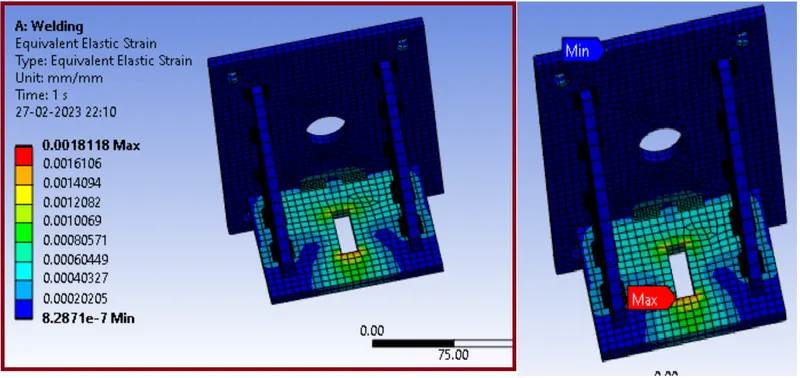
- Strain
Animation....
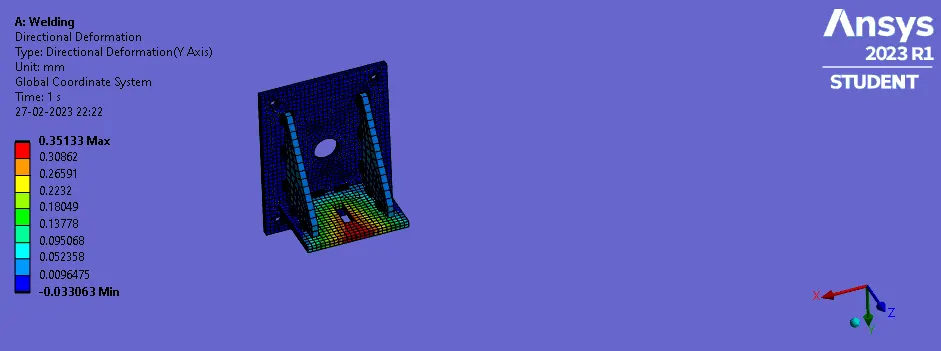
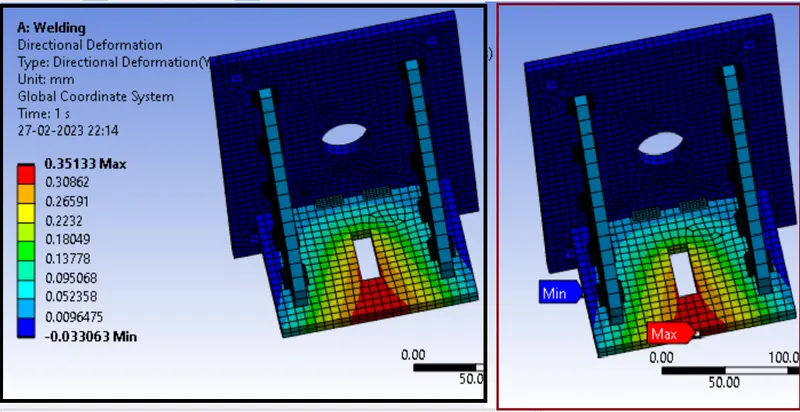
- Directional deformation
Animation....
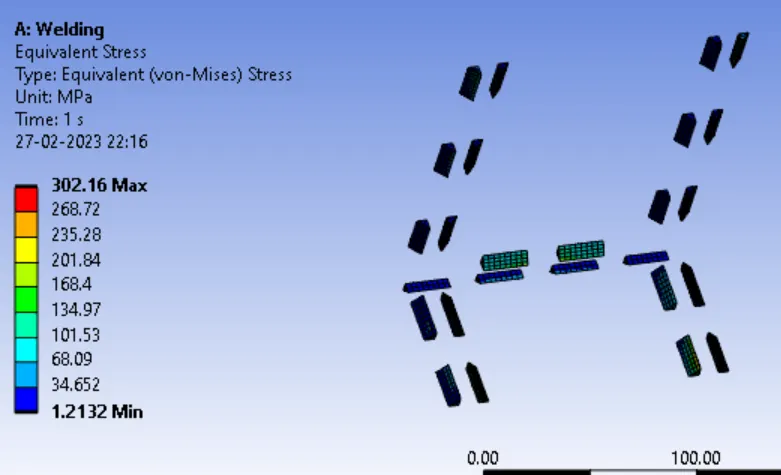
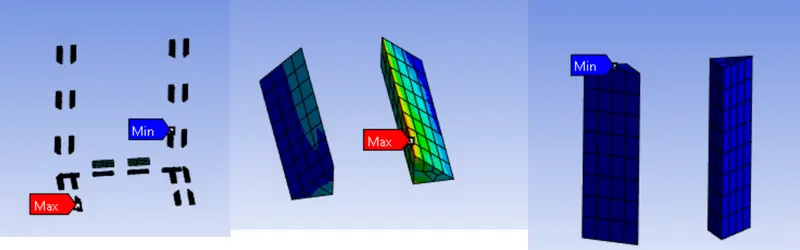
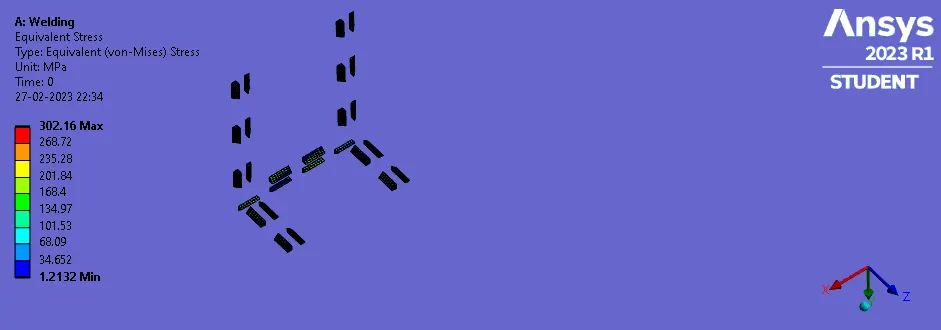
- Stress for Weldments:
Animation...
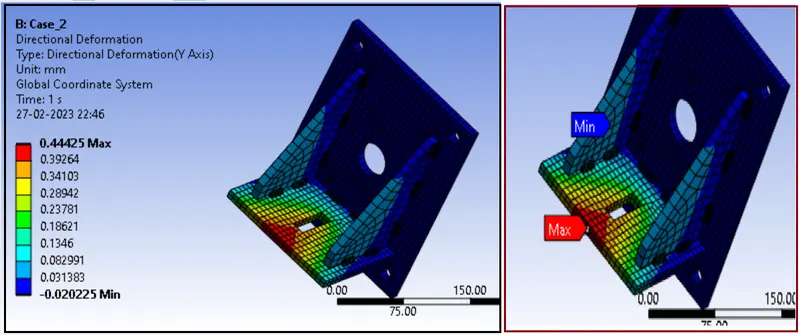
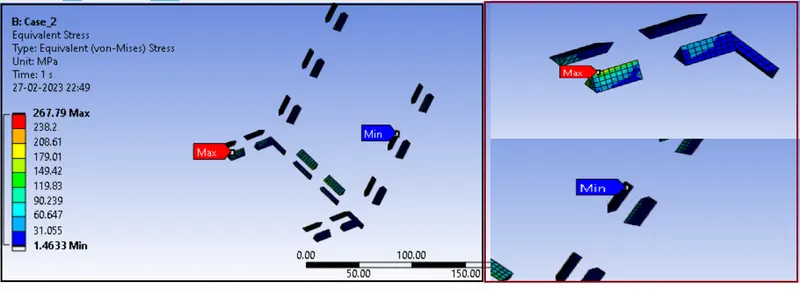
CASE: 2: {Aluminium Alloy high strength, wrought for Weldments, Stainless Steel for Plates & Ribs}
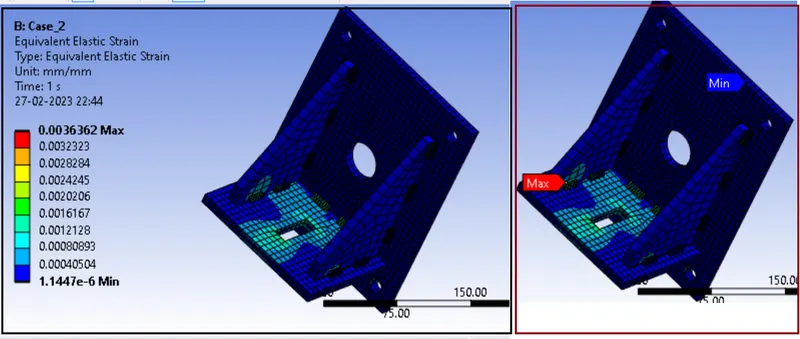
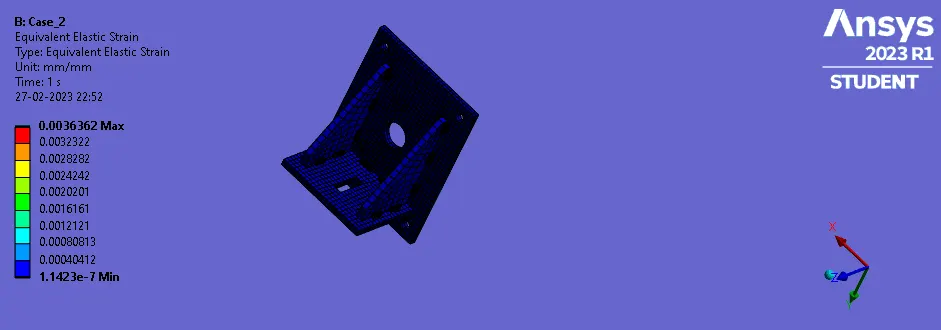
- Strain
animation...
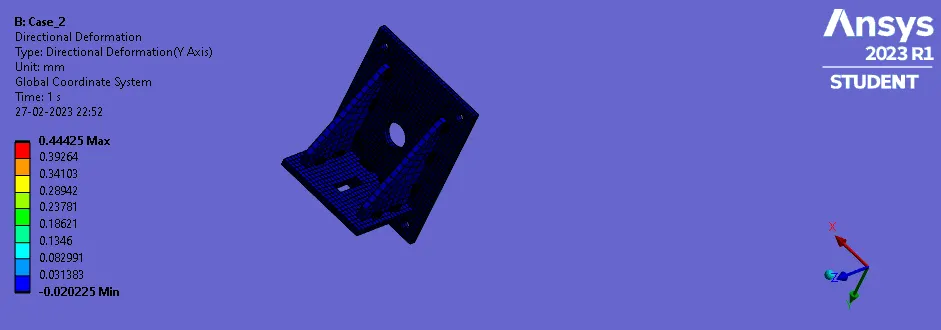
- Directional deformation
Animation...
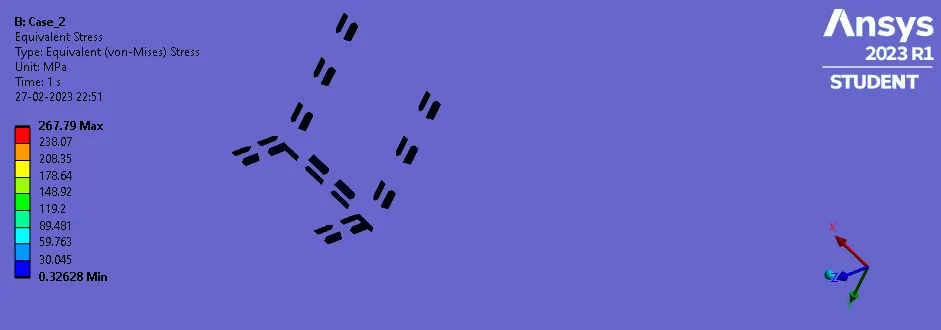
- Stress on Weldments:
Animation...
CASE: 3: {Bronze Cast for Weldments Stainless Steel for Plates, Copper Alloy for Ribs}
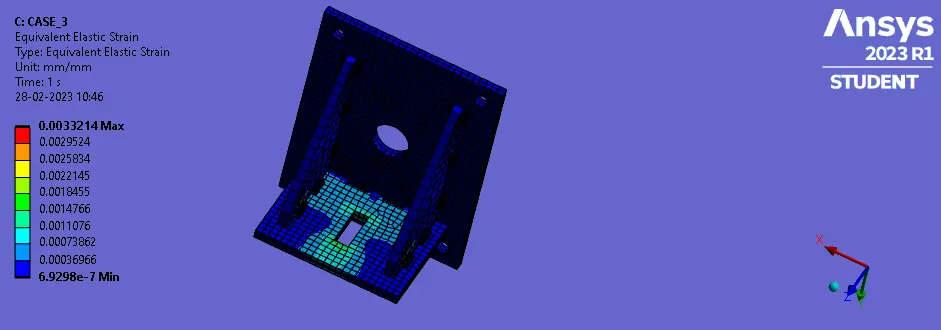
- Strain
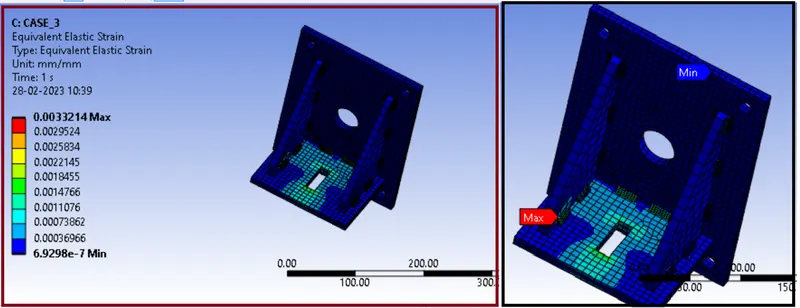
Animation...
- Directional deformation in Y - axis
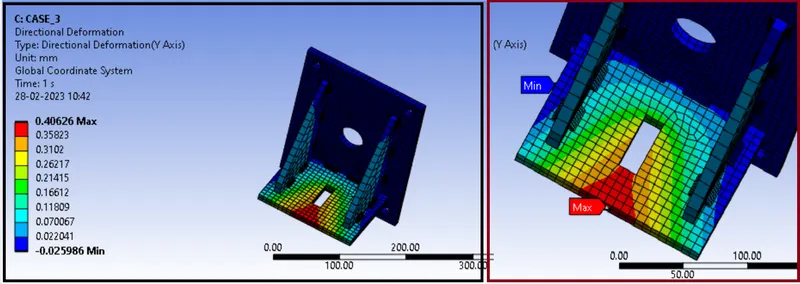
Animation...
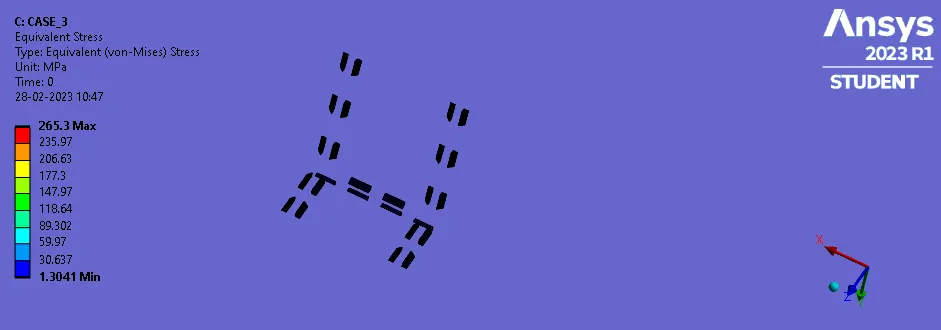
- Stress on Weldments:
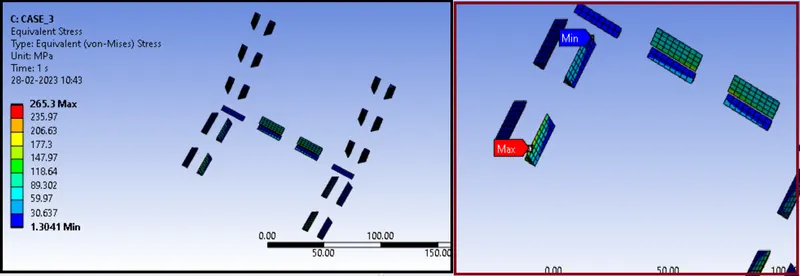
Animation...
COMPARISON OF RESULTS:
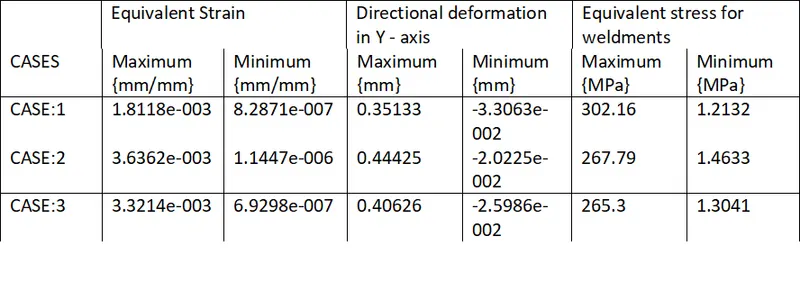
- Here we can observe Directional Deformation is Maximum in CASE:2 This is due to lower Yield Strength.
- We can also see from strain, strain in CASE:2 have maximum strain at weld joint.
- So in CASE: 2 due to lower strength, and high stress and high strain at weld joint, it cannot Survive and failure will occur. Also, we can see that maximum deformation occurs at the square location in all cases, so Weldment 20, near the square hole will be more affected and brazing with ribs can be removed or deformed.
- This is because CASE:2 {Aluminium Alloy (Strength, wrought)} has lowest Modulus of elasticity among all materials. So, at lower modulus of elasticity, strain will always high.
- We can observe from the Results the Maximum Equivalent Stress is Maximum in CASE: 1 where all the components are made of Stain less Steel.
CONCLUSION:
- Aluminium alloys are widely used in fabrication due to their favourable properties such as high strength-to-weight ratio, corrosion resistance, ductility, and good thermal and electrical conductivity. They are used in a variety of applications, ranging from aerospace and automotive industries. So, for welding Aluminium alloys, filler material like Aluminium Alloy (high strength, wrought) is acceptable.
- As we have seen the Brazing in CASE: 3, Brazing has many advantages over other metal joining techniques, because it does not melt the base metal, less thermal distortion and capability of joining two different materials. But the main disadvantage is lack of joint strength. Strength of brazed joint is likely to be less than base metals. Also, it can be damaged under high service temperatures.
- Steel material for welding
There are many different types of steel that can be used for welding, but some are more commonly used than others. Here are a few examples:
- Mild steel: This is a low-carbon steel that is easy to weld and commonly used for general fabrication projects.
- Stainless steel: This is a steel alloy that contains at least 10.5% chromium, which gives it a high level of corrosion resistance. It is commonly used in applications where hygiene and durability are important, such as in the food and beverage industry.
- Carbon steel: This is a type of steel that contains higher levels of carbon than mild steel. It is commonly used in applications where high strength is required, such as in the construction industry.
- High-strength low-alloy (HSLA) steel: This is a type of steel that contains small amounts of alloying elements, such as copper, nickel, and phosphorus. It is commonly used in applications where high strength and good weldability are required, such as in the automotive industry.
So, depending upon the needs of strength, Weldability and availability and cost of material, and based on type of welding process, we can choose different material for weld joint.
***********************************************************************************************************************************************************************************************************************************************************************************************************END
Thanks & regards,
Devesh kashyap