Week 3 Verification of Weld Joints
AIM:
Simulate three different types of welding using three different weld materials.
CASE 1: Stainless steel.
Case 2: Aluminum alloy. (Weld material)
Plate material stainless steel.
Case 3: Bronze: (weld material)
Stainless steel (both plate)
Copper (Ribs)
THEORY:
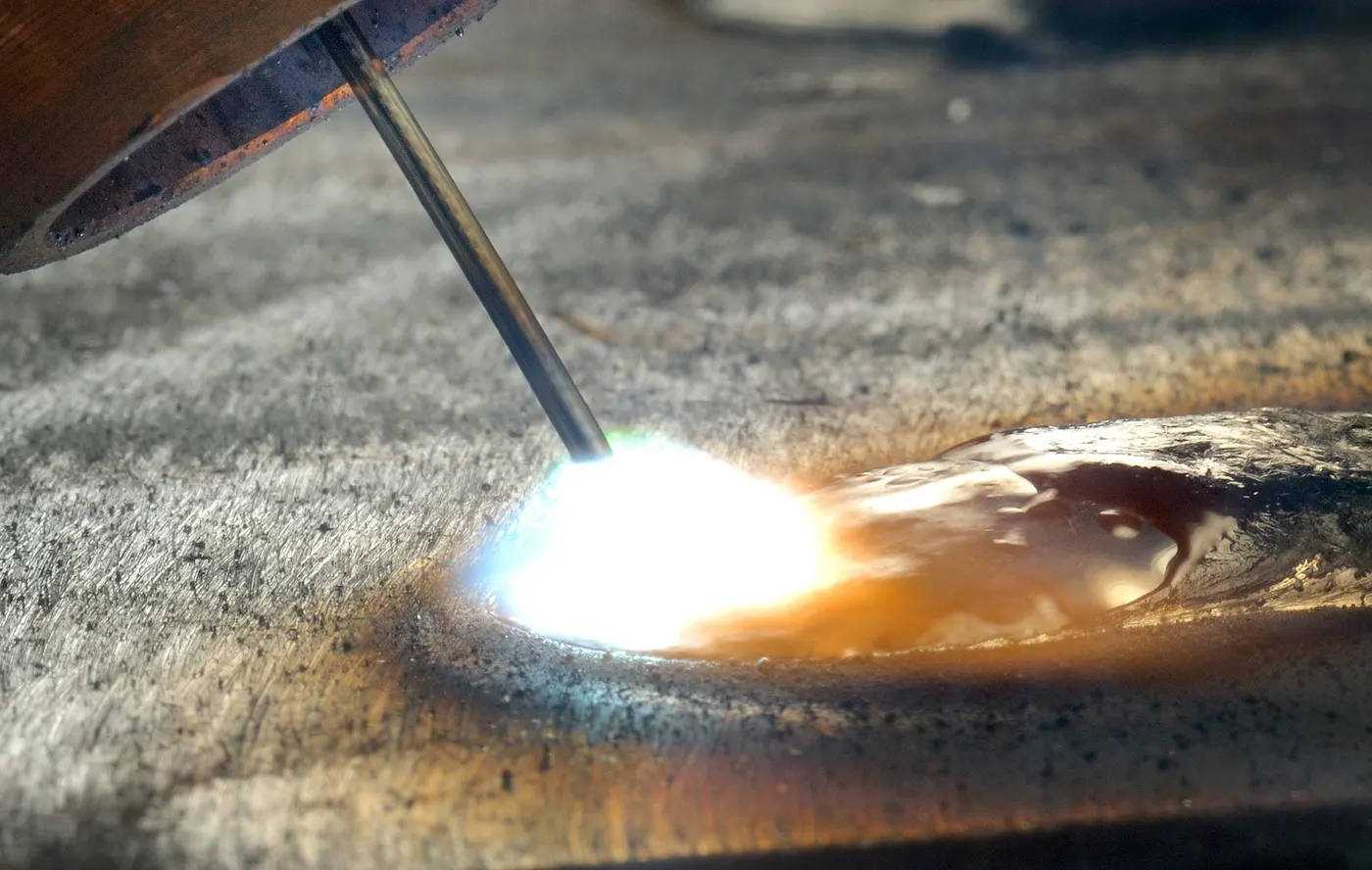
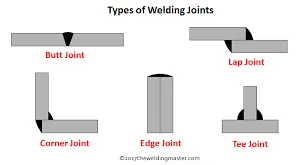
Welding is a fabrication process whereby two or more parts are fused together by means of heat, pressure or both forming a join as the parts cool. Welding is usually used on metals and thermoplastics but can also be used on wood. The completed welded joint may be referred to as a weldment
A brazed joint is made in a completely different manner from a welded joint. The first big difference is in temperature – brazing does not melt the base metals. Brazing temperatures are also significantly lower than welding temperatures for the same base metals, using less energy.
MATERIALS USED :
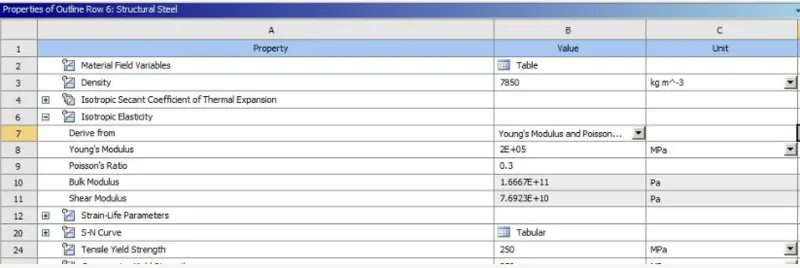
STRUCTURAL STEEL
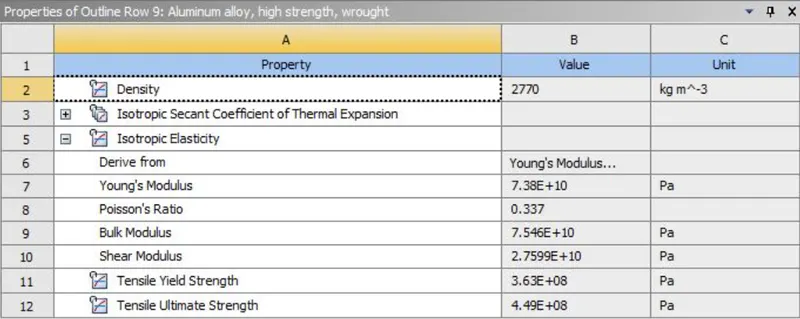
ALUMINIUM ALLOY
BRONZE
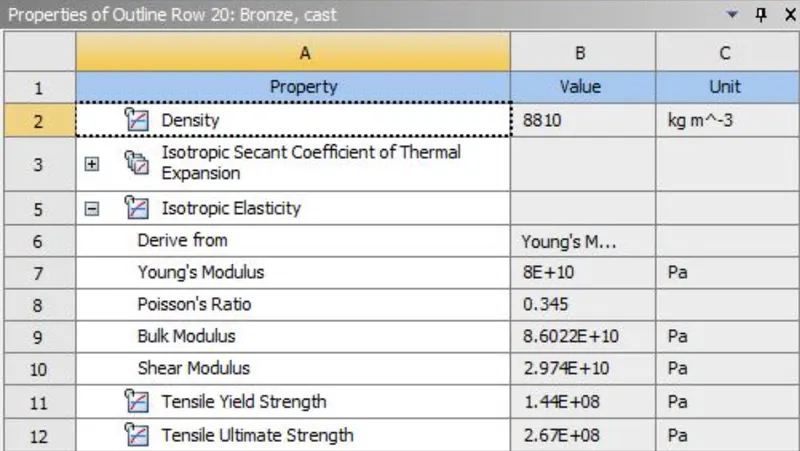
PROCEDURE:
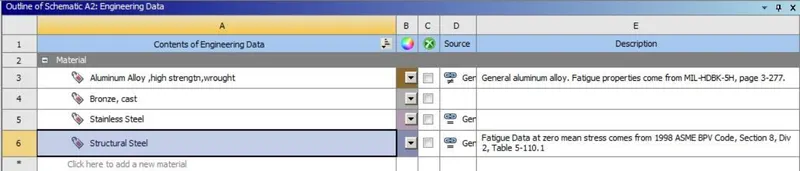
Open structural analysis using Ansys workbench. Click to engineering data and choose any material use for simulation. Right click on geometry and insert edit on space claim. Now right click on model and click an edit model to open the up in mechanical module. Now click on geometry and notice there varies part module in this geometry and rename according to their convenience.
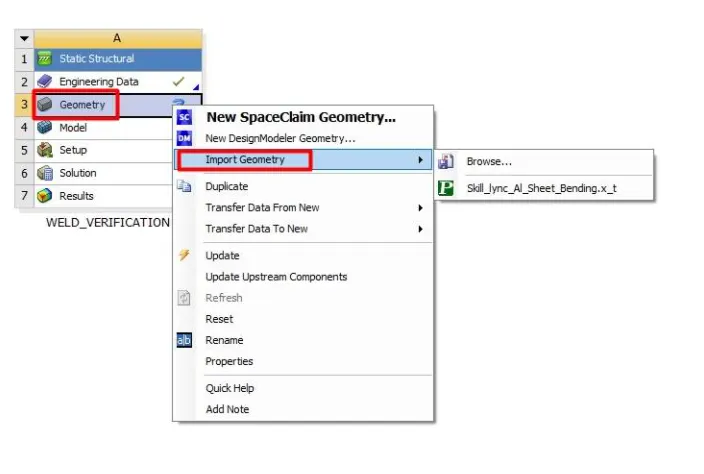
Now we click on geometry and select import geometry
We can check whether the imported geometry is proper or not in SpaceClaim. Through our visual inspection, it can be confirmed it has no defects and we proceed further for the simulation
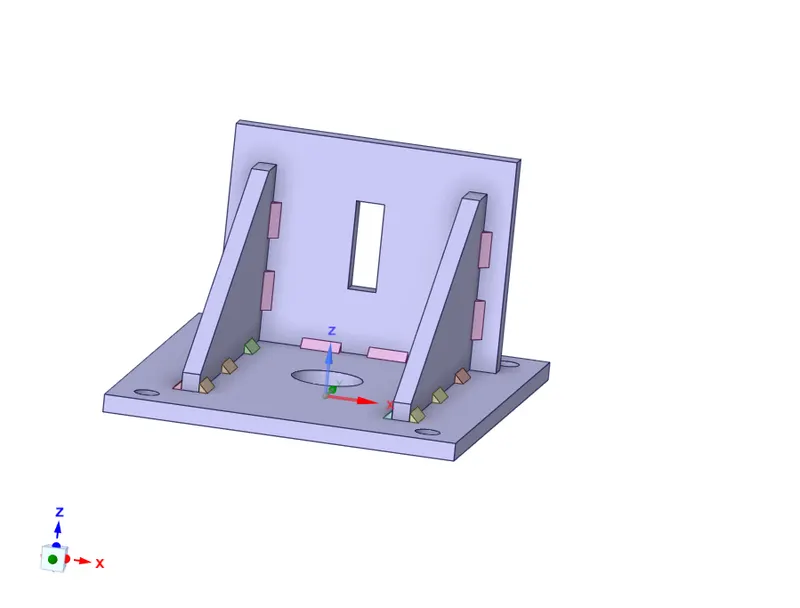
GEOMETRY OPENED IN SPACECLAIM
Open ansys mechanical module for meshing and analysis setup. We can also rename certain parts for easy identification
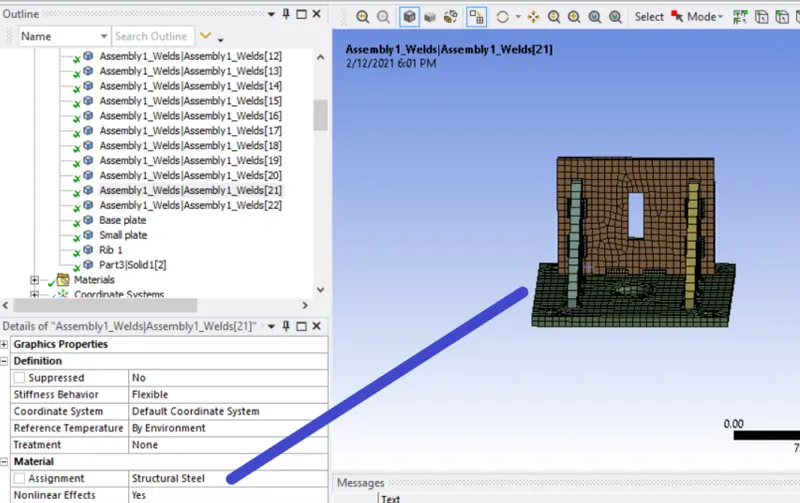
We have to run three different cases differing the material. Here in case 1 we are using structural steel
MATERIAL:
WE don’t worry about the material now.
CONNECTIONS:
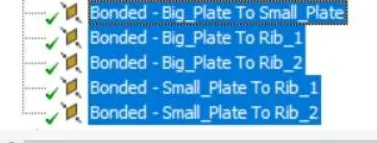
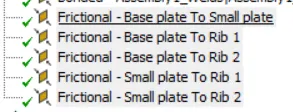
CLICK on contact and expand and click to rename base on definition and check it.
Select contact between the RIBS, SMALL PLATE AND BIG PLATE, select we change this pre defind contact to frictional contact and assign frictional coefficient should be of 0.2.
MESH
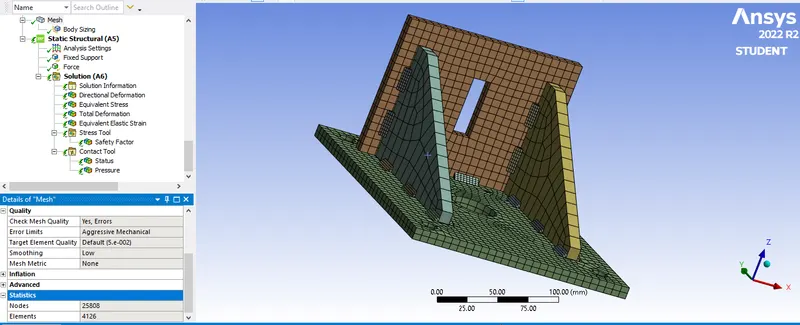
By using solid filter select small and big plate, insert sizing of 7 mm and generate mesh,
NODES: 25808
ELEMENT: 4126
STATISTIC STRUCTURE:
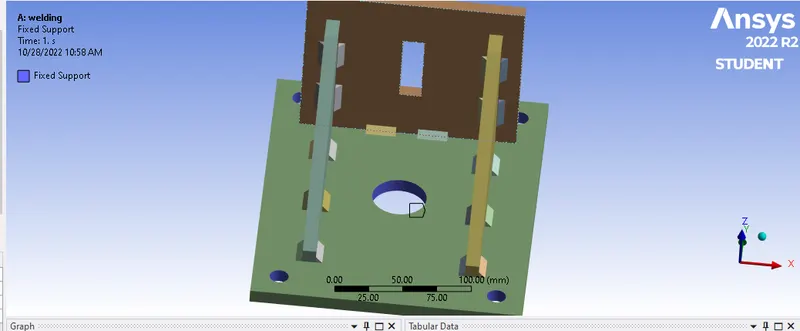
FIX SUPPORT:
By right click on statistic structure insert fix support and select all hole of big plate as geometry.
As shown in below image.
FORCE:
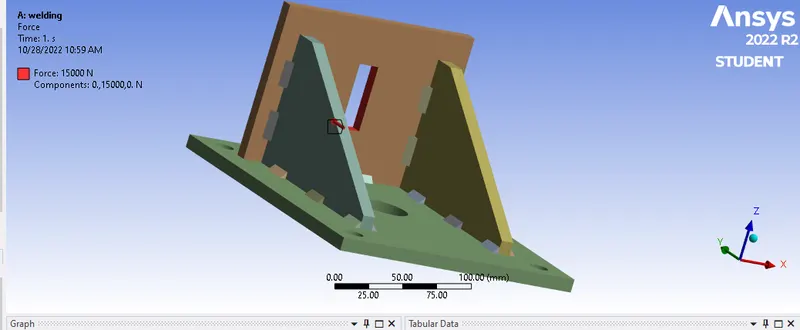
By right click on statistic structure insert FORCE for the small plate and select all inner face of hole of small plate as geometry. Defined by components insert force along Y direction of 15000 N. X & Z should be constant.
Run the simulation for a load of 15000N that is to be applied at the rectangular hole in the small plate.
SOLUTION:
Now click on solution for solve and run the simulation, getting result as per given below.
CASE 1: Stainless steel.
Case 2: Aluminum alloy. (Weld material)
Plate material stainless steel.
Case 3: Bronze: (weld material)
Stainless steel (both plate)
Copper (Ribs)
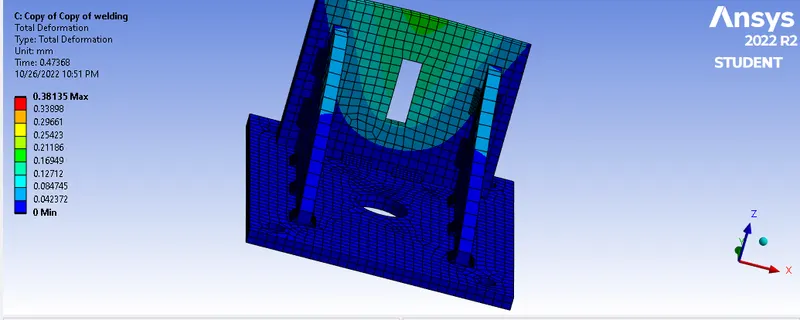
TOTAL DEFORMATION
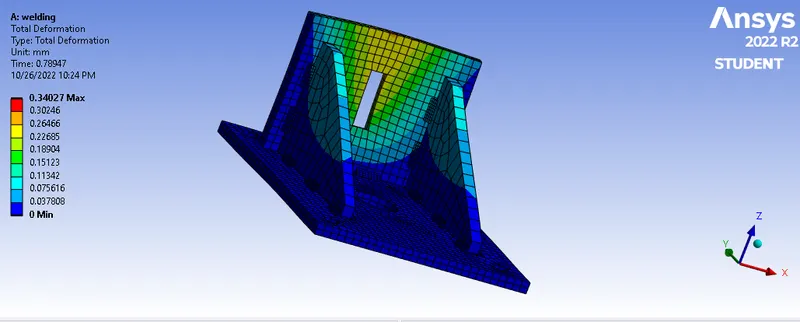 CASE 1
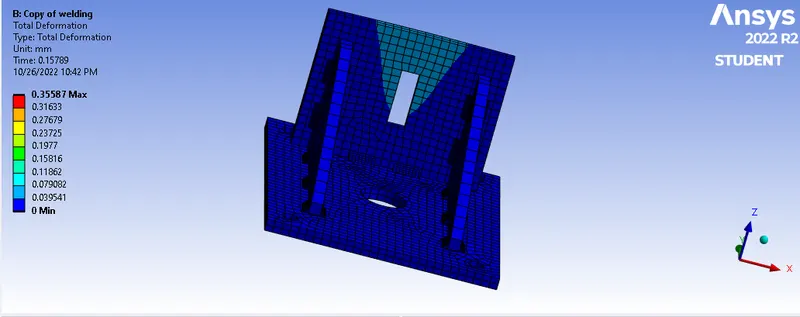 CASE 2
 CASE 3
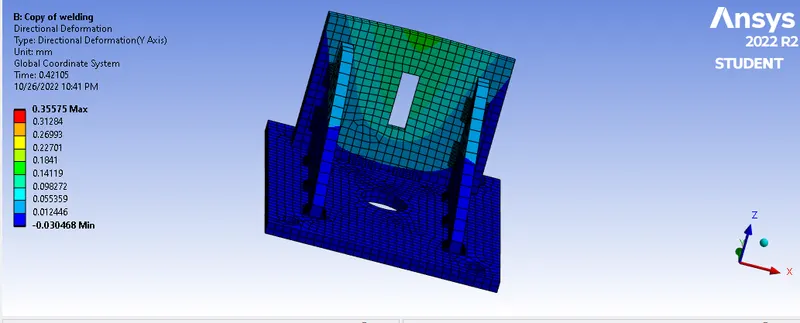
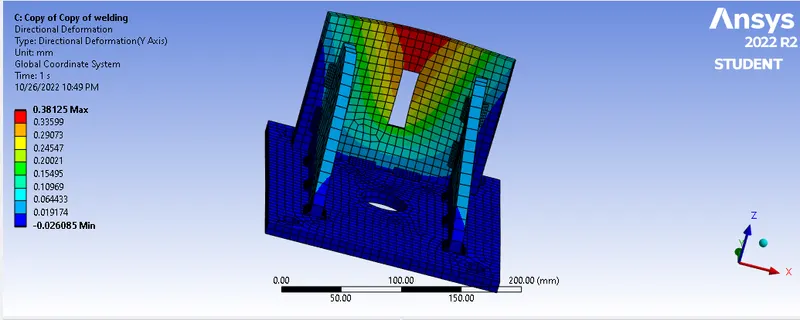
Directional deformation can be seen deformation less for stainless steel due to higher stiffness as compared to alluminium and bronze.
and highest for bronze material due to low stiffness of material it directly depend on youngs modulus.
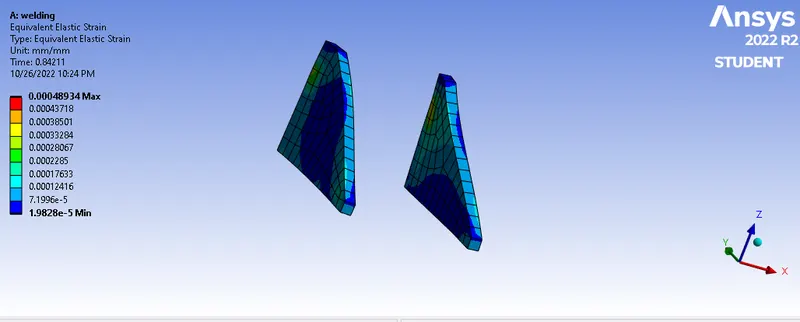
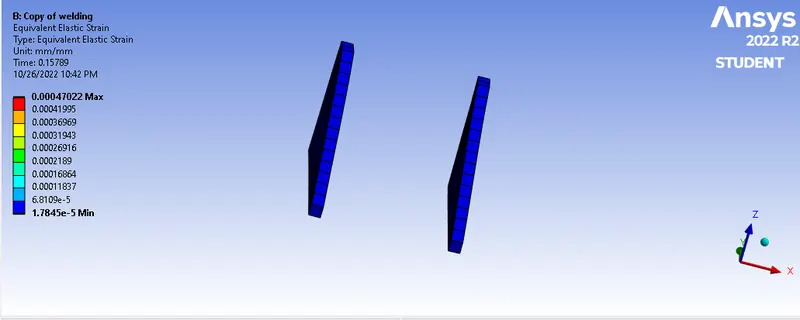
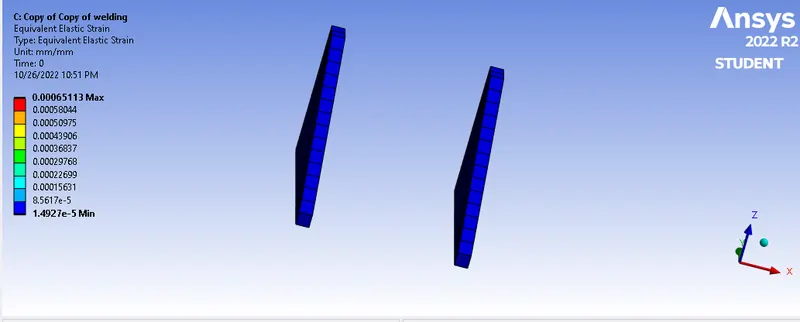
EQUIVALENT ELASTIC STRAIN
 CASE 1
 CASE 2
 CASE 3
- Equivalent elastic strain are lowest for alluminium (case 2) as compaered to other material.
- followed by stainless steel and bronze.
EQUIVALENT STRESS
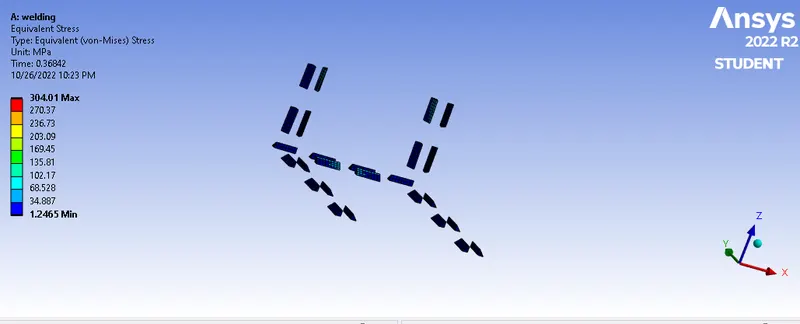 CASE 1
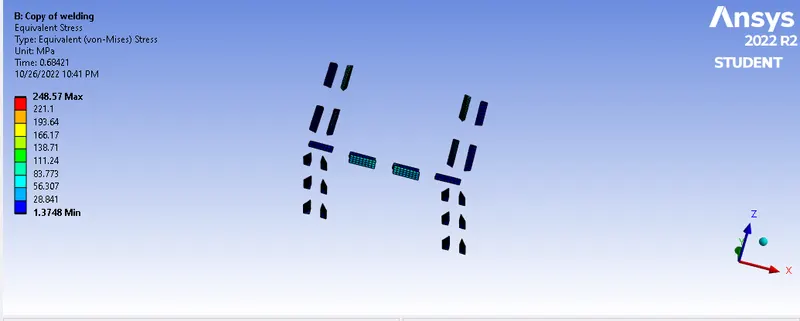 CASE 2
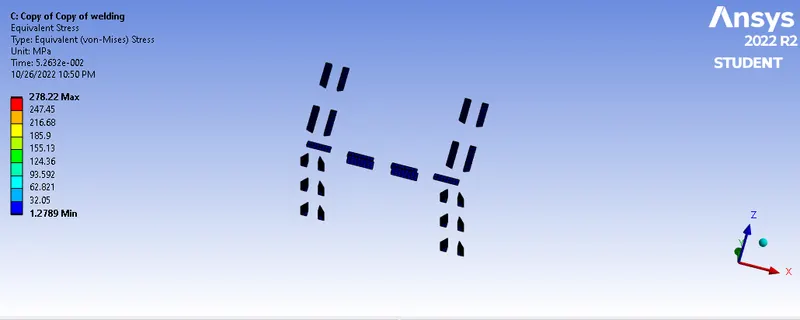 CASE 3
The highest stress on weld joint is observed in Structural Steel(Case 1) followed by bronze (case 3) and Aluminium (case 2).
DIRECTIONAL DEFORMATION
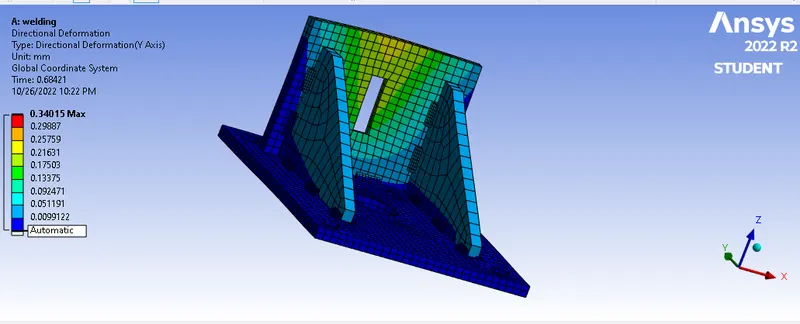 CASE 1
 CASE 2
 CASE 3
PRESSURE
 CASE 1
 CASE 2
 CASE 3
COMPARISION :
|
MATERIAL
|
CASE 1 |
CASZE 2 |
CASE 3 |
|
DIRECTIONAL MAX DEFORMATION min |
0.34015 0 |
0.35575 -0.030468 |
0.38125 -0.026085 |
|
EQUIVALENT STRESS max min |
304.01 1.2465 |
248.57 1.3748 |
278.22 1.2789 |
|
TOTAL max DIFORMATION min |
0.34027 0 |
0.35587 0 |
0.38135 0 |
|
EQUIVALENT MAX ELASTIC STRAIN MIN |
0.00048934 1.9828E-5 |
0.00047022 1.7845E-5 |
0.00065113 1.4927E-5 |
|
PRESSURE MAX MIN |
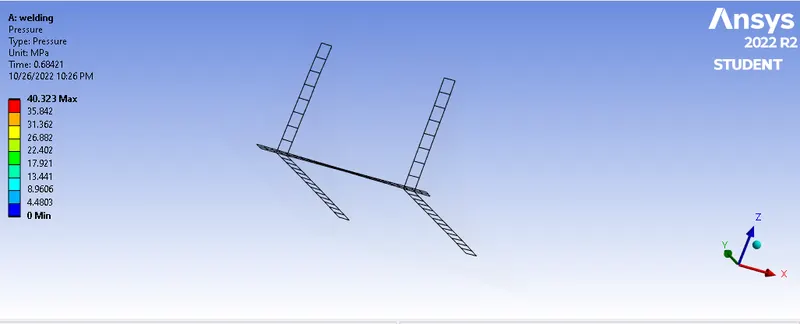
40.323 0 |
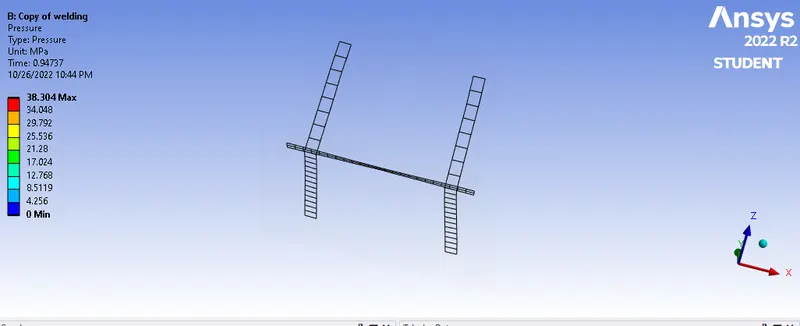
38.304 0 |
41.671 0 |
|
SAFETY FACTOR MAX MIN |
15 0.7418 |
15 0.73069 |
15 0.72333 |
CONCLUSION:
- The test cases were set up and simulation was run successfully.
- Considering the above table, the equivalent strain nearly remain the same in all cases with a marginal difference.
- The deformation is highest in the case of aluminum followed by Structural Steel and Bronze
- The highest stress on weld joint is observed in Structural Steel(Case 1) followed by bronze and Aluminium.
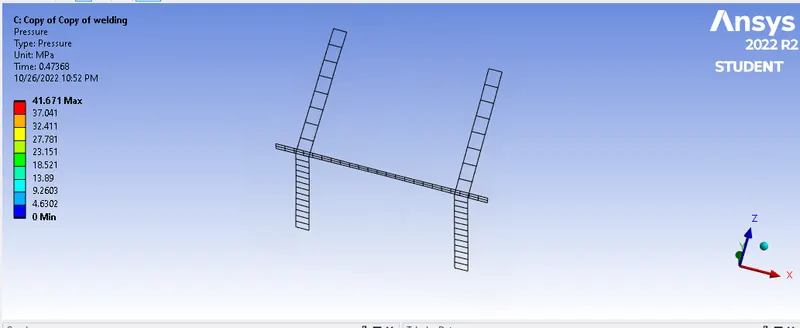
- pressure are higher for case 3 (bronze) followed by stuctural steel and alluminium.
- safety factor of all welds being above are nearly to the same.
- Equivalent elastic strain are lowest for alluminium (case 2) as compaered to other material.