Week 3 Sheet metal Bending challenge
Objective :-
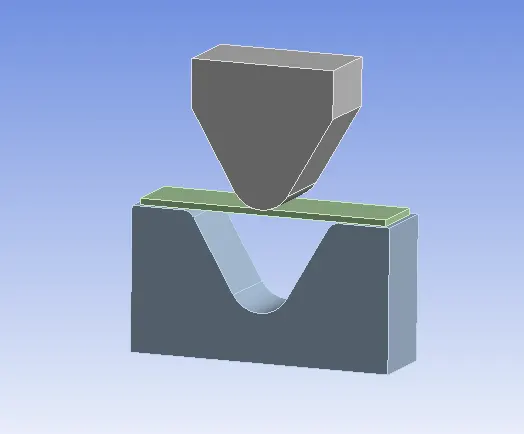
Sheet metal bending is to be performed for 3 different materials mentioned below.
Run the analysis for the material :
Case 1:Aluminium Alloy 1199,Copper Alloy NL and Magnesium Alloy NL. Find out the Equivalent stress, Equivalent elastic strain and Total Deformation in Y direction and compare the results for the three materials.
Case 2:With the material as Aluminium Alloy, change the friction coefficient to 0.19 and run the analysis as mentioned in Case 1. Compare the results with that in case 1.
Case 3: Refine the mesh on the plate such that it doesn't cross the academic limit. With Aluminium alloy as material, run the analysis as in Case 1 and compare the results.
Procedure :-
- open ansys workbench and drop down the static structure onto the project window.
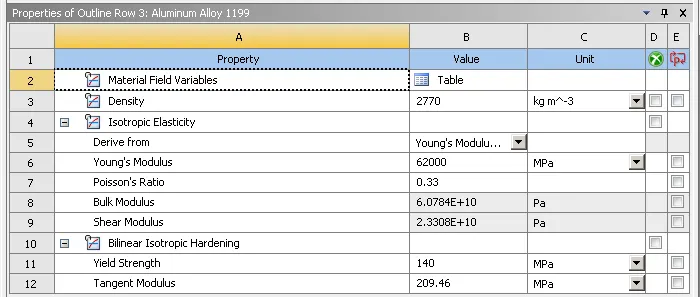
- Select/create materials (Aluminium Alloy 1199,Copper Alloy NL and Magnesium Alloy NL) from Engineering data sources with required properties.
- Import the geometry.
- Open the mechanical module.
case 1 :- Aluminium Alloy 1199 - properties
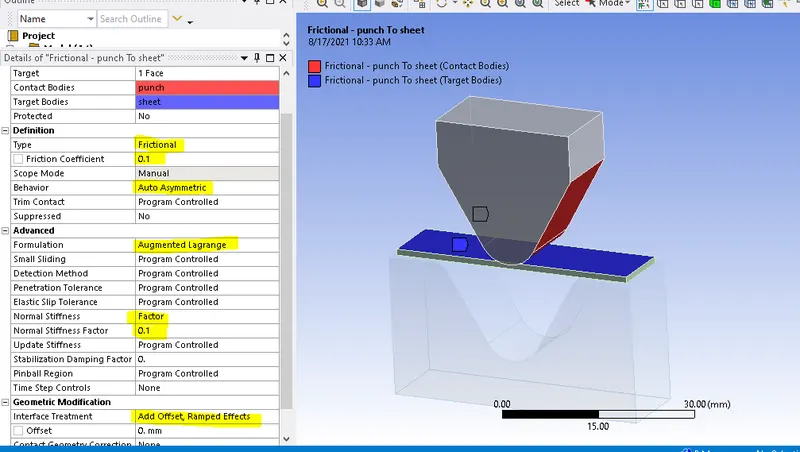
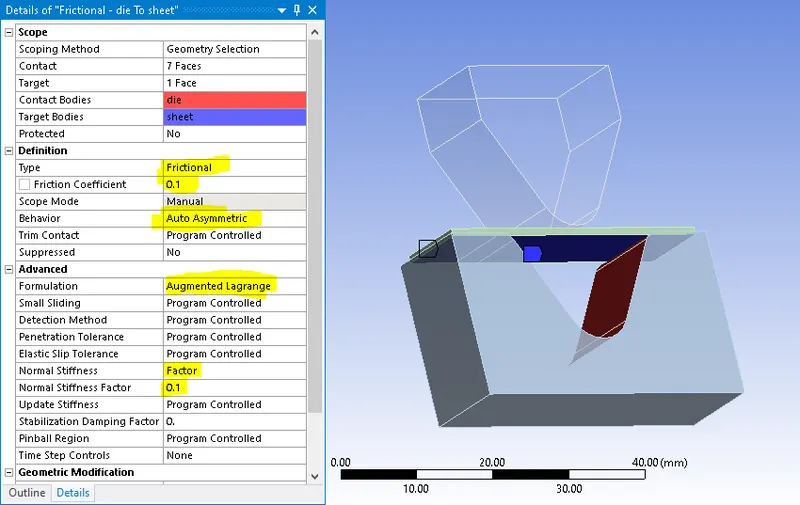
Contacts
- Delete the all default contacts generated by ansys workbench.
- Create a new contacts manually , contacts - insert- manual contact region.
- create a two frictional contacts (punch - sheet and sheet - die) with a frictional coefficient of 0.1
Mesh
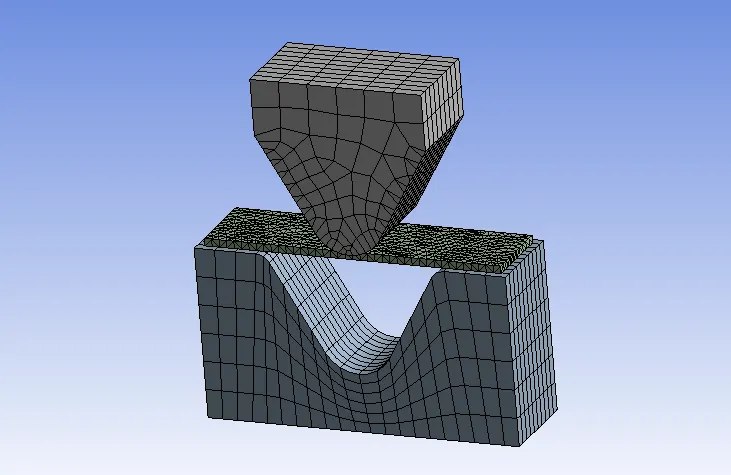
- Mesh the each component with different mesh sizes and types using Sizing and Method options
- Punch and Die - 4mm
- Sheet - 1mm
- contact faces of Punch and Die - 1mm
- change sheet mesh type to tetrahderal
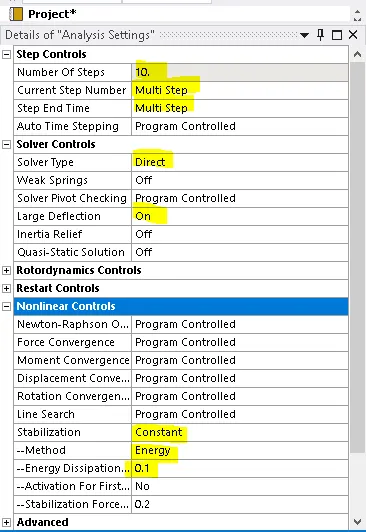
- Analytical settings - this analysis setup for 10 steps, this doesn't control time step, but it is only indication of points where boundary conditions change. the time step is auto controlled by minimum ,initial maximum and time steps.
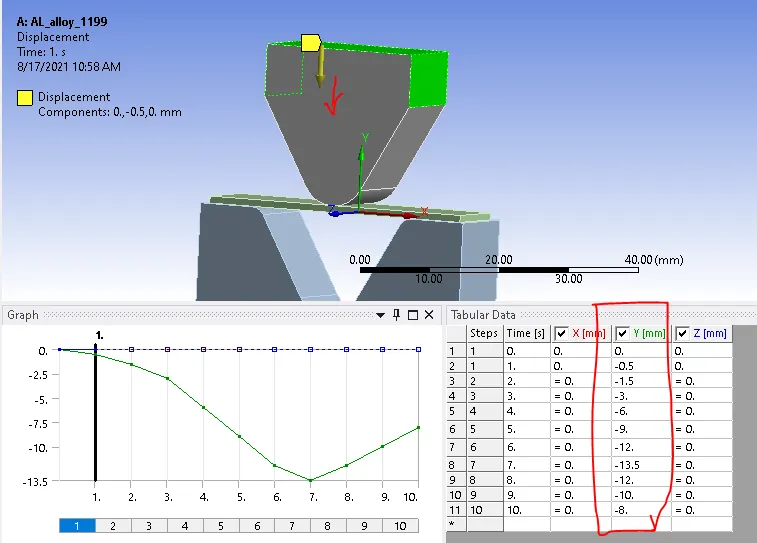
- Now the loads can be defined. during the bending process, punch will advance downwards and hits the sheet after that it will impact the die ,Punch needs to be come backwards after the bending process is complete.
- Static structural - insert- displacement (for punch).
- Select the three faces and Put displacement data in tabular format as shown below.
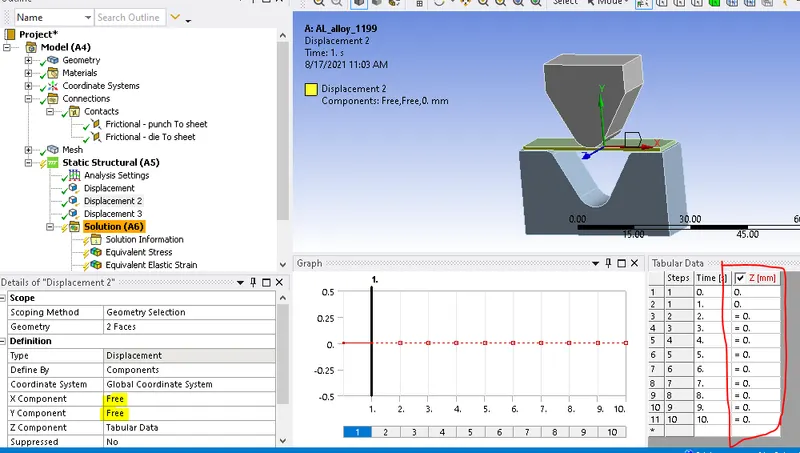
- Static structural - insert- displacement (forsheet).
- Select the two faces (front and back side) and Put displacement data in tabular format as shown below.
- Static structural - insert- displacement (for die).
- Select the faces and Put displacement data in tabular format as shown below.
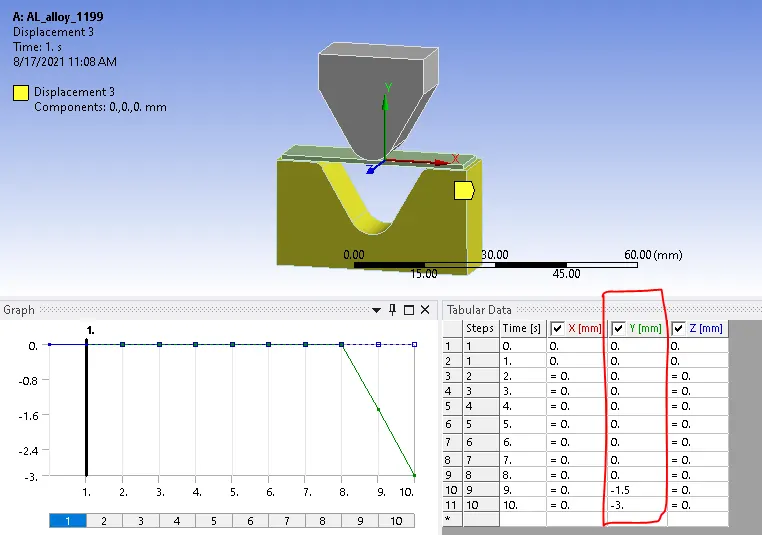
- Follow the same proecdure for Copper Alloy NL and Magnesium Alloy NL .
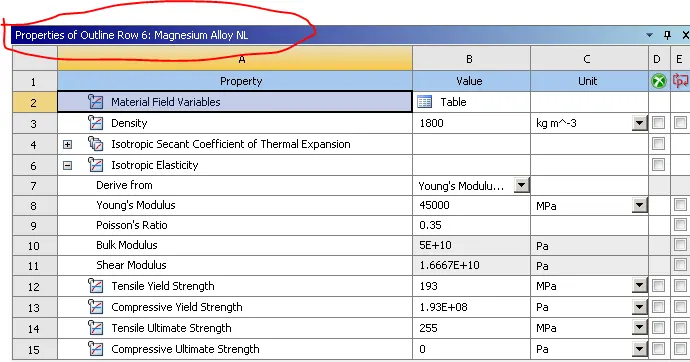
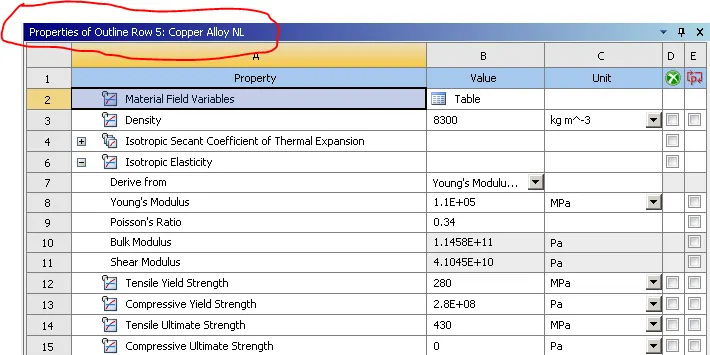
- Output parameters such as Equivalent stress, Equivalent elastic strain and Total Deformation in Y direction have been requested and run the simuation.
RESULTS:-
The simulation for sheet meta has been performed using 3 different materials and compare the results
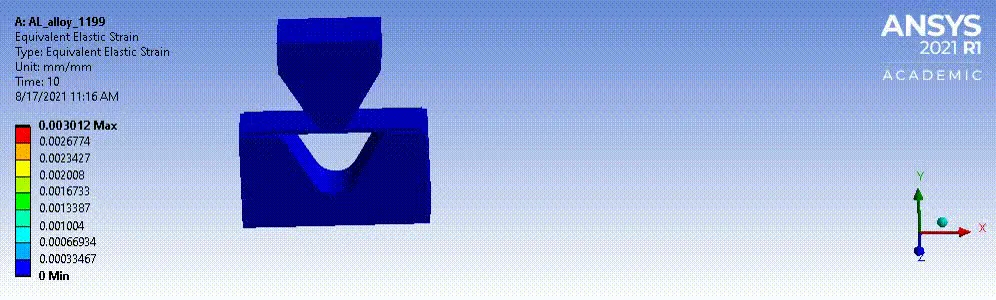
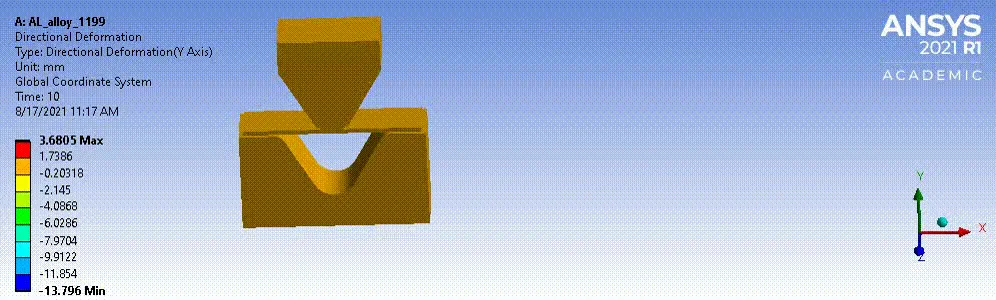
some of the results for Aluminium Alloy 1199
Equivalent stress
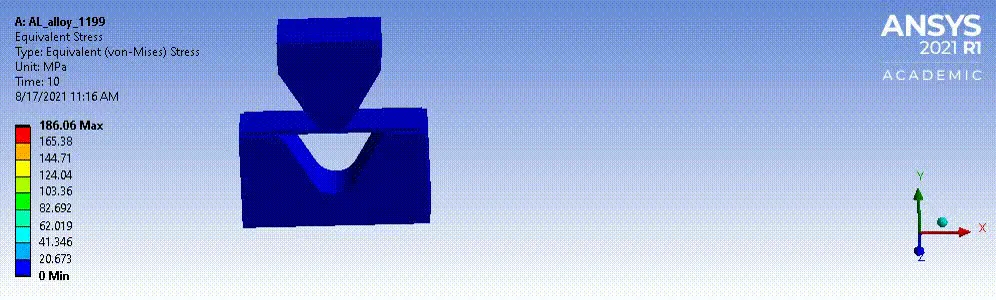
Equivalent elastic strain
Total Deformation in Y direction
Comparing results
case - 1
| Equivalent stress (MPA) | Equivalent elastic strain | Total Deformation in Y direction (mm) | |
| Aluminium Alloy 1199 | 52.949 | 0.0015694 | 2.3603 |
| Copper Alloy NL | 4840.3 | 0.044034 | 0.76049 |
| Magnesium Alloy NL | 1990.6 | 0.044268 | 0.76605 |
case -2
- The coefficient of friction was compared for the values for 0.1 and 0.19 using Aluminium Alloy 1199 sheet metal
| Equivalent stress (MPA) | Equivalent elastic strain | Total Deformation in Y direction (mm) | |
| coefficient of friction -0.1 | 52.949 | 0.0015694 | 2.3603 |
| coefficient of friction - 0.19 | 54.112 | 0.0015784 | 2.3234 |
case - 3
- simulation was performed on sheet with mesh size of 0.75mm using Aluminium Alloy 1199 material.
| Mesh size | Equivalent stress (MPA) | Equivalent elastic strain | Total Deformation in Y direction (mm) |
| 1mm | 52.949 | 0.0015694 | 2.3603 |
| 0.75mm | 70.612 | 0.001682 | 2.2416 |
CONCLUSION
- For case 1, we can see that stress is more in Copper Alloy NL (bcz copper has highest E value) and less in Aluminium Alloy 1199, therefore sheet with Aluminium Alloy 1199 will be having max strength to withstand the failure compared to other matrials in list and Copper Alloy NL has min strength.
- For case 2, AL alloy with coefficient of friction 0.19 has more stress than coefficient of friction 0.19 and small change (negligible) strain.
- For case 3, Stress and strain values more for 1mm mesh size, accuracy of model depends on mesh size typcally small mesh size will give you more accurate results but it takes more simuation time , select the mesh size by considering time and required accuracy for the model.
GOOGLE LINK