Static structure analysis of Sheet Metal Bending
OBJECTIVE: To perform sheet metal bending of 3 different materials and perform variation of certain settings.
Case 1: Use Aluminium Alloy 1199, Copper Alloy NL and Magnesium Alloy NL materials for the plate and do static structural analysis to find out the Equivalent stress, Equivalent elastic strain and Total deformation in Y direction and compare the results for the three materials.
Case 2: With the material as Aluminium Alloy and friction coefficient as 0.19, run the analysis as mentioned in case 1 and compare the results with that in case 1.
Case 3: Refine the mesh on the plate and with Aluminium Alloy as material, run the analysis as in case 1 and compare the results.
SOLUTION:
STEP 1) Design
The model is already provided and consist of three bodies namely, die, sheet and the punch.
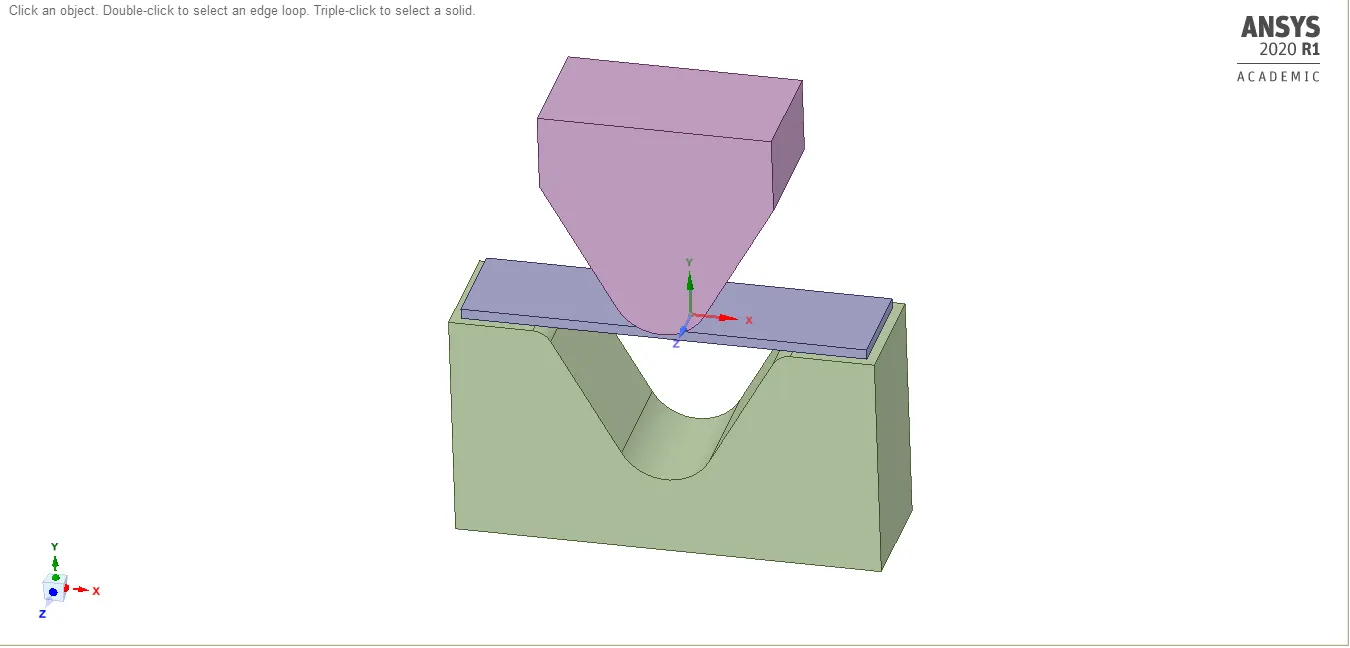

STEP 2) Material
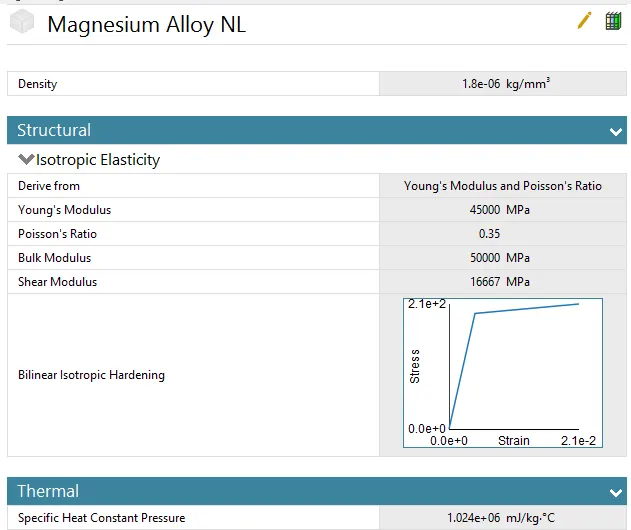
Punch and die were assign structural steel and sheet was assign Aluminium Alloy 1199, Copper Alloy NL and Magnesium Alloy NL materials for different cases. The properties of materials are given below.
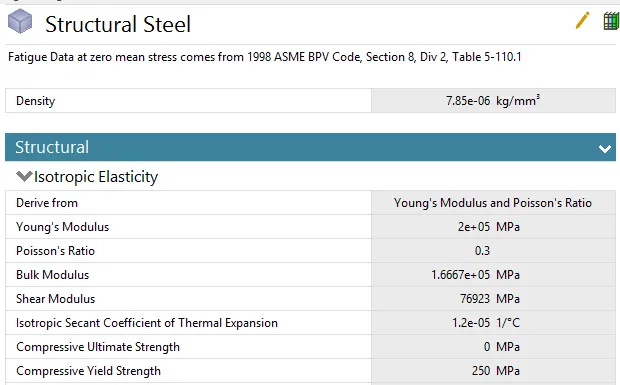
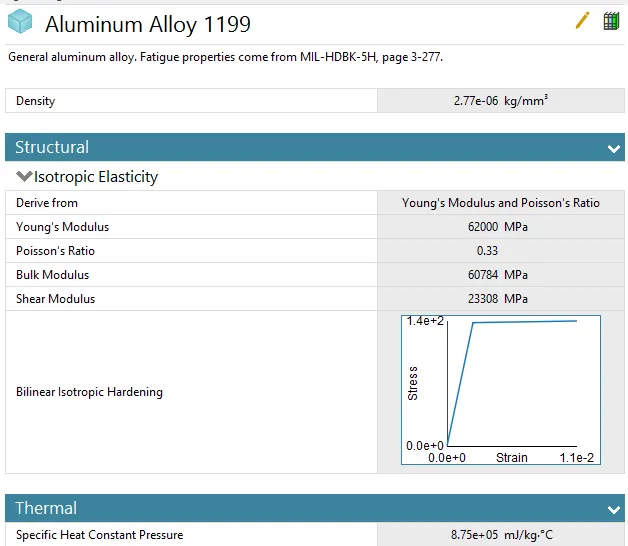
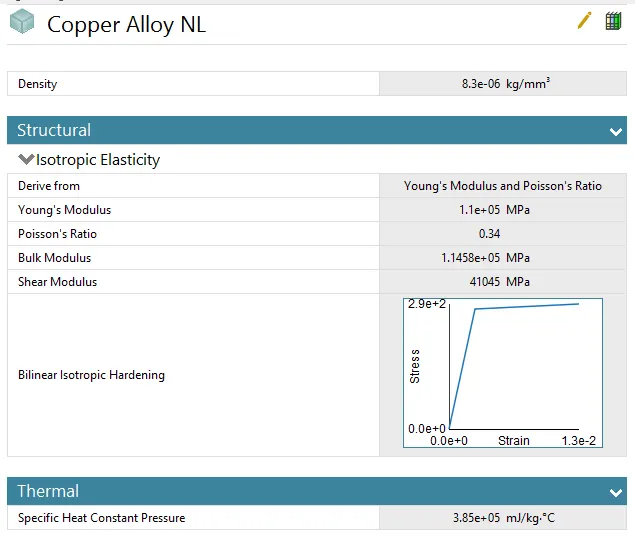
STEP 3) Connections
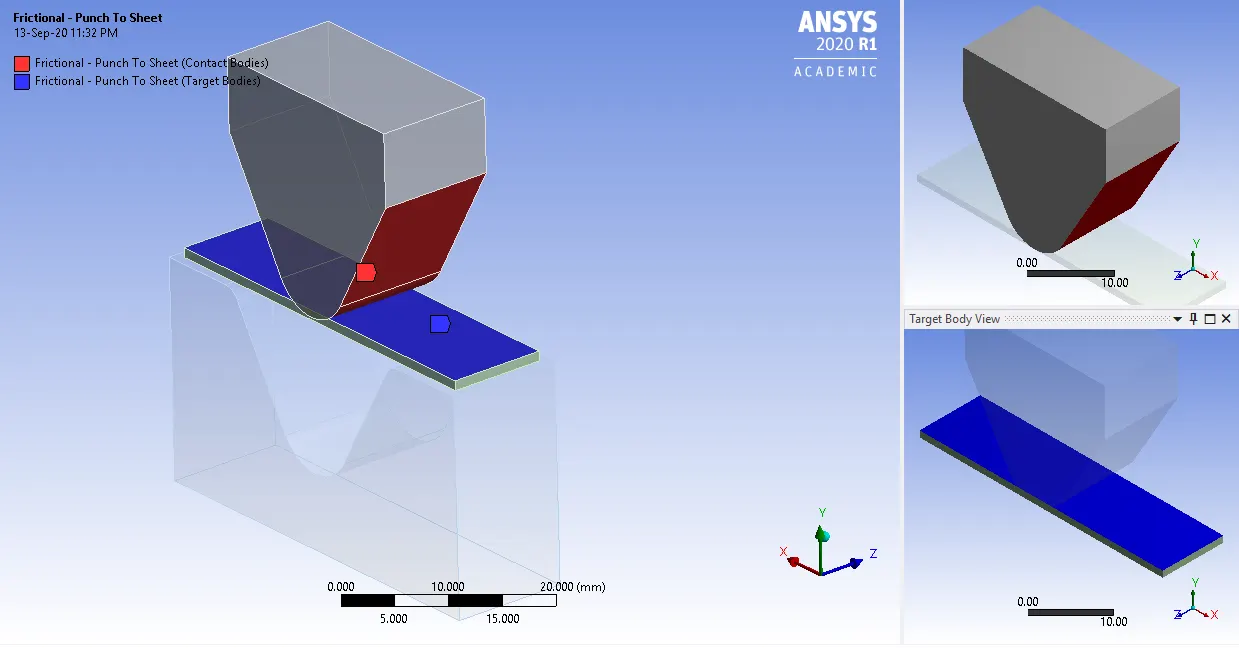
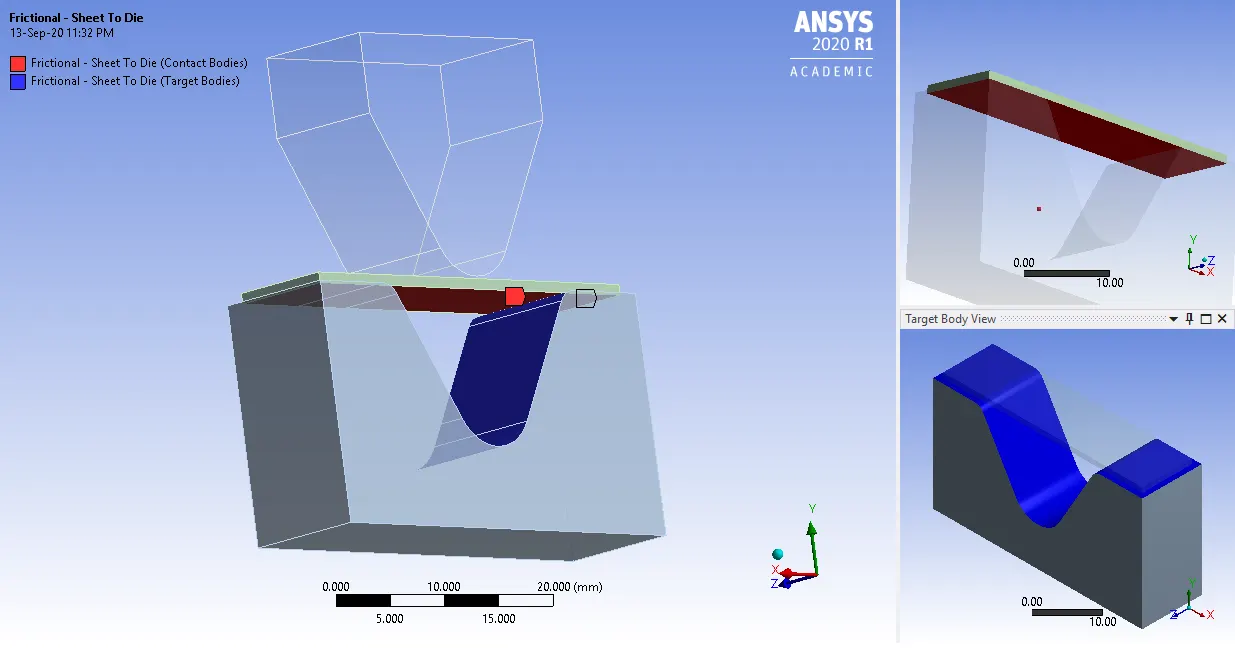
The default contacts between the bodies were deleted and new contacts were added. The first contact was defined between the punch and the sheet, with punch as contact and sheet as target. And other contact was defined between the sheet and the die, with sheet as contact and die as target. Both the contacts were defined as frictional with coefficient of friction as 0.1. The behavior of contact was defined as auto asymmetric and formulation as augmented langrage. A normal stiffness factor of 0.1 was given and the interface treatment was defined as add offset, ramped effect.


STEP 4) Meshing
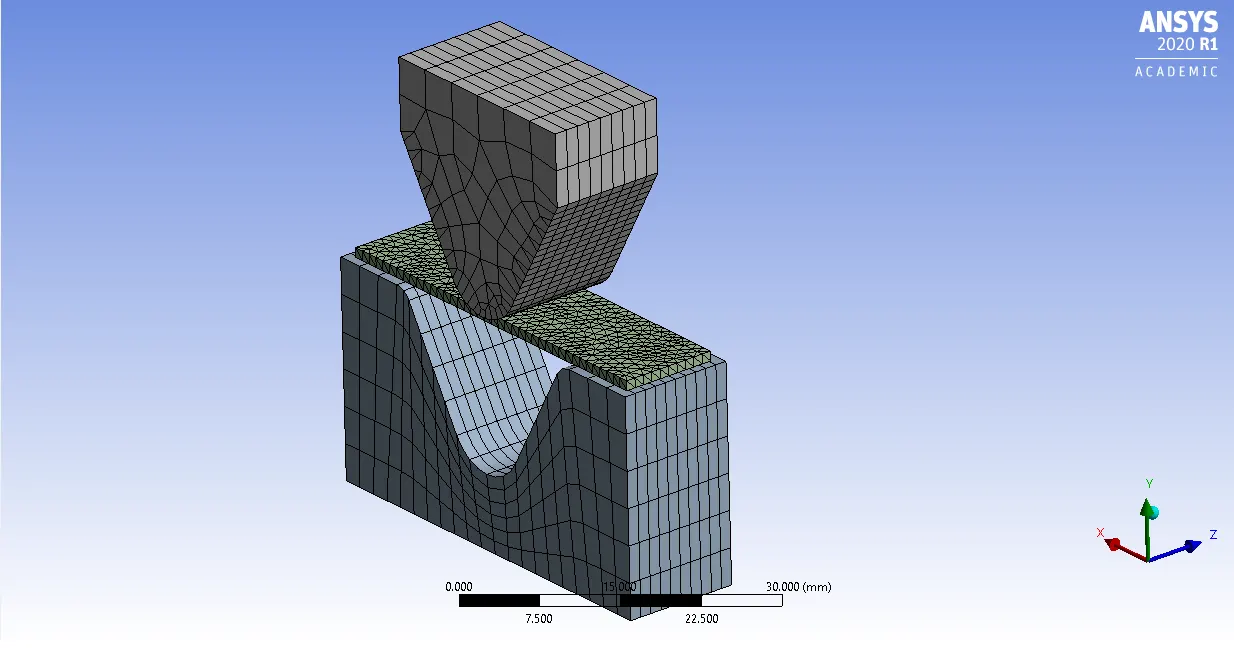
The model was meshed with default mesh. Using sizing method the sheet and contacts were given a finer mesh size of 1mm. Further the sheet was given tetragonal mesh using patch conforming method.

STEP 5) Analysis settings and displacements
In this step, the movement of the bodies were defined. The displacement was defined in 10 steps. The punch has to move down such that it bends the sheet into the die cavity and given a displacement along y direction. The displacement of the sheet is constraint along Z axis. When the punch bend the sheet to its maximum limit then it will retard back as well as die will also retard back by some distance.
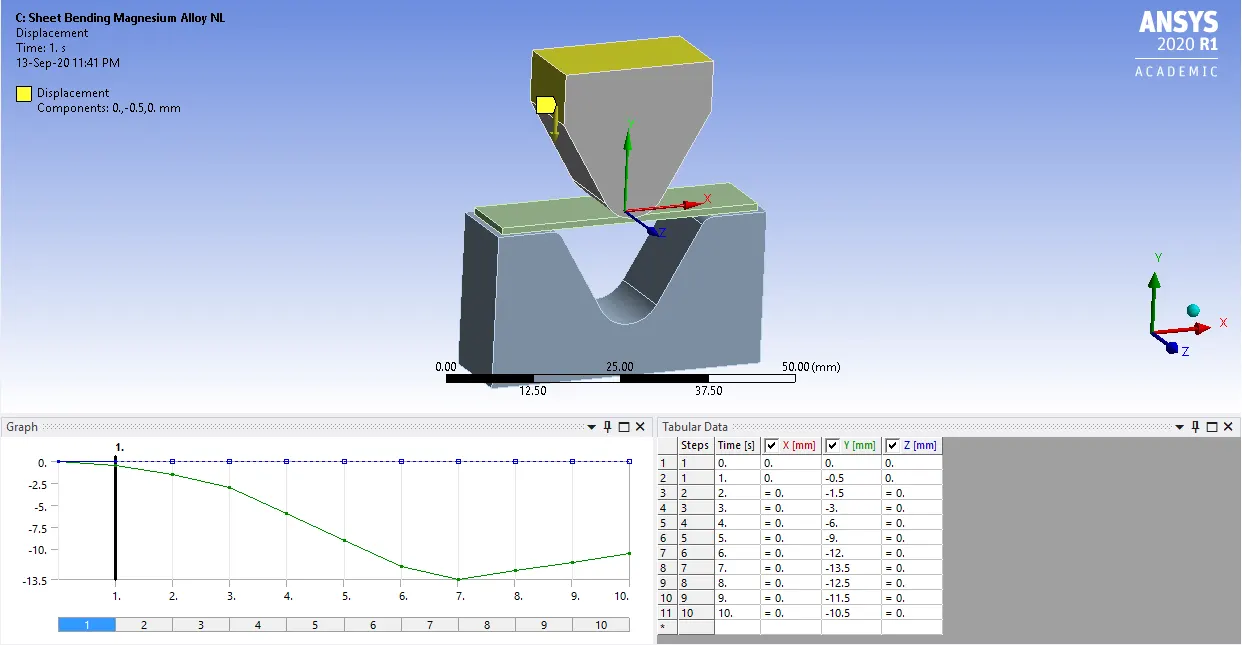

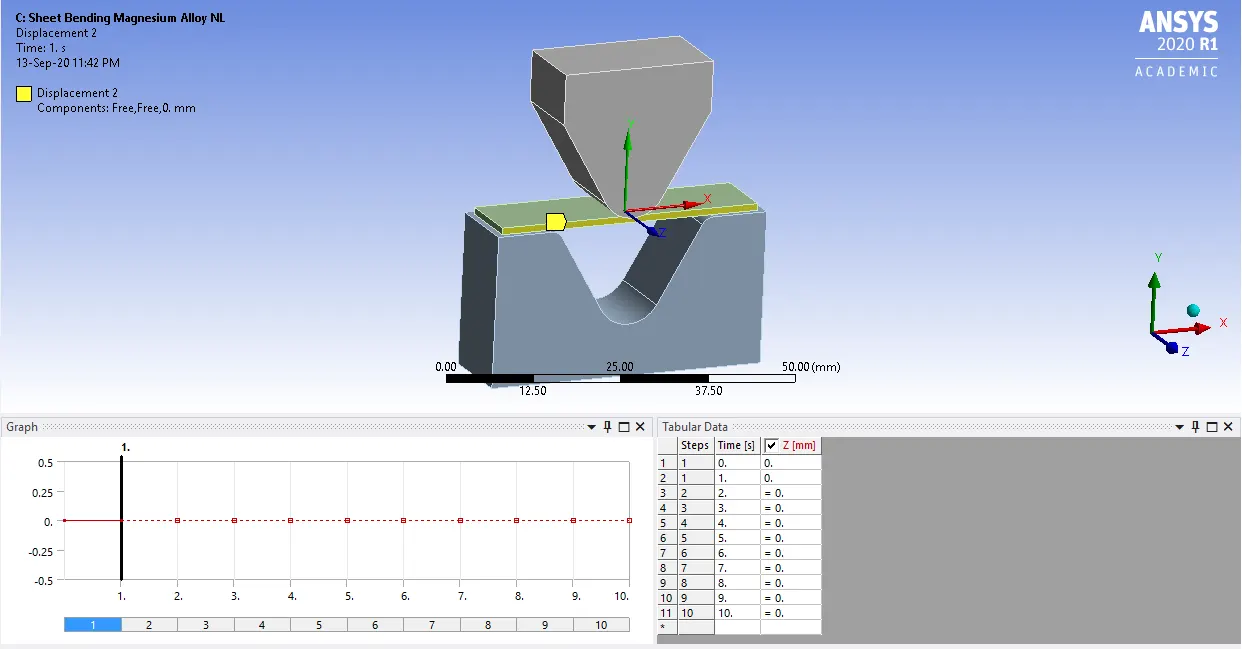

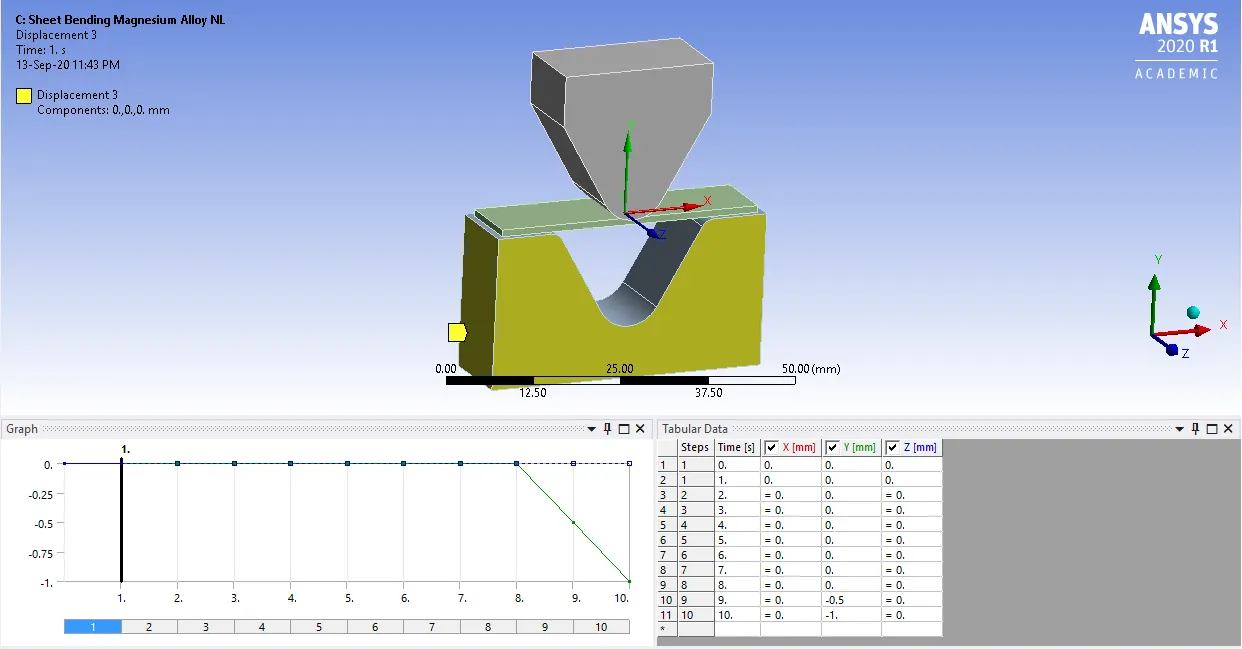

In the analysis settings the solver type is direct, with large deflection turned on and energy dissipation factor was set as 0.1.
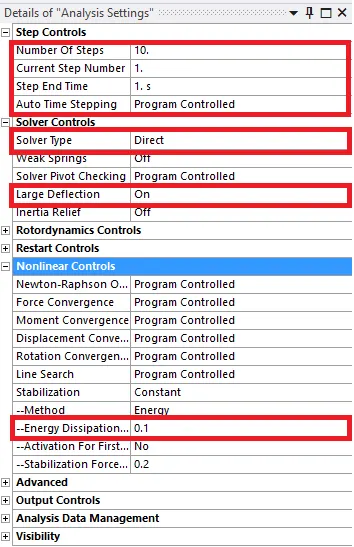


STEP 6) Results
CASE 1:
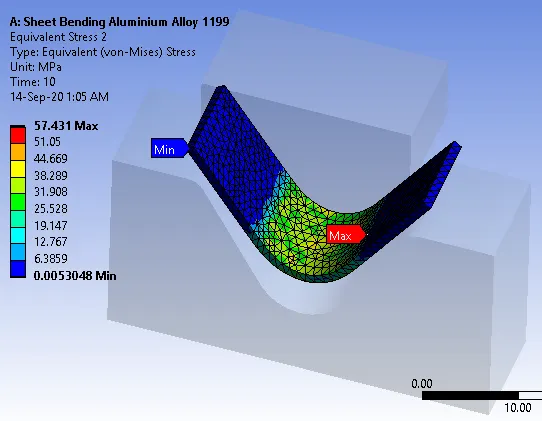
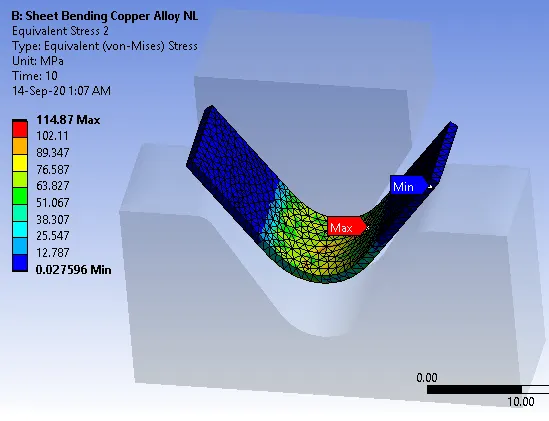
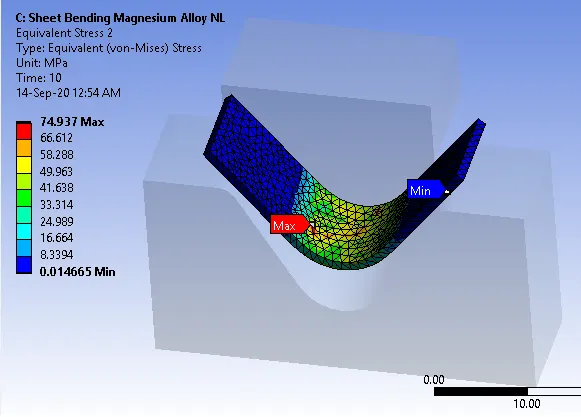
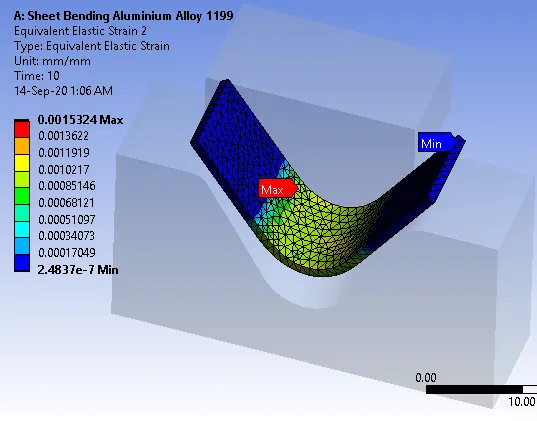
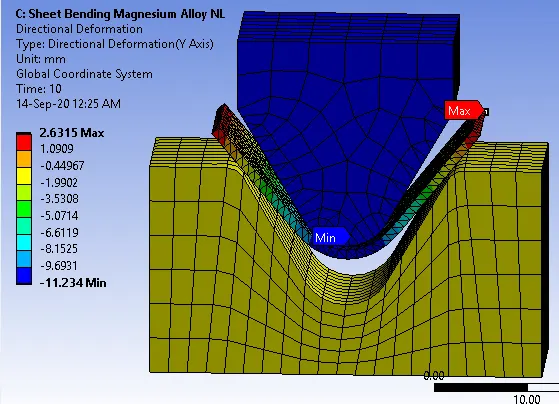
The equivalent stress, equivalent strain and total deformation of sheet in y direction was evaluated for the above materials.
1) Equivalent stress



2) Equivalent strain
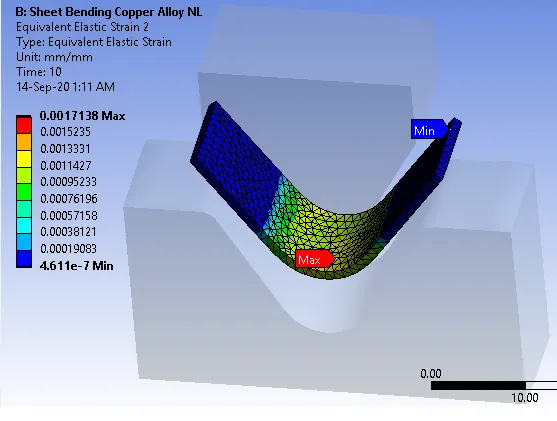
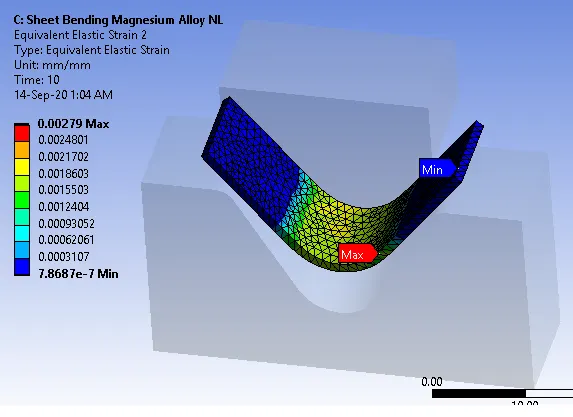
3) Directional deformation
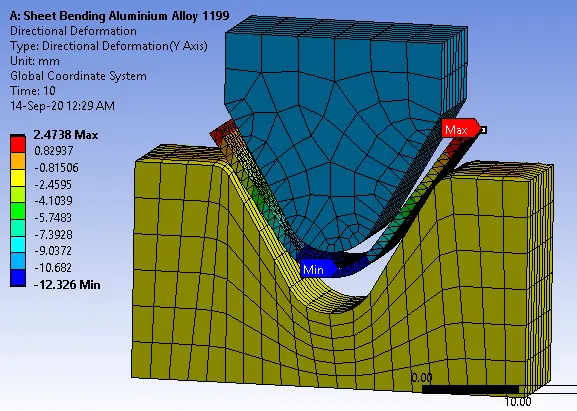
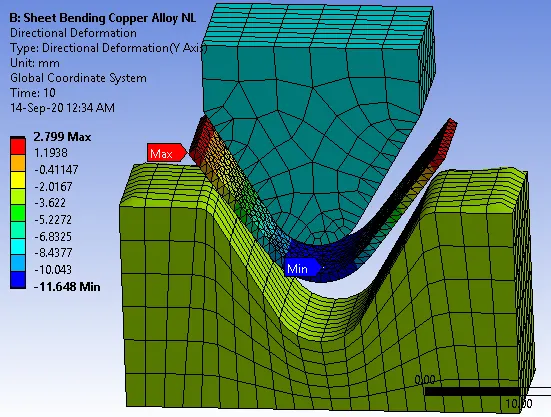
|
Material |
Equivalent stress (MPa) |
Equivalent strain |
Directional deformation (mm) Max Min |
|
Aluminium Alloy 1199 |
57.431 |
0.0015324 |
2.4738 -12.362 |
|
Copper Alloy NL |
114.87 |
0.0017138 |
2.799 -11.648 |
|
Magnesium Alloy NL |
74.937 |
0.00279 |
2.6315 -11.234 |
CASE 2:
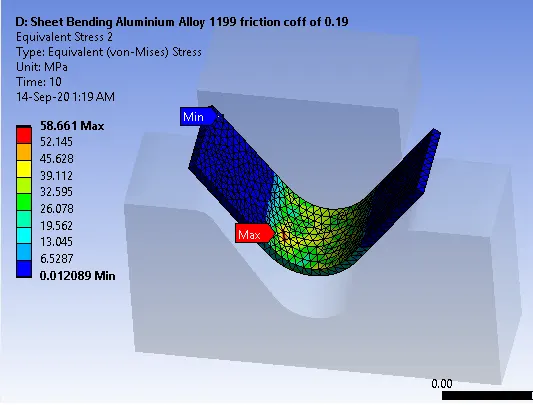
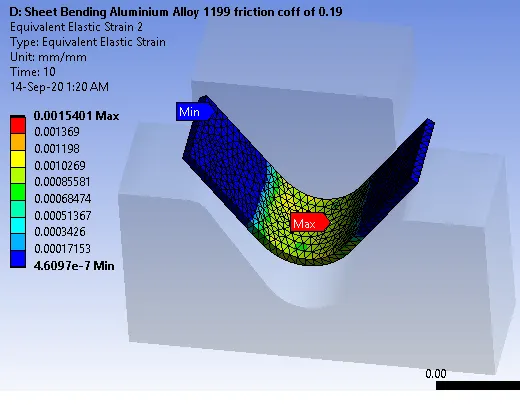
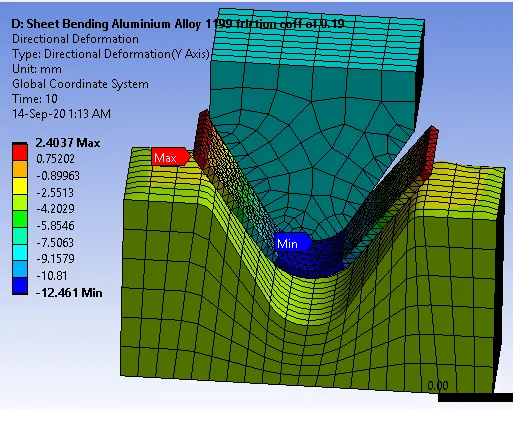
In case 2 the coefficient of friction is increased to 0.19 and material was aluminum alloy 1199. Results were evaluated and compared with case 1.
1) Equivalent stress

2) Equivalent strain
3) Directional deformation
|
Coefficient of friction (µ) |
Equivalent stress (MPa) |
Equivalent strain |
Directional deformation (mm) Max Min |
|
0.19 |
58.661 |
0.0015401 |
2.4037 -12.461 |
|
0.1 |
57.431 |
0.0015324 |
2.4738 -12.326 |
CASE 3:
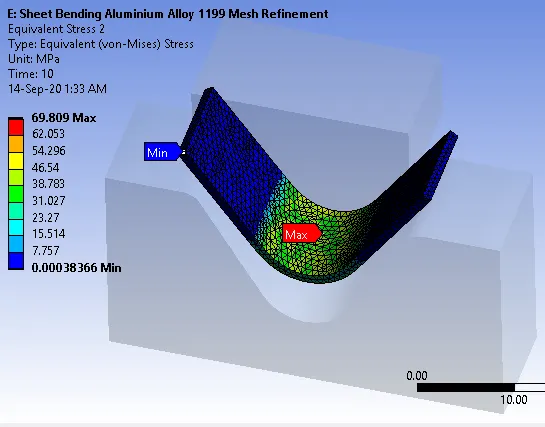
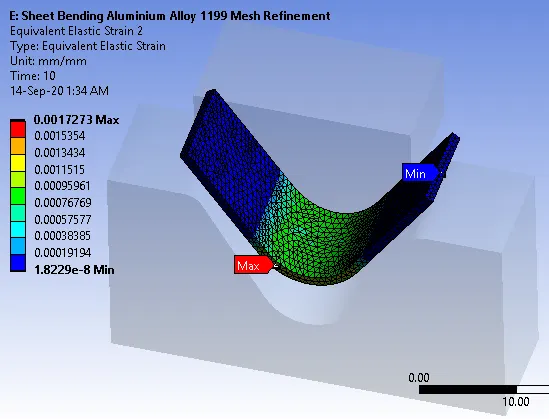
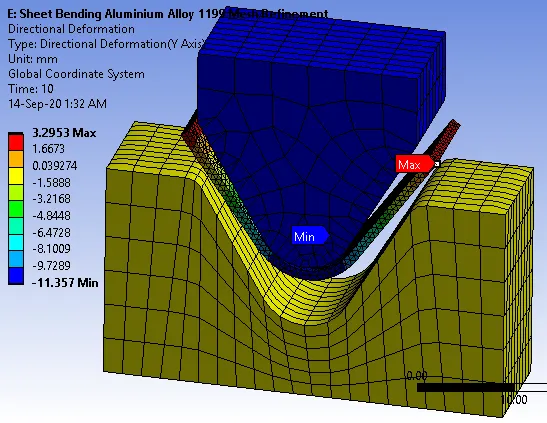
In case 3 the mesh size was refined to the academic version limit. This was done maintaining the default mesh size and refining the mesh size of sheet to 0.7mm. then the results were evaluated and compare with case 1.
1) Equivalent stress

2) Equivalent strain
3) Directional deformation
|
Case |
Equivalent stress (MPa) |
Equivalent strain |
Directional deformation (mm) Max Min |
|
1 |
57.431 |
0.0015324 |
2.4738 -12.326 |
|
3 |
69.809 |
0.0017273 |
3.2953 -11.357 |
CONCLUSIONS:
Case 1:
- Equivalent Stress : Copper Alloy NL > Magnesium Alloy NL > Aluminium Alloy 1199
- Equivalent Strain: Magnesium Alloy NL > Copper Alloy NL > Aluminium Alloy 1199
- Directional Deformation : Aluminium Alloy 1199 > Copper Alloy NL > Magnesium Alloy NL
The yield strength and tensile strength of the material plays very important role in sheet metal bending. In order for the material to be permanently deformed, the load has to exceed the yield strength of the material. To avoid fracture, the load has to be well below the ultimate strength of the material.
As from the above results we can conclude that, Copper Alloy has experienced highest stress. This is because Copper Alloy has highest yield strength, hence higher load is required to deform the metal sheet, which in turn generates higher stress.
Case 2:
In case 2, equivalent stress, equivalent strain and directional deformation increase when coefficient of friction increase. As more force is required to counter that frictional force.
Case 3:
In case 3, as we refined the mesh, then equivalent stress equivalent strain increased and directional deformation value show small decrease. So, we have to perform the grid dependancy test to obtain more accurate results.
Attached analysis files
https://drive.google.com/drive/folders/1pfQ6CwYQbjJPXBr-socnSp-3Et3Ap5B-?usp=sharing