Week 3 Sheet metal Bending challenge
Objective:
Sheet metal bending is to be performed for 3 different materials mentioned below. Variation of certain settings is also to be performed and conclusions are to be added to the report.
Case 1: To perform the Structural Analysis for Aluminium Alloy 1199 (mentioned in the course video), Copper Alloy NL, and Magnesium Alloy NL and find the Equivalent stress, Equivalent elastic strain, and Total Deformation in the Y direction and compare the results for the three materials.
Case 2: With the material as Aluminium Alloy, the friction coefficient to be changed to 0.19 and run the analysis as mentioned in Case 1. Compare the results with that in case 1.
Case 3: Refine the mesh on the plate such that it doesn't cross the academic limit. With Aluminium alloy as material, run the analysis as in Case 1 and compare the results. (Assumed Aluminium 1196 as comparison is to be with different mesh size.)
Analysis Set Up:
Static Structural Analysis is carried for Sheet Metal Bending set up. The materials used are Aluminium Alloy 1199, Copper Alloy NL, and Magnesium Alloy NL and analysis is carried out in Ansys Workbench. The Sheet Bending set up geometry is imported and shown in figure below. The system consists of Punch, Die and sheet to be bent Analysis is done for conditions required in Challenge Objectives. The analysis is required for 3 types of materials of Sheet whereas the material of Die and Punch are Structural Steel.
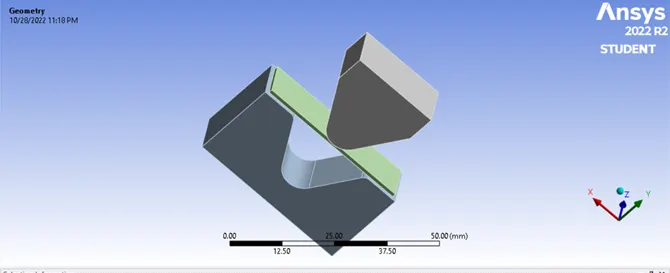
The analysis is done for Aluminium Alloy 1199 and with parametric for other materials and sheet mesh size. Analyses is done by Ansys software.
Properties of Materials:
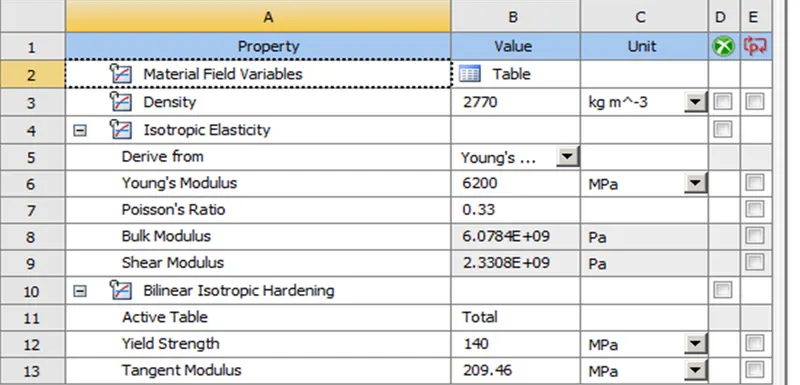
- Aluminium Alloy 1199
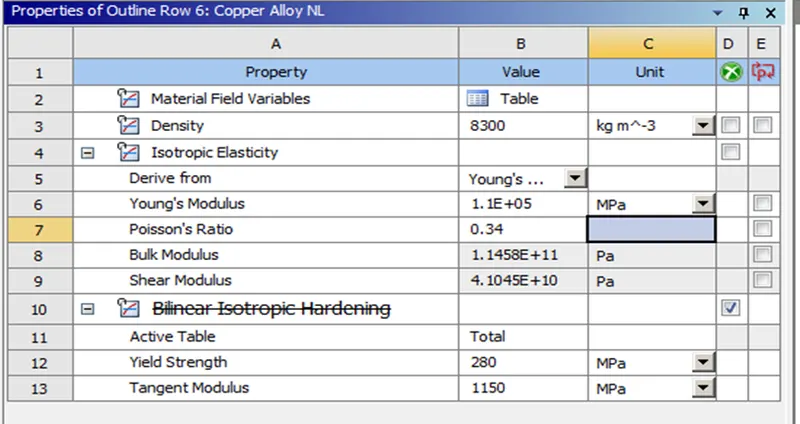
- Copper Alloy NL:
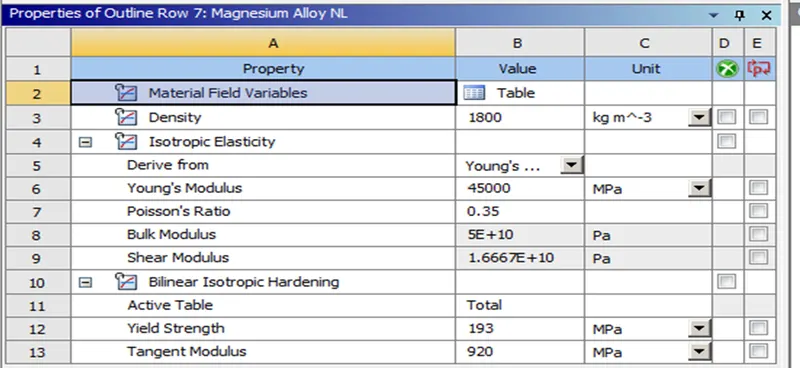
3. Magnesium Alloy
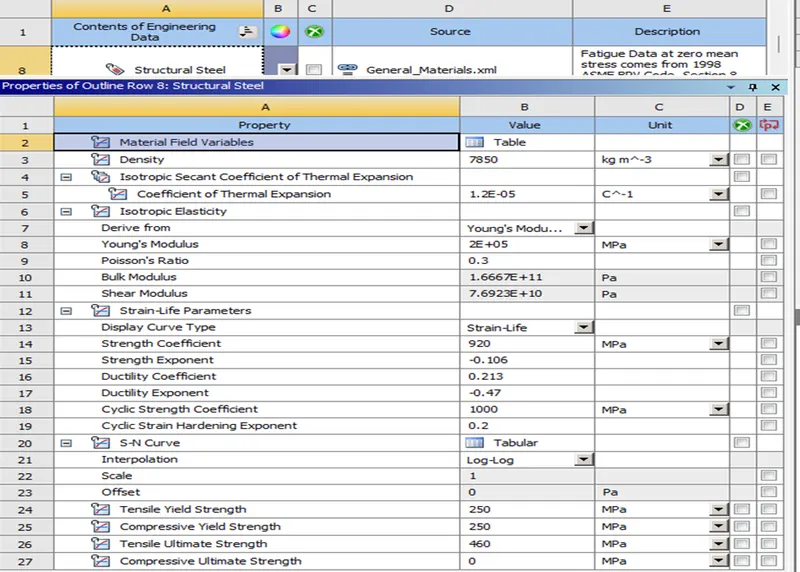
4. Structural Steel: (Die & Punch)
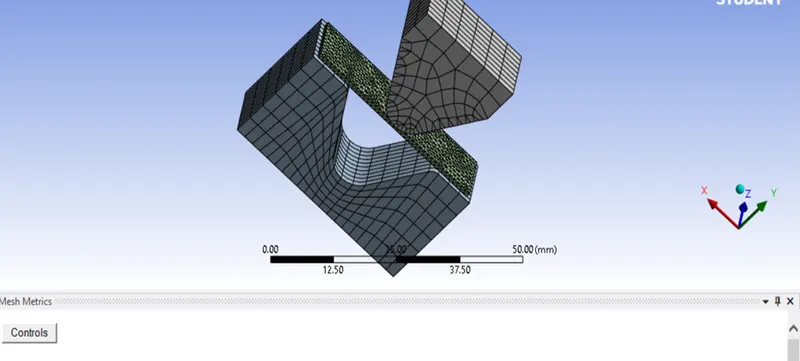
Mesh: 1. The mesh size of Punch and Die body is considered with 4 mm. The mesh size of surface in contact is 1 mm. The mesh size of Sheet to be bend is taken as 1 mm and is to Tetrahedron.
Nodes: 17859
Element: 6229
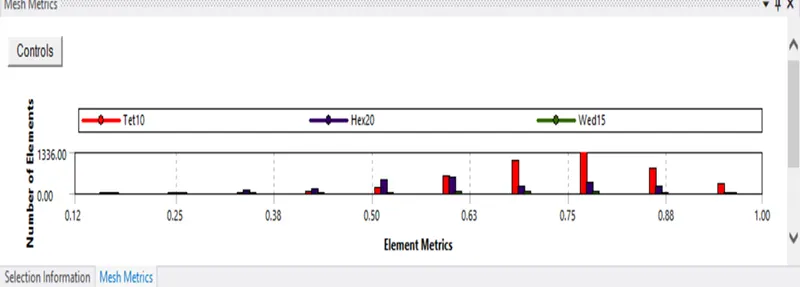
The Mesh Metrics are good as it concentrated beyond 0.5 and Tetrahedrons are high and hence acceptable.
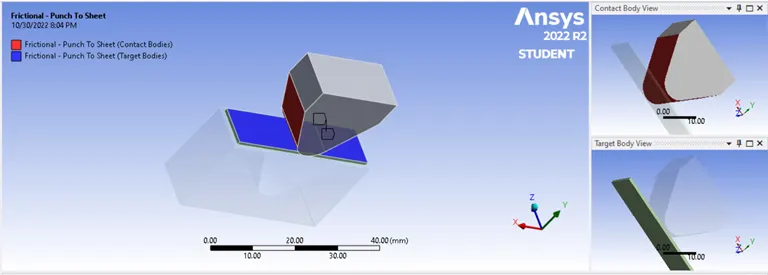
Contact Settings:
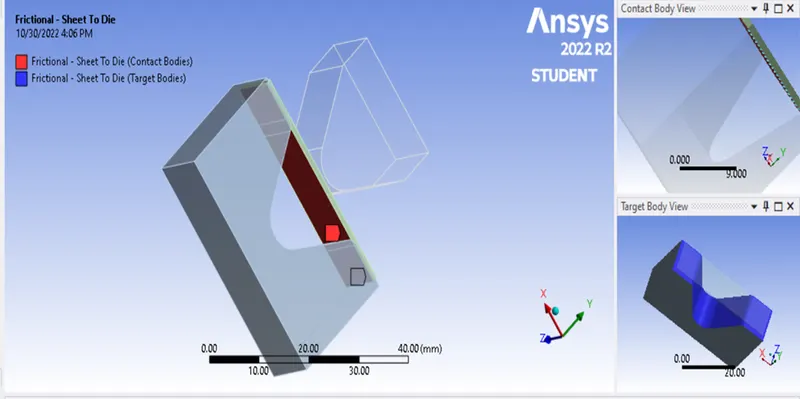
Type: Frictional Frictional Coefficient: 0.1
Behavior: Asymmetric Formulation: Augmented Lagrange
Normal Stiffness Factor: 0.1 Interface Treatment: Add Offsets, Ramped Effects
Punch to Sheet:
Sheet to Die:
Analysis Settings:
No. of Steps: 10 (Select all before pressing ‘Solve’)
Solver Type: Direct
Large Deflection: On
Energy Dissipation ratio: 0.1
Displacement Punch: settings shown in next page.
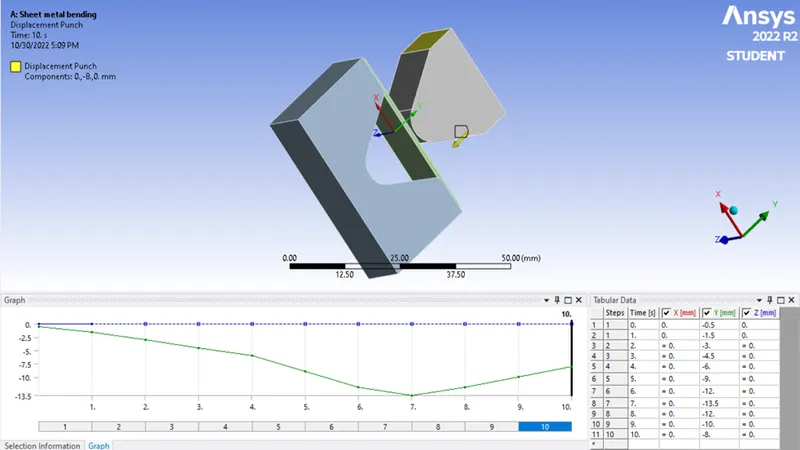
Displacement Punch: The desired displacement data is given in tabular form.
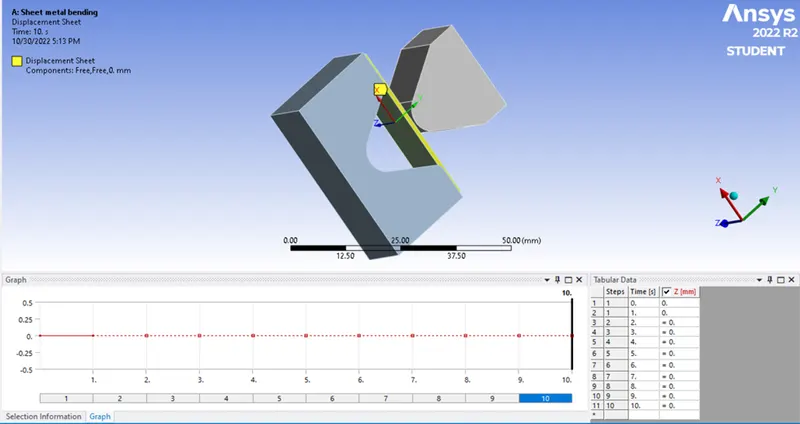
Displacement Sheet: The desired displacement data is given in tabular form.
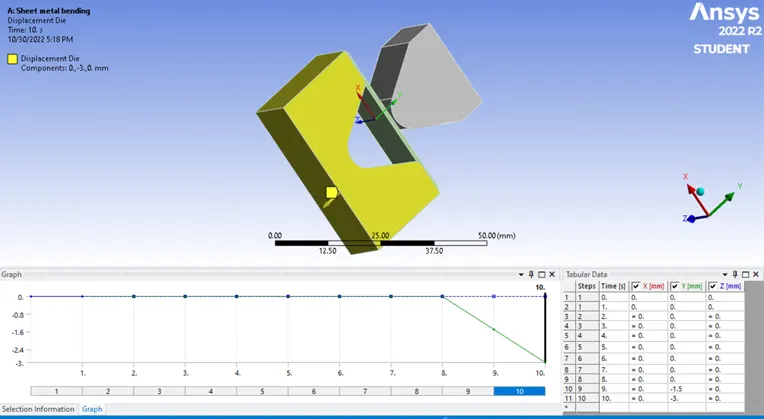
Displacement Die: The desired displacement data is given in tabular form.
Results:
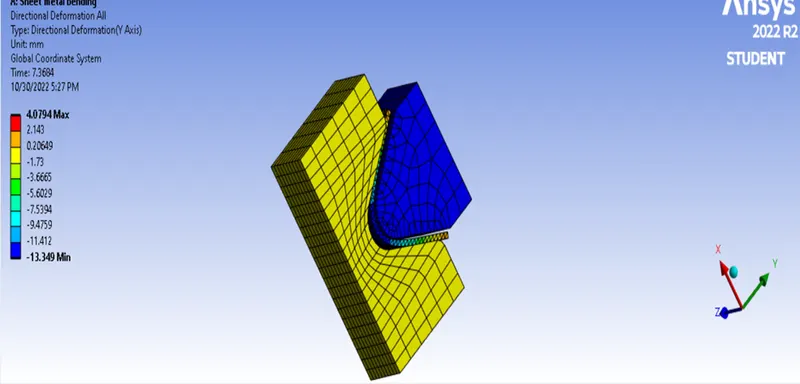
- Directional Deformation: All
- Equivalent Stress: All
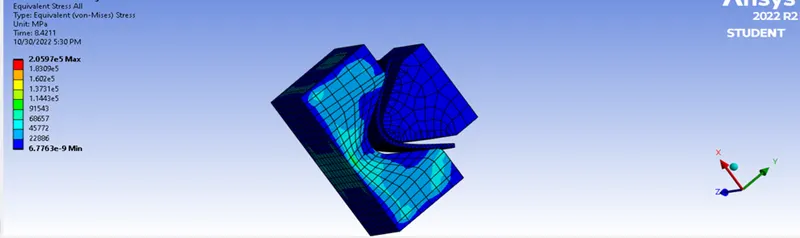 Equivalent
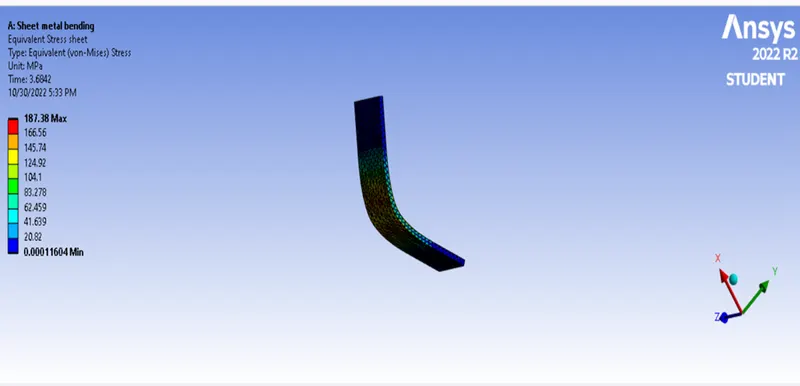
3. Equivalent Stress: Sheet
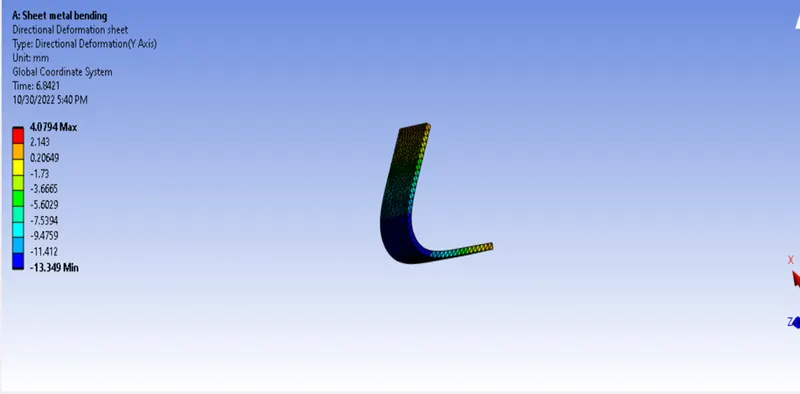
3. Directional Deformation: Sheet
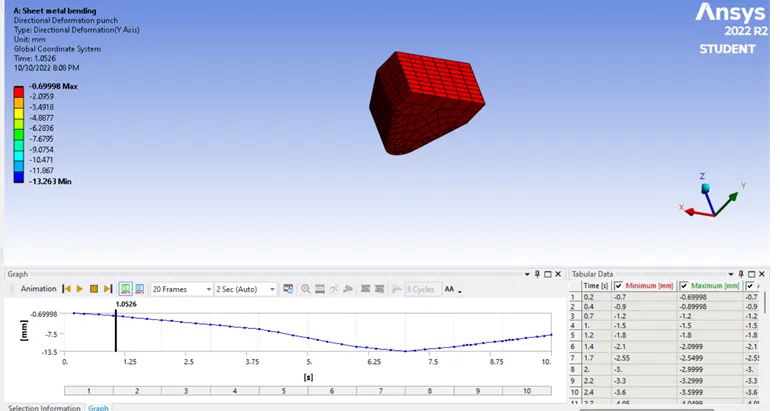
4. Direction Deformation Punch
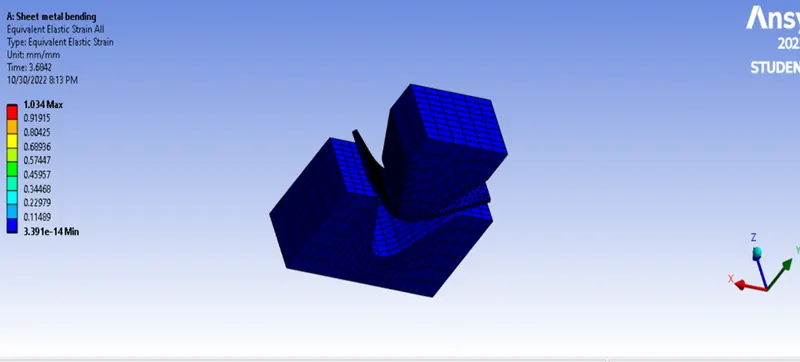
- Equivalent Elastic Strain
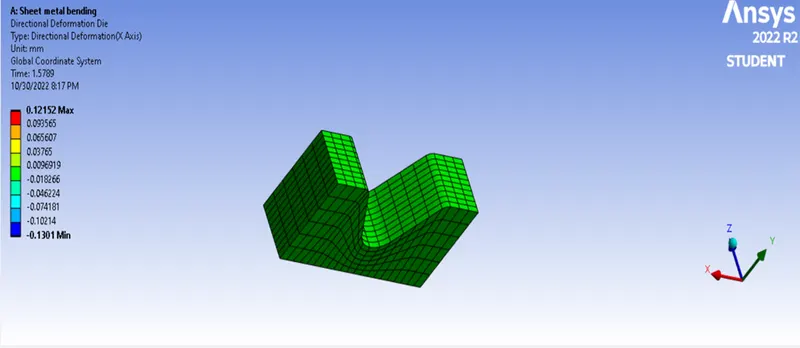
- Direction Deformation -Die
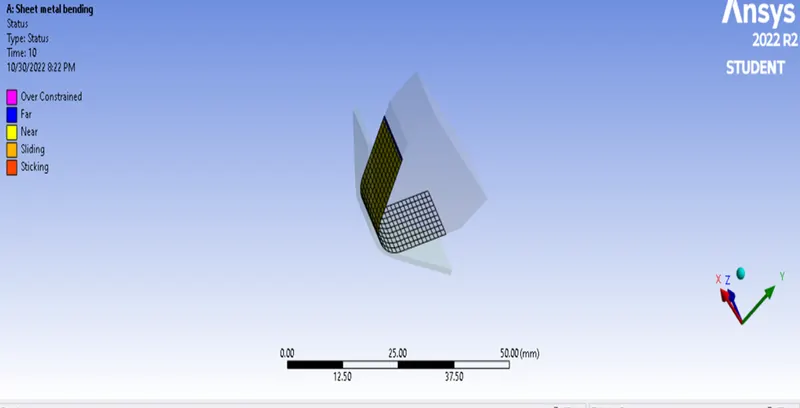
8. Contact Tool(Frictional) Punch to Sheet-Status
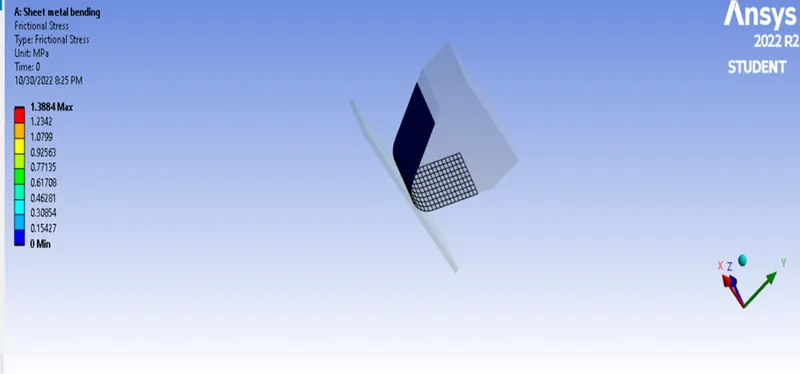
9. Contact Tool(Frictional) Punch to Sheet-Frictional Stress
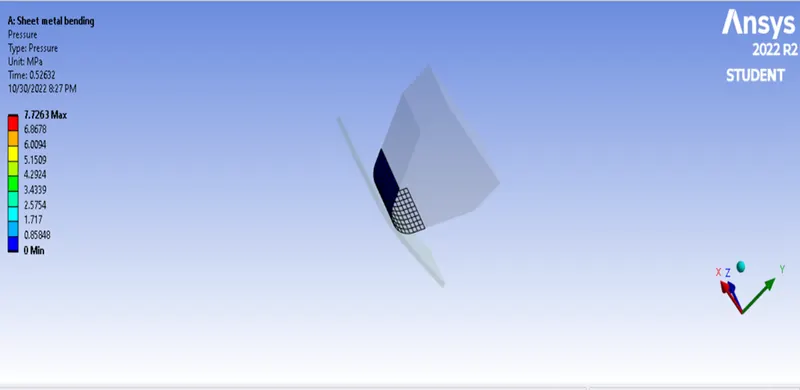
10. Contact Tool (Frictional)Punch to Sheet-Pressure
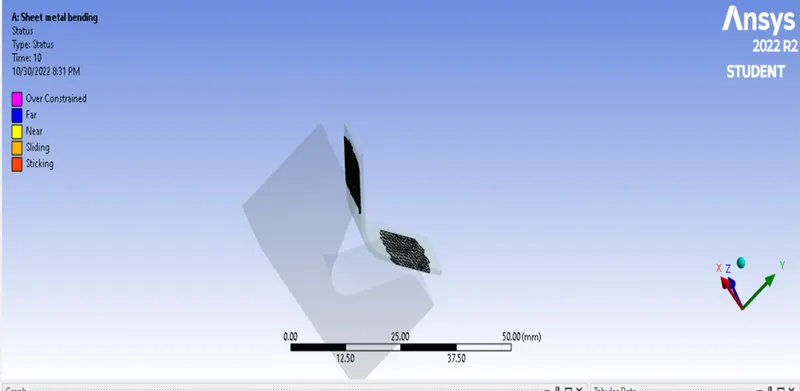
Contact Tool (Friction) Sheet to Die-Status
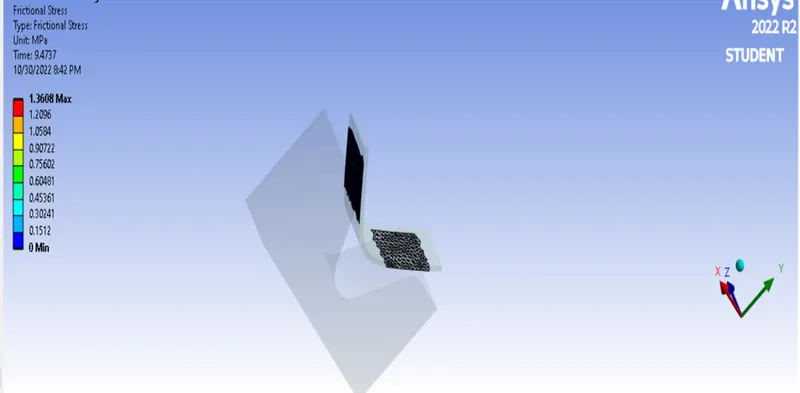
Contact Tool (Friction) Sheet to Die-Frictional Stress
Contact Tool (Friction) Sheet to Die-Pressure
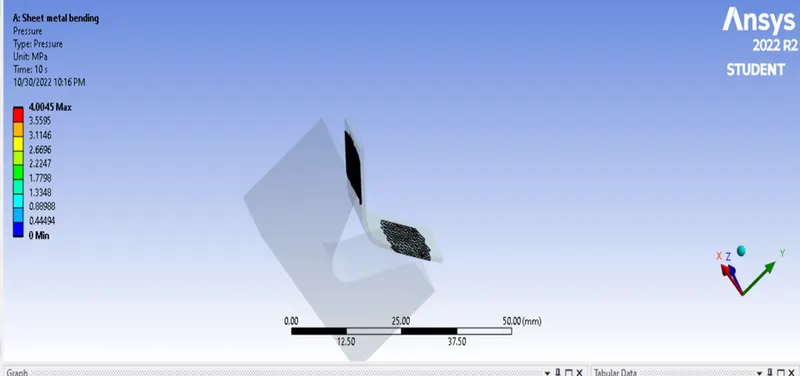
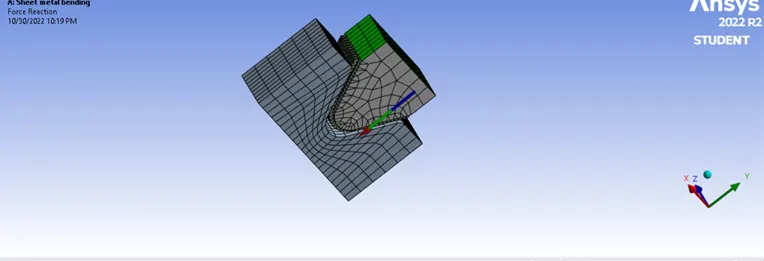
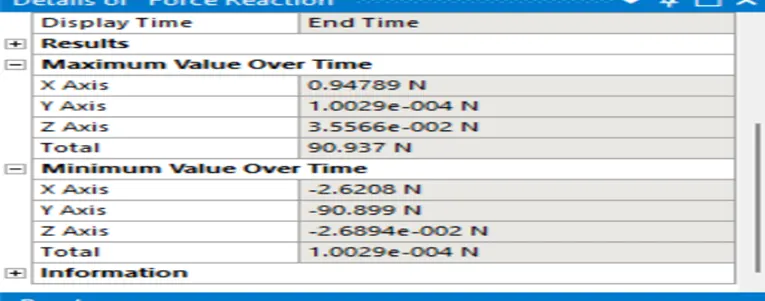
Force Reaction
Maximum and Minimum Pressure
Results by Parametrics for different materials and friction coefficient
|
Sheet Assignment |
Frictional - Punch To Sheet Friction Coefficient |
Frictional - Sheet To Die Friction Coefficient |
Mesh Size Sheet |
Equivalent Stress Maximum All |
Directional Deformation sheet Minimum Over Time |
|
1 |
2 |
3 |
4 |
5 |
6 |
|
mm |
MPa |
mm |
|||
|
Aluminum Alloy 1199 |
0.19 |
0.1 |
1 |
205972.3386 |
-13.58852959 |
|
Copper Alloy NL |
0.1 |
0.1 |
1 |
39143 |
-13.50959969 |
|
Magnesium Alloy NL |
0.1 |
0.1 |
1 |
178811.4201 |
-13.5962038 |
|
Aluminum Alloy 1199 |
0.1 |
0.1 |
0.7 |
193155.2581 |
-13.58362579 |
|
Aluminum Alloy 1199 |
0.1 |
0.1 |
1 |
198051.4113 |
-13.62111855 |
|
Sheet Assignment |
Mesh Size Sheet |
Equivalent Elastic Strain Maximum All Bodies |
Mesh Nodes |
Equivalent Stress sheet Maximum Value Over Time |
Directional Deformation All Bodies. Minimum Value Over Time |
|
|
1 |
4 |
7 |
8 |
9 |
10 |
|
|
mm |
mm mm^-1 |
MPa |
mm |
|||
|
Aluminum Alloy 1199 |
1 |
1.034039184 |
17859 |
190.5396043 |
-13.58852959 |
|
|
Copper Alloy NL |
1 |
0.19578 |
17859 |
10528.76339 |
-13.50959969 |
|
|
Magnesium Alloy NL |
1 |
0.894763917 |
17859 |
272.1490567 |
-13.5962038 |
|
|
Aluminum Alloy 1199 |
0.7 |
0.969321564 |
28642 |
186.3487016 |
-13.58362579 |
|
|
Aluminum Alloy 1199 |
1 |
0.994352892 |
17859 |
192.3969435 |
-13.62111855 |
Objective 3: Results and conclusion of case 1:
Materials are Aluminium 1199, Copper Alloy NL, Magnesium Alloy NL.
Results of 3 materials for equivalent stress, equivalent strain and Deformation in Y direction is given in the of Parametric results.
- The equivalent stress and strain in Die is very high and beyond the Yield Limits. An alloy steel material is required for Die.
The stresses of Aluminium 1192 Sheet and Punch are safe. The stresses in Sheet to be bend must have higher stress than Yield strength and lower than Tangent Modulus. The Die and Punch must have stresses within Yield strength with a factor of safety. Equivalent Stress developed in Die is 2.059E+5 MPa whereas the Yield strength is 250 MPa only and therefore unsafe.
The stresses of Magnesium alloy NL Sheet and Punch are safe. Equivalent Stress developed in Die is 1.7881E+05 MPa whereas the Yield strength is 250 MPa only.
The stress of Copper Alloy NL Sheet(10529 MPa) is higher than Tangent Modulus(1150 MPa) and hence bending to this radius will cause failure. Punch is safe. Equivalent Stress developed in Die is 39143 MPa whereas the Yield strength is 250 MPa only. Hence unsafe.
Properties of the 4 materials are as follows:
|
S. No. |
Material |
Youngs Modulus MPa |
Yield Strength MPa |
Tangent Modulus MPa |
Tensile Strength MPa |
|
1. |
Aluminium 1199 |
62000 |
140 |
209.46 |
|
|
2. |
Copper Alloy NL |
1.1E+05 |
280 |
1150 |
|
|
3. |
Magnesium Alloy NL |
45000 |
193 |
920 |
|
|
4. |
Structural Steel |
2E+05 |
250 |
460 |
Stress, Strain and Deformation
|
Material |
Equivalent Stress (all Bodies) MPa |
Equivalent Stress (Sheet) MPa |
Equivalent Strain (all bodies) mm/mm |
Directional deformation Y (all bodies) mm |
|
Aluminium 1199 |
2.059E+05 |
192.4 |
1.034 |
-13.589 |
|
Copper Alloy NL |
34687 |
10529 |
0.1735 |
-13.51 |
|
Magnesium Alloy NL |
1.7881E+05 |
272.15 |
0.89476 |
-13.596 |
Results and Conclusion of Case 2:
The frictional coefficient for Aluminium 1199 has been changed from 0.1 to 0.19 to see the effect of friction on the Equivalent stress, equivalent strain and directional deformation in Y direction.
|
Frictional Coefficient of Punch to Sheet |
Equivalent Stress All Bodies MPa |
Equivalent Strain All Bodies mm/mm |
Directional Deformation Y mm |
|
0.1 |
1.9805E+05 |
0.99435 |
-13.621 |
|
0.19 |
2.0597E+05 |
1.034 |
-13.589 |
It is seen from this table that friction factor increases stress, strain and decreases deformation. It is concluded that frictional coefficient has to be kept to a minimum.
Results and Conclusion of Case 3:
The higher mesh size generates a more accurate results and is lower. This is seen from the results given in the table below. The table is derived from the parametric chart given above. However, higher mesh sizes are time consuming. The Student Version of Ansys has limitations on Mesh Nodes.
Material: Aluminium 1199
|
Mesh Size mm |
Mesh Nodes Nos. |
Equivalent Stress All Bodies Max. MPa |
Equivalent Stress Sheet Max. MPa |
Equivalent Strain Max. mm/mm |
Deformation Y axis mm |
|
1 |
17859 |
1.9805E+05 |
192.4 |
0.99435 |
-13.621 |
|
0.7 |
28642 |
1.9316E+05 |
186.35 |
0.96932 |
-13.584 |
Attached: Animation files, Static Structural file in wbpz format.