Week 2 Bevel Gear Challenge
1. Objective: To perform Structural Analysis of Bevel Gear and with grid dependency test for face mesh size 6.5 mm and 4 mm and solve for Von-Mises stress, Equivalent elastic strain, and Total Deformation for all the 3 cases. The report with input data, process outline is to be presented.
2. Grid Dependency Test and its use: Mesh density is a significant metric used to control accuracy(element type and shape also control accuracy). A high density curve will produce results with high accuracy. A high density mesh, however, uses high amount of computer memory and takes long run times,espescially for multiple iteration runs that are typical of non-linear and transient analysis.
The method to check mesh quality is to refine a mesh until critical result such as Equivalenet stress does not change significantly with each refinement (i.e. it converges).
3. Process outline: Static Structural is carried for Bevel Gear for face mesh of 1.75 mm. Gear is imported and modified by removing portions not significant for stress analysis. See Fig.1. Here parametrics are used for getting the values of face mesh size of 6.5 mm and 4 mm.
Material Properties of Structural Steel:
Density: 7850 Kg/m3
Young's Modulus:
2E+05 MPa Poissons's Ratio: 0.3
Tensile Ultimate Strength:
460 MPa
Tensile Yield Strength:
250 MPa
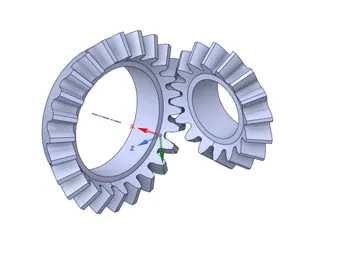
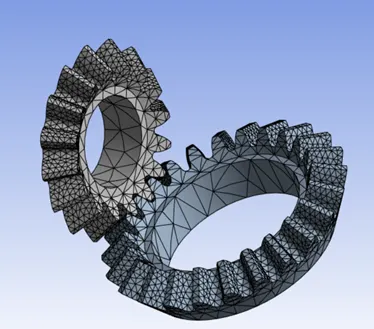
Fig. 1 Bevel Gear downloaded and modified Fig. 2 Face Mesh Size: 1.75 mm Nodes: 23081 Elements 12375

Mesh Matrix for Face Mesh Size 1.75 mm: Most of elements are in around 0.75. This is an acceptable mesh. Elements are in higher nodes.
Moment considered: 100 N mm
Rotation: 120 degrees in steps of 20 degrees
Auto stepping time defined as follows: Initial time step is 0.1 sec; Min. Time Step is 0.05 sec; Max. Time Step is 0.5 sec.
Results for Face Mesh Size 1.75 mm
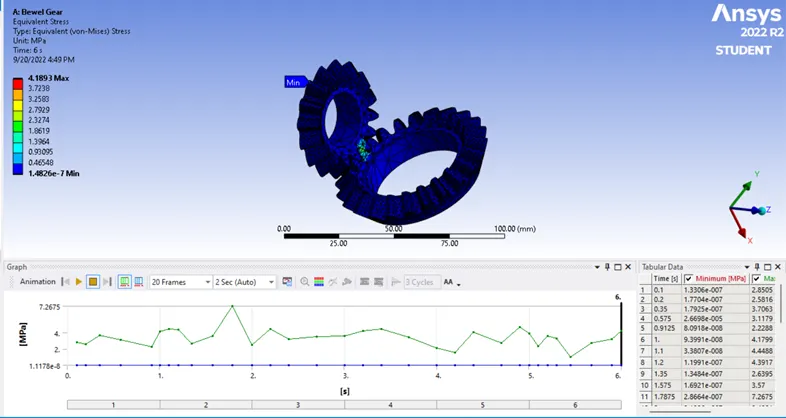
Equivalent Von-Mises Stress
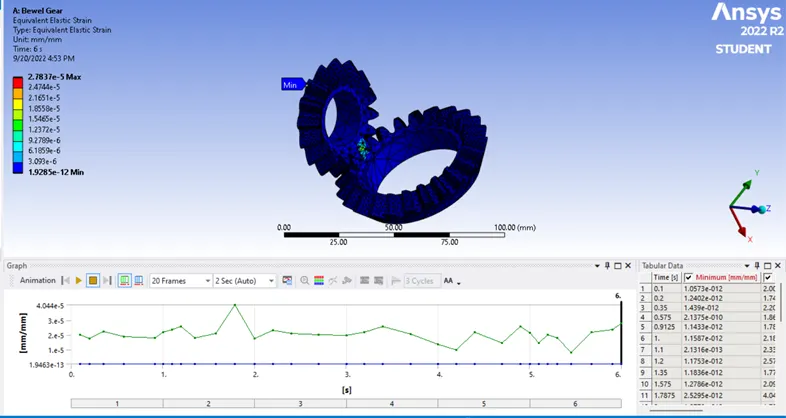
Equivalent Elastic Strain
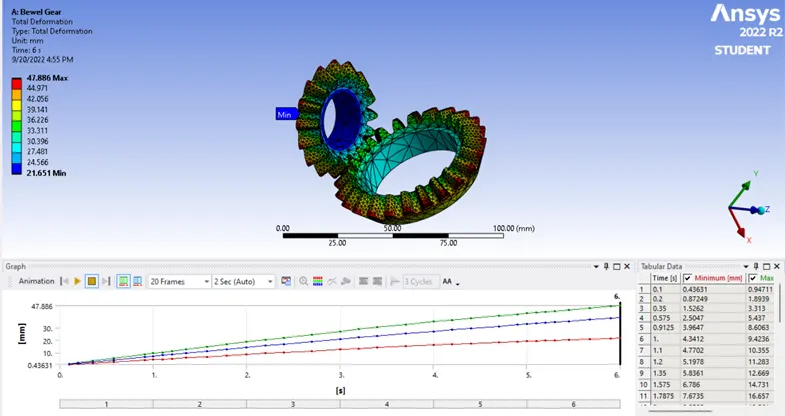
Total Deformation:
Results of above properties for parametrics for Face Mesh Size 1.75, 4 mm, 6.5 mm by parametrics.

Time for 1.75 mesh size: 76 seconds
Time for 4 mm mesh size: 46 seconds
Memory for 1.75mm mesh size: 741 MB
Memory for 4 mm mesh size: 588 MB
Conclusion: Lower mesh size has higher grid density and this gives accurate results. It is seen that 4 mm and 1.75 mm give similar results. However, mesh size 6.5 has 'error updating cell solution in system'. There is an issue of Force conversion. Hence, 4 mm appears to be optimum size. Both time taken and memory used for optimum mesh size is lower.