Week 3 - Pitot tube
AIM:
To perform a simulation on pitot tube using Ansys fluent.
To understand the relationship between total pressure and static pressure.
THEORY:
Pitot tubes are used in aircraft to determine the airspeed and alitimeter. Using the pressure difference of total pressure and static pressure the airspeed and altitude are determined. There are three types of pitot tubes.
- Simple pitot tube: Which determines only the total pressure of the fluid.
- Static tube: Which determines only the static pressure of the fluid.
- Pitot static tube: Which determines both total and static pressure of the fluid.
Advantages of Pitot static tube:
- The construction of the pitot-static tube is different from the other two tubes. It is the combination of the Features of the other two tubes.
- It has an opening at the center that runs through the tube. This opening is used to measure the total pressure of the incoming fluid.
- It also has two openings on the sides and runs through the tube without any contact with the other opening. This is used to measure the static pressure of the incoming air.
The relation between total pressure and static pressure in pitot tube:
`V = sqrt(2((P_(Total)-P_(Static))/rho)`
- V =velocity of the object
- `P_(Total)` = Total Pressure of the fluid
- `P_(Static)`= Static Pressure of the fluid
- `rho` = Density of the fluid
PROCEDURE TO SET UP THE CASE FOR SIMULATION:
- Import the mesh file to fluent.
- After importing the mesh we need to set up the case.
- A pressure-based solver is used.
- In the Viscous model laminar condition is used.
- In boundary conditions, Inlet is considered as velocity Inlet and outlet as pressure outlet.
- The operating condition is set to 0.
- Solver method: coupled method and second-order equations is used.
- For initialization standard initialization is computed from the inlet.
CASE 1:
Velocity : 240 m/s and Gauge pressure : -2817 pa
Static pressure:
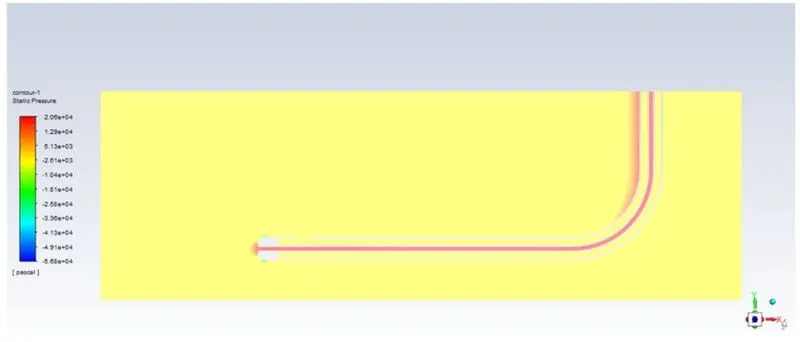
Total Pressure = 64180.988 pa
Static Pressure = 32.606.172 pa
Using this formula we can find the velocity,
`V = sqrt(2((P_(Total)-P_(Static))/rho)`
V= 238.7 m/s
Case 2:
Velocity: 100 m/s and Gauge pressure: 33287 pa
Static pressure:
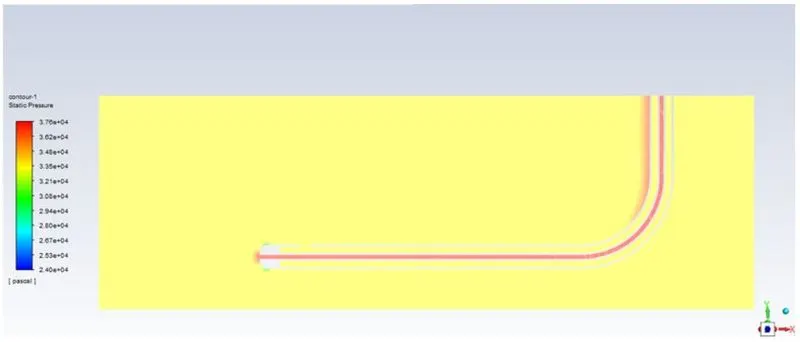
Total Pressure = 39438.324 pa
Static Pressure = 33150.742 pa
Using this formula we can find the velocity,
`V = sqrt(2((P_(Total)-P_(Static))/rho)`
V= 101.31 m/s
Case 3:
Velocity: 62 m/s and Gauge pressure: 65780 pa
Static pressure:
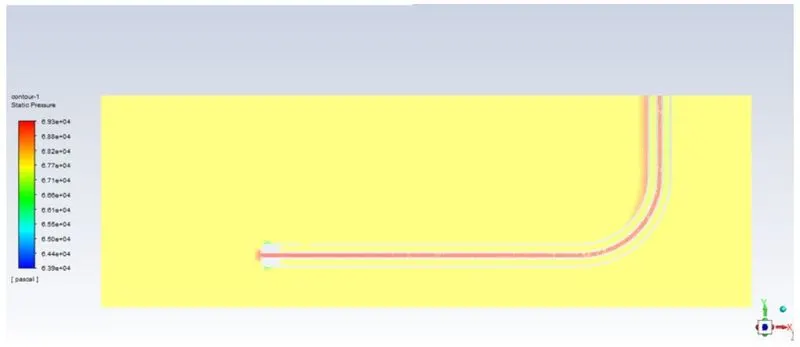
Total Pressure = 69948.594 pa
Static Pressure = 67544.219 pa
Using this formula we can find the velocity,
`V = sqrt(2((P_(Total)-P_(Static))/rho)`
V= 63.2 m/s
| Velocity (given) (m/s) | Velocity (obtained from simulation) (m/s) | Error % | |
| Case 1 | 240 m/s | 238.7 m/s | 1.3 |
| Case 2 | 100 m/s | 101.31 m/s | 1.3 |
| Case 3 | 62 m/s | 63.2 m/s | 1.3 |
The error for the three cases is less than 5%.
CONCLUSION:
From this pitot tube simulation, we came to understand the variation between static pressure and total pressure and also the purpose of the pitot tube.