Week 3 - Pitot tube
Pitot Tube
Aim: To study on pitot static tube.
Objecive:
1. A literature review of pitot-static tube. Also establish a relationship between Total (stagnation) pressure and static pressure
2. To create surfaces and fill it separately for Total pressure port and static pressure port
Theory:
Pitot tubes are used for fluid flow measurement to find the velocity of aircraft, and the velocity of gases in industries.
Simple pitot tubr measures the total pressure of the incoming fluid.
Static tube measures the static pressure of the incoming fluid.
Pitot static tube measures the total pressure and the static pressure. It will be used in low-speed aircraft's Measurement will be accurate in the low Mach conditions.
Basically, a pitot tube is used in wind tunnel experiments and on airplanes to measure flow speed. It's a slender tube that has two holes on it. The front hole is placed in the airstream to measure what's called the stagnation pressure. The side hole measures the static pressure. By measuring the difference between these pressures, you get the dynamic pressure, which can be used to calculate airspeed.
Mathematical relationship between stagnation pressure and static pressure.
`V = sqrt(2(P_o-P_s)/rho`
Procedure:
Import the Mesh in Ansys fluent.
Setup:
Solver:
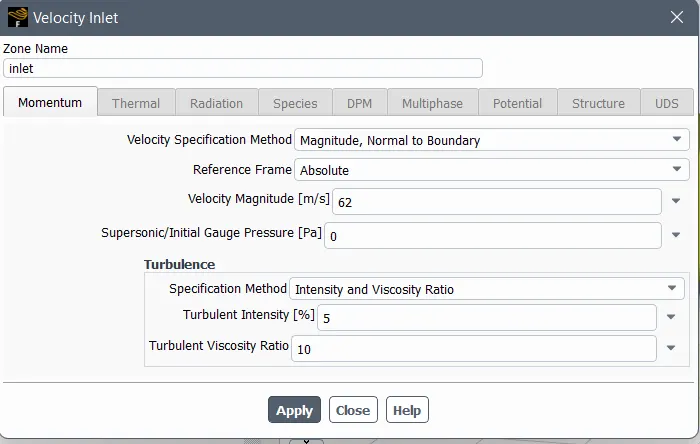
Steady state
Pressure based
K-omega SST
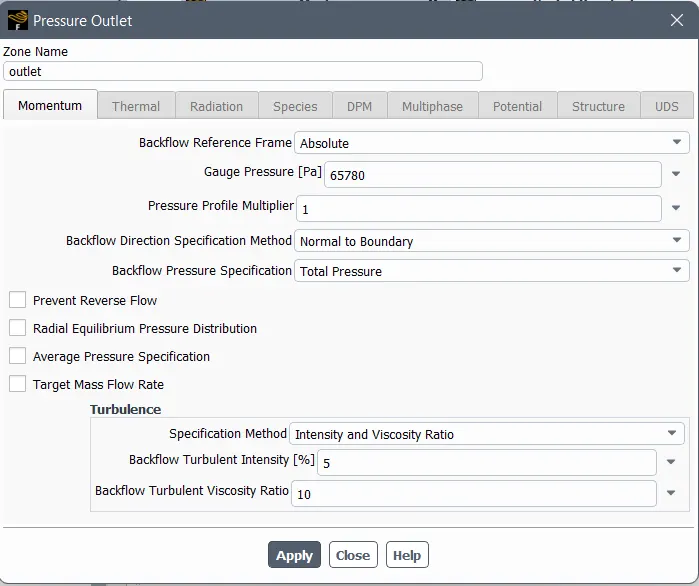
Case 1:
Inlet:
Outlet:
Residulas:

Pressure contour:
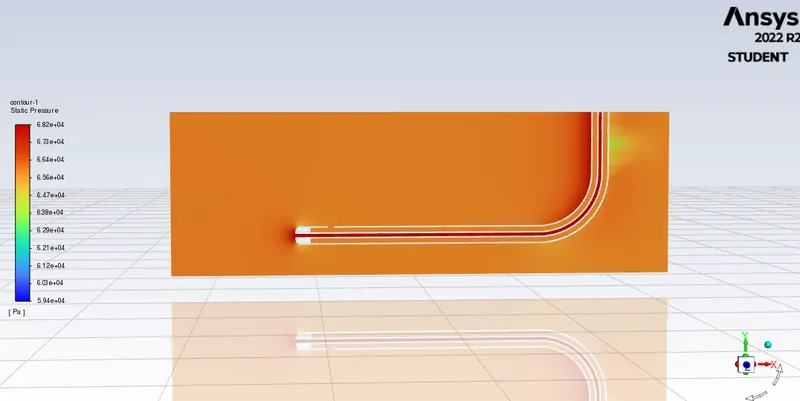
Create the points for stagnation and static pressure measurement.
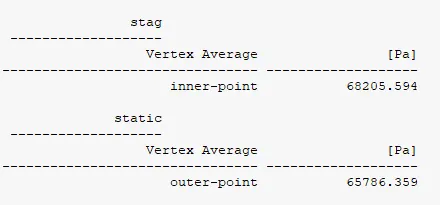
Velocity = 62.97
The percentage error = 1.6 %
Case 2:
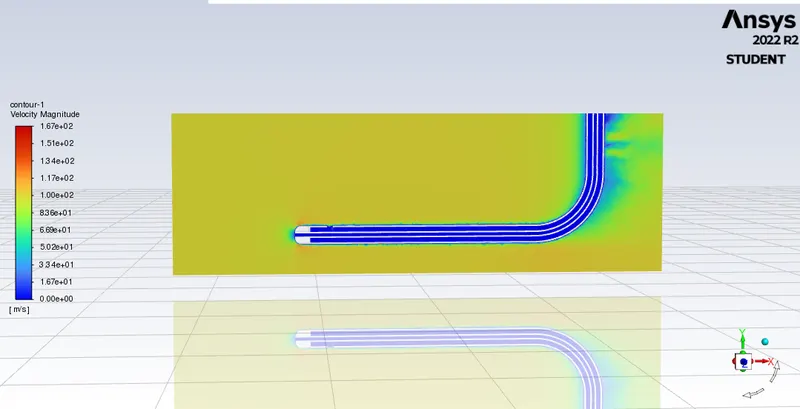
velocity = 100 m/s , pressure= 33287 Pa
Pressure contour:
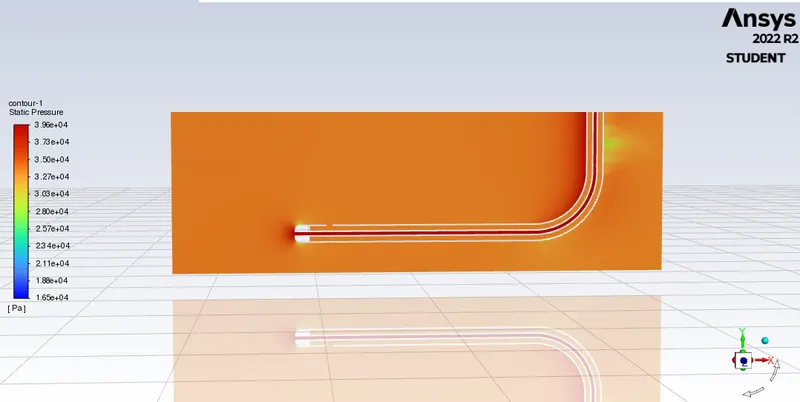
Velocity contour:
Pressure:
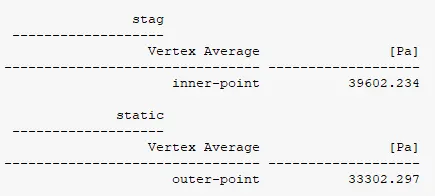
Velocity = 101.41 m/s
Error in velocity = 1.4%
Case 3:
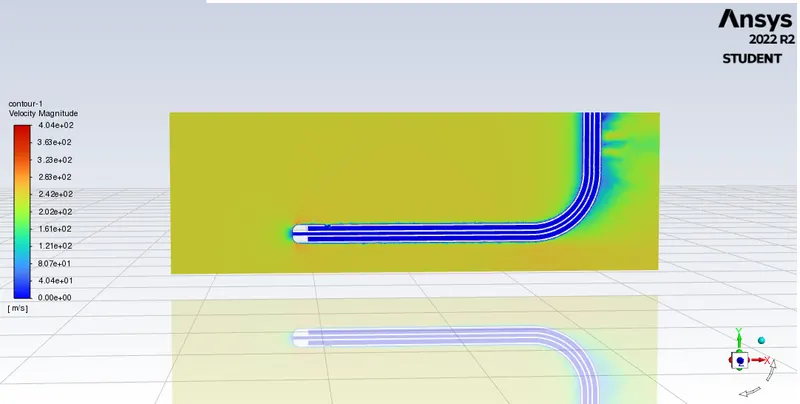
Velocity = 240m/s Pressure = 2817 Pa
Velocity contour:
Pressure contour:
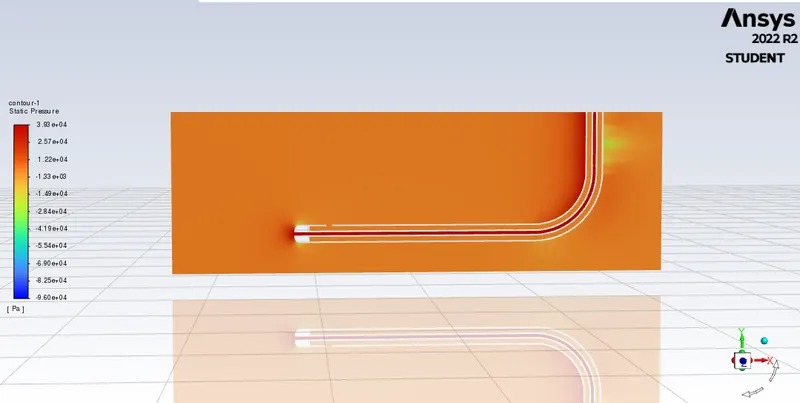
Pressure:
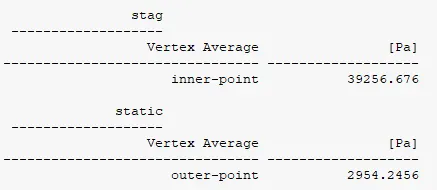
Velocity = 243.4 m/s
Error in velocity = 1.4 %
Conclusion:
A literature review of Pitot static tube is written.
Simulation of the pitot static tube for three different cases shows that there is small error in velocity around 1.5 %