Week 3 Mathematical Model of a Battery
AIM:- Run a MATLAB script for the mathematical model of lead acid battery and comment on it
What is a Lead-acid Battery?
The Lead-acid battery is one of the oldest types of rechargeable batteries. These batteries were invented in the year 1859 by the French physicist Gaston Plante. Despite having a small energy-to-volume ratio and a very low energy-to-weight ratio, its ability to supply high surge contents reveals that the cells have a relatively large power-to-weight ratio.
Lead-Acid Battery
Lead-acid batteries can be classified as secondary batteries. The chemical reactions that occur in secondary cells are reversible. The reactants that generate an electric current in these batteries (via chemical reactions) can be regenerated by passing current through the battery (recharging).
The chemical process of extracting current from a secondary battery (forward reaction) is called discharging. The method of regenerating active material is called charging.
Chemical Reaction for Discharging
When the battery is discharged, it acts as a galvanic cell and the following chemical reaction occurs.
Negative:
Pb(s) + HSO4– + H2O(l) –> 2e– + PbSO4(s) + H3O+(aq) (oxidation )
Positive:
PbO2(s) + HSO4–(aq) + 3H3O+(aq) + 2e– –> PbSO4(s) + 5H2O(l) (reduction)
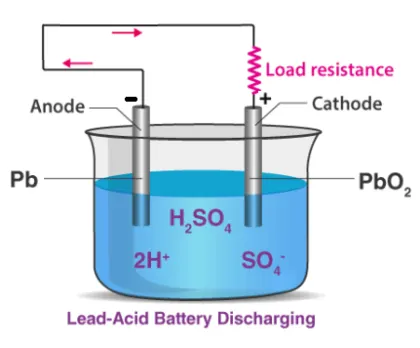
Lead sulfate is formed at both the electrodes. Two electrons are also transferred in the complete reaction. The lead acid battery is packed in a thick rubber or plastic case to prevent leakage of the corrosive sulphuric acid.
Lead Acid Battery Charging
The sulphuric acid existing in the lead discharge battery decomposes and needs to be replaced. Sometimes, the plates change their structure by themselves. Eventually, the battery becomes less efficient and should be charged or changed.
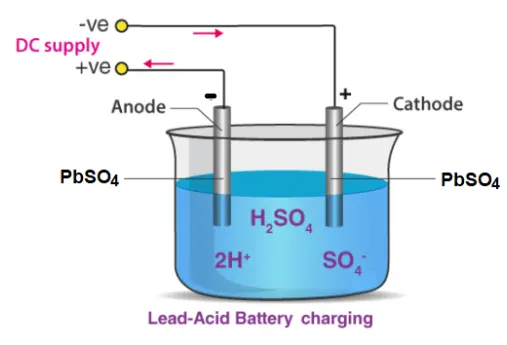
When car batteries spend considerable durations of time in their discharged states, the lead sulfate build-up may become extremely difficult to remove. This is the reason why lead-acid batteries must be charged as soon as possible (to prevent building up of lead sulfate). Charging of the lead batteries is usually done by providing an external current source.
A plug is inserted which is linked to the lead-acid battery and chemical reaction proceeds in the opposite direction. In cases where the sulphuric acid in the battery (or some other component of the battery) has undergone decomposition, the charging process may become inefficient. Therefore, it is advisable to check the battery periodically.
Chemical Reaction for Recharging
The chemical reaction that takes place when the lead-acid battery is recharging can be found below.
Negative:
2e– + PbSO4(s) + H3O+(aq) –> Pb(s) + HSO4– + H2O(l) (reduction)
Positive:
PbSO4(s) + 5H2O(l) –> PbO2(s) + HSO4–(aq) + 3H3O+(aq) + 2e– (oxidation)
While recharging, the automobile battery functions like an electrolytic cell. The energy required to drive the recharging comes from an external source, such as an engine of a car. It is also important to note that overcharging of the battery could result in the formation of by-products such as hydrogen gas and oxygen gas. These gases tend to escape from the battery, resulting in the loss of reactants.
Open Circuit Voltage :- When an open circuit condition is created in any device or circuit, the difference of electric potential between the two terminals is known as the open-circuit voltage. In network analysis, the open-circuit voltage is also known as the Thevenin Voltage.
The battery is represented as having a fixed voltage E,but the voltage at the terminals is a different voltage V
V = E – IR
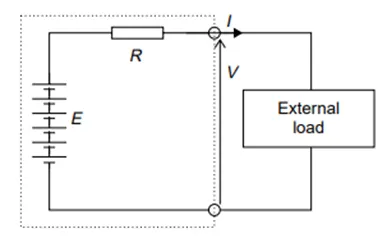
E = n × (2.15 − DoD × (2.15 − 2.00))
WHERE, n= no of cell.
Terminal voltage: When current is drawn from a cell, the potential difference between the electrodes of the cell is called its terminal voltage.
Internal Resistance: The resistance offered by the electrolyte inside the cell to the flow of electric current through it is called the internal resistance of the cell.
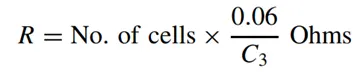
State of charge (SoC): The state of charge (SOC) is a measurement of the amount of energy available in a battery at a specific point in time expressed as a percentage. For example, the SOC reading for a computer might read 95% full or 10% full.
Soc=(current capacity/nominal capacity)*100
Depth of Discharge (DOD): refers to how much energy is cycled into and out of the battery on a given cycle. It's expressed as a percentage of the total capacity of the battery. For those new the industry, DOD sounds like it may be a difficult topic to understand, but it's actually simple. For instance, a battery that has been drained 30% has a 30% DOD, and 70% of its capacity remains.
DOC= 1-SOC
Peukert's law:- presented by the German scientist Wilhelm Peukert [de] in 1897, expresses approximately the change in capacity of rechargeable lead–acid batteries at different rates of discharge. As the rate of discharge increases, the battery's available capacity decreases, approximately according to Peukert's law.
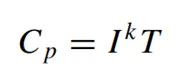
where k is a constant Peukert Coefficient. current I A, and time(T) h
CHARGE SUPPLIED: - the amount of charge or energy supplied from the battery to the system.
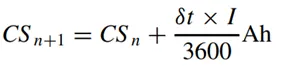
CHARGE REMOVED:-the amount of charge or energy removed from the total energy of the battery.If CRn is the total charge removed from the battery by the nth step of the simulation.
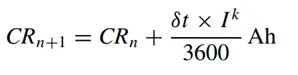
It is very important to keep in mind that this is the charge removed from the plates of the battery. It is not the total charge actually supplied by the battery to the vehicle’s electrics.
my codes
clear all
close all
clc

% The time step is set to 50 seconds, which is sufficiently small for such a constant current experiment.
% We need to form some arrays for holding data.
T=(0:50:50000);
% creating arrays of zeros
CR=zeros(1,length(T));                                % Charged removed from electrodes,
DoD=zeros(1,length(T));                              % Depth of discharge,
V=zeros(1,length(T));                                   % Battery voltage at each time step
CS=zeros(1,length(T));                                 % Charge supplied by the battery in Ah
I = [10,20,100];                                            % Set discharge current Amps
NoCells=1;                                                    % no of cell battery
Capacity=50;                                                 % normal 3 h rated capacity of the battery
k=1.045;                                                        % Peukert coefficient, < 1.
deltaT = T(2)-T(1)*ones(1,length(T));         % time step difference
Rinternal = (0.06/Capacity)*NoCells;          % internal resistannce
E(1)=2.15;                                                     % open circuit voltage
PeuCap=((Capacity/NoCells)^k)*NoCells;

for i =1:length(I)
    V(i) = NoCells*(2.15 - I(i) *Rinternal);
   % voltage equation of OCV
    for a=2:length(T)
CR(a) = (CR(a-1) + ( deltaT(a)*(I(i)^k ))/3600);
DoD(a) = (CR(a)/PeuCap);
E (a) = 2.15-DoD(a) * (2.15 - 1.75);
  V(a)=E(a)-(I(i)*Rinternal);

if   DoD(a)>1
     DoD(a)=1;
end

if DoD(a)>0.99
    E(a)=0;
    V(a)=0;
end

if E(a)>0
CS(a)=CS(a-1)+ ((I(i)*deltaT(a))/3600);
else
CS(a)=CS(a-1);
end
    end

figure(1)
hold on
plot(DoD,V,'--',LineWidth=2);
xlabel('DEPTH OF DISCHARGE (DOD) ' );
ylabel('VOLTAGE (V)');
legend('10A','20A','100A')

figure (2)
xlabel('CHARGE SUPPLIED' )
hold on
plot(CS,V,LineWidth=3)
legend('10A','20A','100A')
ylabel('VOLTAGE')

figure (3)
xlabel('CHARGE REMOVED')
axis([0 80 0 2.5])
hold on
plot(CR,V,LineWidth=3)
legend('10A','20A','100A')
ylabel('VOLTAGE')
ELPLANATION
first we are creating an array of time.
then using zero command to create an array of zero to the length of the time.
deltat is the difference of between 2 time step and creating an array of the same.
we used 2 for loop
firest is for the array of current
second loop is to find the open curcit voltage.
we used if and else command which provide the condition while the loop is running.
using of hold on command for all the plots because to plot all which is bee run for 3 time due to the first loop and then plot it on on.
OUTPUT voltage vs DOD
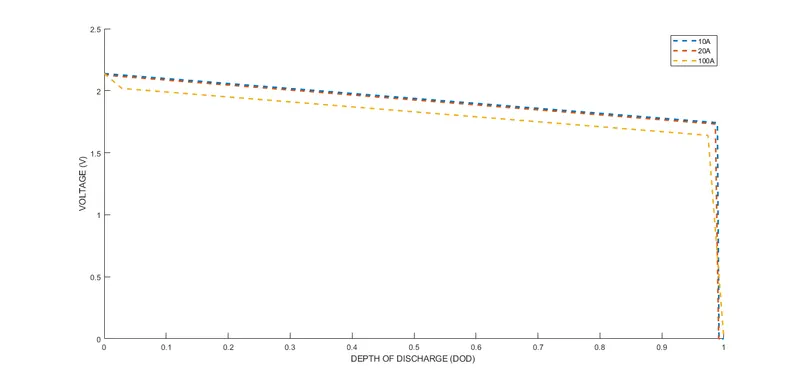
the above figure shows of lead acid battery at high current 100A we get more DOD while at low current 10A we get slightly less DOD where as at high current 100A voltage lis redusing qickly while at low current the voltage is reduced slowly.
VOLTAGE VS CHARGE SUPPLIED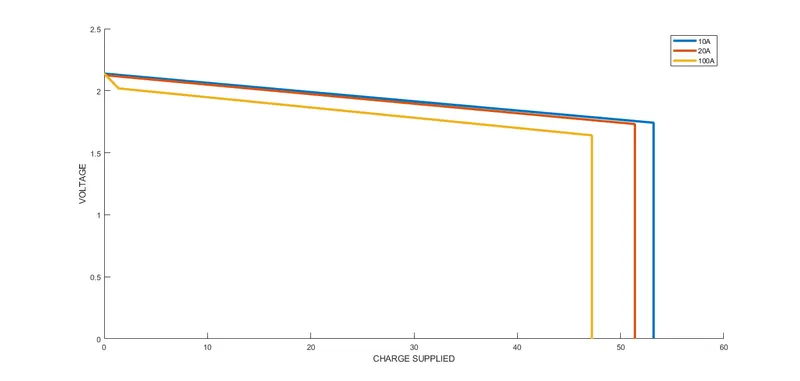
in above graph we can see at high current 100A we are getting less capicity while at low current 10A we get more capicity.
VOLTAGE VS CHARGE REMOVED
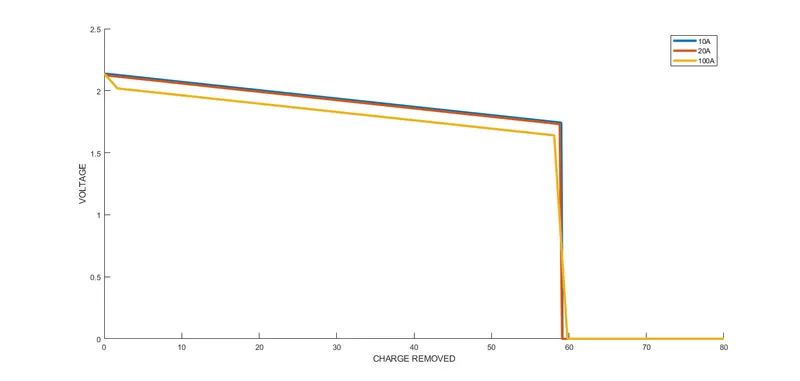
we can see at high current 100A less charge is removed while at low current 10A we get more charge removal.
WECAN SEE THE DIFFERENCES IN GRAPH DUE THE THE GIVEN EQUATION CHANGES IN EQUATION CAN PROVIDE CHANGES IN GRAPH.
refrences:
https://byjus.com/chemistry/lead-acid-battery/
James Larminie, John Lowry - Electric Vehicle Technology Explained (2003, J. Wiley) - libgen.lc
THANK YOU