Week 3 - External flow simulation over an Ahmed body.
Aim:
External flow simulation over an Ahmed body at different.
Objective:
The main objective of this challenge is to perform a flow simulation over an Ahmed body, find out drag and lift coefficients, and perform the grid independence test.
Expected Results:
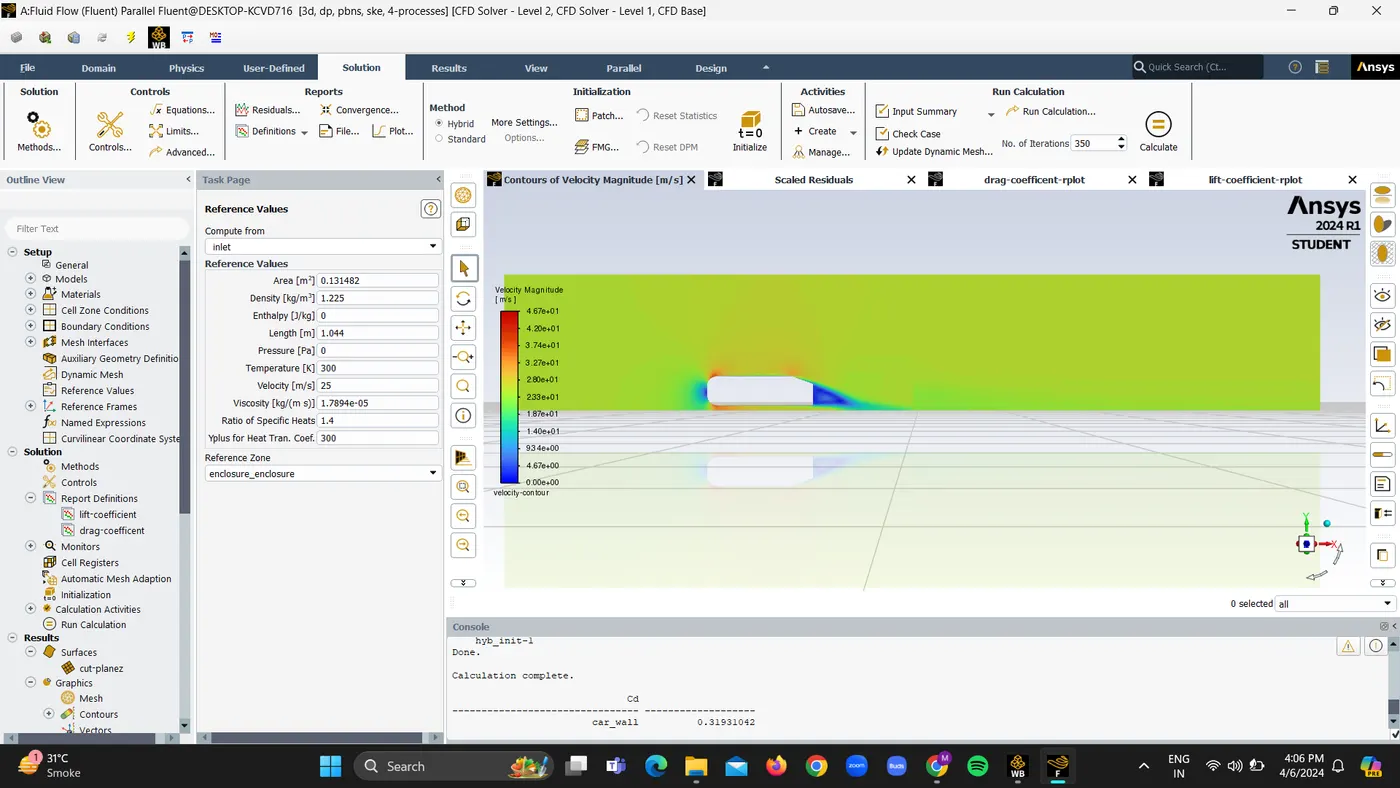
1. Velocity and pressure contours.
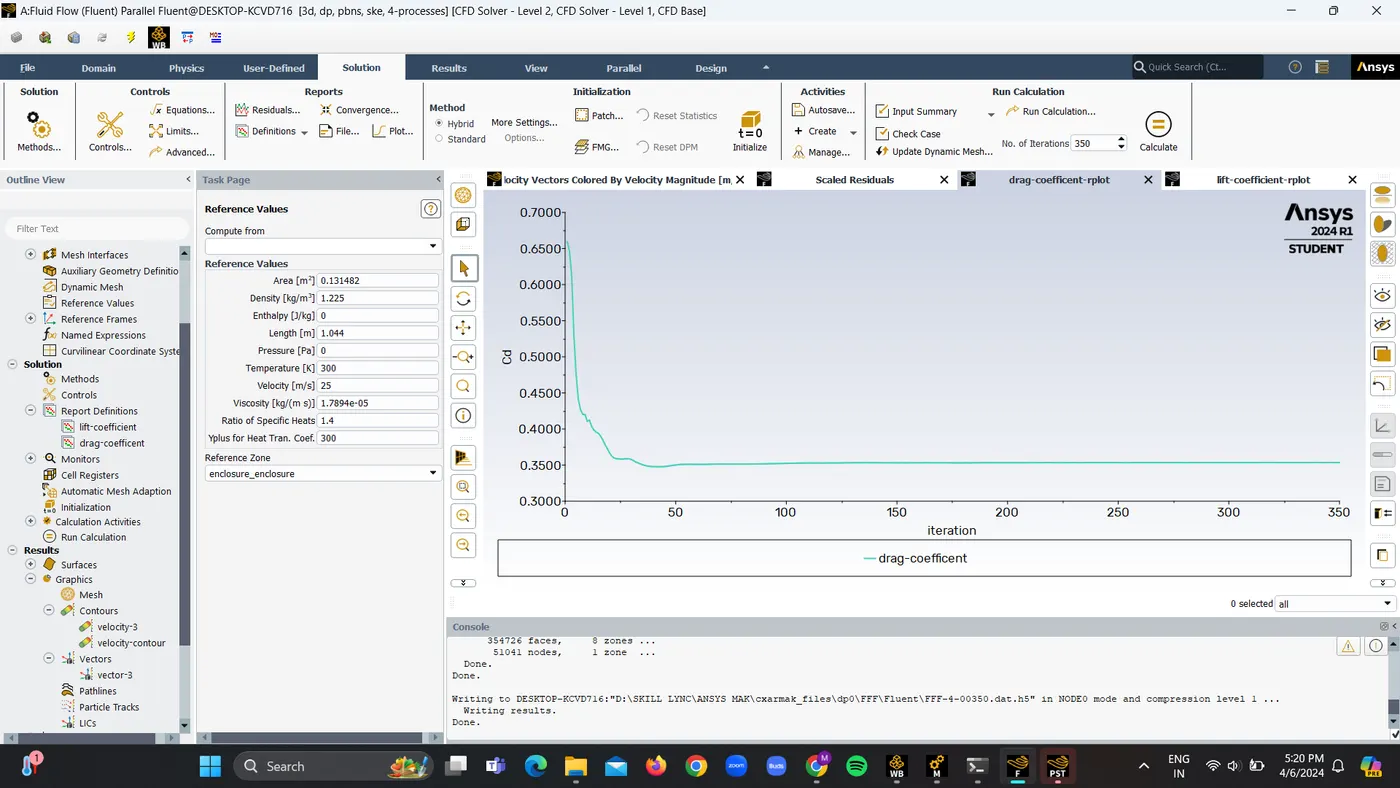
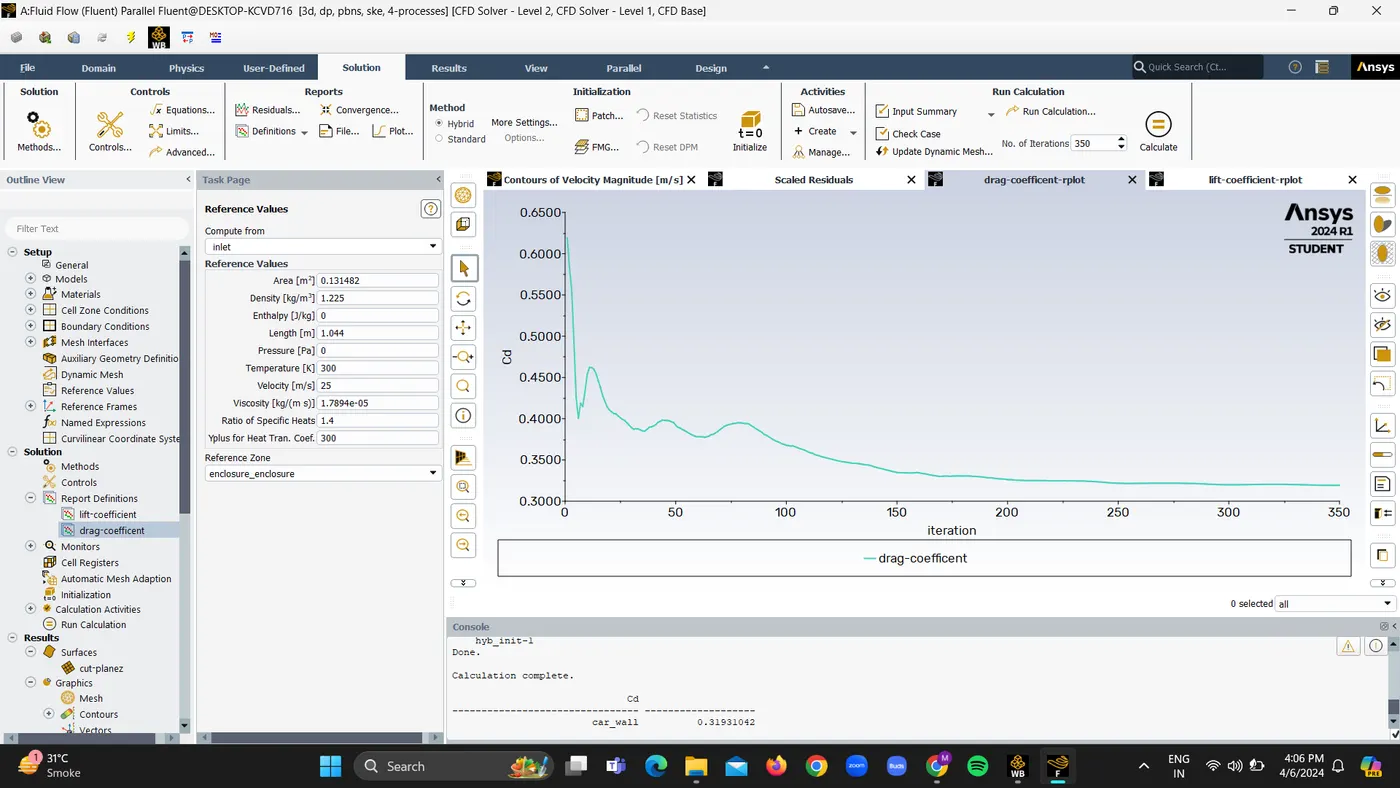
2. The drag coefficient plot for a refined case. (For a velocity of 25 m/sec, the drag coefficient should be around 0.33).
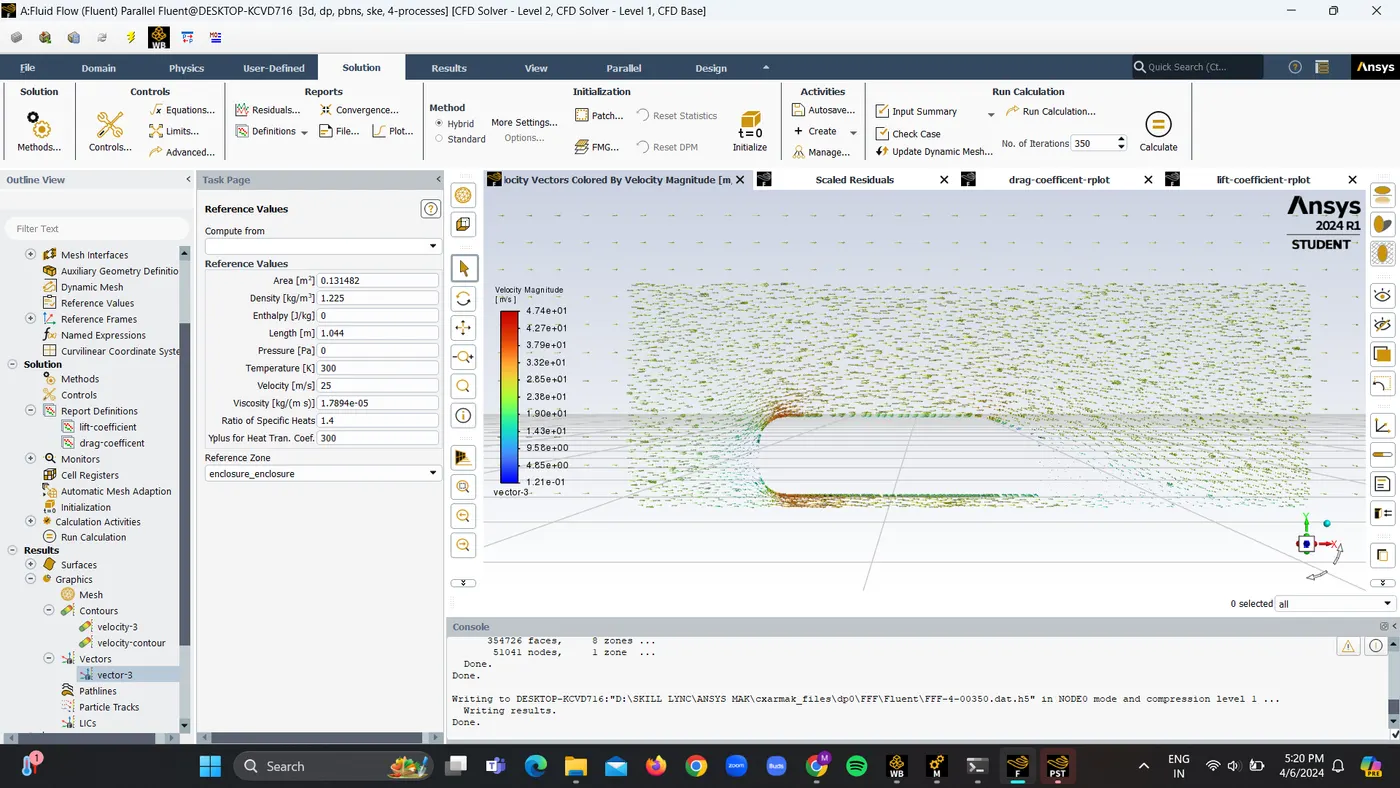
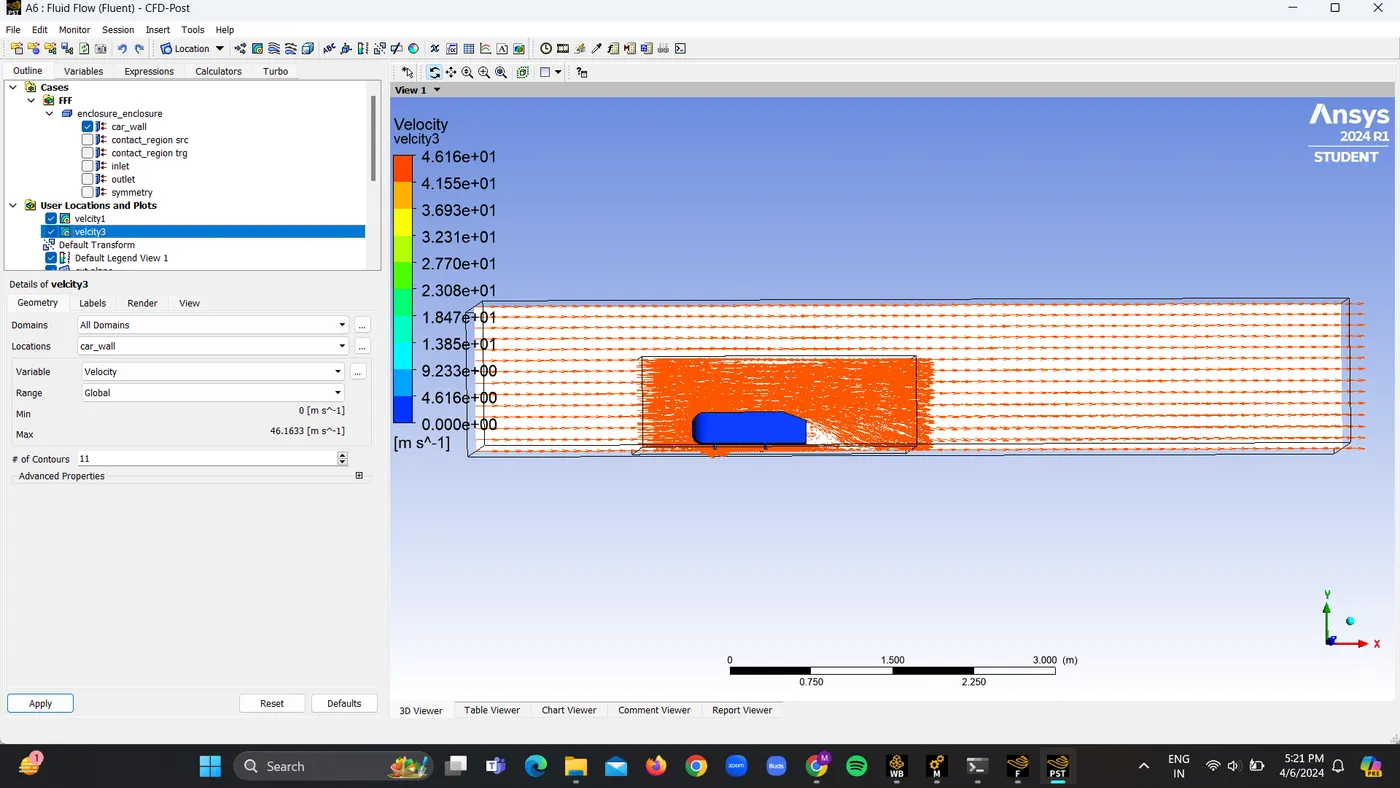
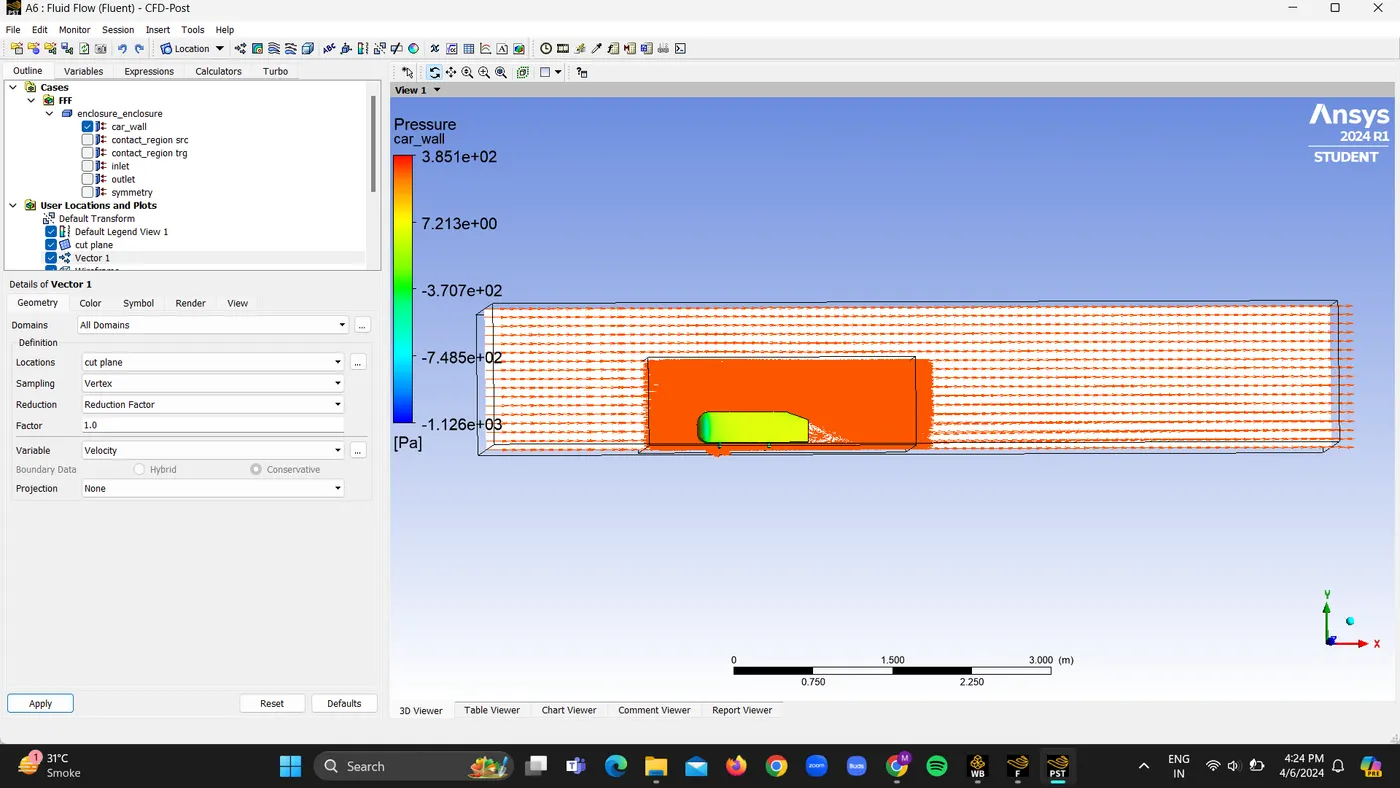
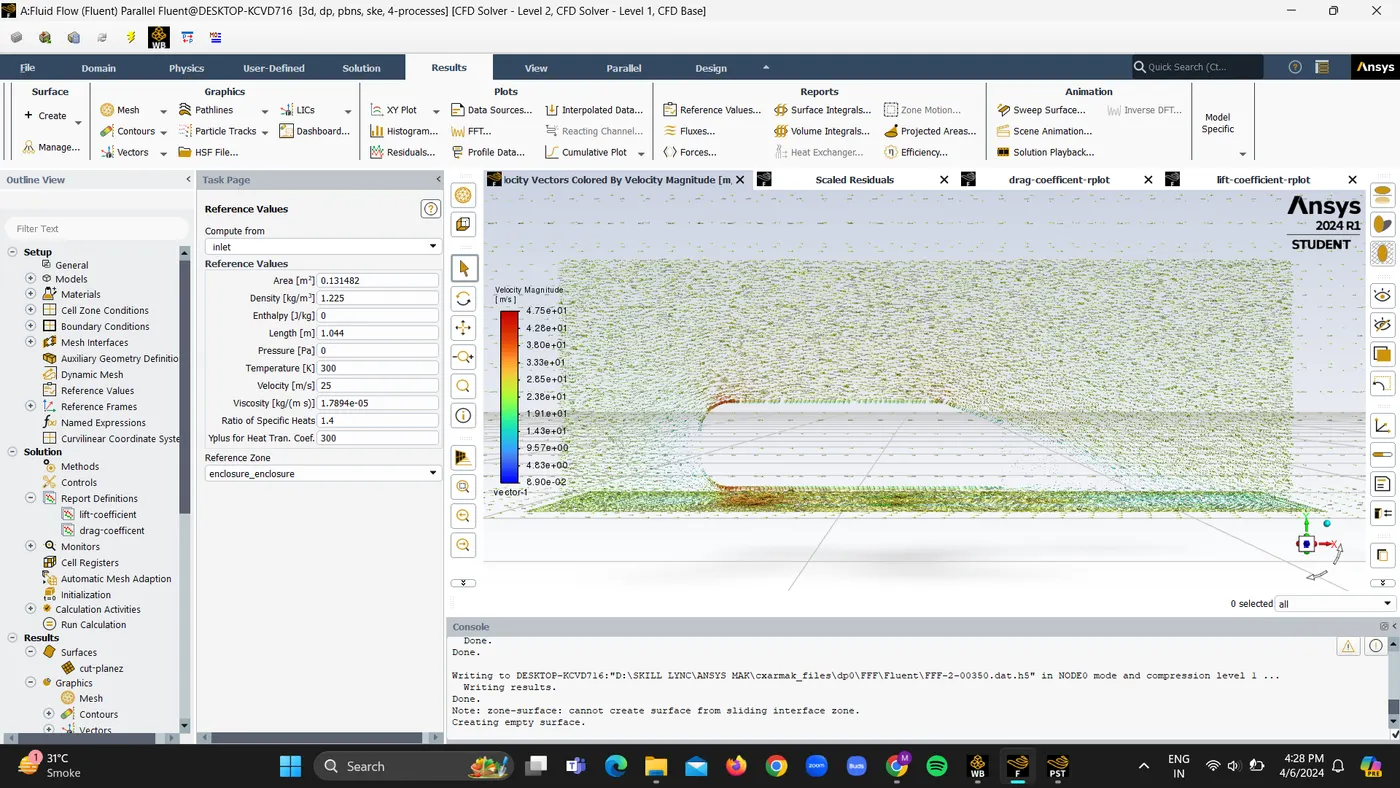
3. The vector plot clearly shows the wake region.
4. Perform the grid independence test and provide the values of drag and lift for each case.
Introduction:
Ahmed body:
The Ahmed body is a generic car body (a simplified vehicle model). The airflow around the Ahmed body captures the essential flow features around an automobile and was first defined and characterized in the experimental work of Ahmed. Although it has a very simple shape, the Ahmed body allows us to capture characteristic features that are relevant to bodies in the automobile industry.
This model is also used to describe the turbulent flow field around a car-like geometry. Once the numerical model is validated, it is used to design new models of the car.
Importance of Ahmed's body:
- The drag force is an important factor considering fuel consumption. As the drag force increases, fuel consumption also increases, which in turn becomes expensive for car owners. As the burning of fossil fuels becomes an issue, manufacturers are pressing for fuel-efficient cars.
- One of the main factors in determining whether the car is fuel-efficient or not is the car's geometry.
- Complex-shaped cars are very challenging to model and it is difficult to quantify the aerodynamic drag computationally. The Ahmed body is a benchmark model widely used in the automotive industry for validating simulation tools.
- The Ahmed body has features similar to those of a general car and is broadly utilized for authentication of new codes in the automobile industry
Negative pressure in the wake region
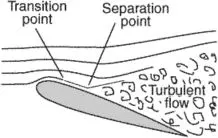
When the air moving over the vehicle is separated at the rear end, it leaves a large, low-pressure turbulent region behind the vehicle, which is known as the wake. This contributes to the formation of pressure drag, which affects the vehicle's performance.
When the vehicle is moving at a certain velocity, the fluid imparts viscous force to the vehicle as long as it is in the viscous sublayer of the boundary. When the fluid reaches the rear end of the vehicle, it gets detached from the surface of the body, causing negative pressure in the wake region. The movement of the fluid around the vehicles depends on the geometry of the car and the Reynolds number.
Seperation Point:
let's go for challenge work
Here, we will conduct a grid dependence test and analyze the flow through Ahmed's body.
there are stages, such as
- geomentry preparation
- mesh generation
- setup and solution
- post processing
In order to analyze the issues we are having with using a regular enclosure, similar to the previous challenge, we will first perform basic mesh here.
Base Mesh:
Geomentry prepartion:
After importing the geometry into Open Space Claim, use the split body command to split the Ahmed Bosy. Because it is symmetrical, we can also use it to enable our device to function with small mesh sizes.
Select the exact mid planes by clicking on the split body and pressing one side of the ahmed body.
Click the body after selecting the enclosure command.
Give the dimensions that the sketch indicates, click the green checkmark, and close the space claim.
with a 2 m front, 6 m rear, 0.5 m side, and 1 m top face distance.
open mesh and generate mesh.
Case study:
We will perform the same split geometry here for three different mesh sizes, and we will be able to see the differences as well.
Geomentry preparation:
In addition to creating two enclosures repeatedly, as seen in the figure, we also need to perform an interference check to prevent body confusion.
open mesh and designate the desired areas, such as the car wall, outlet, inlet, and symmentry.
click generate Mesh.
mesh>>insert>>method >> multizone>>select outer body
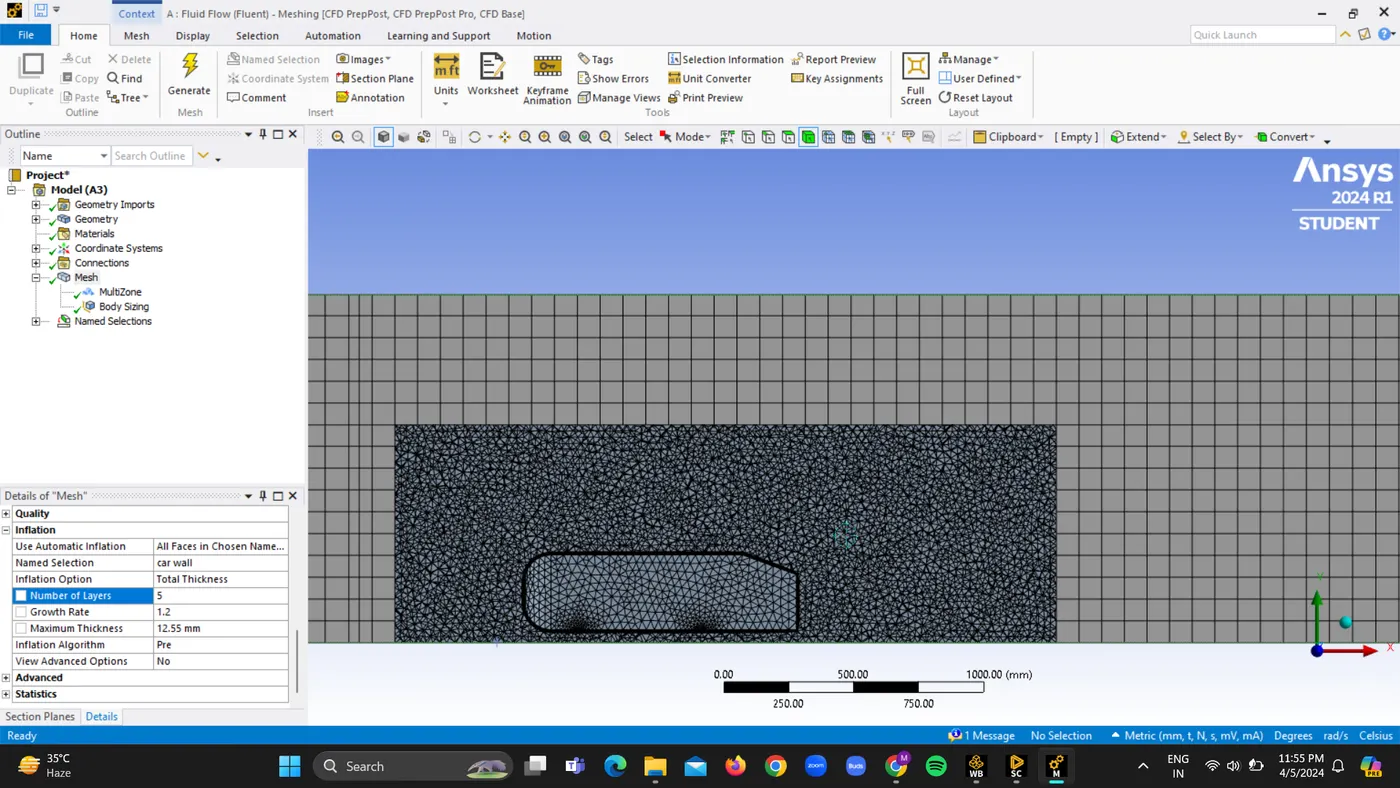
click on mesh and give size as 90mm and also click insert >>body sizing>>inner body and give size as 30mm and click generate mesh
we need to mesh.>inflation select inner body >>selct car wall (named selection) >>first layer thickness>>5mm>>5 layers and click on generate mesh
open setup>> as for pressure based solver >>viscous>> K epsilon>>ok
inlet velocity>>25m/s
hybrid initialize the mesh
create contour for velocity and plots for drag and lift coefficient
have iteration for 350
go to cfd post to analyze vector plot
like this, we are going to flow and analyze for three different sizes
| outer body size | inner body size | |
| case 1 | 110mm | 60mm |
| case 2 | 100mm | 50mm |
| case 3 | 90mm | 30mm |
Now we are going to analyze each and every case one by one.
OBSERVATION:
Case1:
Mesh
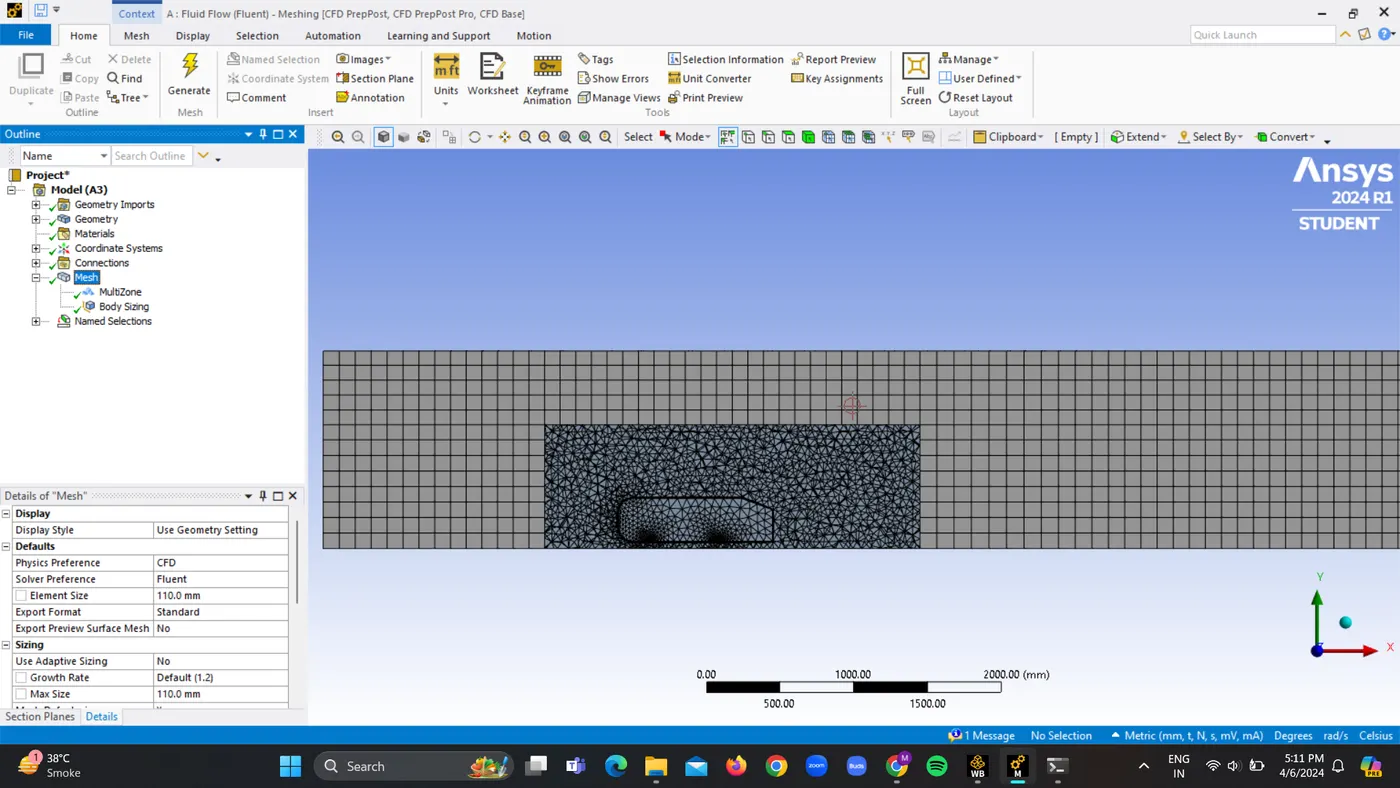
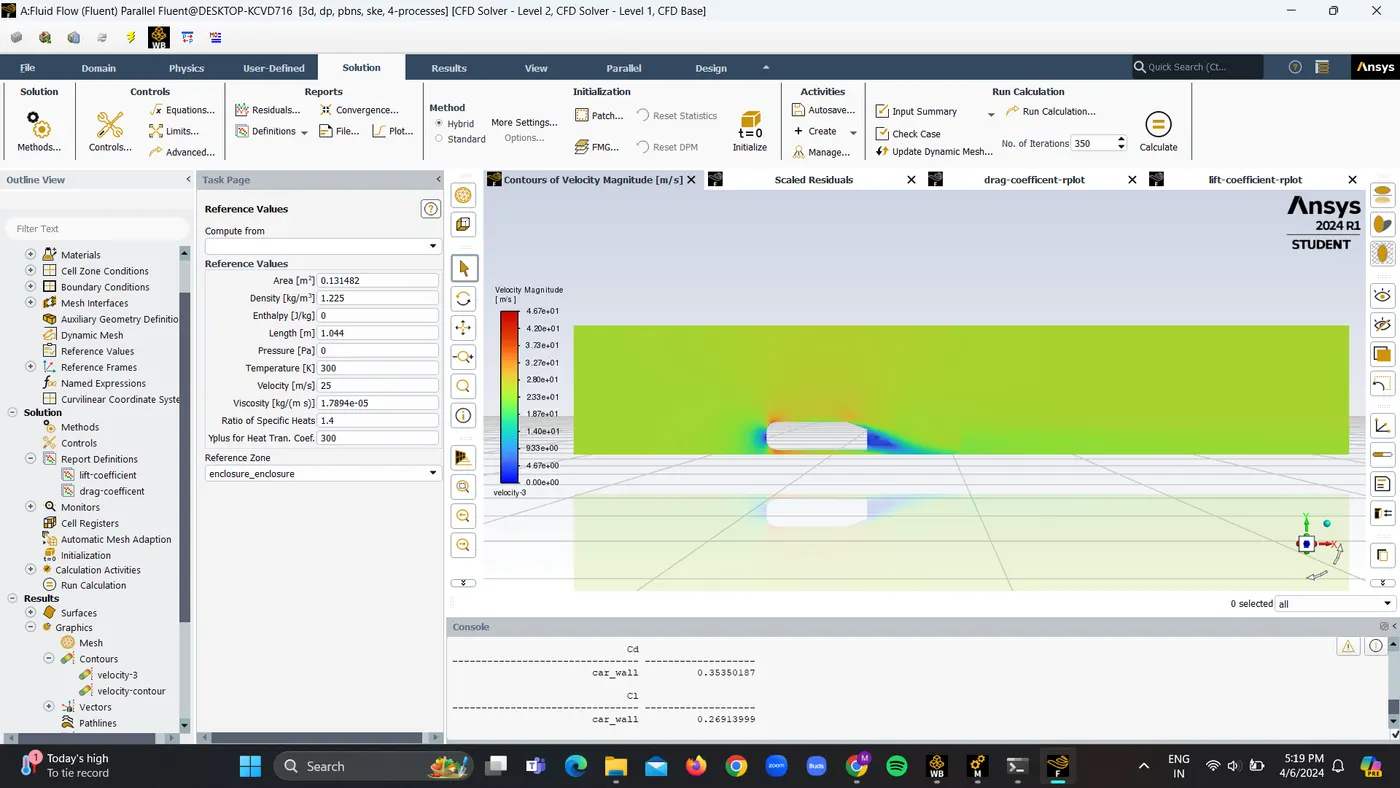
1. Velocity and vector contour plots
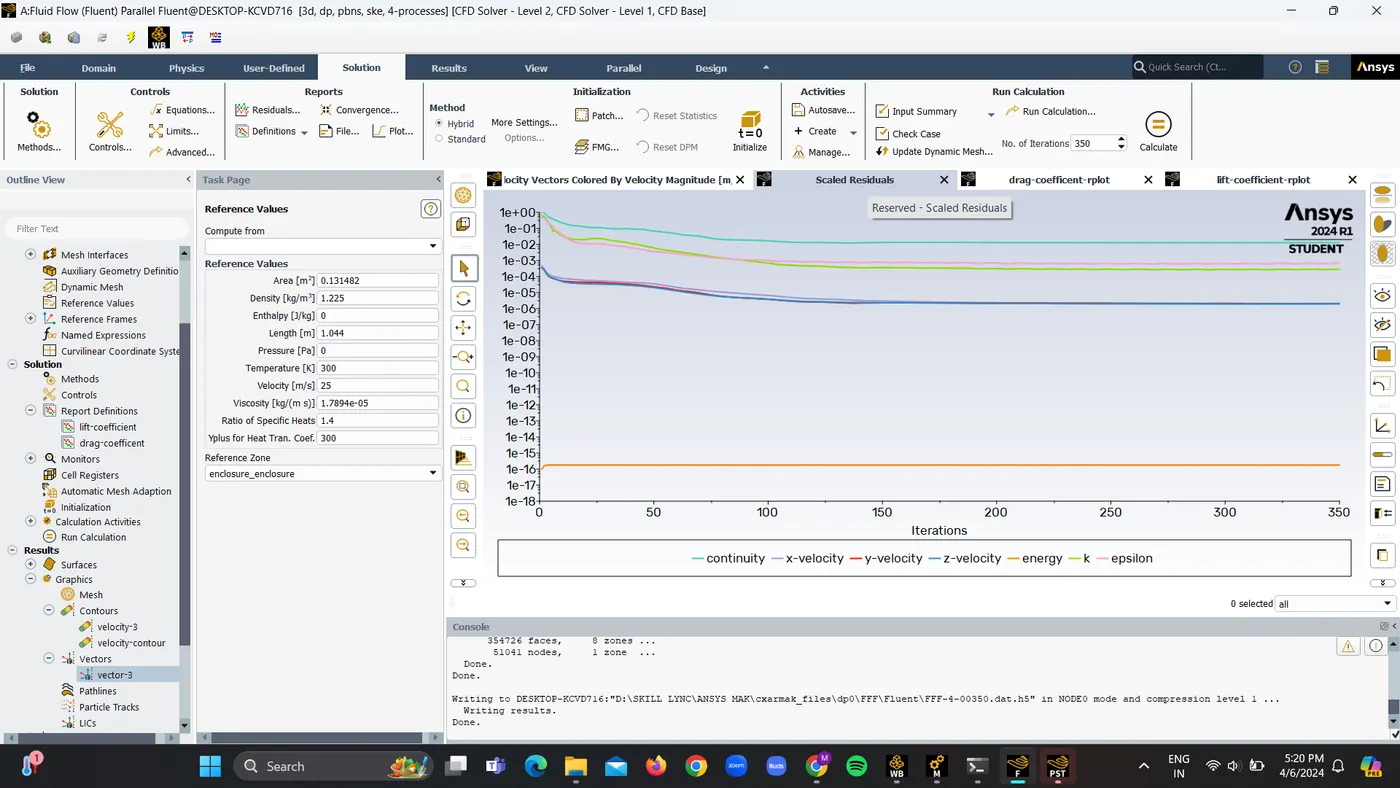
2. Residuals
3. Drag coefficient = 0.35
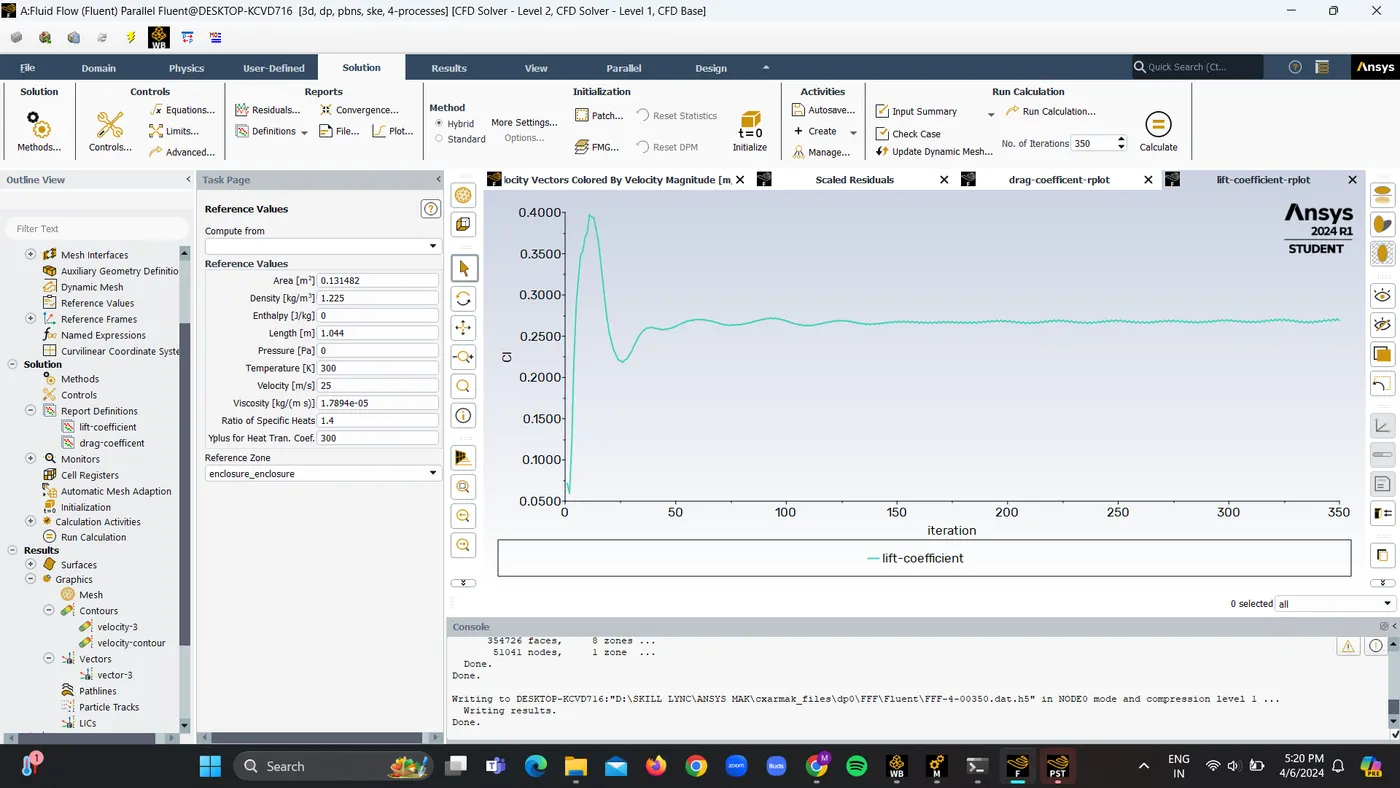
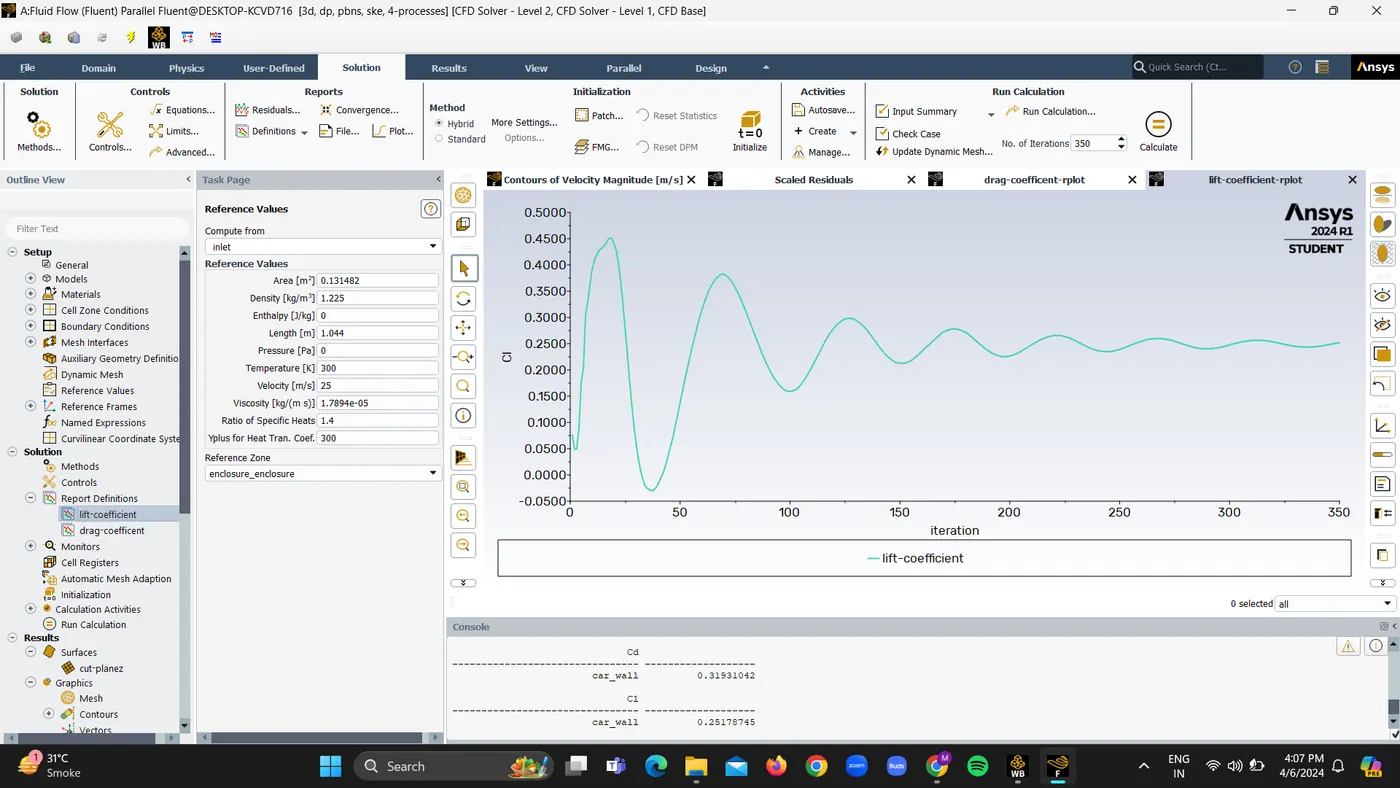
4. Lift coefficent = 0.26
Case2:
Mesh
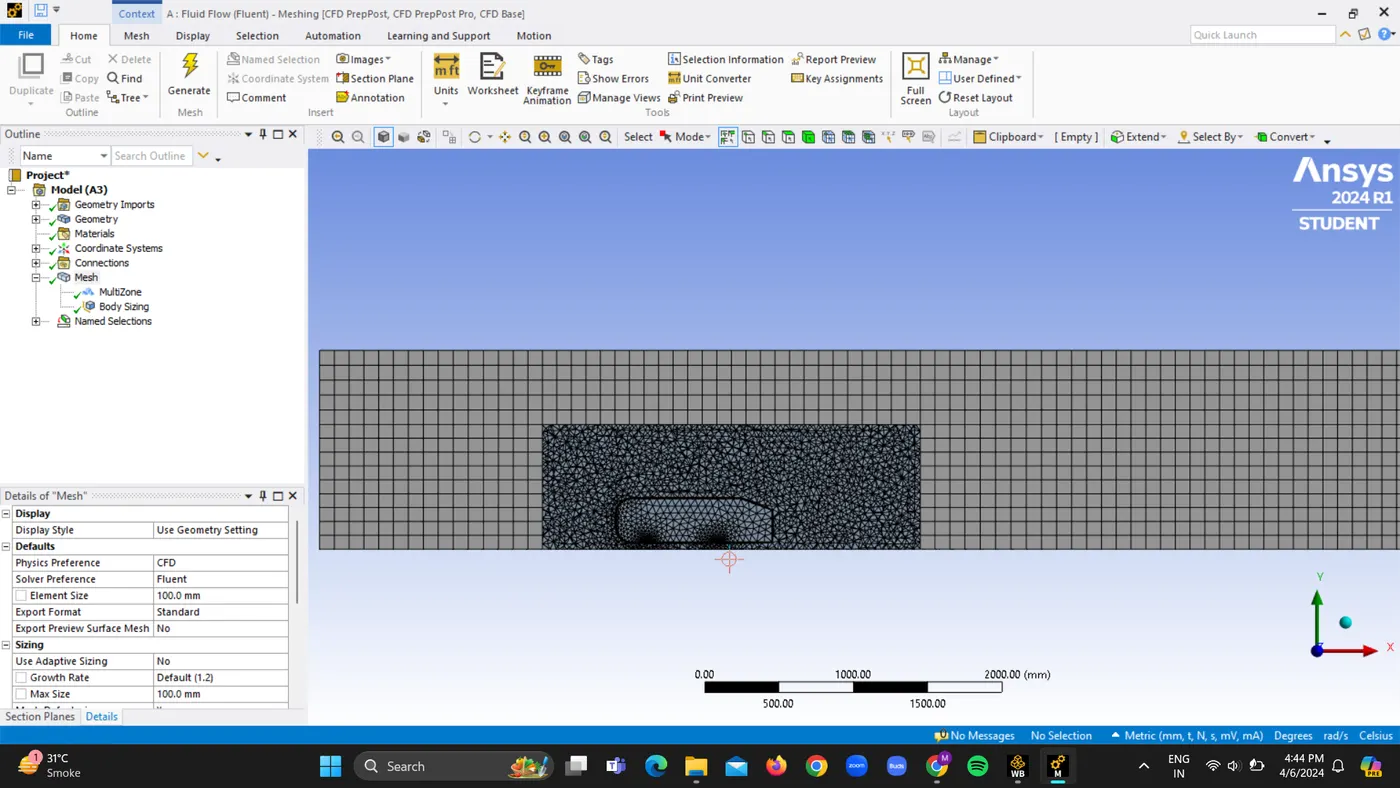
1. Velocity and vector contour plots
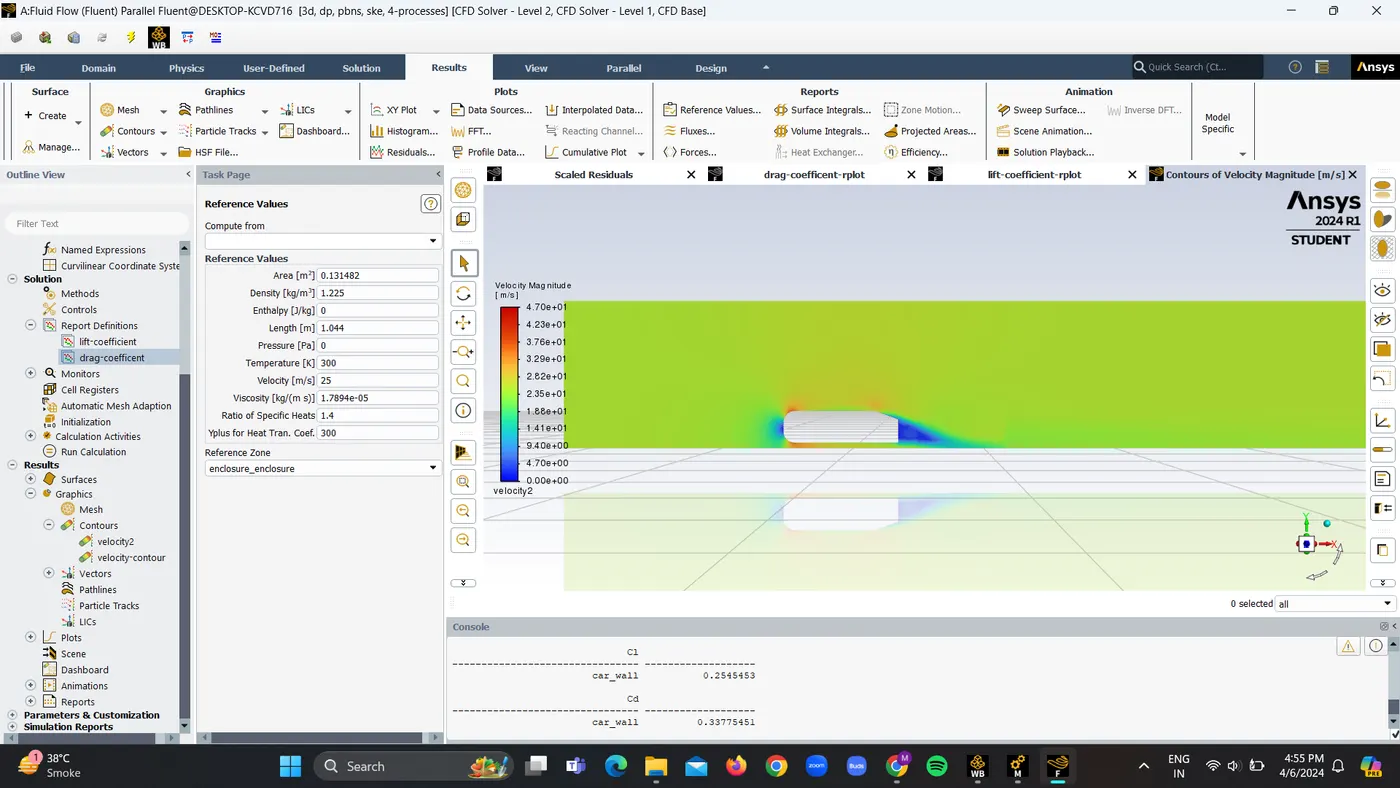
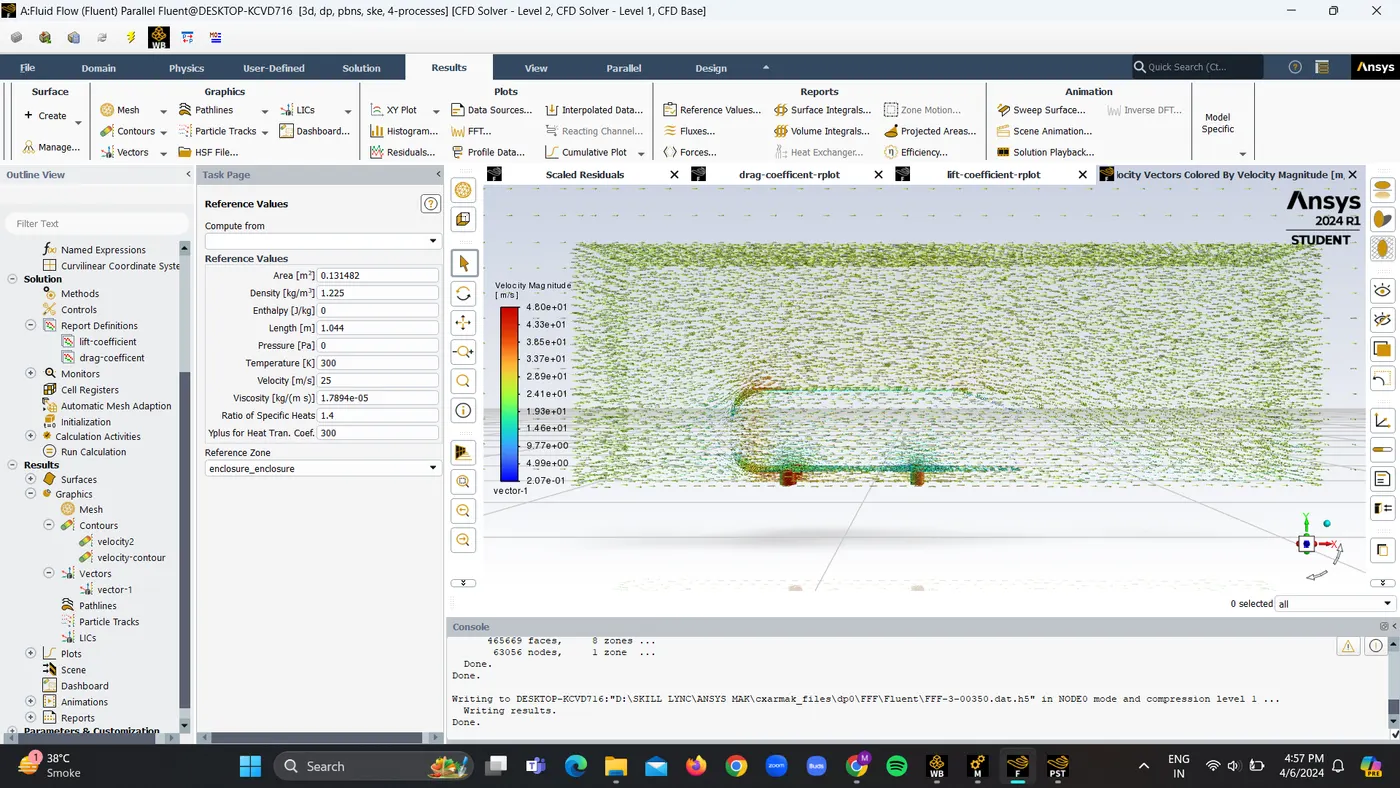
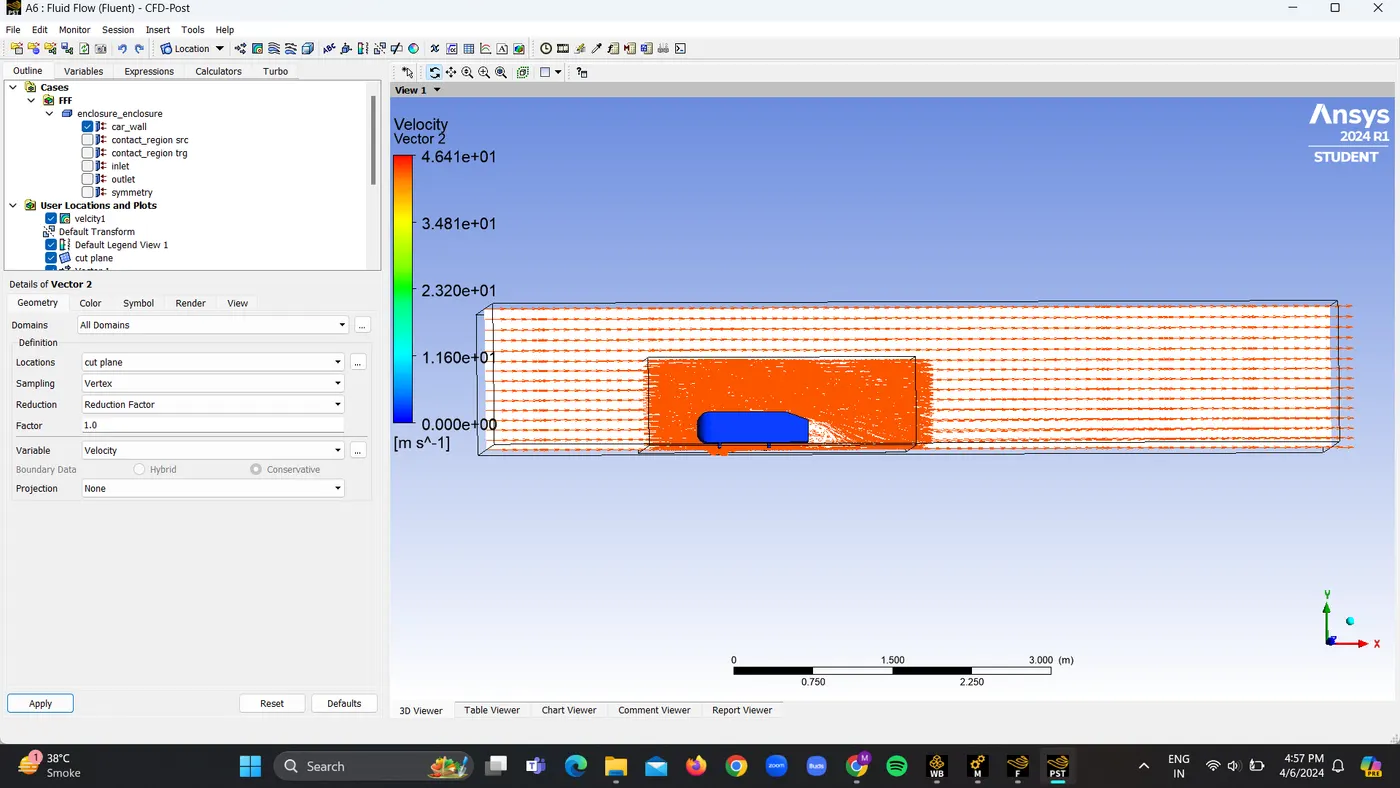
2. Residuals
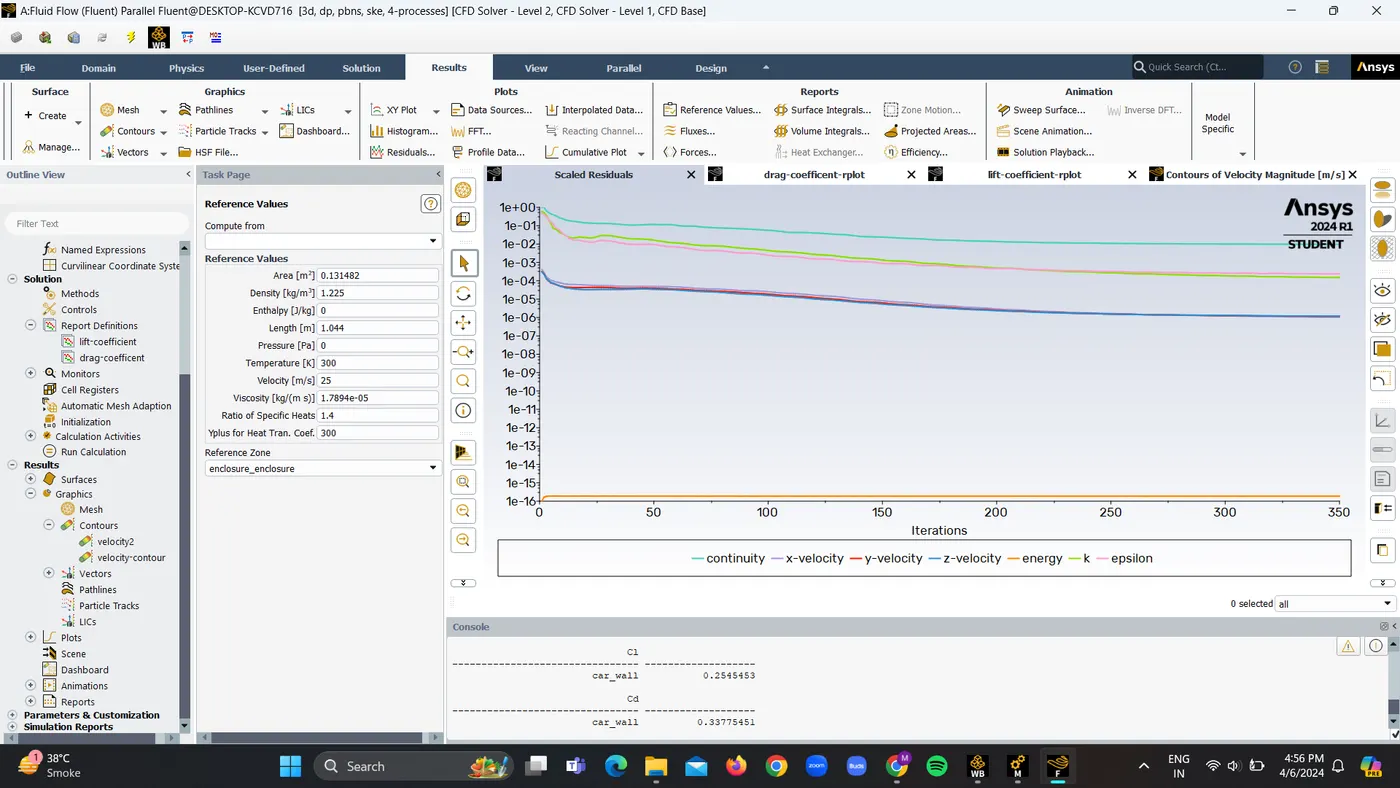
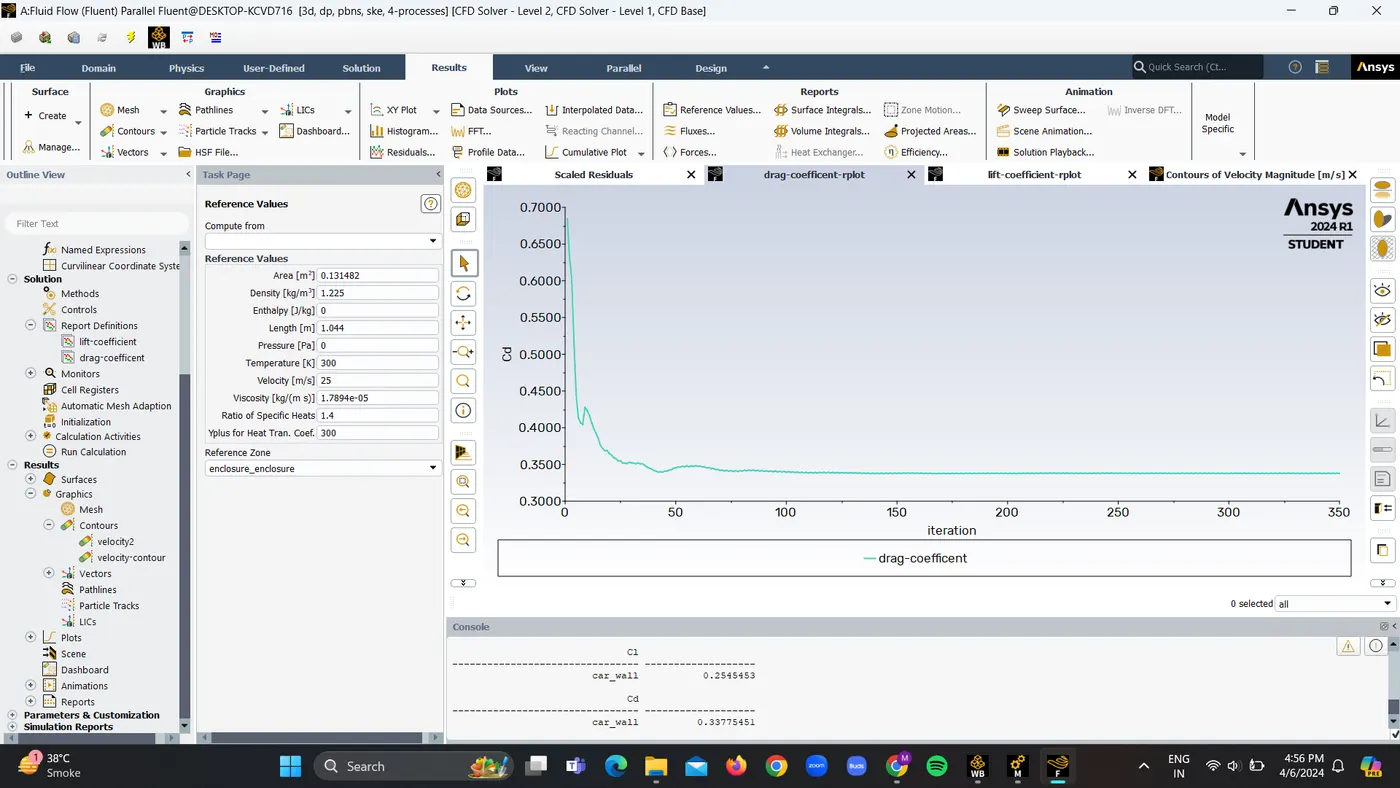
3. Drag Coefficient = 0.33
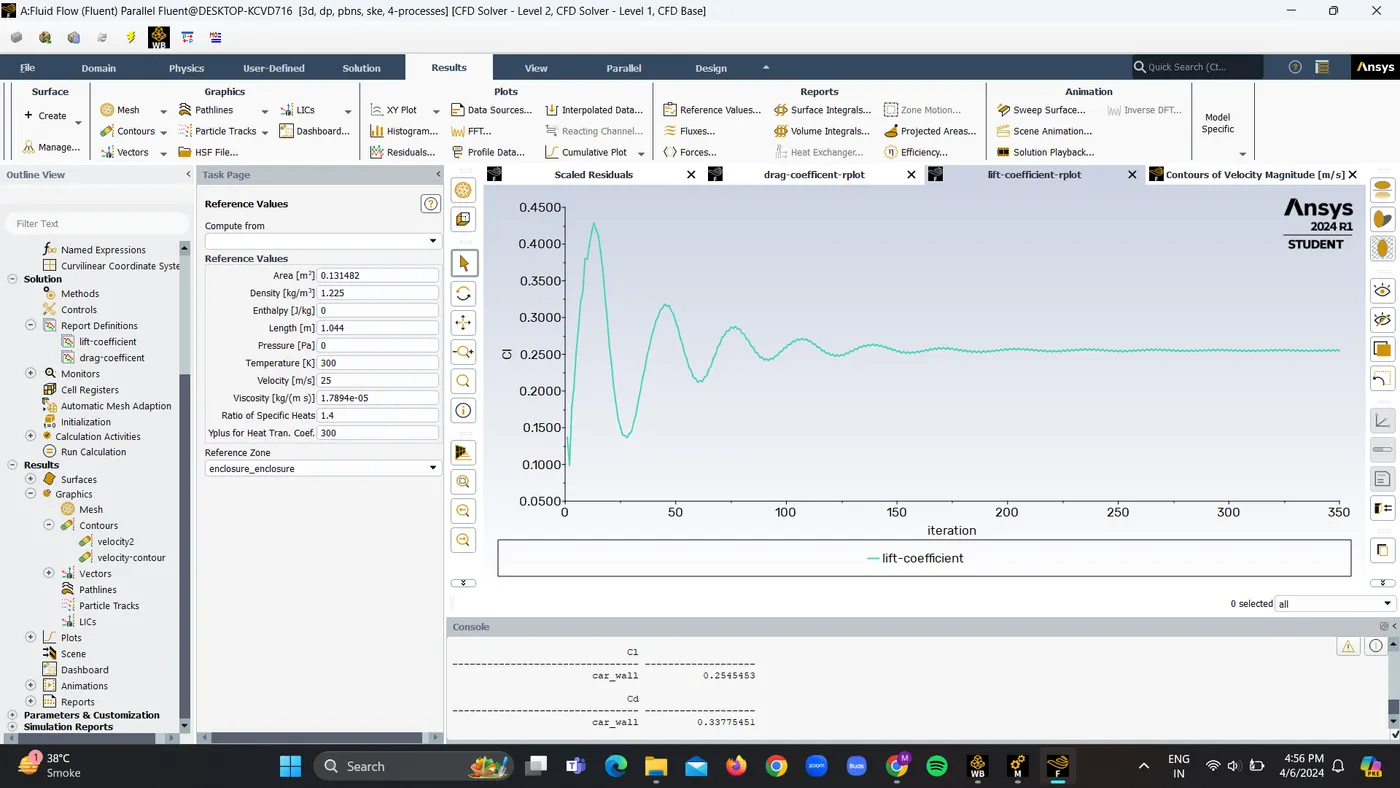
4. Lift coeffiecient = 0.25
Case 3. Mesh:
1. Velocity contour and vector plots
2.Residuals
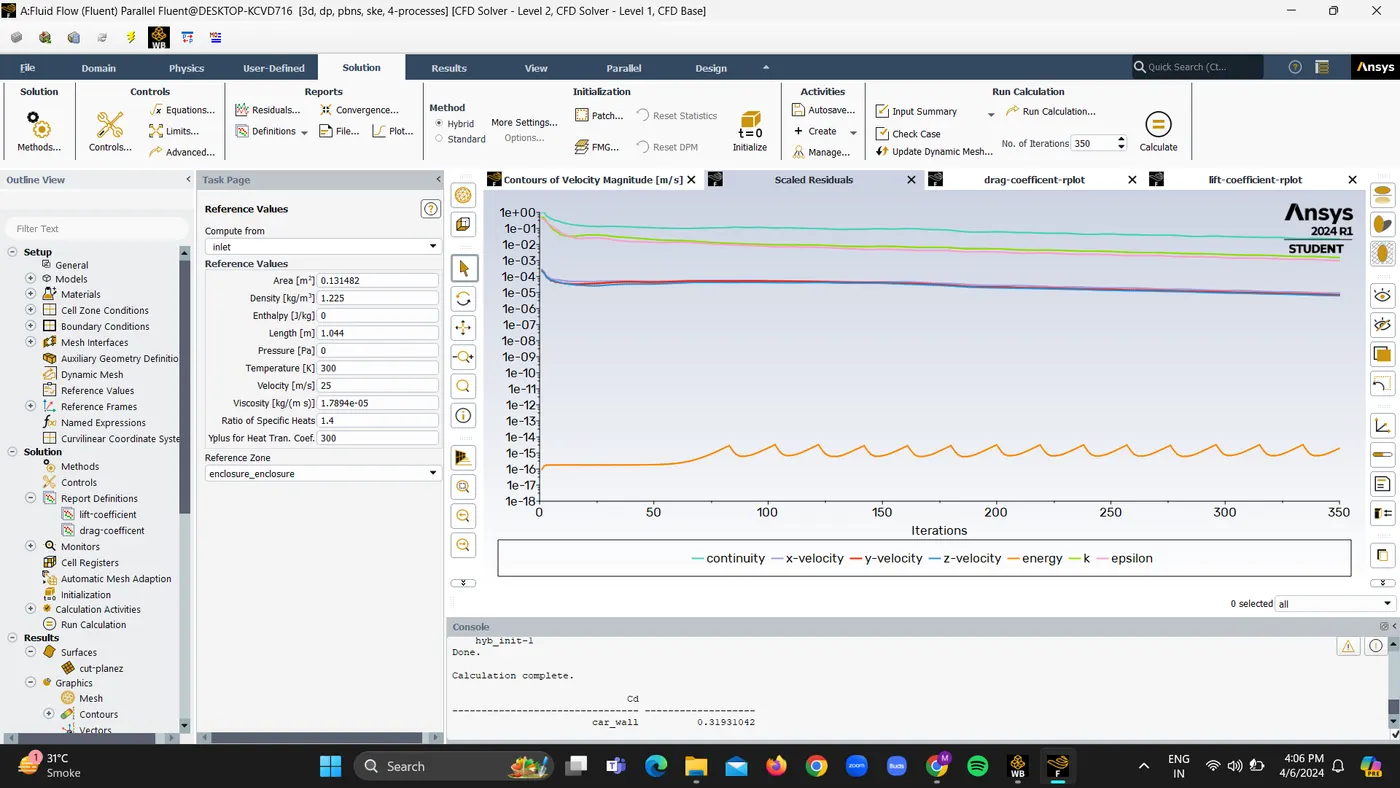
3. Drag coefficent = 0.32
4. Lift coefficient = 0.25
conclusion:
| S.no | Case | outer mesh | Inner mesh | Cd | Cl |
| 1 | Case 1 | 110mm | 60mm | 0.353 | 0.269 |
| 2 | Case 2 | 100mm | 50mm | 0.337 | 0.254 |
| 3 | Case 3 | 90mm | 30mm | 0.319 | 0.251 |
by question it is given that drift coefficient will be 0.33
From the above results we can observe that case 2 gives closer value for calculated drift coefficient.
Hence we can ensure that smaller the mesh size the accuracy will be higher.
Results:
Thus we performed flow simulation over ahmed body.