ADVISOR Tool
Objectives:
Use ADVISOR tool and simulate the following:
1. For EV_defaults_in file, if cargo mass is 500 kg with all other default conditions, can the vehicle travel for 45 km with FTP drive cycle? Conclude your observations.
2. In the above case, try changing the battery capacity and repeat the simulation.
3. Perform gradeability test with PRIUS_Jpn_defaults_in file.
4. Compare the results in a table and conclude.
ADVISOR TOOL:
ADVISOR tool is an advanced vehicle simulator tool developed by National Renewable Energy Laboratory. It was created using simple Simulink blocks and Matlab codes in the form of GUI to determine the fuel economy and the performance of a vehicle. It includes conventional vehicle, hybrid electric vehicle and electric vehicle. MATLAB provides an easy-to-use matrix-based programming environment for performing calculations while Simulink can be used to represent complex systems graphically using block diagrams. ADVISOR uses three primary graphical user interface (GUI) screens to guide the user through the simulation process. With the GUIs, the user can iteratively evaluate the impacts of vehicle parameters and drive cycle requirements on vehicle performance, fuel economy, and emissions. The GUIs facilitate interaction with the raw input and output data that is present in the MATLAB workspace. The vehicle model is depicted graphically using Simulink block diagrams to define the connections between components. The model then reads the input data from the MATLAB workspace during the simulation and outputs the results to the workspace to be viewed in the results window.
Part 1:
The input values are set to defaults for the EV_defaults_in file except for the cargo load. It is set to 500 Kg in the first window. Going to the second window, FTP drive cycle was considered and as we want to check whether the vehicle can cover 45 Km, the number of cycles is set to 3 as single FTP cycle almost covers 18 Km. As we don't have to determine the hill-climbing effort, those conditions are neglected and the results are calculated.
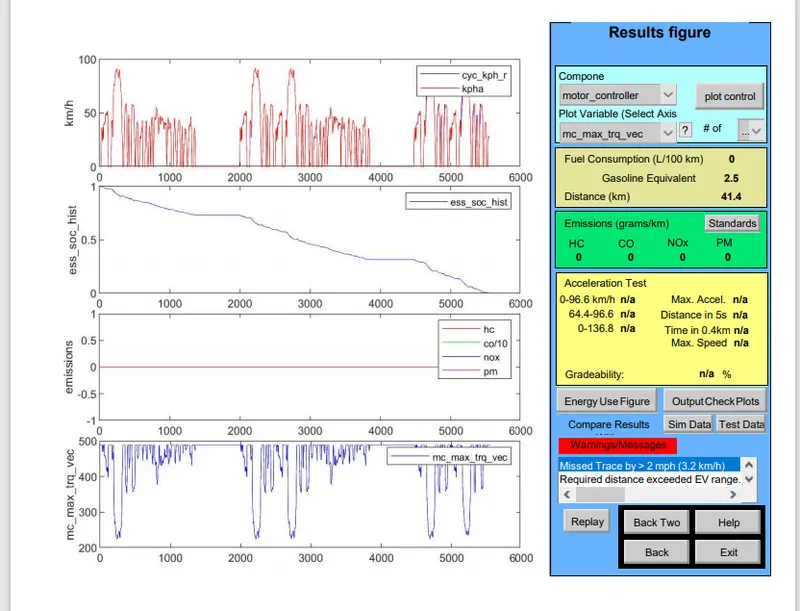
Based on the results figure, it can be inferred that the vehicle can cover a total distance of 41 Km till the battery goes dry. The second plot i.e the soc vs time graph provides an idea for the time taken by the battery to go from 100 % to 0 %. Based on the results obtained, the vehicle cannot cover 45 Km as the battery gets drained at 41 Km.
Part 2:
Here the number of Lead-acid battery modules is changed from 25 to 30 that changes the overall mass of the battery pack and the voltage. With all the other factors including the cargo mass and the number of FTP cycles are remaining the same.
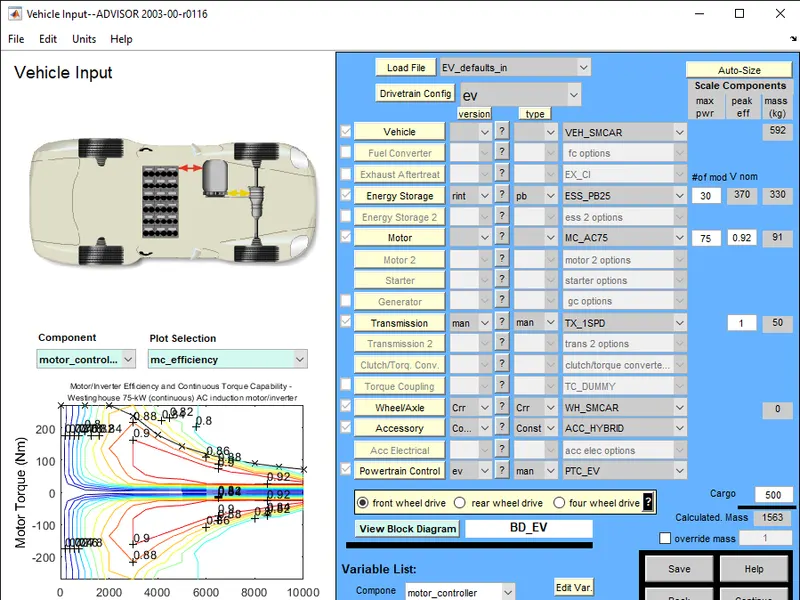
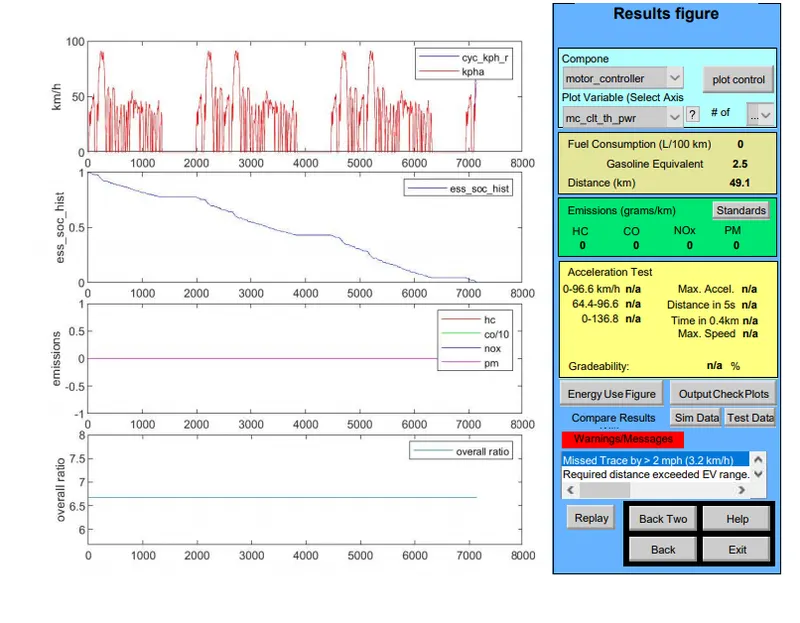
From the above results figure data, it can be clearly seen that increasing the battery capacity has provided a small change or increase in the overall distance travelled from 41 Km to 49 Km and as the acceleration and the gradability test arent performed, the change in the numbers cant be determined. As this is an electric vehicle, it doesn't have any emissions so it remains 0 throughout the span.
Part 3:
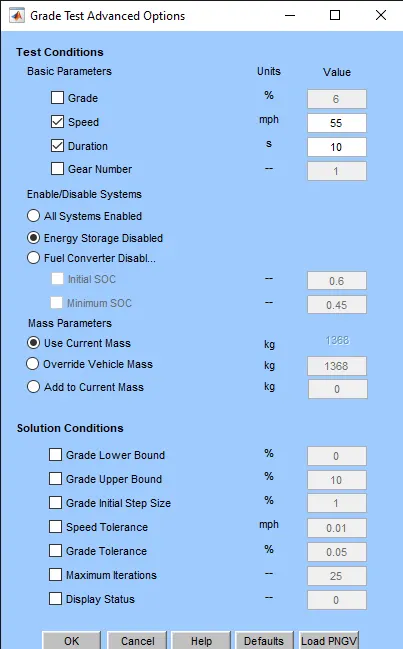
Here the PRIUS model is selected with the default configuration except for the cargo weight. The cargo weight remains 500 Kg and the FTP driving cycle is used for 3 iterations. As a gradability test is performed, the test is selected.
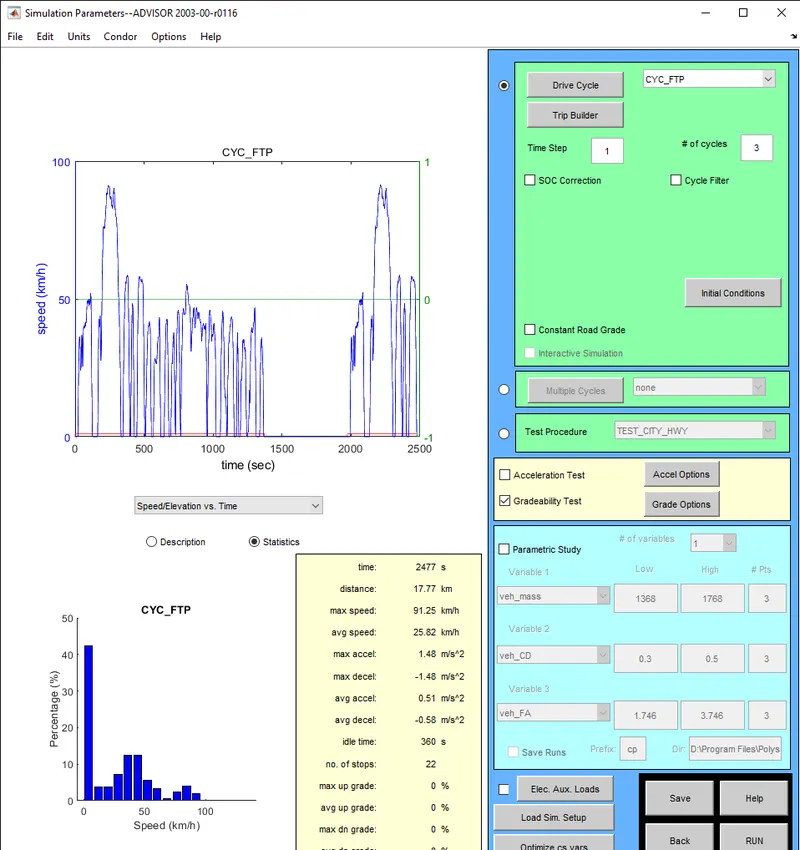
Gradability test configuration is set to defaults:
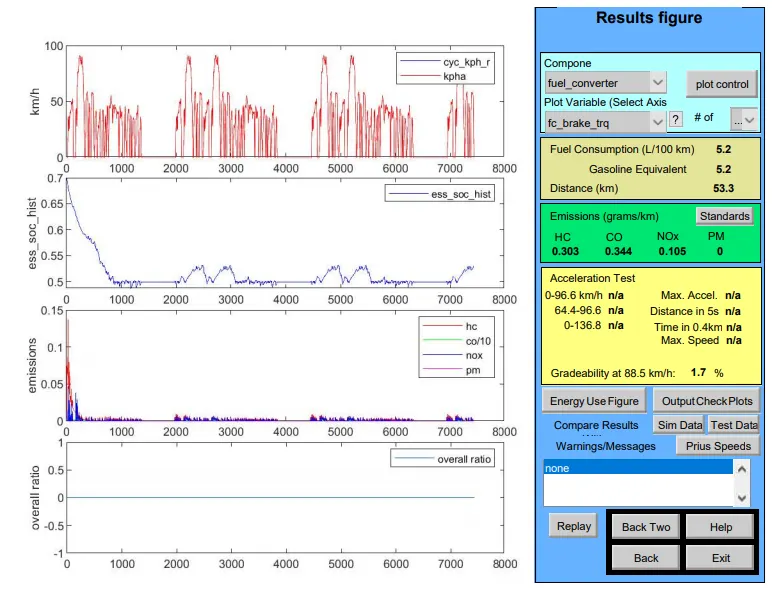
From the results figure from the soc vs time plot, it can be clearly seen that the vehicle could run more than 3 FTP drive cycles. At the end of the third cycle, the battery is getting charged. So the vehicle can run more than 53 Km.
Conclusion:
As the standard EV vehicle has two ways to charge (external supply and through regeneration), the mileage of the vehicle can be improved by increasing the battery capacity and also dependant on the drive cycles and auxiliary electrical loads. In the case of the hybrid vehicle, the vehicle can run in both conventional engines as well as electric power. The battery can be charged with the help of the generator connected to the conventional engine that eventually increases the overall efficiency of the vehicle thereby providing a higher mileage.
Bibliography:
ADVISOR: a systems analysis tool for advanced vehicle modelling PII: S0378-7753(02)00189-1 (uvic.ca)