Week-3 Challenge: ADVISOR Tool
WEEK 3 - ADVISOR TOOL CHALLENGE
AIM: Use the ADVISOR tool and simulate the following:
- For the EV_defaults_in file, if the cargo mass is 500 kg with all other default conditions, can the vehicle travel for 45 km with FTP drive cycle? Conclude your observations.
- In the above case, try changing the battery capacity and repeat the simulation.
- Perform gradeability test with PRIUS_Jpn_defaults_in file.
Compare your results in a table and conclude.
THEORY:
1) ADVISOR tool, developed in November 1994 by the National Renewable Energy Laboratory (NREL), which enables users to simulate and analyse conventional, advanced, light, and heavy vehicles, including hybrid electric and fuel cell vehicles. The tool allows users to evaluate the impact of modifications to other parts of the vehicle, such as the motor, battery, catalytic converter, climate control system, and alternative fuels, as well as other changes that may affect the vehicle's performance, emissions, or fuel economy.
It is a collection of text files with models, data, and scripts for use with Matlab and Simulink.
2)You may benefit from using ADVISOR if you want to:
- estimate the fuel economy of vehicles that have not yet been built
- learn about how conventional, hybrid or electric vehicles use (and lose) energy throughout their drivetrains
- compare relative tailpipe emissions produced on a number of cycles
- evaluate an energy management strategy for your hybrid vehicle’s fuel converter
- optimize the gear ratios in your transmission to minimize fuel use, maximize performance, etc.
The models in ADVISOR are:
- mostly empirical, relying on drivetrain component input/output relationships measured in the laboratory, and
- quasi-static, using data collected in steady state (for example, constant torque and speed) tests and correcting them for transient effects such as the rotational inertia of drivetrain components.
SOLUTION:
1)For the EV_defaults_in file, if the cargo mass is 500 kg with all other default conditions, can the vehicle travel for 45 km with FTP drive cycle?
Units are changed to metric.
Cargo Mass: 500kg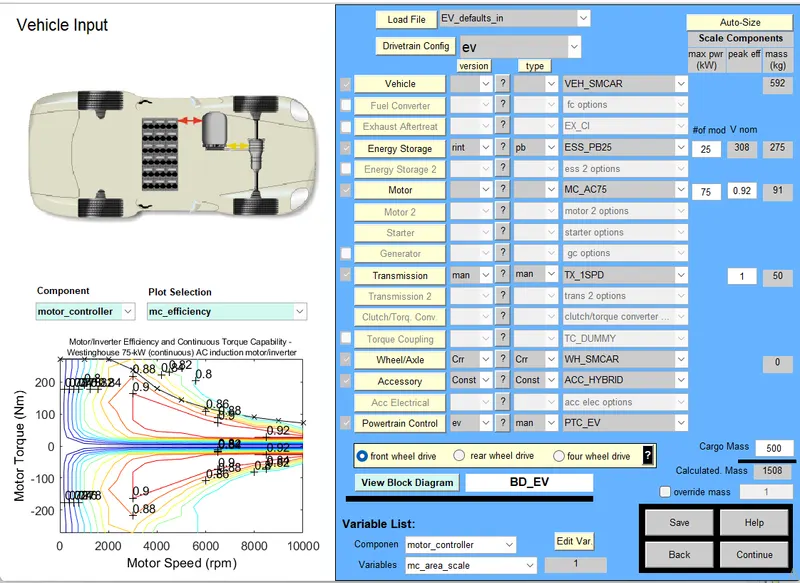
No of Cycles:3
Drive Cycle: CYC_FTP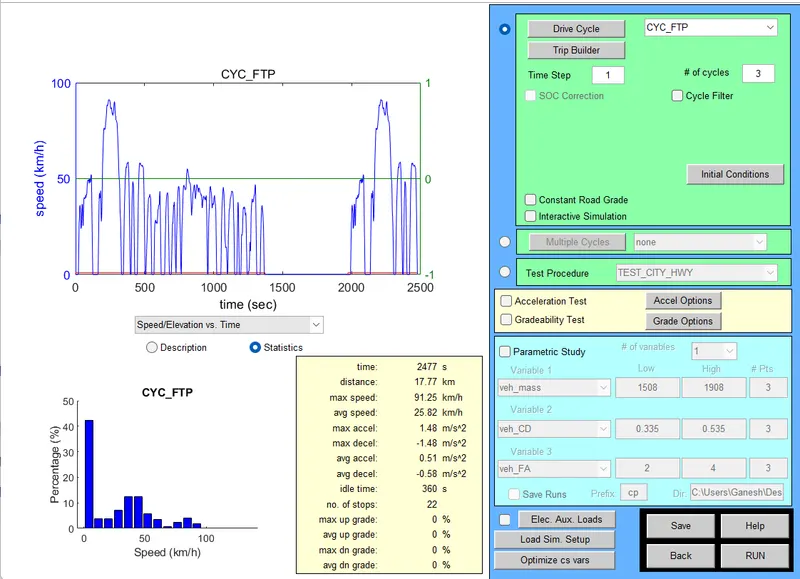
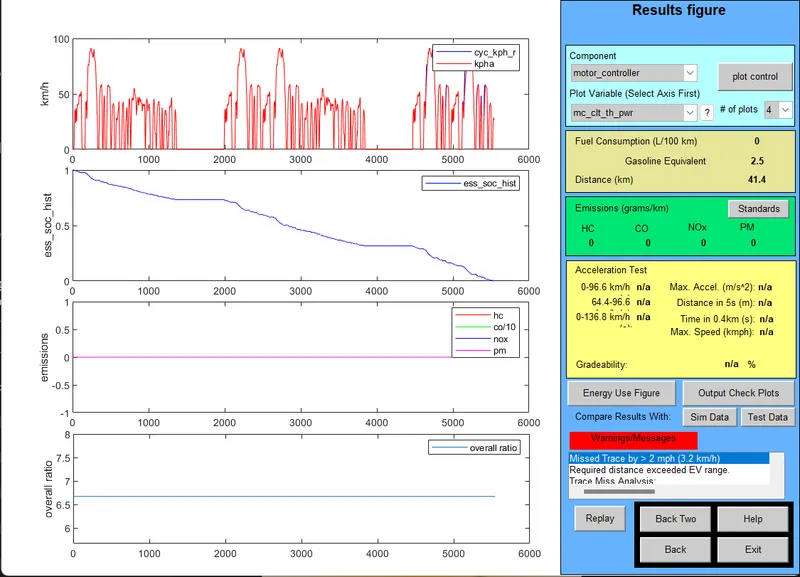
Observations:
The max distance that can be travelled using this vehicle model is 41.4km. So this vehicle model cannot travel 45km as the battery depletes at 41.14km.
2) In the above case, try changing the battery capacity and repeat the simulation.
We change the #of module to change the battery capacity
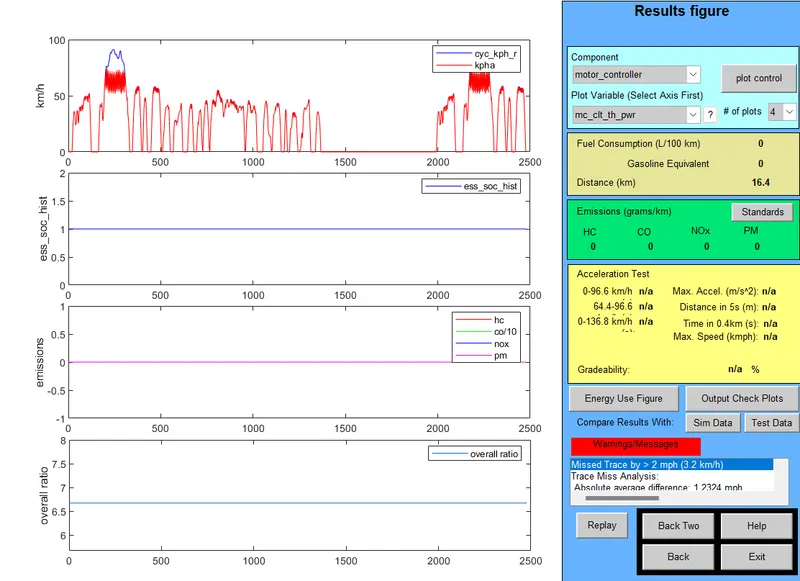
- Battery Module # - 5
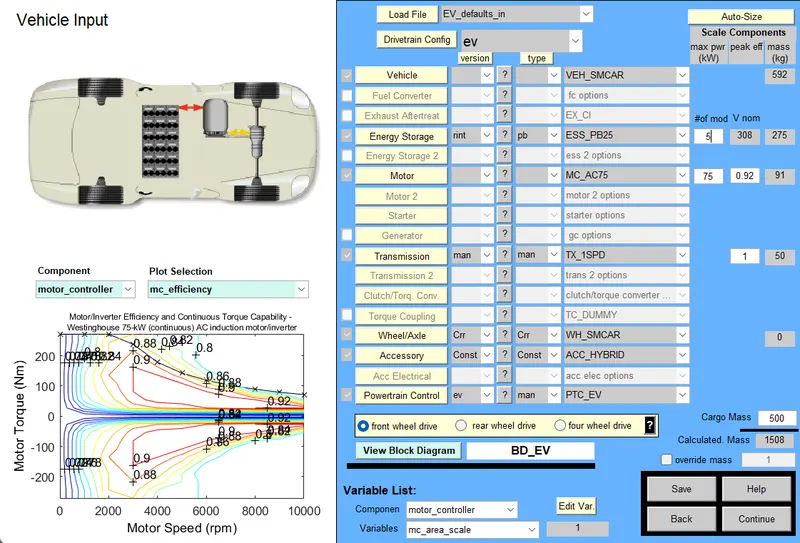
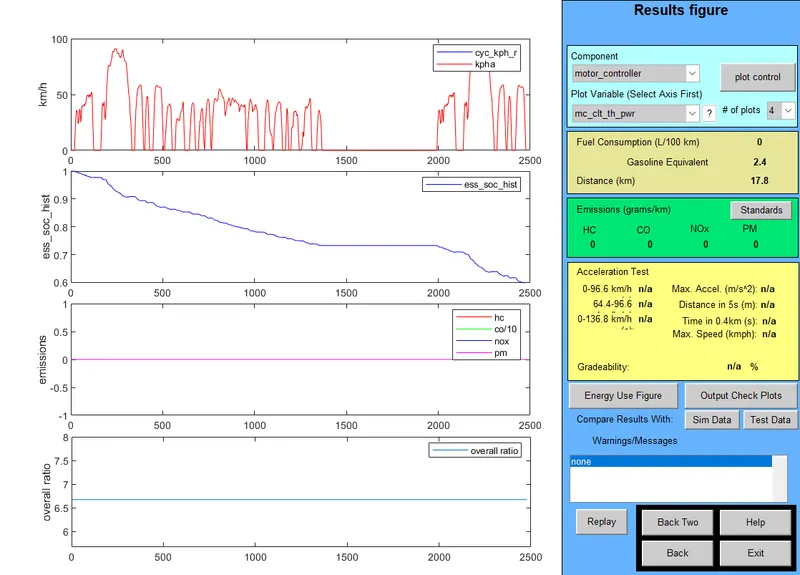
- Battery Module # - 25
- Battery Module #- 27
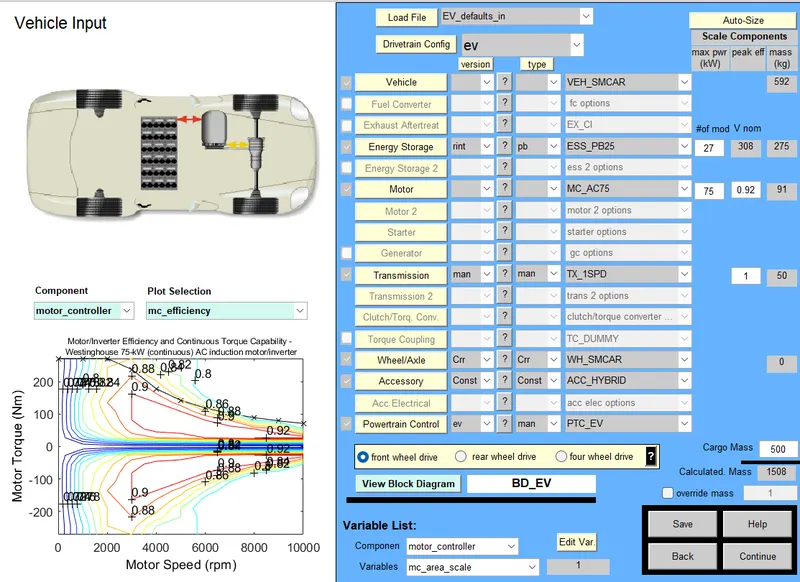
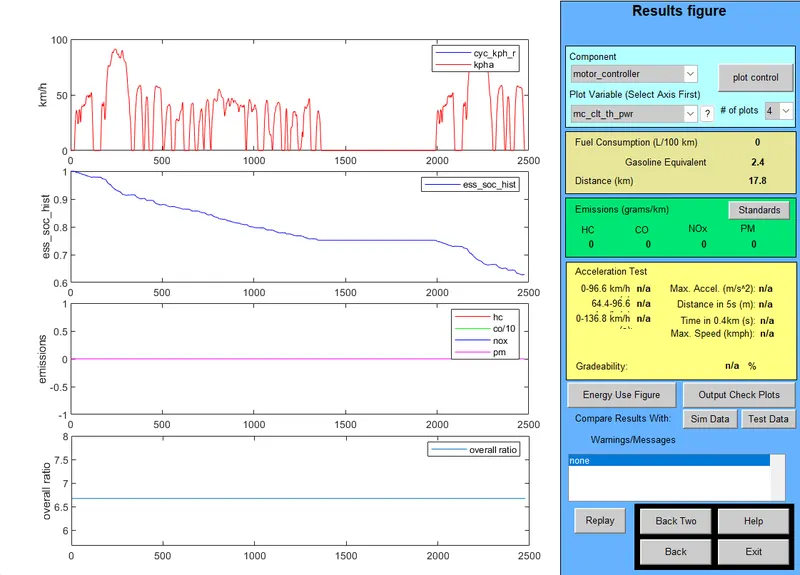
According the observations made, the range increases for 1 cycle is increasing by changing the battery module # till module #25. The distance travelled is constant from battery module #25, i.e 25 km.
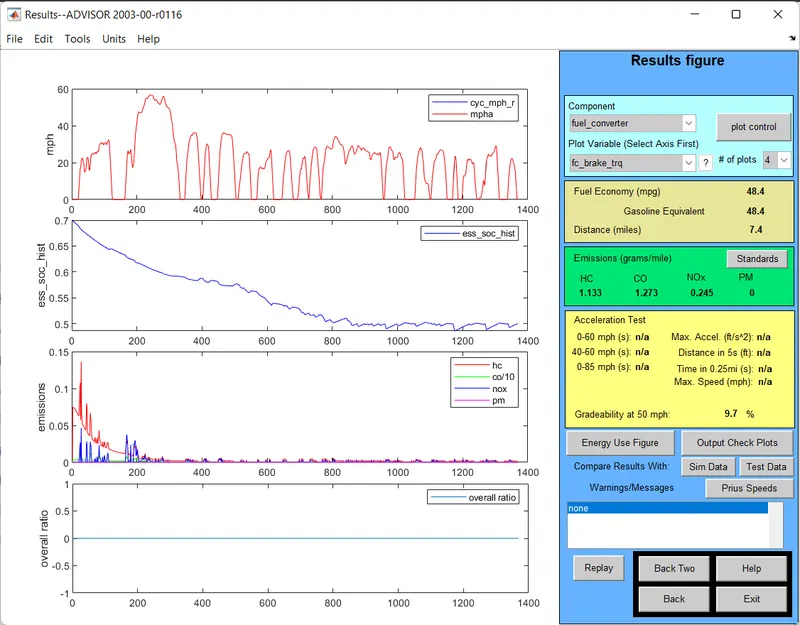
3) Perform gradeability test with PRIUS_Jpn_defaults_in file
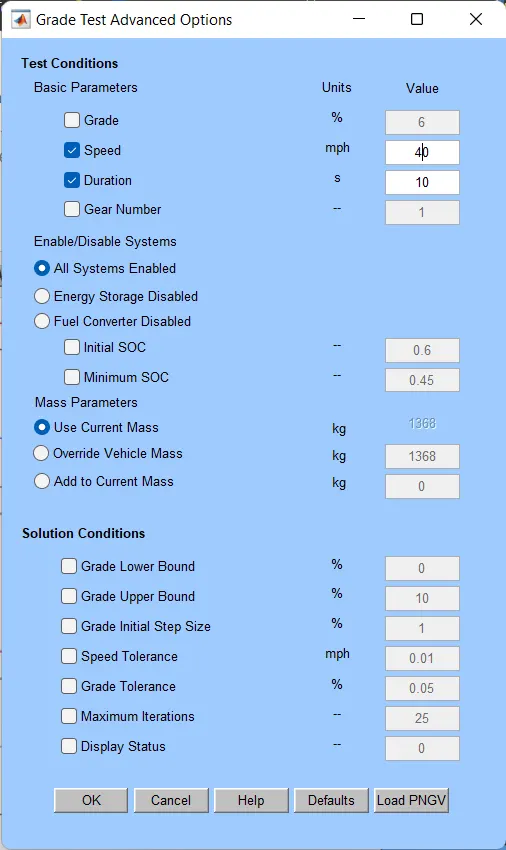
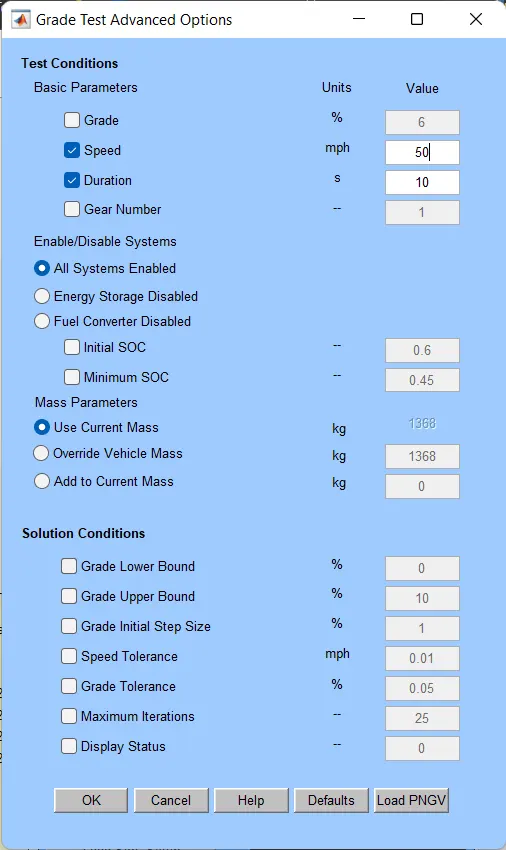
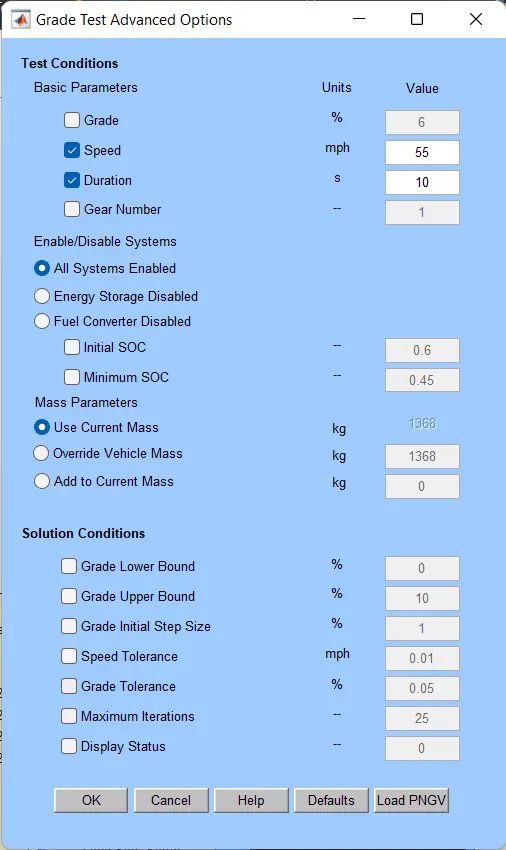
The following input model parameters are chosen-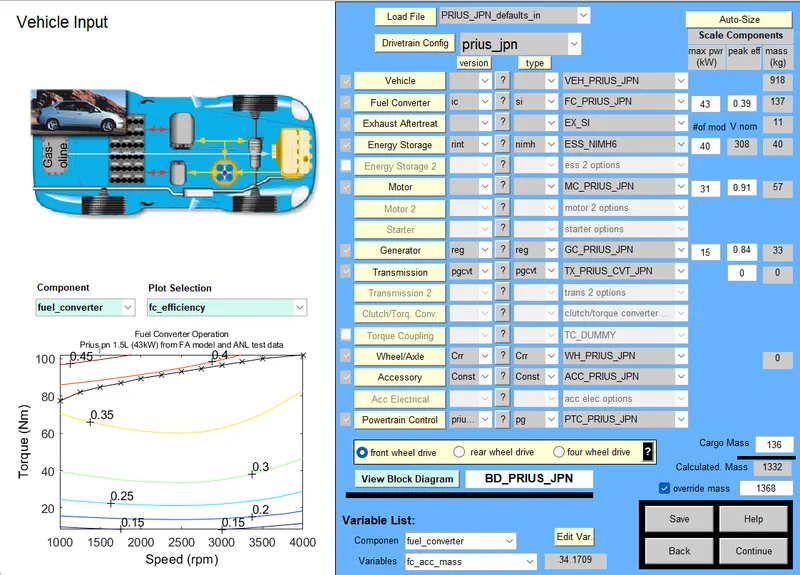
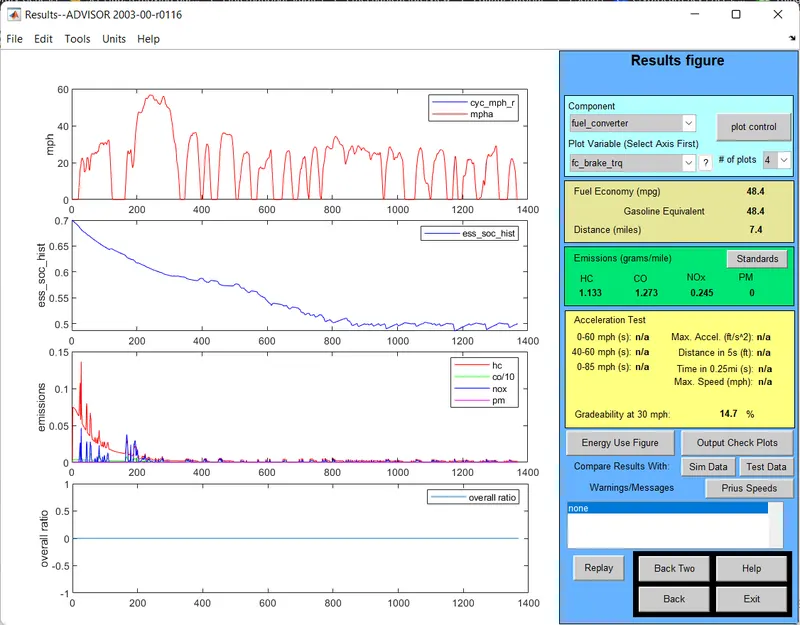
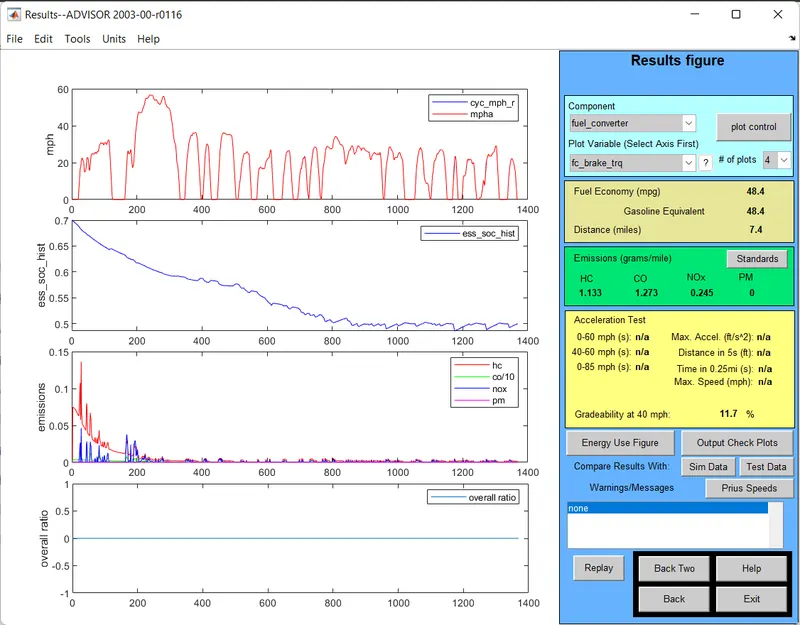
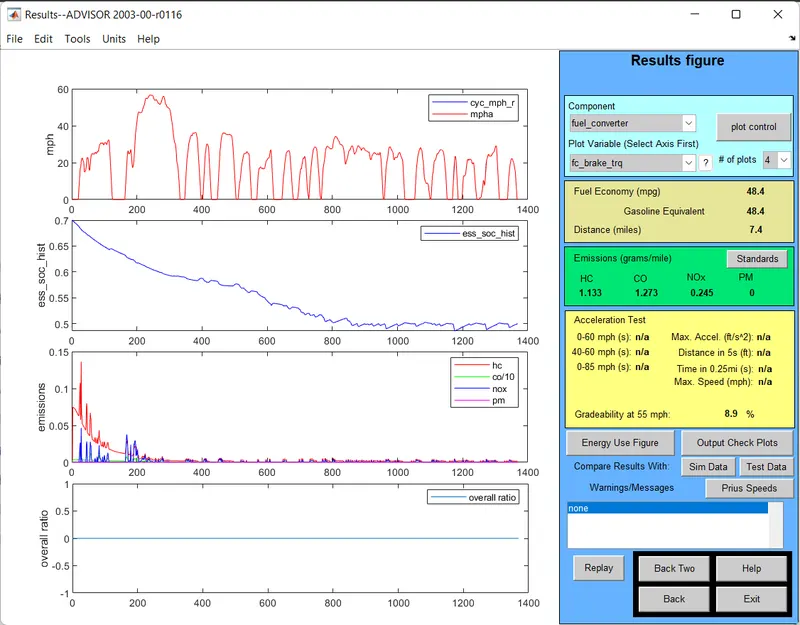
To perform a gradability test, a speed range of 20-55 is applied.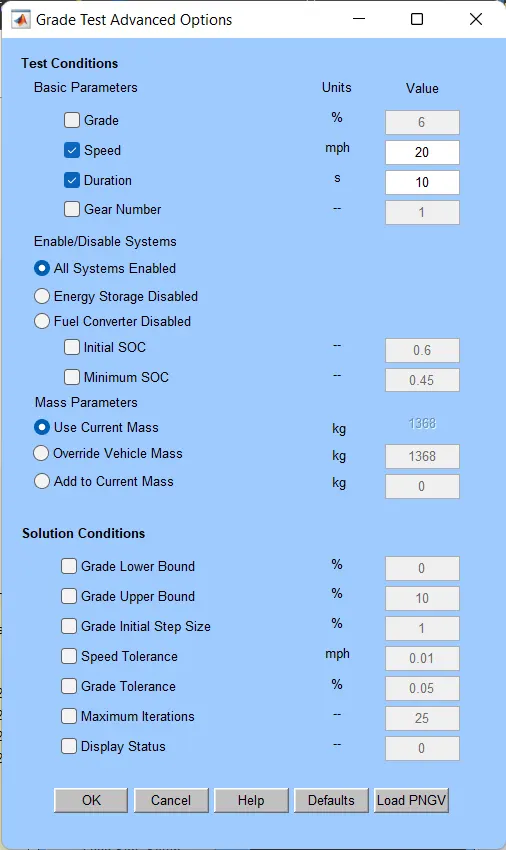
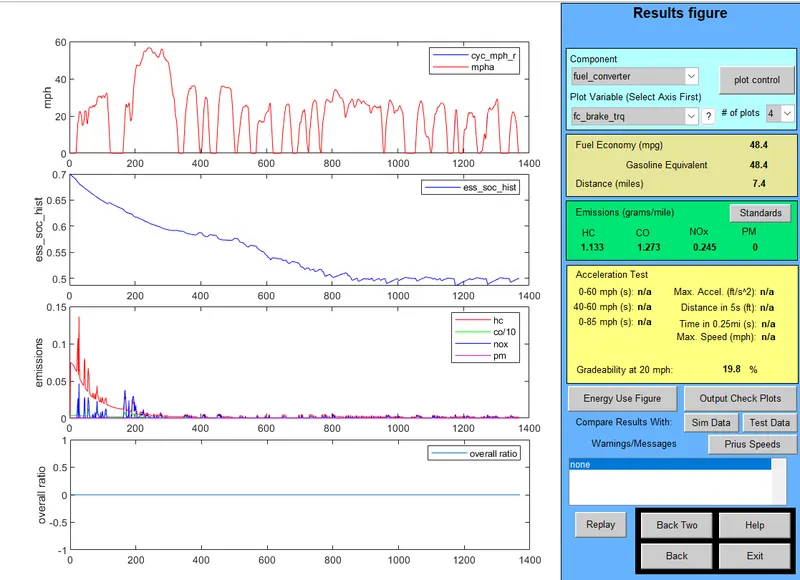
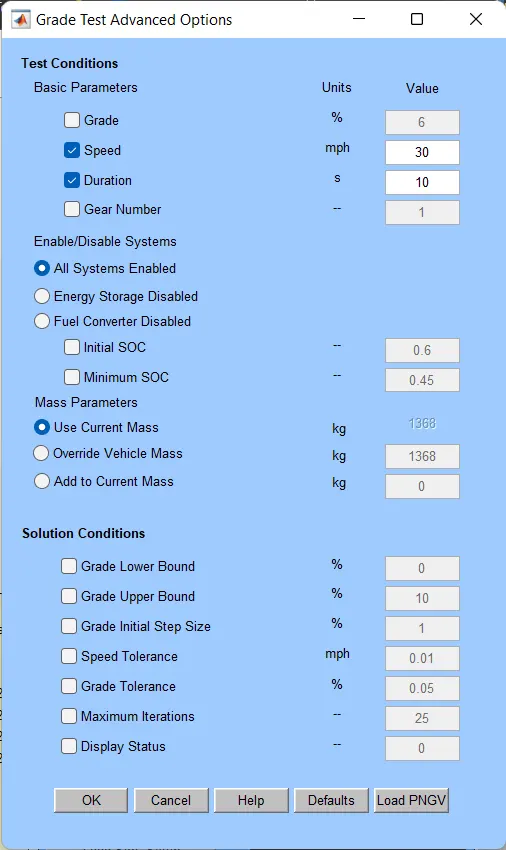
Results:
| Speed (mph) | Gradability |
| 20 | 19.8% |
| 30 | 14.7% |
| 40 | 11.7% |
| 50 | 9.7% |
| 55 | 8.9% |
From the above table, we can observe that the gradability is inversely proportional to the to speed.
So we can conclude that gradability is highest at a lower speed than at high speeds.
CONCLUSION:
- We learnt the uses of the Advisor tool.
- We calculated the range of the default vehicle model for 500kg mass.
- We also checked the distance travelled for the different module # of batteries.
- We also performed a gradability test for the PRIUS_JPN model and concluded that the gradability is inversely proportional to the speed.