Week-3 Challenge: ADVISOR Tool
1. In this we are going to observe the vechicle parameters for the default parameters with only change in the cargo mass of 500kg.
The default model is EV_defaults_in in which we are going to select the FTP drive cycle.
The below is the EV_defaults_in model where we can see the Vehicle consists of only the battery pack and the Electric Motor with the transmission system.
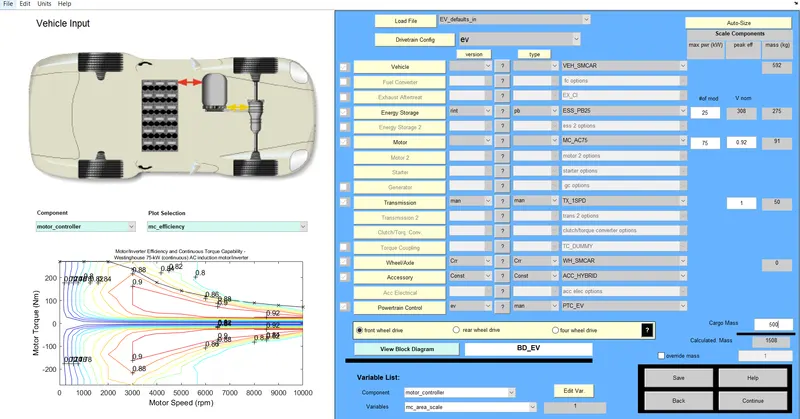
We have changed the cargo mass to 500 as per the question.
From the default parameters we can see that the Energy storage consists of 25 modules and the Motor is of AC type with the Effeciency of 92%.
By continuing the simulation, we see the window where we need to select the drive cycle
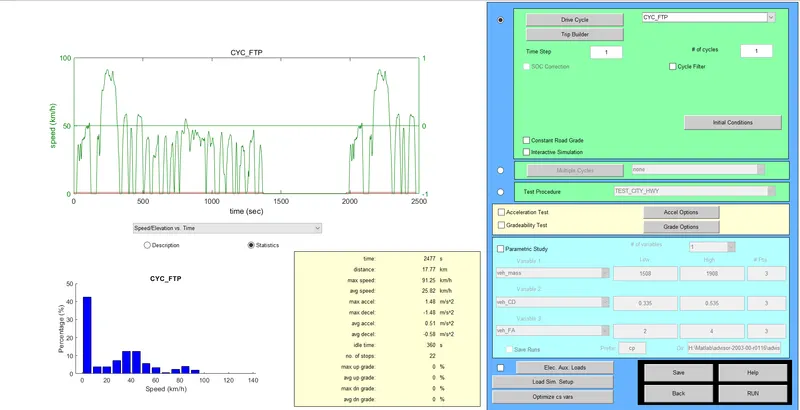
As per the suggestion we have selected the FTP drive cycle. In the graph we can see the time is taken till 2500 sec and the top speed reached is around 91.25kmph and the avg speed is 25.82kmph with the distance travelled is 17.8.
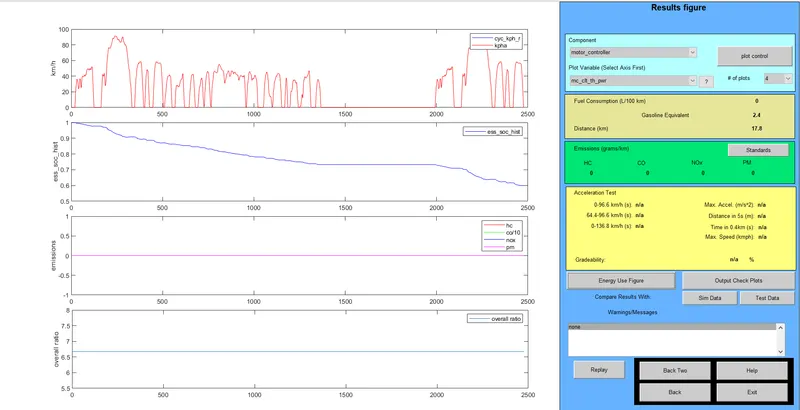
Also we could see from the graph that the charge is reduced to 40%.
Our objective is to find the possibility of the vehicle to be travelled 45KM on the default battery configuration.
Thus we are about to increase the drive cycle to 2 times the FTP drive cycle and look for the observations.
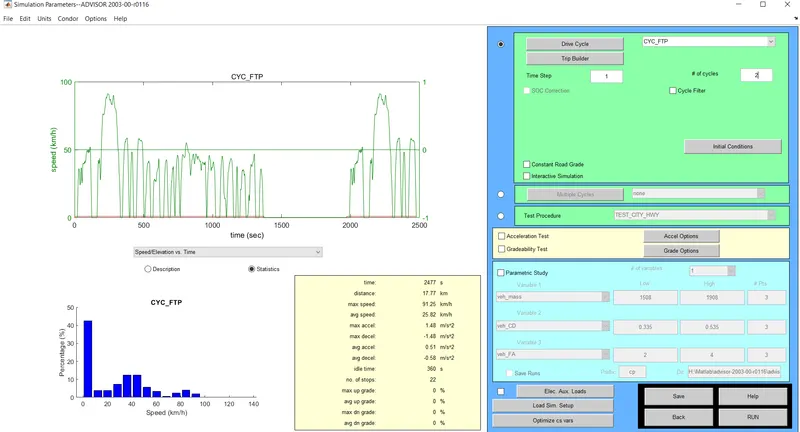
Now the drive cycle will be simulated for two times and the result will be provided.
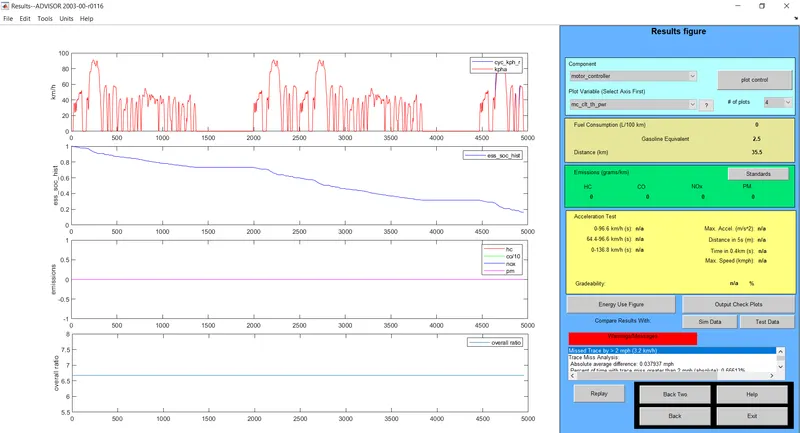
In this result we could see that the distance travelled is 35.5KM and the charge is reduced below 20% since our desired distance travelled is 45KM we can run 3 number of FTP drive cycle and check the graph. [We could also see some warning message in the box where is reduction in accurancy is mentioned.]
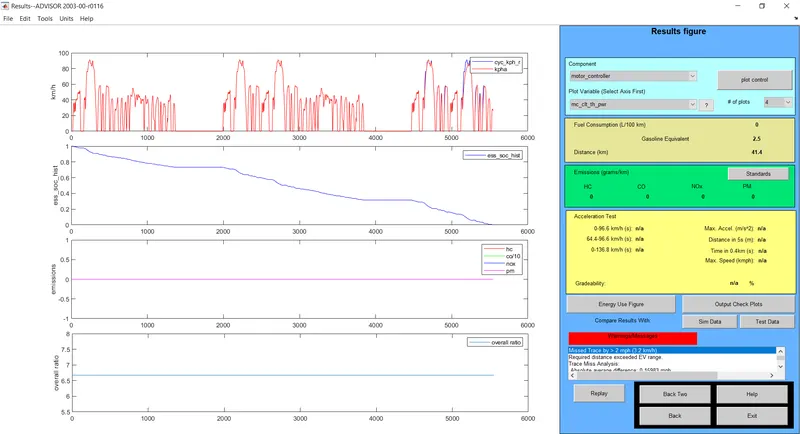
Finally the battey charge is reached to 0% in around 5500 seconds and the distance travelled is 41.4KM, thus we can conclude that with 3 times the FTP drive cycle we can travel till 41.4KM with the EV base model with 500KG of cargo load.
So, for the question if this model can travel to 45KM in FTP drive cycle is not possible with this energy storage.
And the maximum distance that can be travelled with this FTP drive cycle is 41.4KM with the default parameters.
2. The second question is to change the battery capacity and do the simulation. We need to attain the 45KM range by increasing the battery parameter, which can be done by increasing the battery module of the battery pack.
In the simulation we have a input parameter as #of mod which takes the input of the number of battery module that is to be used in that particular simulation.
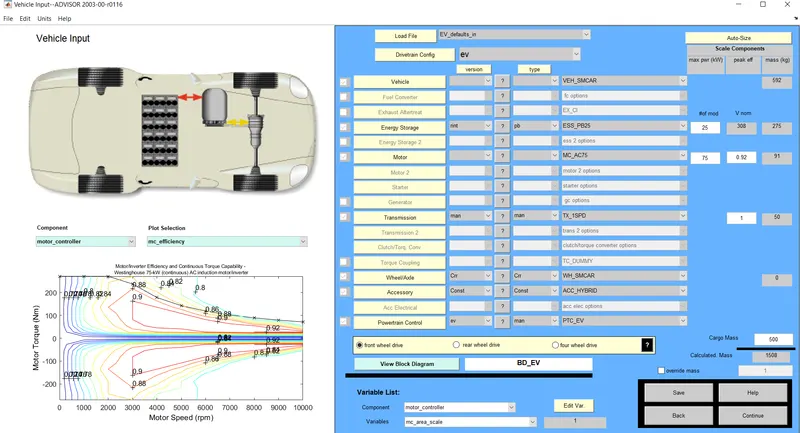
The default number of modules is 25, which we are going to increase and see if the range of 45KM is about to acheive.
Note: we are going to use 3 times the FTP drive cycle in order to attain the distance of 45KM.
For the 26 #of Mod we get this output
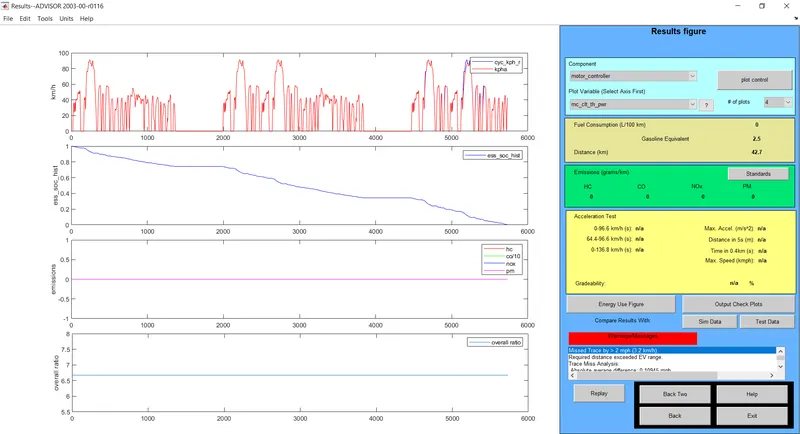
Where we could see that the distance travelled is 42.7KM which is still below our desired range, also there is small increase in the range as compared to 25 #of mod [42.7-41.4= 1.3KM] thus by increasing 1#of mod we get a increase of 1.3KM of range.
We need 45KM of range thus by adding 3# of mod we can get addition of 3.9KM, there by having the total range of 45.3KM.
As per the manual rough calculation we get this, lets simulate with addition of 3 modules and check.
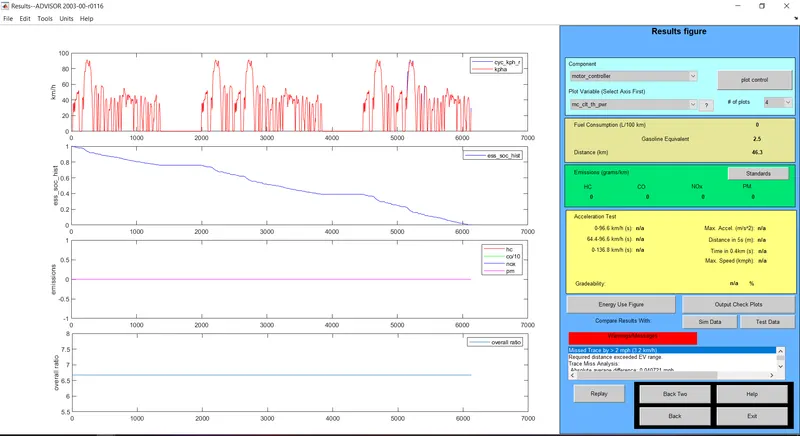
As per the simulation we get the range of 46.3KM for 28# of Modules and 3 times the FTP drive cycle.
Thus if the 45 KM of range is to be attained for the EV configuration these are the parameter that have to be coinsider.
3. In this we need to perform the gradeability test with the Prius default file.
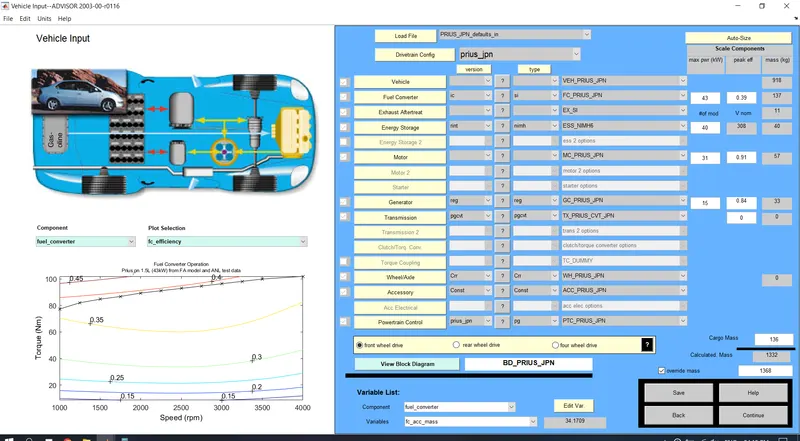
This is the default model of the PRIUS_JPN_defaults_in, were we can see the battery pack, electric motor, fuel tank, Engine, transmission system, this is a typical hybrid electric vehicle.
We will be selecting the FTP drive cycle with 1# of cycles.
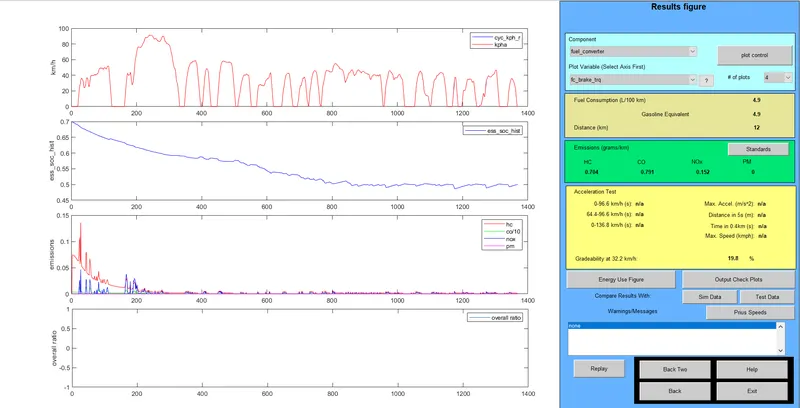
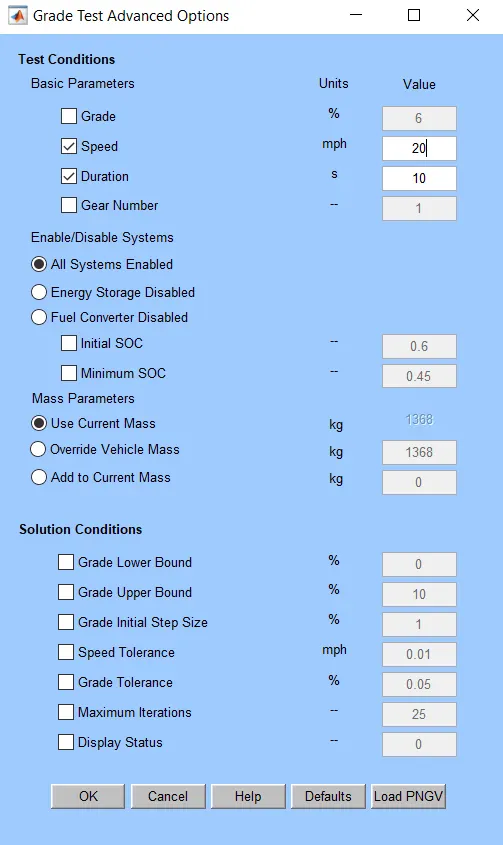
Under the grade test advance options we can change the speed in mph and the duration in sec, we need to select the all systems enabled radio button to have the complete calculation.
For the 32.2kmph speed the gradeability is 19.8%
By changing the kmph we get this table [Keeping the duration as default value 10 seconds]
| S.No |
Speed KMPH |
Gradeability % |
| 1 | 32.2 | 19.8 |
| 2 | 35.4 | 18.3 |
| 3 | 40.2 | 16.5 |
| 4 | 45.1 | 15.3 |
| 5 | 48.3 | 14.7 |
| 6 | 51.5 | 14.1 |
From the table we can see that the gradeability is being decreasing with increase in the speed, from the table we can see the higher gradeability is achieved at 32.2kmph which is 19.8%.