Week-3 Challenge: ADVISOR Tool
Use ADVISOR tool and simulate the following :
1. For EV_defaults_in file, if cargo mass is 500 kg with all other default conditions, can the vehicle travel for 45 km with FTP drive cycle? Conclude your observations.
2. In the above case, try changing the battery capacity and repeat the simulation.
3. Perform gradeability test with PRIUS_Jpn_defaults_in file
Compare your results in table and conclude.
Introduction :
ADVISOR [Advance Vehicle Simulator ] tool was developed in Novemberr 1994 by the National Renewable Energy Laboratory (NREL) .It is set of model ,data and script text files for use with matlab and simulink. It is designed for rapid analysis of the performance and fuel economy of conventional ,electric and hybird vehicles. ADVISOR also provides a backbone for the detailed simulation and analysis of user defined drivetrain components, a starting point of verified vehicle data and algorithms from which to take full advantage of the modeling flexibilty of simulink and analytic power of MATLAB.
Benefit of ADVISOR are :
- Estimate the fuel economy of vehicles that have not yet been built.
- Learn about hoe conventional ,hybird or electric vehicles use or loss the energy through their drivetrains.
- Compare relative tailpipe emissions produced on a number of cycles.
- Evaluate an energy management strategy forr your hybird vehicle's fuel converter.
- Optimize the gear ratio's in your transmission to minimize fuel use or maximize performance etc.
The Model of ADVISOR are :
- Most empirical, relying on dirvetrain component input/output relationships measured in the laboratory.
- Quasi- static, using data collected in the steady state tests and correcting them for transient effects such xas the rotational inertia of drivetrain and components.
How to start ADVISOR Tool :
- Launch MATLAB and set default location folder to the advisor folder, add path for folder and subfolder to it.
- Now in the command window of MATLAB type "advisor" and press enter (or) run advisor.m file from the folder list.
- ADVISOR tool window will open and then set "metric" for unit and start ADVISOR.
- ADVISOR tool have 3 windows:
- Vehicle Input window
- Simulation Parameter window
- Result window
Default ADVISOR window :
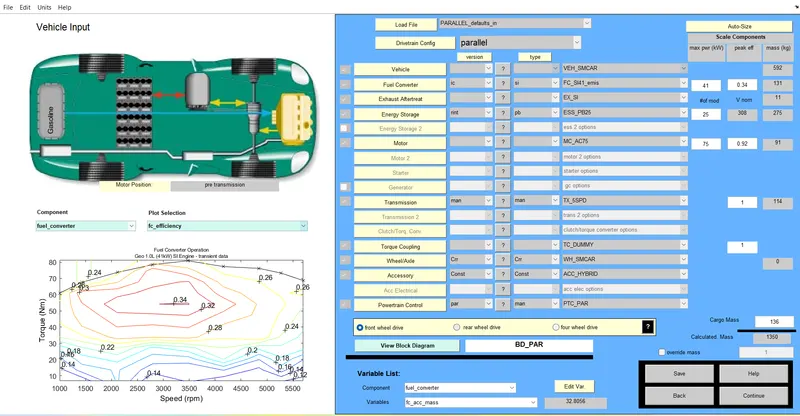
Q1. For EV_defaults_in file, if cargo mass is 500 kg with all other default conditions, can the vehicle travel for 45 km with FTP drive cycle? Conclude your observations.
Procedure :
1) In the load file option ,from the drop-down menu change the parallel_default_in to and select EV_defaults_in from vehicle input window.
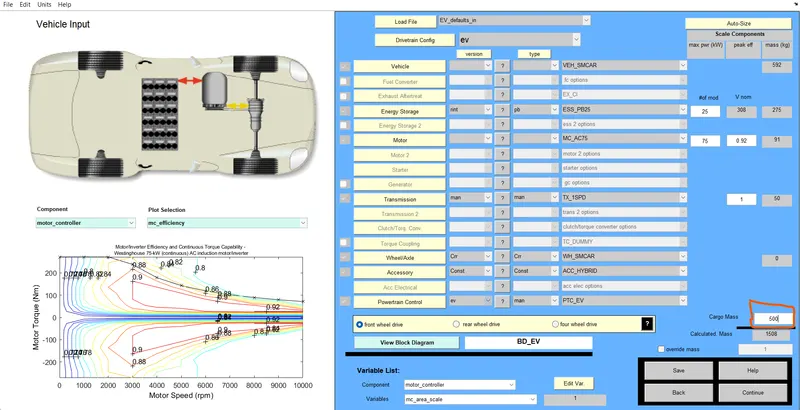
In the above example, a battery electric vehicle is modelled with following Specifications :
- Drivetrain configuration is ev.
- Energy storage : Lead Acid battery with 25 modules having 308 V as nominal voltagewith 0.92 motor efficiency.
- Motor : AC induction motor with 75KW
- Transmission : Manual
- Drive type : Front wheel drive
Now as per the question ,lets change the Cargo Mass to 500kg and click on continue
- In Simulation Parameter window change drive cycle to CYC_FTP by selecting from the drop-down menu.
- Below that we will see # of cycles from here we can set our drive cycle.
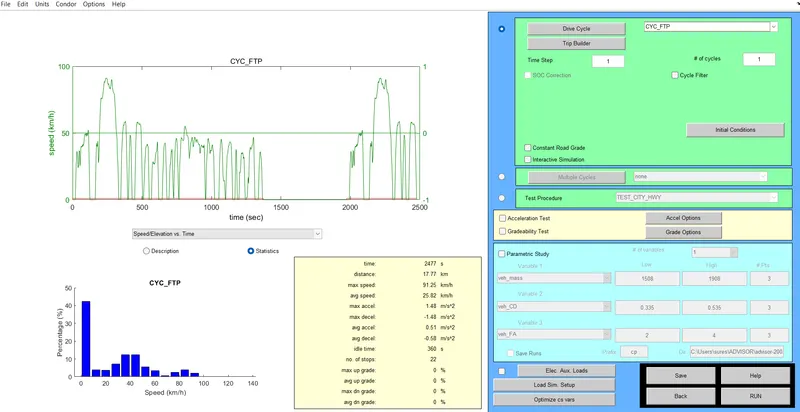
- After clicking on the RUN button, the simulation will start and it will show results in a new window.
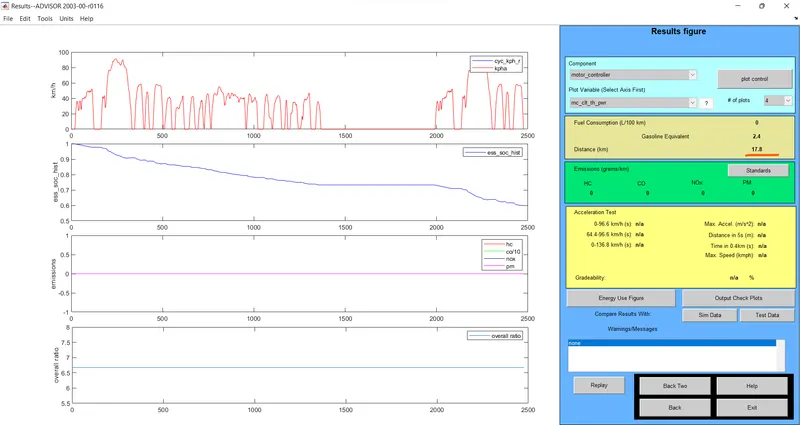
- The distance traveled by the vehicle in 1 drive cycle is 17.8km used.It has used almost 40% SOC.
Increasing the number of drive cycles to 2.
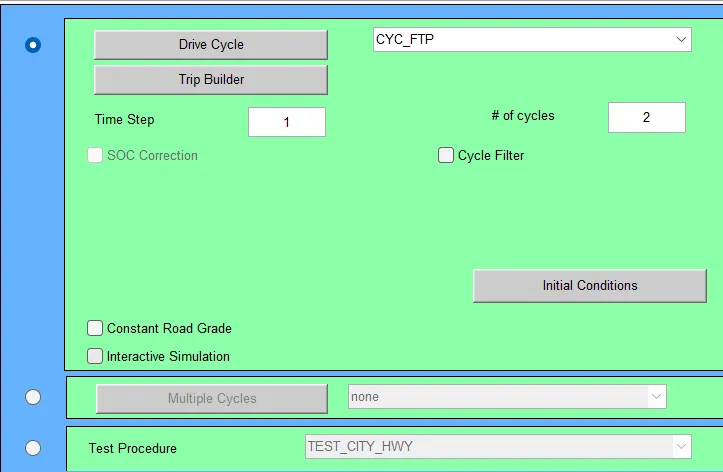
Results with 2 drive cycles :
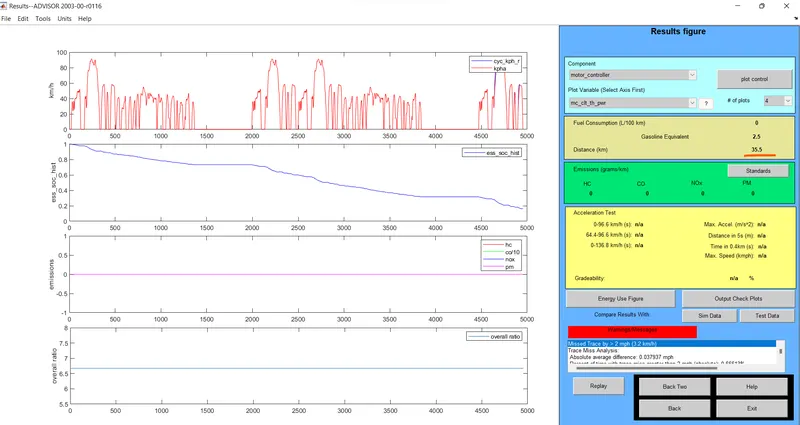
The distance traveled by the vehicle in 2 drive cycles is 35.5km. It has used almost 81% SOC.
Increasing the number of drive cycles to 3.
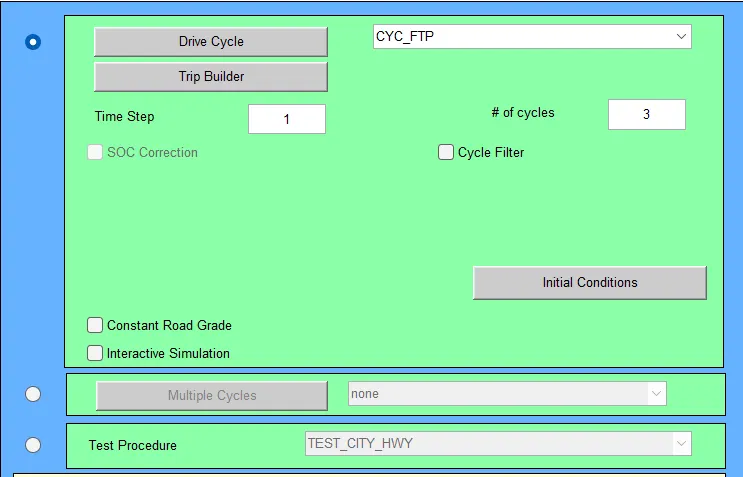
Results with 3 drive cycles :
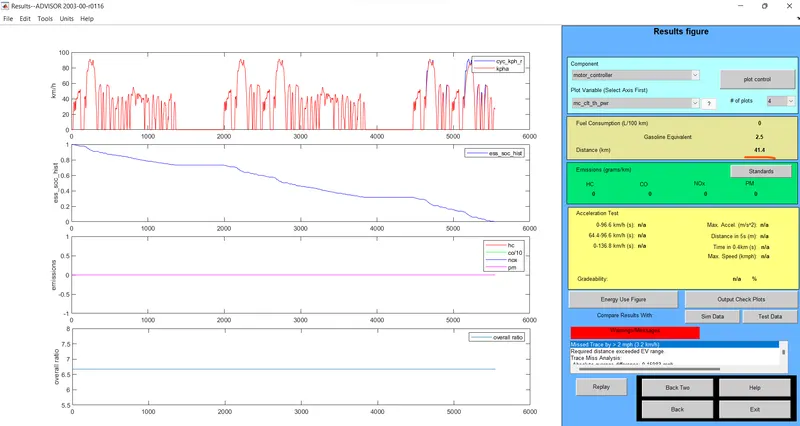
The distance traveled by the vehicle in 3 drive cycles is 41.4km. It has used used almost 100% SOC.
| No. of drive cycles | Distance covered in kms |
| 1 | 17.8 kms |
| 2 | 35.5 kms |
| 3 | 41.4 kms |
The minimum distance traveled by car is 17.8km with drive cycle CYC_FTP - 1 with 40% of SOC , whereas the maximum distance traveled by the car is 41.4 kms which consumes completely 100% od battery in 3 drive cycles. Hence the vehicle cannot travel 45km in a single charge.
Therefore EV_defaults_in cannot travel the distance of 45 km due to insufficient of SOC.
Q2. In the above case, try changing the battery capacity and repeat the simulation.
Soln :
Procedure :
- In this case the same default conditions are taken that are initated in question 1 and battery capacity will be changed foe accelerating the vehicle that will increase the vehicle distance travel km.
- In vehicle input window we will change the capacity of battery form energy storage which will be open in 1st.
- "#of mod V nom" describes the battery capacity ,so we will change the module number of batteries from the first box and we will see that thier is changes in voltage and weight of the battery.
- In simulation parameter window ,keeping the values as same as question1 i,e. no. of drive cycle as 3.
- After completing of simulation,we will see the result window where we observe the change in distance of wehicle travel.
- We can repeat this simulation by changing the battery module.
i) Energy Storage System with 26 modules and 3 drive cycles.
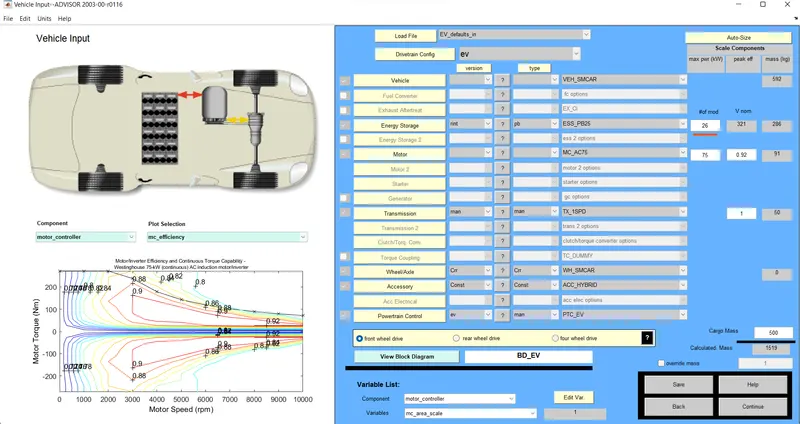
Result :
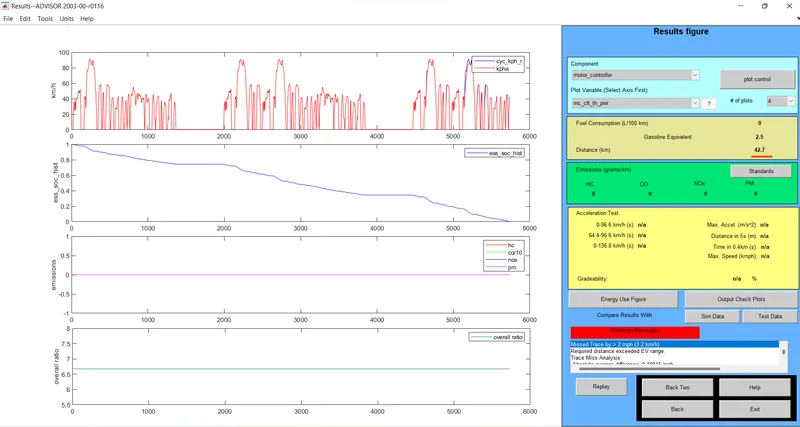
- Thus by increasing the capacity of battery module to 26 ,distance covered by vehicle also increased to 42.7 kms battery voltage and weight also increasing to 321V and 286kg.
ii) Energy Storage System with 28 modules and 3 drive cycles.
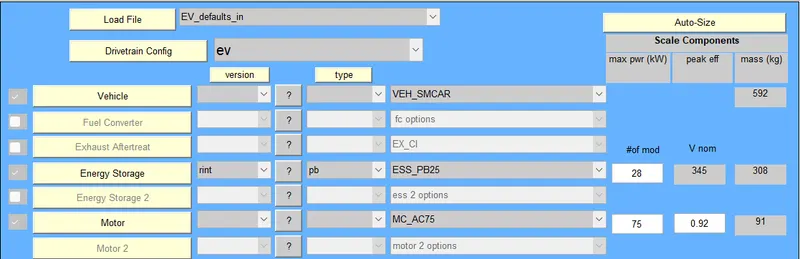
Result :
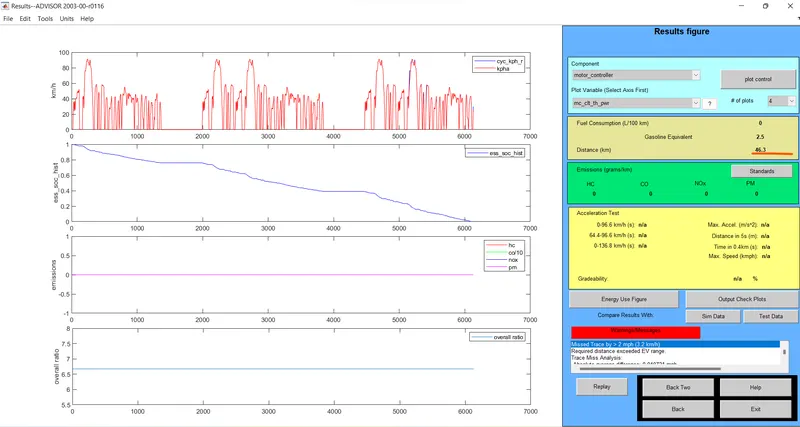
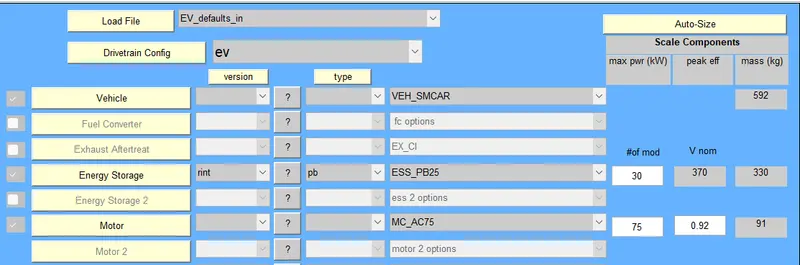
- Thus by increasing the capacity of battery module to 28 ,distance covered by vehicle also increased to 46.3 kms battery voltage and weight also increasing to 345V and 308kg.
iii) Energy Storage System with 30 modules and 3 drive cycles.
Result :
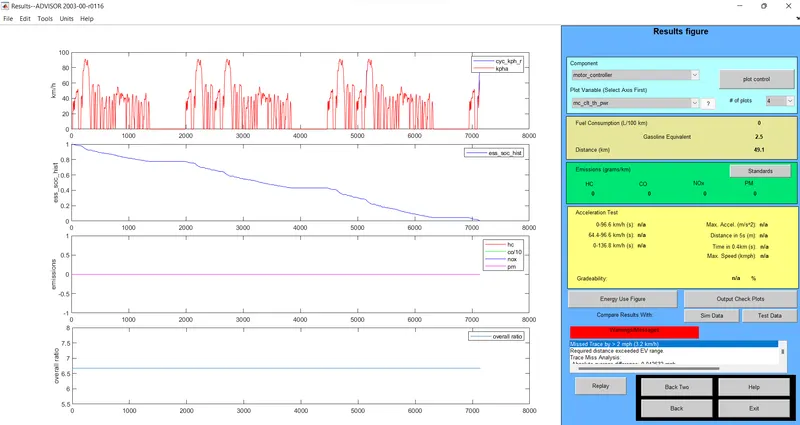
- Thus by increasing the capacity of battery module to 30 ,distance covered by vehicle also increased to 49.1 kms battery voltage and weight also increasing to 370V and 330kg.
| Battery Module | Voltage | Distance covered in kms | Battery Weight in kg |
| 26 | 321 | 42.7 kms | 286 kg |
| 28 | 345 | 46.3 kms | 308 kg |
| 30 | 370 | 49.1 kms | 330 kg |
- Thus by increasing the the no. battery module ,their is a increase in the distance covered by the vehcile.
- Inorder to achieve a range of 45 km, 3 more module to the battery capacity can be added i,e. to 28 modules.
- And battery voltage and battery weight also increasing respectively with module.
Q3. Perform gradeability test with PRIUS_Jpn_defaults_in file
Compare your results in table and conclude
Soln:
Description :
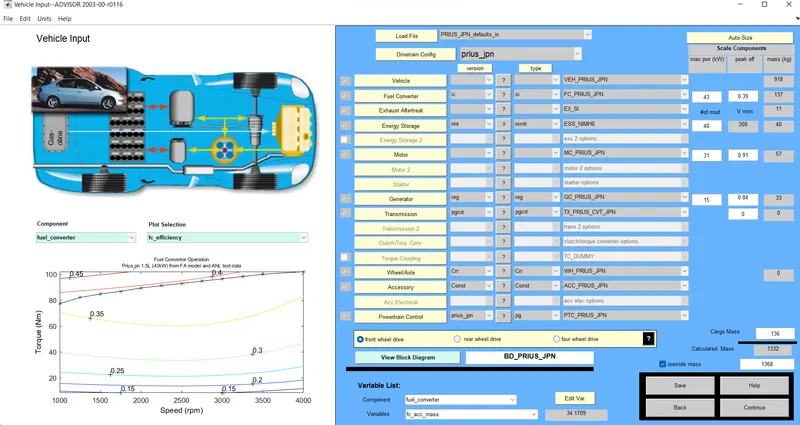
- Following is the model of Toyota Prius parallel hybird vehicle.
- It uses battery and an IC engine to power the wheels.
- The differential is connected to a motor and it is also connected to an IC engine via a device called as a power split device.
- Power split device, splits the power according to the throttle demands keeping the engine in maximum efficiency zone, providing additional power via battery and engine during aggressive conditions.
- Charging the battery via a generator during conditions such as regenerative braking and preserving the energy efficiently.
Model :
Vehicle Specifications :
- Power produced by IC engine : 43kW with fuel convertor efficiency of 0.39
- Battery capacity : NMH( Nickel Metal Hydride ) batteries ,with 40 modules producing a nominal voltage of 308V
- Generator( Regenerative ) : 15kW
- Motor : Induction motor producing power of 15kW with 0.84 efficiency.
- Transmission : CVT
- Drive : Front wheel drive
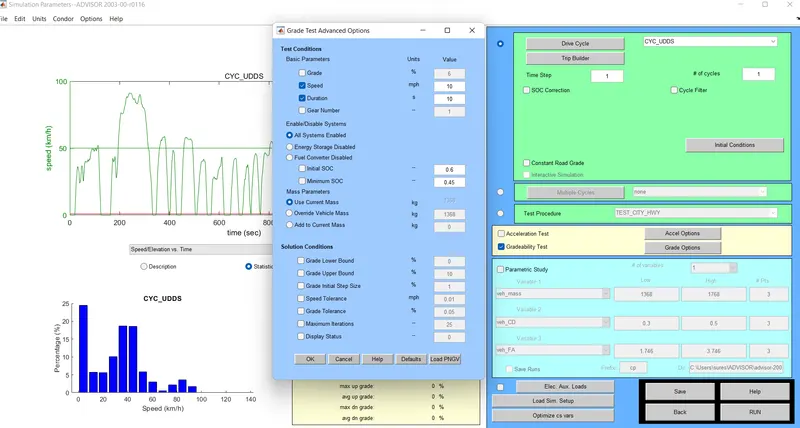
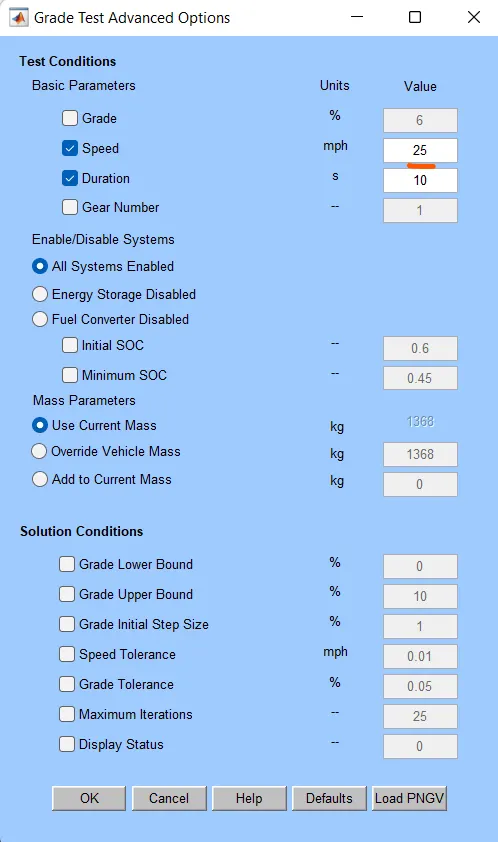
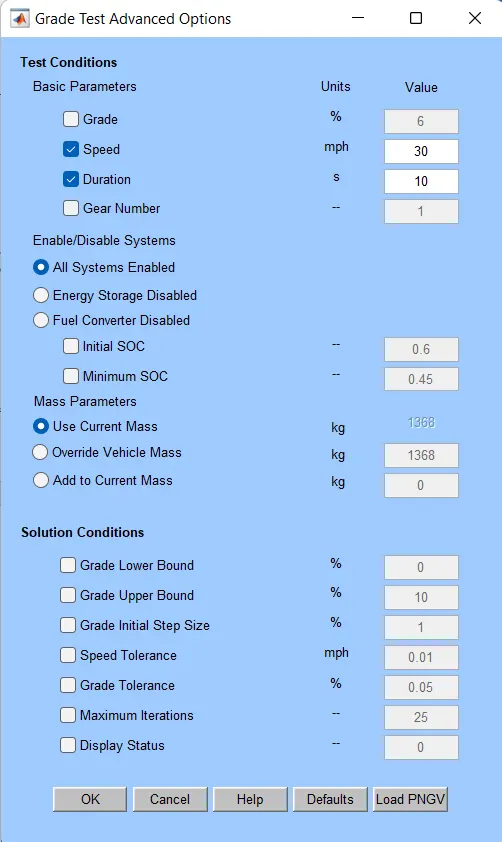
Inorder to perform the gradeability test. we maintain the grade value constant and change the speed values to find out the maximum gradeability at an optimum speed simulating for 10s. And selecting All Sytems Enabled condition in the menu.
case1 : speed = 10mph (16.1 kmph)
Result :
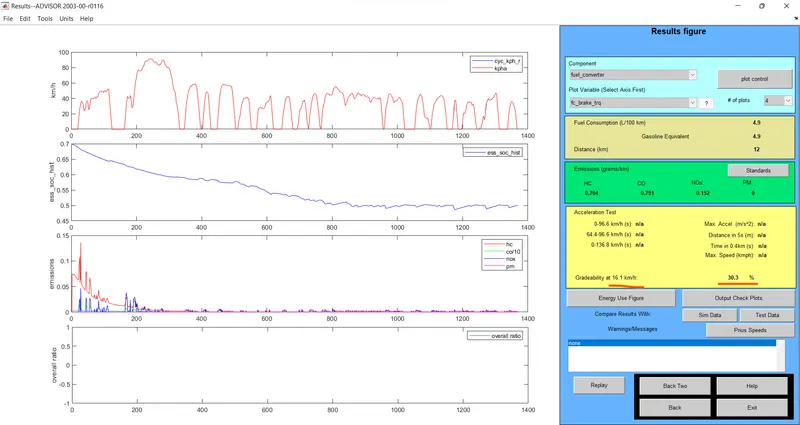
Gradeability : 30.3%
case2 : speed = 15mph(24.1kmph)
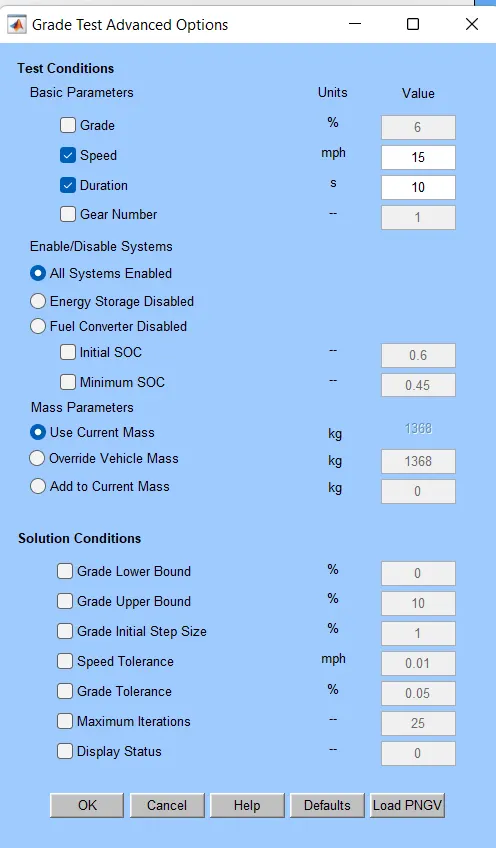
Result :
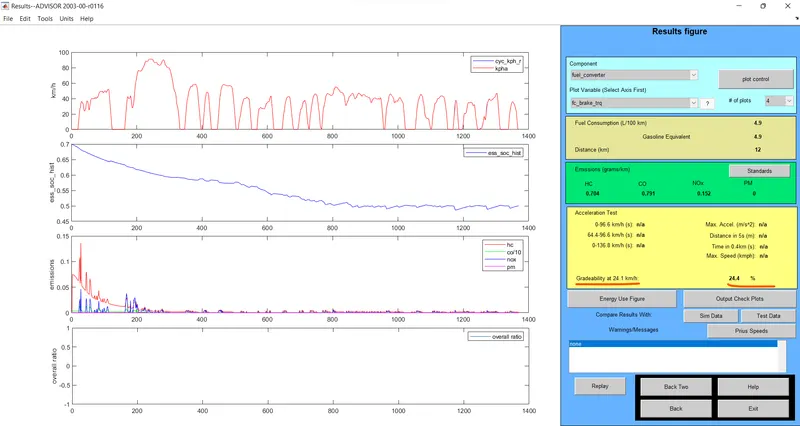
Gradeability : 24.4%
case3 : speed = 20mph(32.2kmph)
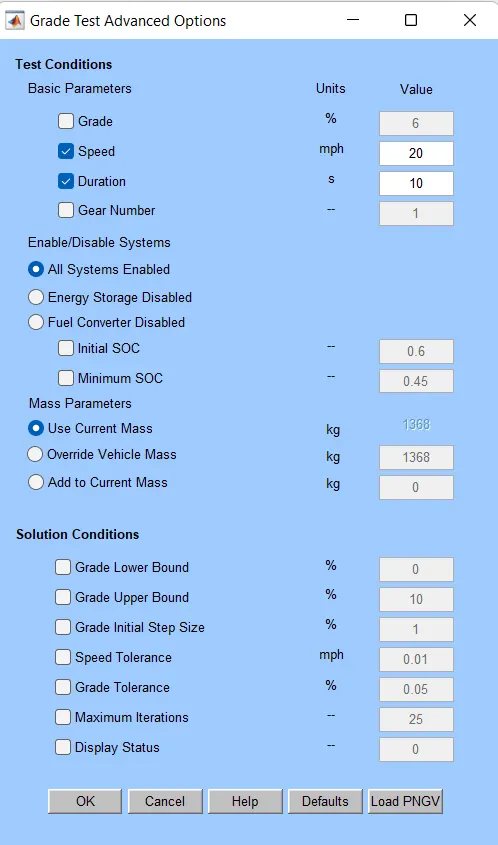
Result :
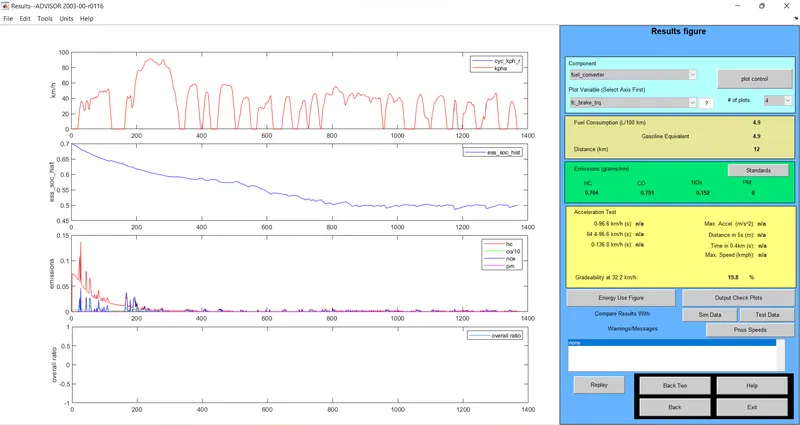
Gradeability : 19.8%
case4 : speed = 25mph(40.2kmph)
Result :
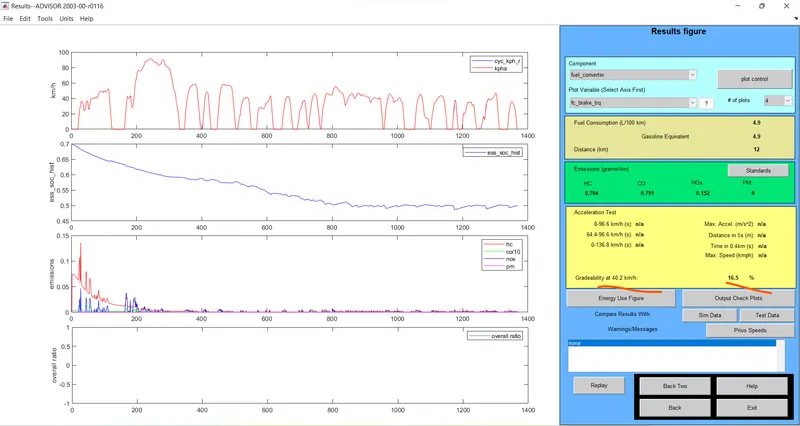
Gradeability : 16.5%
case5 : speed = 30mph(48.3kmph)
Result :
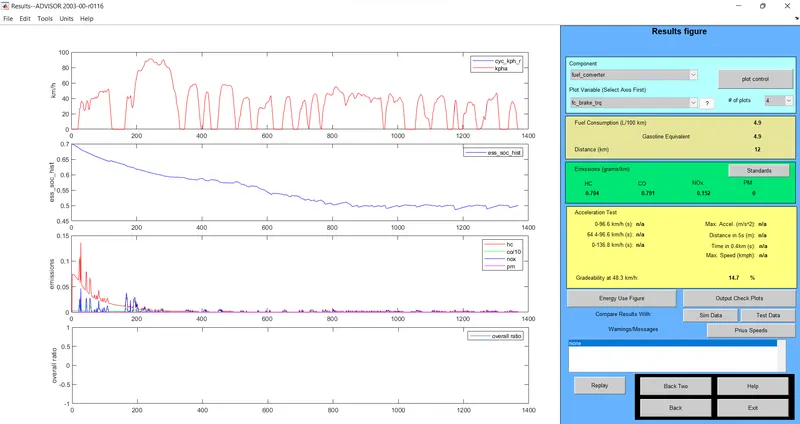
Gradeability : 14.7%
| case no. | Speed (mph) | Speed (kmph) | Gradeability % |
| 1 | 10 | 16.1 kmph | 30.3% |
| 2 | 15 | 24.1kmph | 24.4% |
| 3 | 20 | 32.2kmph | 19.2% |
| 4 | 25 | 40.2kmph | 16.5% |
| 5 | 30 | 48.3kmph | 14.7% |
Conclusion : From the above table ,it can be seen that when vehicle speed increases there is a decrease in gradeability.