Week-3 Challenge: ADVISOR Tool
Week-3 Challenge: ADVISOR Tool
Aim:
To simulate the vehicle characteristics and performance of different components at different condition using ADVISOR tool in MATALAB.
Objective:
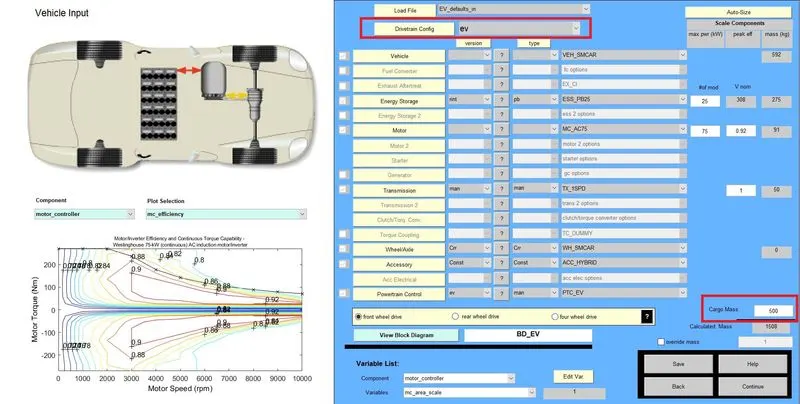
- Run ‘EV_defaults_in’ file with cargo mass as 500kg, drive cycle as ‘CYC_FTP’ and analyze if the vehicle can cover the distance of 45km. Conclude the observation.
- For the above case change the battery parameter and repeat the simulation.
- Perform gradeability test with ‘PRIUS_Jpn_defaults_in’ file. Compare and conclude the result.
ADVISOR:
ADVISOR is Advanced VehIcle SimulatOR MATLAB tool developed by National Renewable Energy Laboratory (NREL). ADVISOR is basically a combination script, model and data file for use with MATLAB and simulink.
It was developed for the rapid analysis of characteristics and performance of vehicle based on the inputs, along with it also provides several results based on any specific components for specific parameters.
It is used for the analysis of conventional, electric and hybrid vehicles. ADVISOR provides full model flexibility and provide results for user defined or custom combination of vehicle component specifications.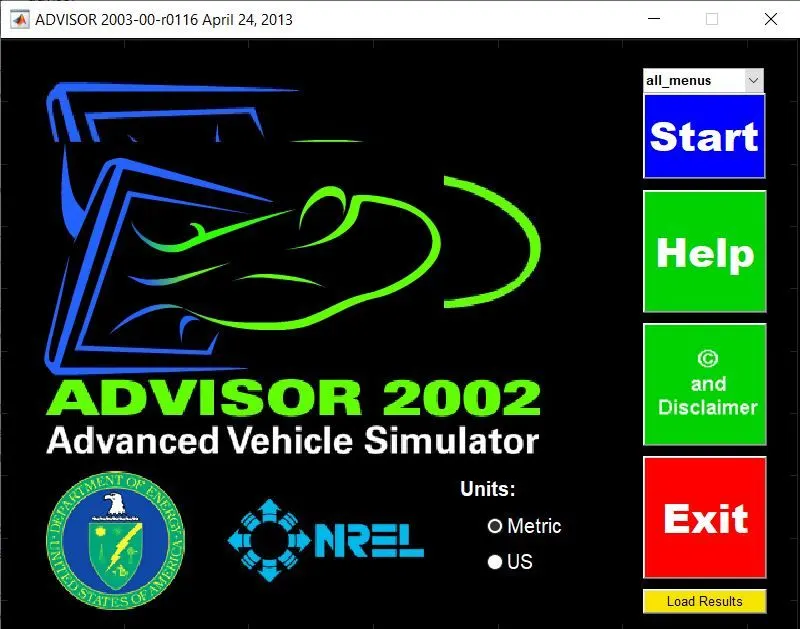
ADVISOR uses the physical data gathered from a live vehicle and compute them based on the physical characters and algorithm and compute output as per the user desired. It can also use the same data to compute characteristics of any vehicle specification which does not exist.
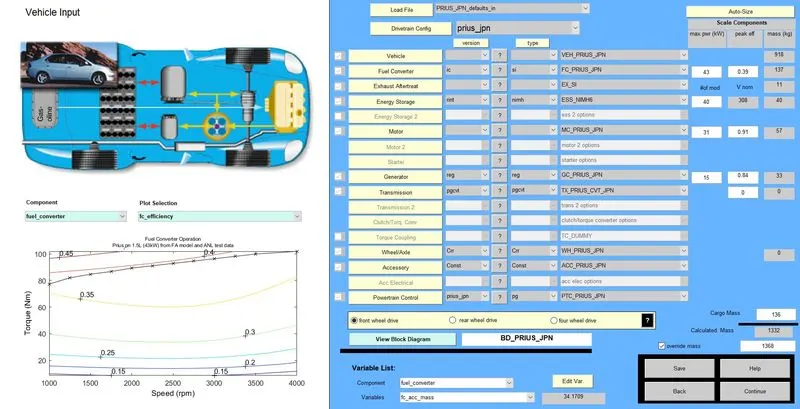
The GUI of the ADVISOR is as below, It include the vehicle layout with speed torque data on the LHS. While the RHS includes the input panel where the user can enter the specifications and physical characters of the vehicle and related parameters if desired. ADVISOR includes the library of the performance characters of different vehicle and vehicle components measured physically and stored as the data points. It also includes different drive cycles for which the vehicle can be tested.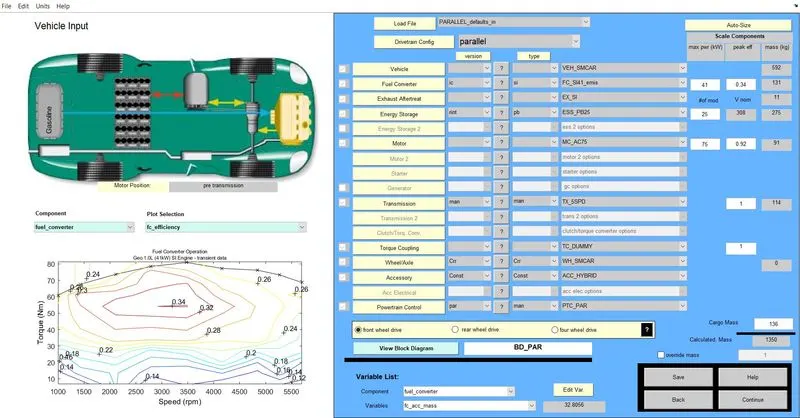
Objective 1:
Run ‘EV_defaults_in’ file with cargo mass as 500kg, drive cycle as ‘CYC_FTP’ and analyze if the vehicle can cover the distance of 45km. Conclude the observation.
- After opening up the ADVISOR script file and by typing the syntax ‘advisor’ in the command window the ADVISOR GUI opens up, where the units were selected as ‘metric’ which takes the input and provides the result in metric unit. By clicking on to the ‘start’ button the ADVISOR tool starts and shows up the default vehicle layout and parameters.
- In the ADVISOR panel the Drivetrain configuration was selected as ‘ev’ which load up the file ‘EV_default_in’ from the library, by keeping all the parameter as the same only the cargo mass was changed to 500 kg.
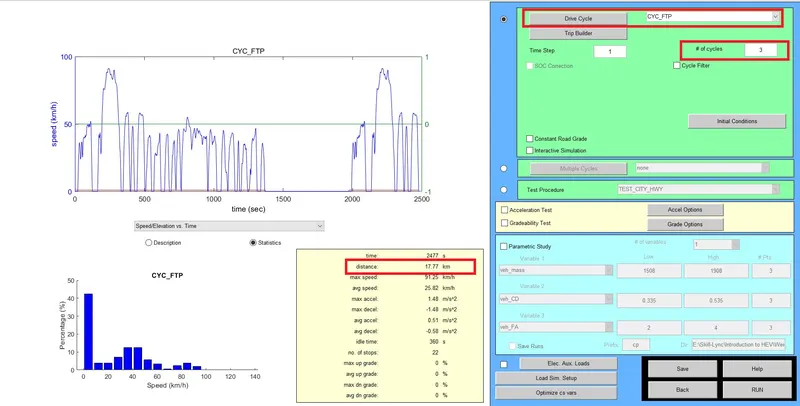
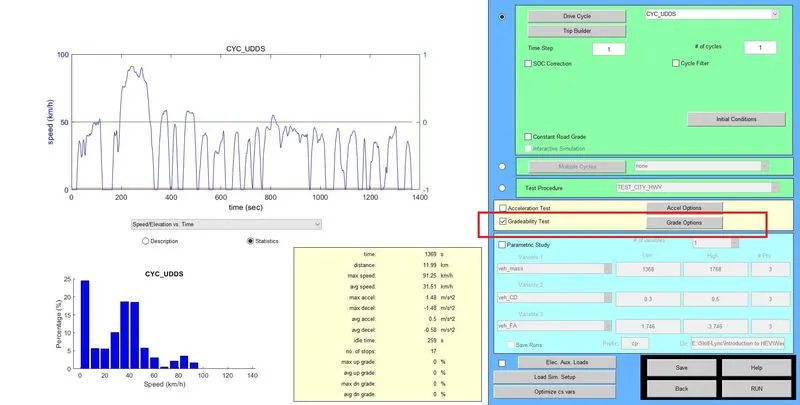
- On clicking on to the ‘continue’ button it moves to the next page where the required drive cycle can be selected. Here the Drive cycle ‘CYC_FTP’ has been selected. For one complete FTP cycle it takes the distance of 17.77km, in order to check for the given distance of 45km it will at least take 3 times the drive cycle distance, for that purpose the number of cycles has been provided as 3.
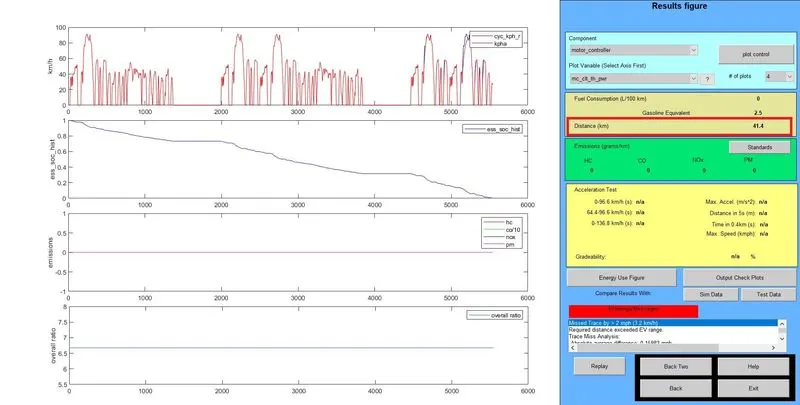
- By running the simulation at this condition the below results were obtained, where the distance covered by the electric vehicle is 41.4 km.
Conclusion:
We can conclude from the result that with FTP drive cycle and with the cargo mass of 500kg the electric vehicle cannot achieve the range of 45 km in distance. The result shows that the vehicle could cover only 41.4 km with the battery capacity specified as default, which is 25kwh.
Objective 2:
For the above case change the battery parameter and repeat the simulation.
- By keeping the values the same for the above case it was again attempted to run the simulation only by changing the battery capacity to make the vehicle to cover 45km.
- In the previous case it was found the battery capacity at default is 25kwh.
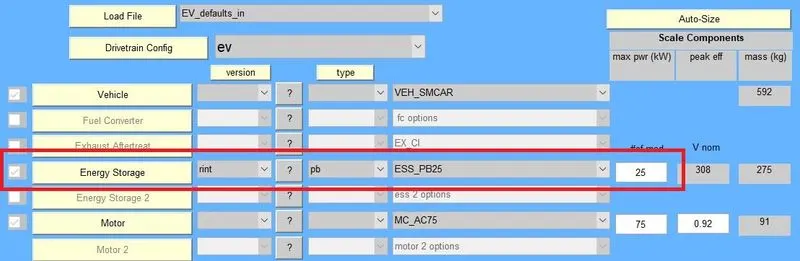
- The battery capacity range is then changed to 33kwh.
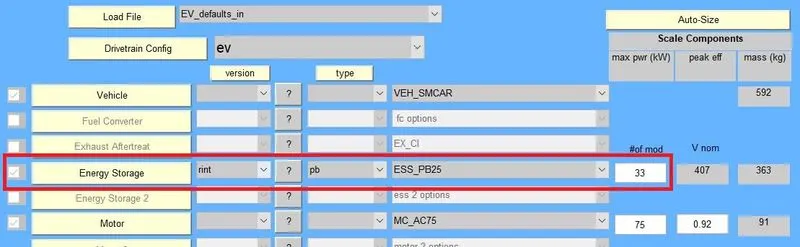
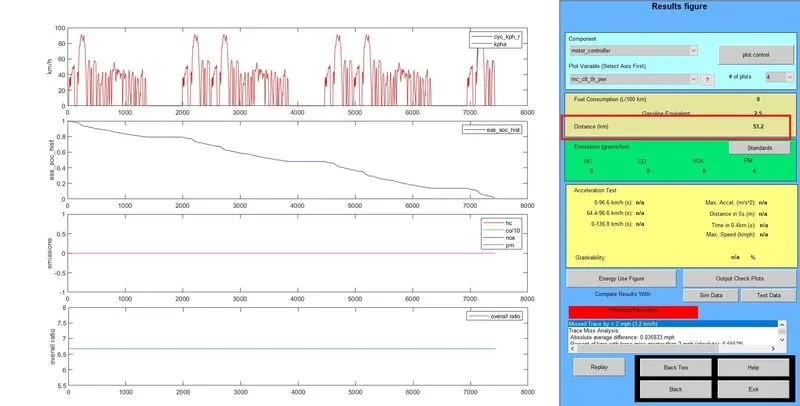
- Then attempted to run the simulation with the modified battery capacity as 33kwh and the below result was obtained. The total distance covered by the vehicle is 53.2km.
Conclusion:
By changing the battery capacity from 25kwh to 33kwh with the same cargo mass of 500kg at FTP drive cycle the vehicle changed its range from 41.4km to 53.2km.
Objective 3:
Perform gradeability test with ‘PRIUS_Jpn_defaults_in’ file. Compare and conclude the result.
- The performance with the file ‘PRIUS_Jpn_defaults_in’ was done with different speed condition with FTP drive cycle.
- The gradeability test was enable by choosing ‘Gradeability Test ’ option, there by different speed conditions were set and the performance can be tested.
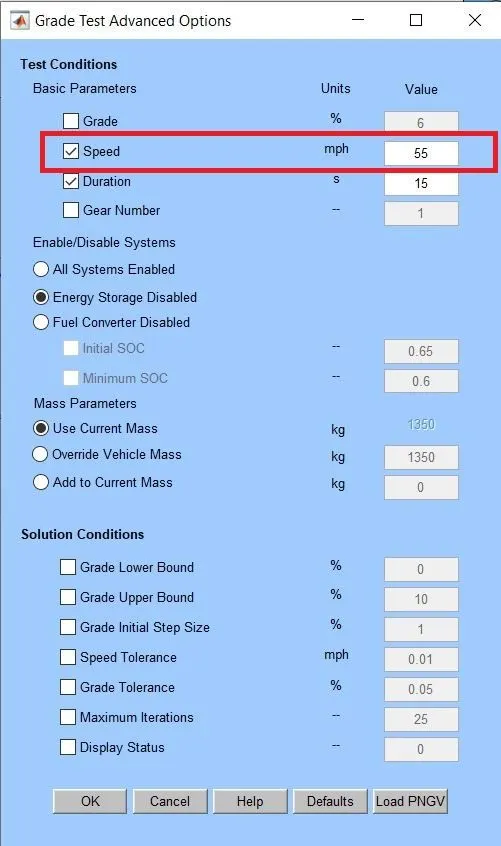
- Observation-1
The speed was set at default 88.5kmph and the performance was calculated where the car can achieve the gradeability 6.8%.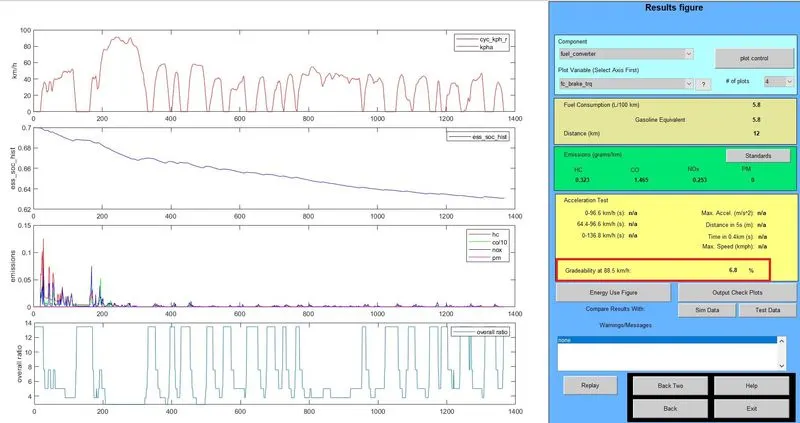
- Observation-2
The speed was set to 72.4kmph and the performance was calculated where the car can achieve the gradeability 11.8%.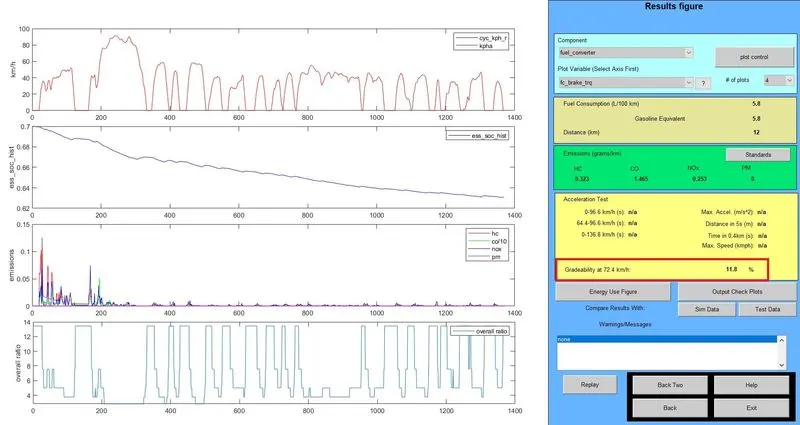
- Observation-3
The speed was then set to 56.3kmph and the performance was calculated where the car can achieve the gradeability 13.1%.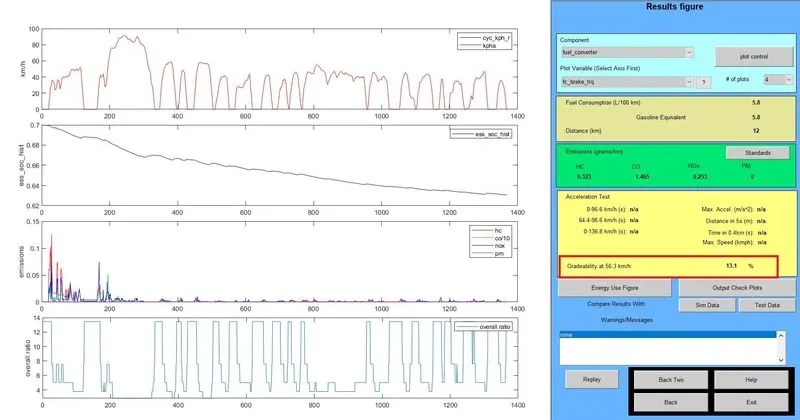
- Observation-4
For the fourth observation the speed was further lowered to 40.2kmph and the gradeability the car can achieve was calculated as 24.1%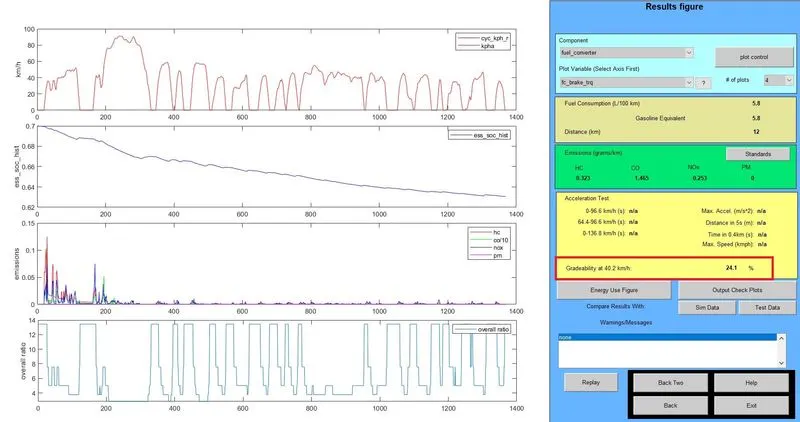
- Observation-5
In the last observation the speed was set as 24.1kmph and the gradeability the car can achieve was calculated as 26.4%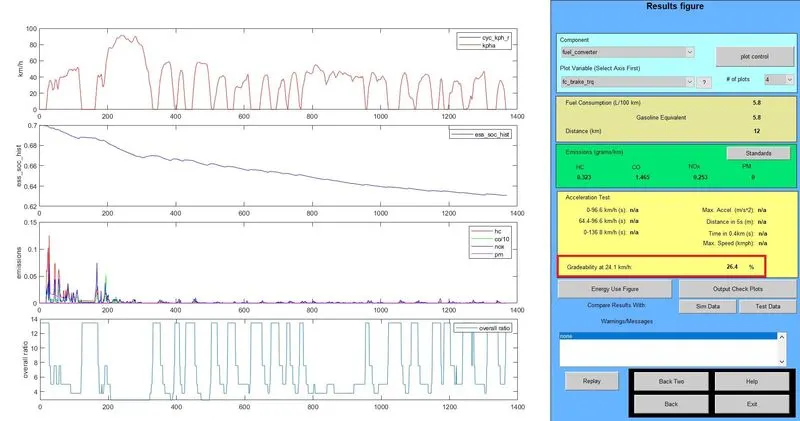
Conclusion:
The gradeability test on ‘PRIUS_Jpn_defaults_in’ was done for different speed condition and the result calculated were tabulated as below.
| Sl.no | Speeed (kmph) | Gradeability (%) |
| 1 | 88.5 | 6.8 |
| 2 | 72.4 | 11.8 |
| 3 | 56.3 | 13.1 |
| 4 | 40.2 | 24.1 |
| 5 | 24.1 | 26.4 |
From this observation it can be concluded that the gradeability of Prius is inversely affecting the performance of the vehicle. Change in gradeability requires more power demand or it will be compromised with other factors like speed, which is getting yielded from the power of the vehicle.