Week-3 Challenge: ADVISOR Tool
AIM 1: For EV_defaults_in file, if cargo mass is 500 kg with all other default conditions, can the vehicle travel for 45 km with FTP drive cycle? Conclude your observations.
THEORY: Advanced Vehicle Simulator (ADVISOR) was first developed in November 1994 at the National Renewable Energy Laboratory. It was designed as an analysis tool to assist the US Department of Energy (DOE) in developing technologies for hybrid electric vehicles (HEV) through the Hybrid Electric Vehicle Propulsion System contracts with Ford, General Motors, and DaimlerChrysler. Its primary role is to highlight the system-level interactions of hybrid and electric vehicle components and their impacts on the vehicle performance and fuel economy.
ADVISOR was created in the MATLAB/Simulink environment. MATLAB provides an easy-to-use matrix-based programming environment for performing calculations while Simulink can be used to represent complex systems graphically using block diagrams. ADVISOR uses three primary graphical user interface (GUI) screens to guide the user through the simulation process. With the GUIs, the user can iteratively evaluate the impacts of vehicle parameters and drive cycle requirements on the vehicle performance, fuel economy, and emissions.
PROCEDURE:
- Download ADVISOR tool from internet and open the same inside MATLAB.
- Start the tool by using "Metric" units.
- Once inside the main GUI screen, we have to select "EV_defaults_in" as the model under "Load File" option.
- As given, we keep all the other parameters the same except the "Cargo Mass". For this, we go to the bottom of the first page and select the "Variable List" option and select "Vehicle" as component and "veh_cargo_mass" as variables.
Below screenshot will help.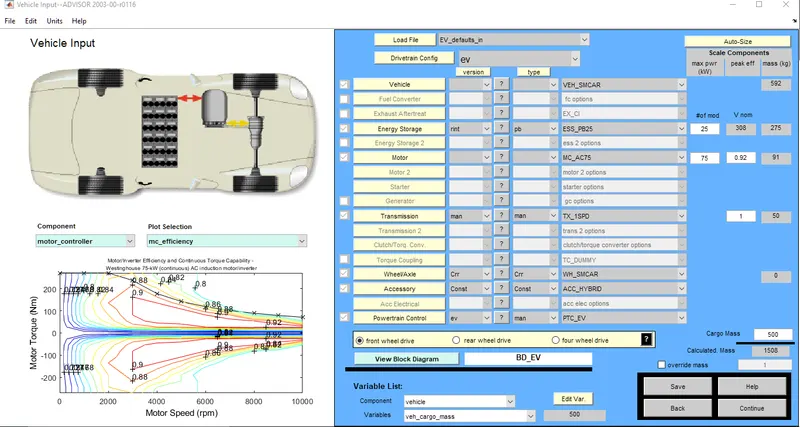
- Now we have to select the "Drive Cycle". For this we have to go to the second page clicking on "Continue"
- Here, we select the "Drive Cycle" as "CYC_FTP".
- We can observe that the distance for one cycle is 17.77 km. As we need to observe the Battery SOC for atleast 45 kms, we can take 4 cycles to have comfortable data set for analysis.
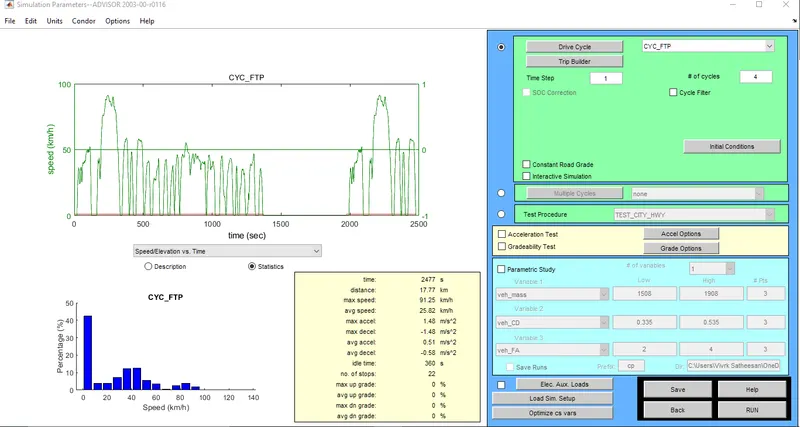
- We keep the other options as default.
- Run the simulation and observe the results.
OBSERVATIONS:
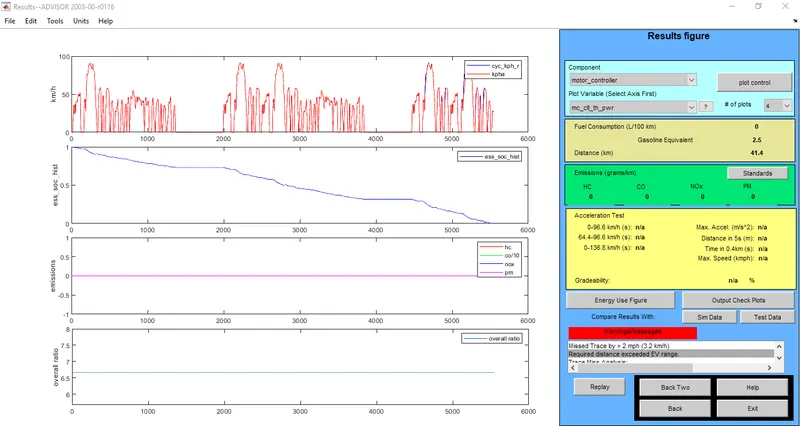
As we can see in the second graph, the "ess_soc_hist" the SOC of the battery drops down to zero and vehicle is only able to cover the distance of 41.4km. This can be seen on the right hand side under second green block.
RESULT AND INFERENCE:
The car with Lead Acid battery with 25 modules having 308V as nominal voltage with 0.92 motor efficiency (AC Induction motor - 75kW) and cargo mass 500kg was not able to complete the target 45km as the battery dies off by 41.4 km.
AIM 2: In the above case, try changing the battery capacity and repeat the simulation.
PROCEDURE:
Here we change the number of battery modules from 25 to 28. This can be done on the first page of GUI. Refer below image.
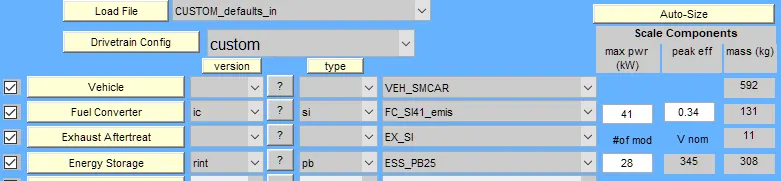
Now, we run the simulation and observe the results.
RESULT AND INFERENCE:
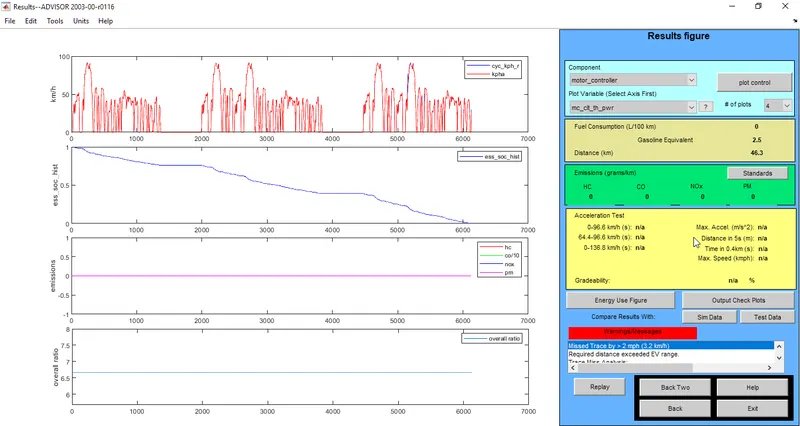
As you can see here, the vehicle is now able to cover the distance of 45km. From the values on the right hand side, we can see the vehicle travelled a total of 46.3 kms before the battery discharged out.
AIM3:Perform gradeability test with PRIUS_Jpn_defaults_in file. Compare your results in table and conclude.
THEORY:Toyota PRIUS is a full hybrid electric automobile manufactured by Toyota since 1997. Initially offered as a 4-door sedan, it has been produced only as a 5-door liftback since 2003.
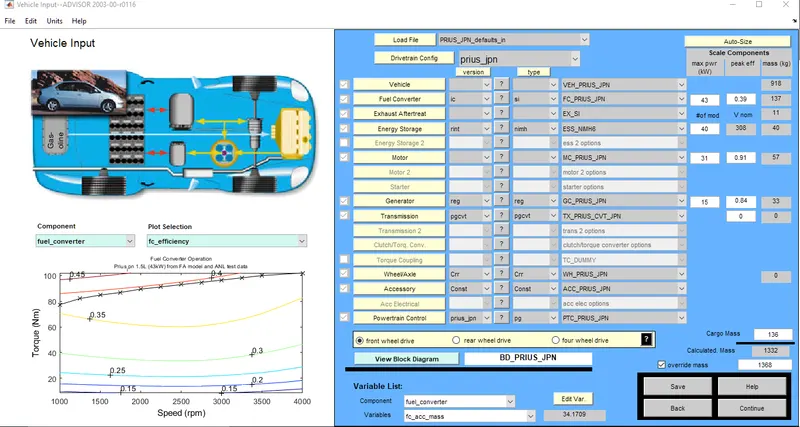
Specifications from the ADVISOR model.
- Fuel Converter: IC Engine - Petrol.
- Energy Storage: Nickel Metal Hybride with 40 modules giving us 308V.
- Motor: 31kW with 91% peak efficiency
- Generator: 15kW with 84% efficiency
- Transmission: CVT
PROCEDURE:
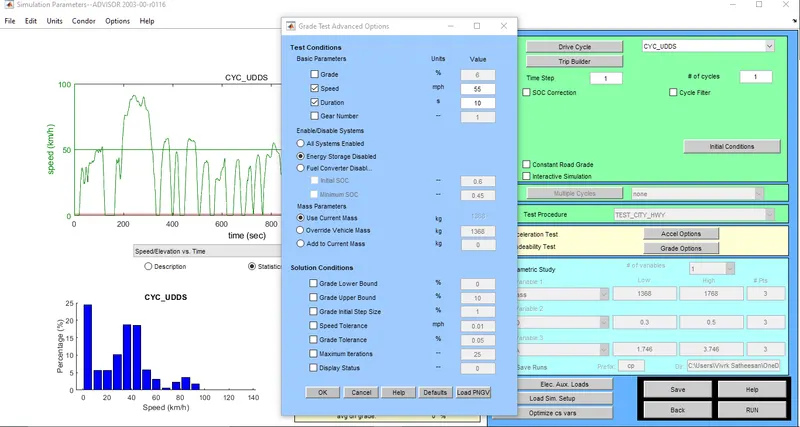
From the gradeability option given above, we calculate Max. Gradeablity for the vehicle under different speed, keeping other values and parameters constant.
We will conduct tests for speeds from 5mph to 40mph in steps of 5, which will give us 8 samples to work on.
OBSERVATION:
| Case 1 | Speed (mph) | Speed (kmph) | Gradeability (%) |
| 1 | 5 | 8 | 18.00 |
| 2 | 10 | 16 | 23.50 |
| 3 | 15 | 24 | 26.50 |
| 4 | 20 | 32 | 25.30 |
| 5 | 25 | 40 | 24.20 |
| 6 | 30 | 48 | 13.90 |
| 7 | 35 | 56 | 13.00 |
| 8 | 40 | 64 | 12.50 |
RESULT AND INFERENCE:
From the above tabulation, we can thus conclude that the gradeablity of the Prius car is best when the speed is between 24-40kmph. Thus this would be the suggested optium speed in those situation.