Week-3 Challenge: ADVISOR Tool
Objectives:
1. For EV_defaults_in file, if cargo mass is 500 kg with all other default conditions, can the vehicle travel for 45 km with FTP drive cycle?
2. For the above case, change the battery capacity and repeat the simulation to analyze the results.
3. To perform gradeability test with PRIUS_Jpn_defaults_in file
and comparing the results in table and make conclusions.
THEORY:
ADVISOR tool, developed in November 1994 by the National Renewable Energy Laboratory (NREL), allows users to simulate and analyze conventional, advanced, light, and heavy vehicles, including hybrid electric and fuel cell vehicles. The tool allows users to assess the effect of changes in vehicle components (such as motors, batteries, catalytic converters, climate control systems, and alternative fuels) and other modifications that might affect fuel economy, performance, or emissions.
The benefits of using ADVISOR tool:
- Estimate the fuel economy of vehicles that have not yet been built
- Learn about how conventional, hybrid or electric vehicles use (and lose) energy throughout their drivetrains
- Compare relative tailpipe emissions produced on a number of cycles
- Evaluate an energy management strategy for your hybrid vehicle’s fuel converter
- Optimize the gear ratios in your transmission to minimize fuel use or maximize performance, etc.
Advisor tool has 3 windows:
1. Vehicle Input window
2. Simulation Parameter window
3. Results window
Simulation setup:
1) Select the EV_defaults_in file and change the cargo mass as 500 kg in the vehicle input window and click continue to proceed to the next window as shown below:
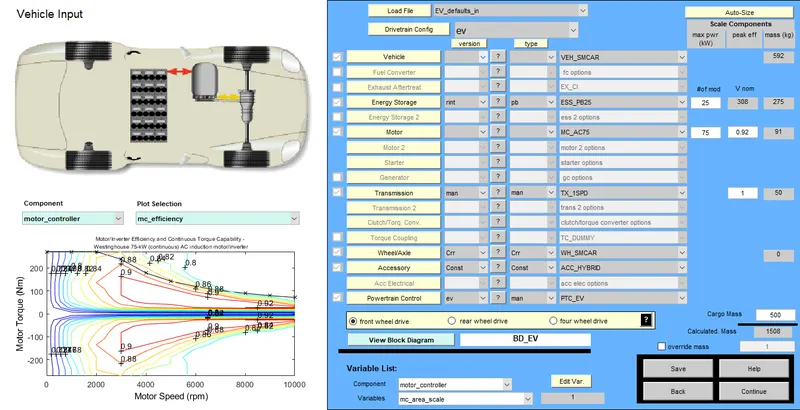
Since the FTP drive cycle is to be used, change the drive cycle to CYC_FTP and keep the number of drive cycles as 1 as shown below in the simulation parameter window: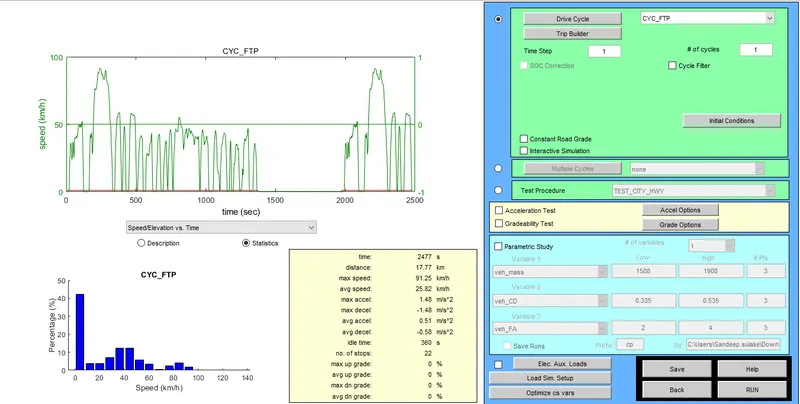
Run the simulation to obtain the simulation results for 1 drive cycle as shown:
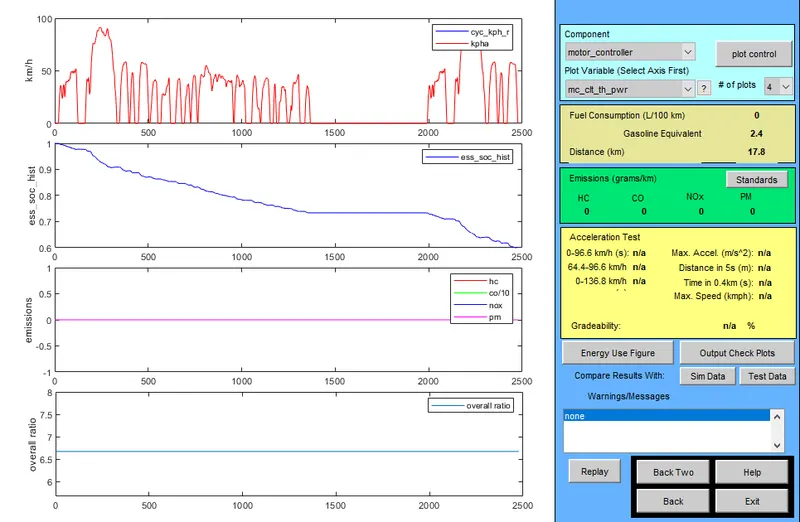
Notice that after 1 drive cycle, the total distance travelled is 17.8 km with the State of Charge (SOC) of the battery at 0.6 (60%) left.
Now change the drive cycles to 3 and observe the results:
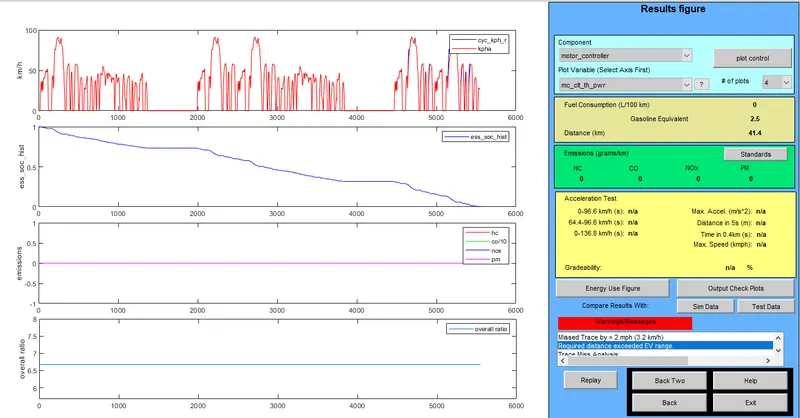
Notice that the total distance travelled is 41.4 km and the SOC of battery has reached 0 already. Hence the EV with one full charge cannot travel 45 km with a cargo mass of 500km and FTP drive cycle.
2) Now change the battery and repeat the simulation.
#no.of.mod represents the number of battery modules in the car. Hence to increase the battery capacity, change the number of modules from 25 to 30 as shown below:
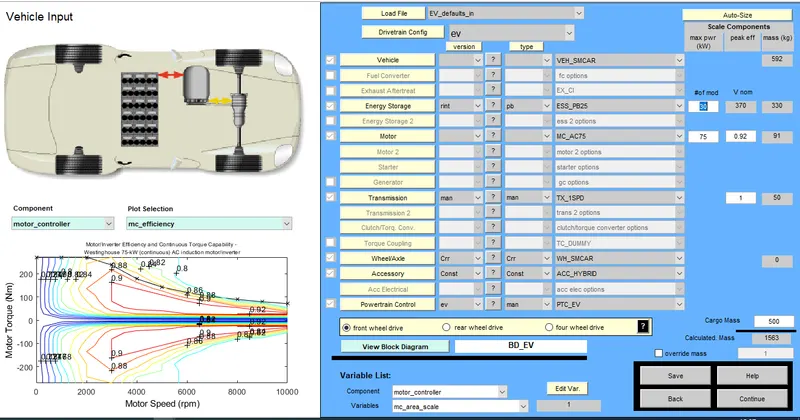
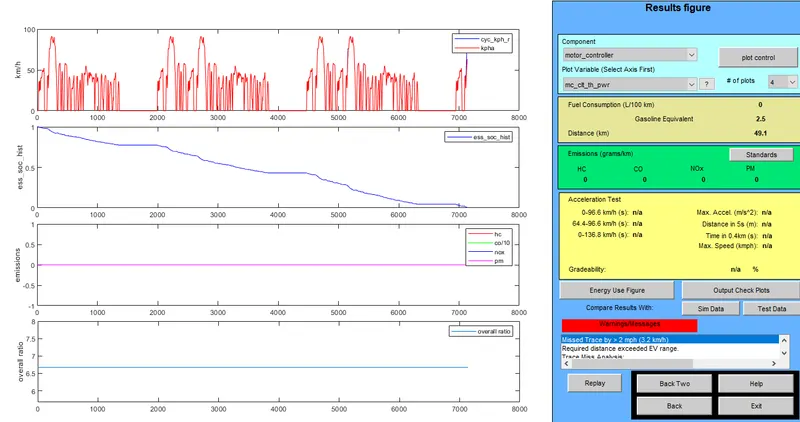
The results obtained after the simulation is run for 3 drive cycles is given below:
Notice that the total distance travelled by the car is now 49.1 km which is greater than 45 km.
3) Gradeability test:
Gradeability by definition is the ability of a commercial vehicle to negotiate a grade(slope/acclivity) in Gross Vehicle Weight (GVW) condition and it can vary from 0% to 45% (maximum). In other words, gradeability is the highest grade a vehicle can ascend maintaining a particular speed.
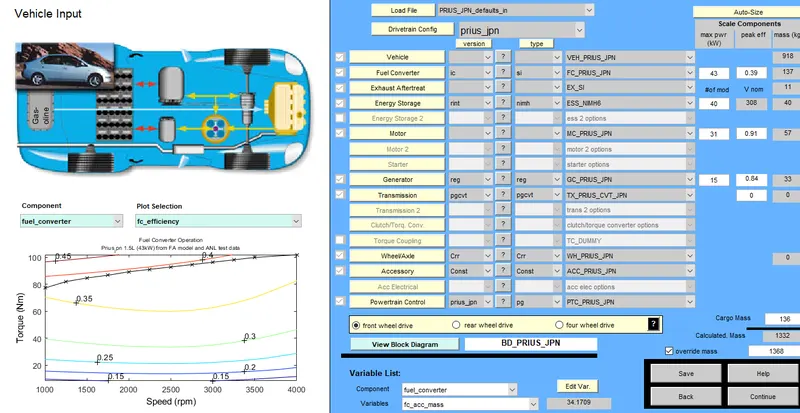
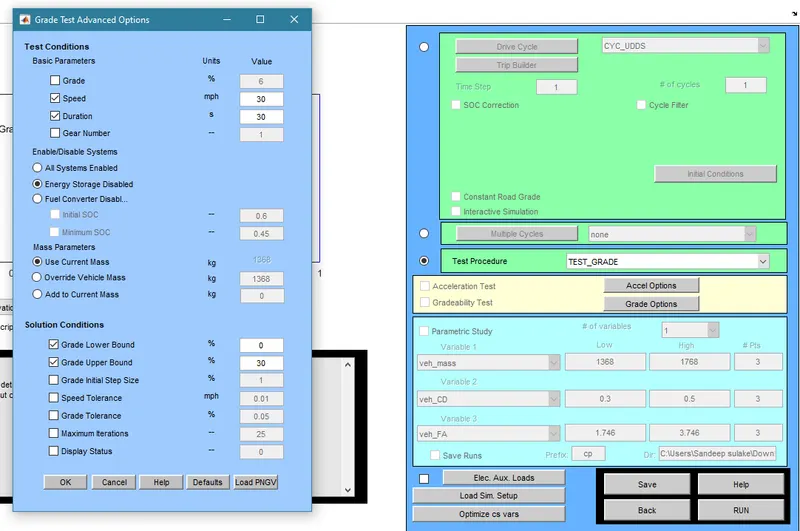
Gradeability test here is performed by defining a constant speed for 30 seconds and evaluating the grade in each case.
Different cases considered are:
1) 30 mph for 30 s
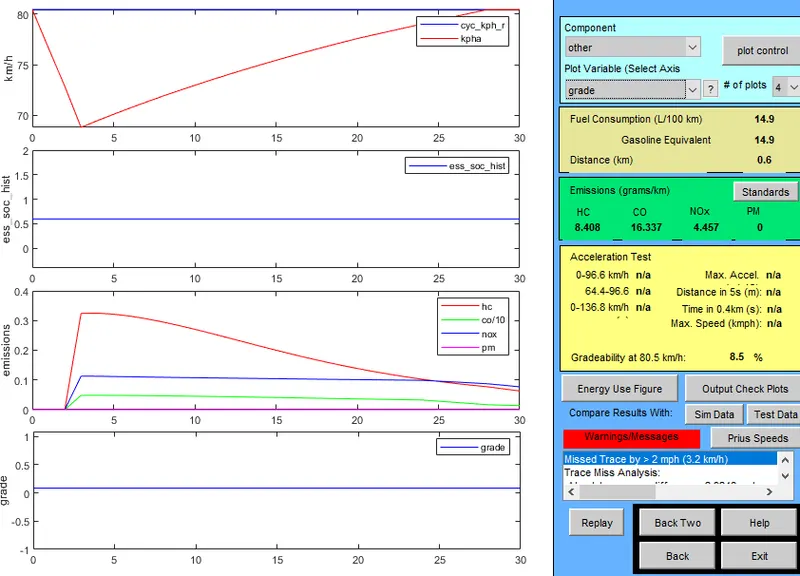
2) 50 mph for 30 s
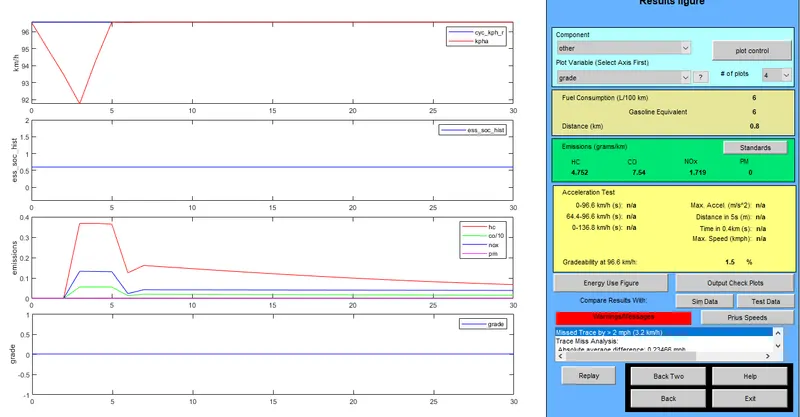
3) 60 mph for 30 s
The gradeability parameters can be modified as shown below:
Gradeability results:
Case 1:
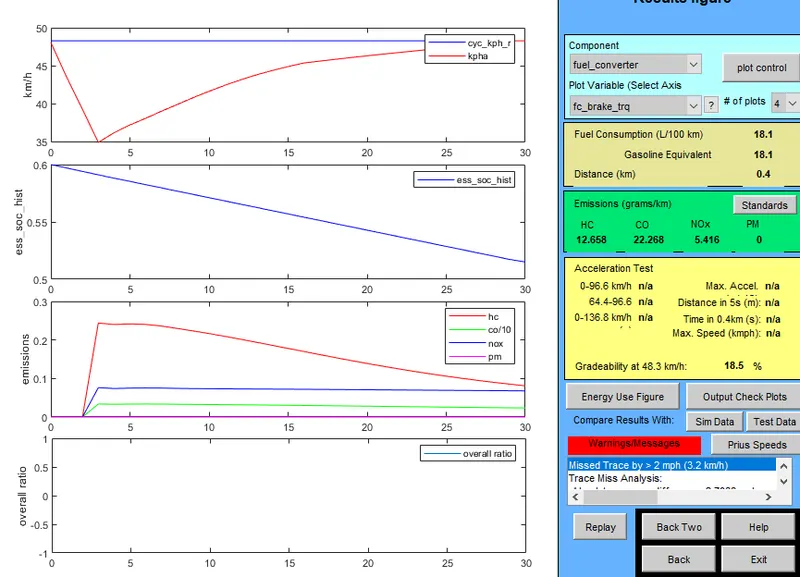
The gradeability comes out to be 18.5% for a speed of 30mph for 30 seconds.
Case 2:
The gradeability is 8.5% for a speed of 50 mph for 30 seconds.
Case 3:
The gradeability is 1.5% for a speed of 60 mph for 30 seconds.
Conclusions:
The gradeability decreases as the vehicle speed increases for same amount of time.