Week 3 Challenge
Introduction :
- In this challenge I have to answer the theorotical questions and solve the numerical
- I have to calculate th scour Depth by using the formula
QUESTION NO 1) How hydrology and geotechnical studies (preliminary and detail studies, zone of influence) are used in fixing span as per IRC standards and type of bridge. Mention the clauses applicable for the same.
SOLUTION :
- Design Discharge helps in deciding total length of bridge , depth of foundation and river training works
- Calculation of discharge can be done with Calculating catchment area and then discharge formulas can be used to calculate velocity and discharge of river
- Bridge scour is removal of deposits such as sand , gravel near abutement or pier location
- Scour caused by fast moving water , can scoop out cut holes , distributing stability of structure
- scouring depends on stratum of river bed , bigger size of soil particles , more will be scour
To provide adequate margin , the scour for foundation shall be determined as per IRC 5 as given below
| CATCHMENT AREA IN KM2 | INCREASE OVER DESIGN DISCHARGE IN % |
|
0-3000 |
30 |
| 3000-10000 | 30-20 |
| 10000-40000 | 20-10 |
| ABOVE 40000 | 10 |
Hydrology studies we have to do for fixing span is :-
- We have to collect data hydrological data from the site like ( Stream flow data, Observed high flood level, ordinary flood level, Flow condition)
- Hydrogical detail survey we have to do before construction.
- Site visit for actual observation.
- Hydrological analysis, the estimation of flood discharge.
- The calculation of flood patterns , flood level, & flood velocity.
- Bridge proposal including assesment of option.
- Frequency of submerge & duration of traffic obstruction.
- Scour assessment.
- Percentage obstruction to flow.
Type of bridge :-
Base on structure
- Slab bridge
- beam bridge.
- Truss bridge.
- Arch bridge
- cable stayed / suspension bridge.
Base on Material
- Concrete bridge.
- Steel bridge.
- Stone bridge.
- PCC and RCC bridge.
Base on length.
- Culvert bridge ( Span < 6>
- Minor bridge ( 6 < span>
- Major bridge ( spqan > 60 M )
- Long bridge ( Span > 120 M )
Base on function.
- Highway bridge.
- Railway bridge.
- Pedistrain bridge.
- Aquaduct / Viaduct.
- Road cum rail of pipeline bridge.
Determine the scour depth at the pier and abutment location having silt factor =3
Design discharge = 1000 cumecs
Linear waterway = 128 m
Assumption :-
6 pier ( 2 meter width )
Solution :-
Calculating Effective linear waterway
= Linear Waterway - 6 x 2
= 128 - 12
= 116 meter
Effective liner waterway is 116 meter.
Now,
Formula for Calculating Scour Depth
dsm=1.34 ( `Db^2` / Ksf )1/3
Where,
Db = The design discharge for foundation per meter width of effective waterway
Ksf = Silt factor for representative sample of bed material obtain upto the level of anticipation deepest scour
Determining the value of Db
Db = Design discharge / Effective liner waterway
= `1000/1116`
= 8.62 m / s
The value of Design discharge Db is 8.62 m/s
As per clause 703.2.1 which is given in IRC:78 The value of Db may be determining by dividing thedesign discharge for foundation by lower of theoretical and actual effective linear waterway as given in IRC:5
Calculating the Score depth,
dsm = 1.34 `(8.62^2/3 )^frac{1}{3}`
= 3.90 Meter
Scour depth for foundation dsm is 3.90 Meter
Maximum Depth of scour for foundation design
Flood without seismic combination,
For Piers, = 2 X dsm
= 2 X 3.90
= 7.8Meter.
For Abutment, = 1.27 X dsm
= 1.27 x 3.90
= 4.96 Meter.
Maximum depth of scour for pier is 7.8 M and for Abutment 4.96 M
question n0 2 : what measures can be taken to avoid scour at bridge for shallow foundation. Also draw the section of measures on the downstream and the upstream side.
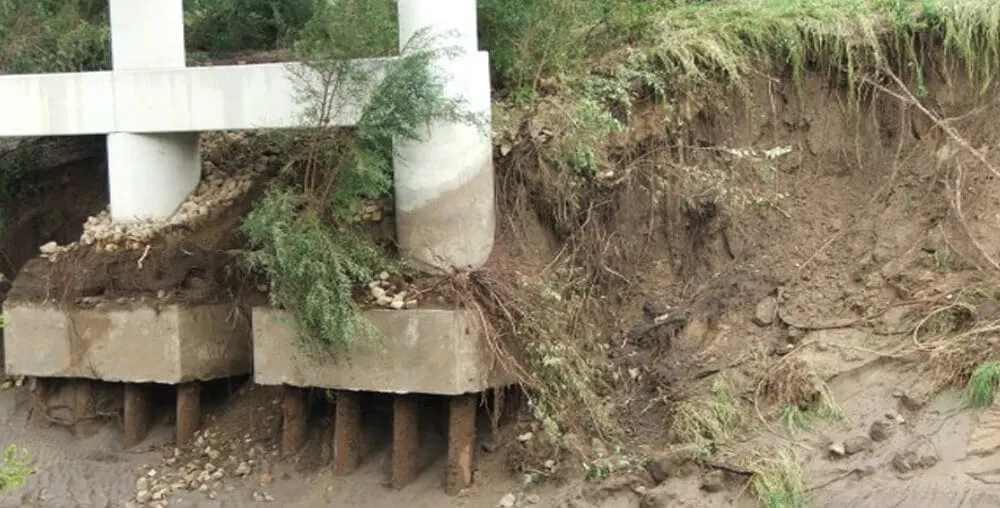
- Bridge scour mitigation refers to measures taken to prevent or reduce the effects of scour around bridge piers or abutments. Bridge scour is a significant concern for the safety and stability of bridges, as it can undermine the foundation of the bridge and lead to collapse or failure. By implementing effective scour mitigation measures, the risk of bridge failure due to scour erosion can be significantly reduced.
-
GeoStabilization International uses several methods for bridge scour mitigation, including:
- Micropiles: Micropiles are used to prevent scour, underpin bridge substructure units, and to re-establish the load carrying capabilities for bridge abutments and piers. Since micropiles can be installed while the bridge superstructure remains in place, repairs can be accomplished with minor disturbance to the bridge unit.
- Sheet piling: A technique that can be employed to mitigate scour before a superstructure has been placed atop the abutments. GRS abutments can be constructed behind steel sheet piling for scour prevention.
- Armor placement: This involves placing riprap or other materials around the bridge pier or abutment to protect against scour erosion.
- Grout injection: Grout is injected into the soil around the bridge pier or abutment to stabilize the soil and prevent scour erosion.
- Monitoring and maintenance: Regular monitoring and maintenance of bridge structures can identify potential scour problems before they become serious issues.
- Advantages
- improved safety: By preventing or reducing the effects of scour erosion around bridge piers and abutments, the risk of bridge failure and collapse is reduced, which increases the safety of the traveling public.
- Increased bridge lifespan: Scour erosion can significantly reduce the lifespan of a bridge by undermining its foundation. By implementing effective scour mitigation measures, the lifespan of a bridge can be extended, reducing the need for costly replacements or repairs.
- Reduced maintenance costs: Scour mitigation measures can reduce the need for costly maintenance and repairs due to scour erosion damage.
- Improved reliability: Bridges are critical infrastructure, and the failure of a bridge can cause significant disruption to transportation networks. Scour mitigation measures can improve the reliability of bridges and reduce the risk of unexpected closures or disruptions.
- Protection of natural resources: Scour erosion can cause sediment to be deposited downstream, leading to potential damage to natural resources such as aquatic habitats. Scour mitigation measures can reduce the impact of scour erosion on natural resources.
QUESTION NO3 : What is uplift and how it can affect the foundation. (loss of contact)
- Uplift pressure, which is also known as hydrostatic uplift, is an upward pressure applied to a structure that has the potential to raise it relative to its surroundings. It is the condition of greater pore water pressure than the overburden pressure of the structure.
- The uplift pressure can be problematic if it is greater than the weight of the structure exerted downwards. ASCE 7-10, states that the upward pressure of water shall be taken as the full hydrostatic pressure applied over the entire area. The hydrostatic load shall be measured from the underside of construction.
- The structure must be designed properly to provide greater resistance against uplift forces in order to prevent risks due to water pressure. So, the uplift pressure must be taken into consideration during design stage since rehabilitation and maintenance of foundation cannot be carried out easily in the future.
Calculate the uplift in U trough of below section with height 3,4,5 meters. with water level on top of ramp wall level .
What are different measures that can be taken to avoid uplift.
The uplift pressure is calculated as follow :-
The (hw) is taken from water table to buttom of U trought
Pu = `gamma w` X hw
= 10 X (3 + 4 + 5)
= 120 kN/`m^2`
Total uplift pressure acting on U trough is 120 kN/`m^2`.
2.5 is the factor of sefty to consider for Uplift.
Following are the measure that can be taken to avoid uplift :-
1) Toeing in the foundation into the surrounding ground.
- When a substructure is built inside an open excavation or temporary cofferdam, the base slab or raft foundation can be extended outside perimeter to increase resistance to uplift.
- The weight of backfill material on the tied-in foundation increase the weight of the structure against uplift pressure. This method is not feasible where a diaphragm or secant pile wall is used as a permanent retaining structure.
2) Increase in self wt. of structure.
- The self-weight of the bridge can be increased by increasing the size of structural members. sometime, the dead weight of the low-rise podium in a high-rise complex is increased by incorporating a rooftop garden with a thick soil fill.
3) Ground anchor
- Pre-stressed anchors can be used as a temporary measure to counteract uplift forces. Permanent application of ground anchors is limited by concerns about their long-term performance with respect to corrosion.
4) Piling Method
- The piling method is the most effective method to resist Uplift pressure. Various types of piles are available to be used for countering uplift pressure based on soil condition and their necessity on site.
- For instance, end bearing pile, friction pile, un-reamed pile, sheet pile, tension pile, and compaction pile. Table 1 presents different types of piles used to contain uplift pressure based on soil conditions.