Week 3
Question:
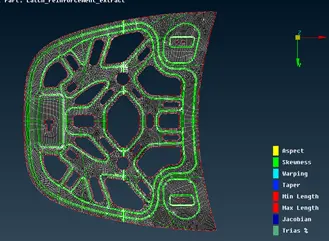
For the given component, check for the geometrical errors and mesh with the given element Quality criteria. After meshing the component the thickness has to be assigned.
Write a detailed report on your meshing process and also mention which method you used to extract the mid-surface along with the reason.
Answer:
Objective:
To mesh the component using the different command we have with ANSA which must satisfy all the required criteria.
The required criteria are:
|
1 |
Target/Average length |
5 |
|
2 |
Minimum Length |
2 |
|
3 |
Maximum Length |
7 |
|
4 |
Aspect |
3 |
|
5 |
Warpage |
15 |
|
6 |
Skewness |
45 |
|
7 |
Jacobian |
0.7 |
|
8 |
Minimum Quad Angle |
45 |
|
9 |
Maximum Quad Angle |
135 |
|
10 |
Minimum Tria Angle |
30 |
|
11 |
Maximum Tria Angle |
120 |
|
12 |
Tria Percentage |
15 |
Import the model.
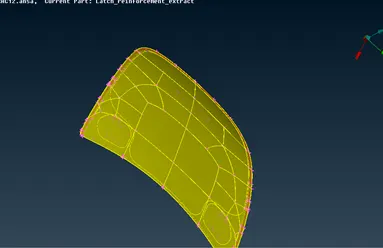
After importing the model make sure of no imperfections in the cad model so that the midsurface can be obtained effectively.
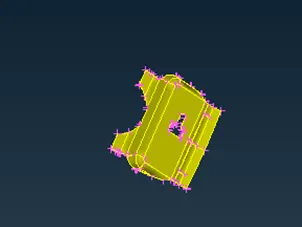
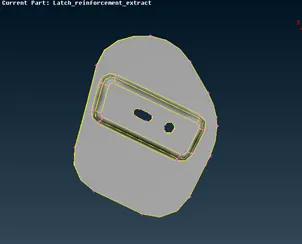
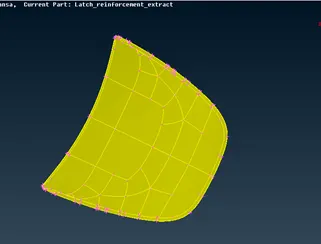
After checking the geometry its time for mid-surfacing the cad model.
Each component is individually midsurfaced using the offset command. Post midsurface assign property to each and every cad model with thickness.
In our model different surfaces have different thickness so assignment of the thickness is made accordingly.
The outer hood component is assigned the thickness of 0.75
The inner hood component has 0.75 thickness.
The component below is assigned thickness of 1.2
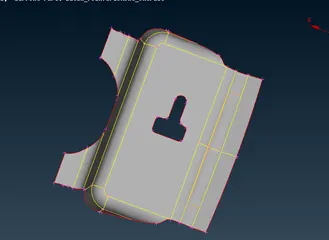
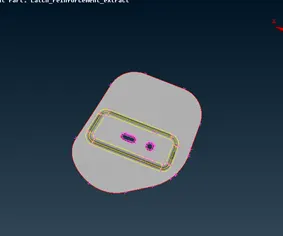
After the thickness is assigned we will have to go in mesh mode and hidden style to mesh the component.

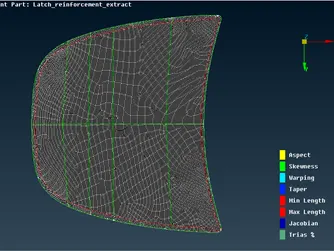
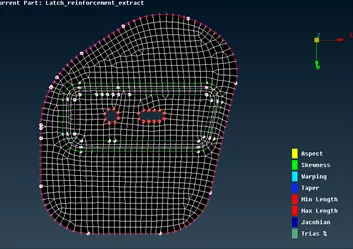
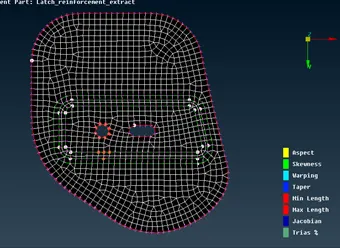
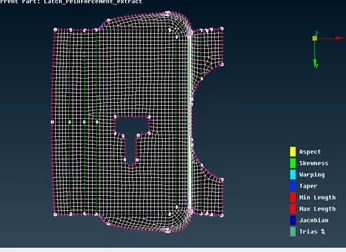
Meshing the component individually with keeping in mind the mesh flow must satisfy the required quality criteria.
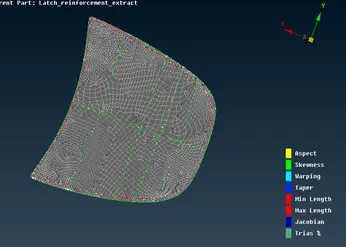
Conclusion:-
The mesh obtained finally satisfies all the given criteria.