Week 2 Session 7
Compare the different architectures of HEV. Discuss the pro's and con's
Answer:
Hybrid vehicle types based on architectures are series HEV, parallel HEV, and series-parallel HEV.
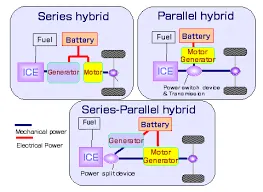
Comparison of Series HEV, Parallel HEV, and Series-Parallel HEV.
Series HEV:
- Internal combustion engine directly does not power wheels
- Engine drives the generator and the generator either charge the batteries or power an electric motor that drives the wheels
- Recharged from the IC engine, and Regenerative braking
Parallel HEV:
- Both ice and electric motor are connected to the transmission
- Ice and motor supply power to wheels switching back and forth as per driving conditions.
- Recharge from the regenerative braking.
- Honda CIVIC is an example of a Parallel HEV
Series – Parallel HEV:
- ICE can drive the wheels directly as in parallel
- Effectively be disconnected with an only electric motor providing power to wheels as in series.
- At lower speed, operates more as a series HEV.
- At higher speeds where the series drivetrain is less efficient ice is taken over.
- Toyota Prius is an example of a Series–Parallel HEV.
Each type of HEV has its own pros and cons.
Hybrid Electric Cars Pros and cons are listed below.
Pros:
- Hybrid cars may be more environmentally – friendly
- They may require less maintenance
- They may have a higher resale value.
- Range anxiety may not be a problem
Cons:
- High voltage system Repair costs may be more expensive.
- They may have a higher upfront cost.
- They may have less power when compared to standard ice vehicles.