Week 2 Session 7
Compare the different architectures of HEV. Discuss the pro's and con's.
There are 3 different types of archirecture of the HEV
1.Series hybrid electric vehicle
2.Parallel hybrid electric vehicle
3.Series parallel hybrid electric vehicle
Series hybrid electric vehicle:-
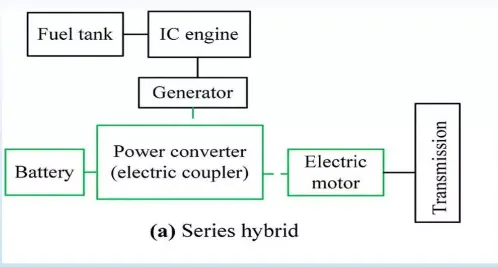
In this archicture the battey and the IC engine is connected in the series manner. Battery conneected to the power converter ckt means the battery provided supply to the power converter circuit and further the power converter circuit is gives the power to the electric motor and the vehicle will run. And another side The fuel tank is connected to the IC engine. The IC engine produce the purpolsion power and this power is provided to the generator. The generator is gives the power to the converter. . Through the generator it is connected to the motor. As we can see both the system is connected to the electric motor through the elctric coupler.
Parallel Hybrid electric vehicle:-
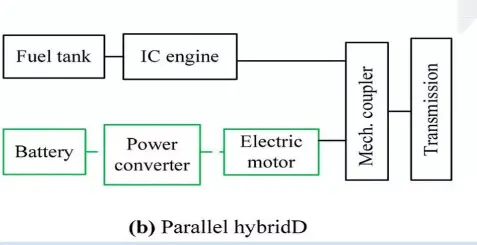
In a parallel hybrid electric vehicle, the combustion engine and the electric motor are connected to the transmission independently. The electric motor is designed to provide power during stop-and-go traffic while at highway speeds the vehicle is powered solely by the internal combustion engine. During acceleration, both the electric motor and the combustion engine power the transmission.
Series Parallel hybrid electric vehicle:-
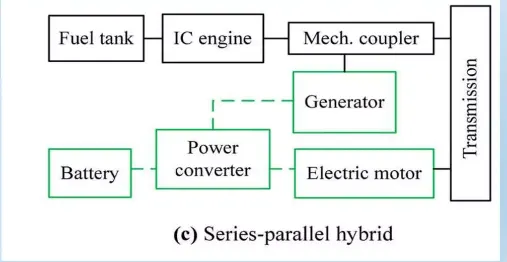
In this archiracture we can see the IC engine and the battery module both provided power to the transmission system alternately. A sper the requriment or the condition of the vehicle. THe fuel tank provide the fuel to the IC engine which produce the purpolsion power. The IC engine produce the purpolsion power which provided to the generator through the mech coupler and it is also direct connected to the transmission system. Another side the battery module is connected to the power convertr circuit which is conneccted to the generator and the electric motor both. Whenever the cpndition is meet . As per the requriment IC engine or the electric motor will provide the purpolsion power to the transmission system.The vehicle can be powered by the gasoline engine working alone, the electric motor by itself, or by both energy convertes working together. Power distribution between the engine and motor is designed so that the engine can run in its optimum operating range as much as possible.
| Pro's | Con's |
| Lower emission | Less power |
| Regenerative braking | Electrocution risk |
| Charging cost is less as compared to the fuel cost | High cost or most expensive to buy |
| The complicated multi speed and clutch system is eliminated. | Not much range |
| Extra power provided by the motor as well as the combustion engine. | Maintainance cost is high |