Week 2 Railwheel and Track
Aim: To perform static structural analysis on the Railwheel and track setup.
Objective:
- Carry out a static structural analysis to find out Equivalent stress, Total deformation and Life.
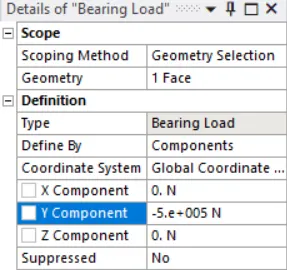
- Comparing results of 100000N and 5-time of bearing load i.e., 500000N load for analysis.
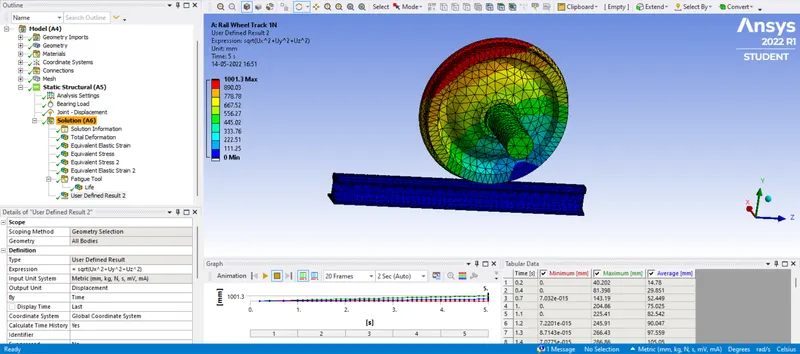
- Implementing a user-defined result and calculating the total deformation from the results and comparing it with results of previous analysis on the basis of the solution.
Introduction:
The railway transportation system, as one of the notable means of commuting systems, has served human societies and has pursued its improvements as other promoted aspects of life. In recent years, the capacity of carrying axial loads for world railways as well as their velocities has been enhanced which results in increasing the number of strains and stresses on lines and digression of rails. we are performing the rail wheel and track analysis carrying the load.
Procedure:
1) For both cases, we use the static structural tool in the analysis system toolbox to define the geometry and other input parameters for the same.
2) in the engineering data we input the material and its properties.
3) Input the given rail wheel and track geometry from the geometry tab. Open in model manager to check for any errors if visible.
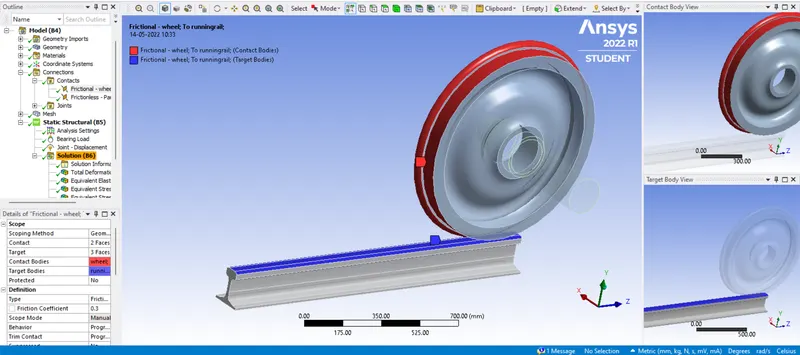
4) In connection, we have to define the contact faces of the rail wheel and track geometry by selecting and deselecting contact or target bodies. In contacts under the connection tab, we define the type of contact as frictional contact with a coefficient of friction of 0.3.
Contact Region 1:
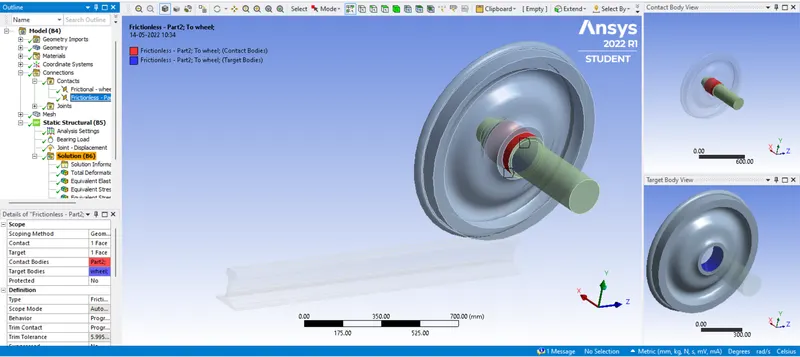
Contact Region 2:
5) To define the type of joint we use the contact tab and specify the body to ground connection type. Also scoping the geometry by selecting the faces of the geometry for fixed, planar and translational motion of the bodies.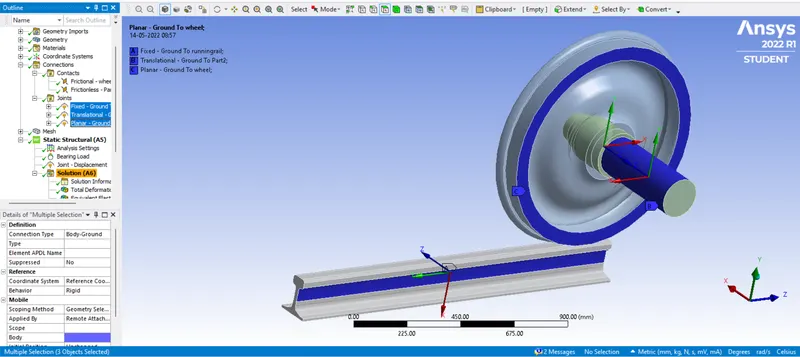
6) By opening the modelling tab, we mesh the geometry with an element size of 35 mm. Generating the mesh thereafter by right-clicking on the Mesh icon. Face sizing under the mesh tab is used to refine the mesh where contacts are present.
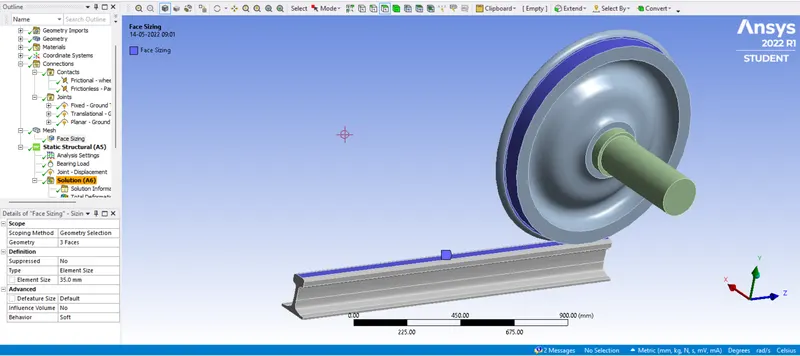
Finer mesh on the contact regions and 35 mm on the rest of the geometry.
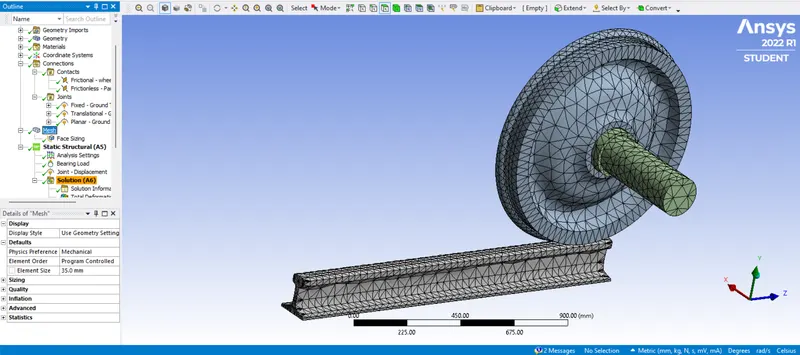
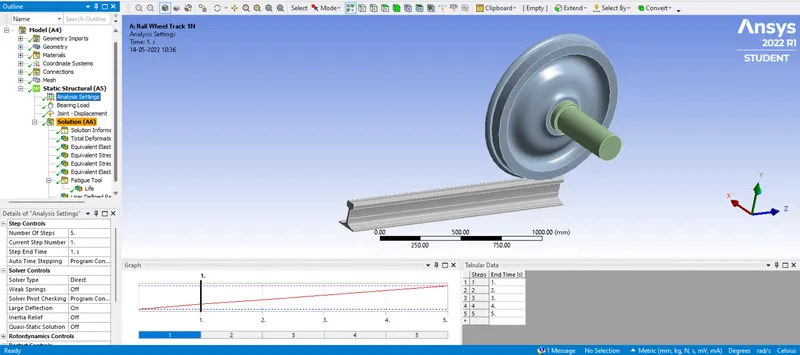
7) After defining the contacts and joints, we open the analysis setting where we define step control settings and input the parameters as needed.
For the 1st step:
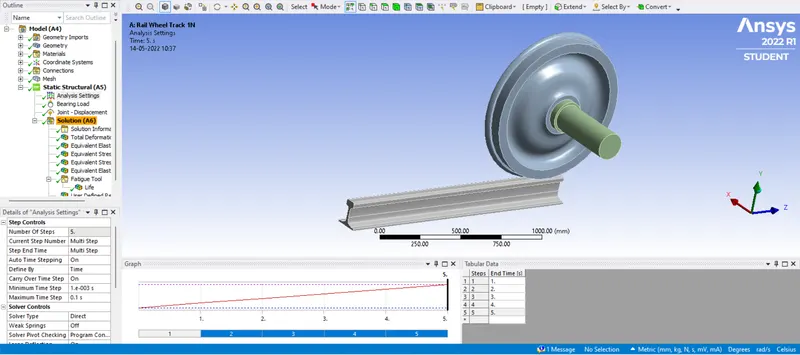
For the 2nd to 5th steps:
8) Defining displacement of 100mm by incrementing for each step in X direction about Z-axis.
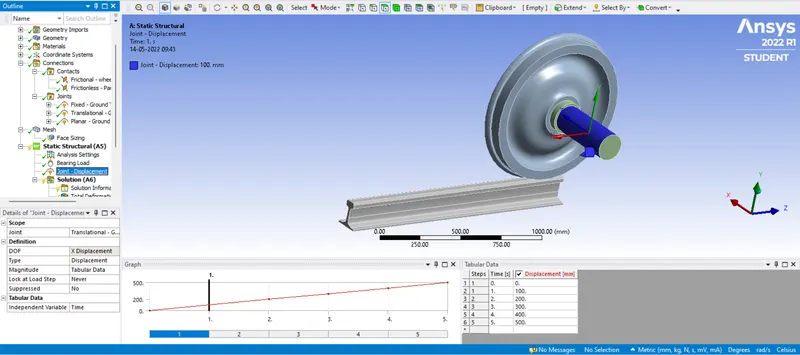
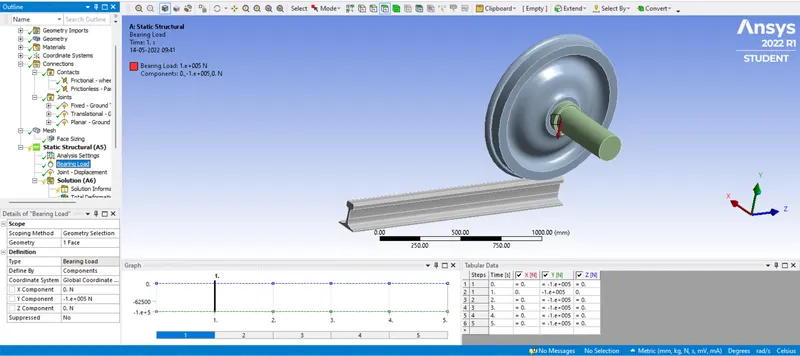
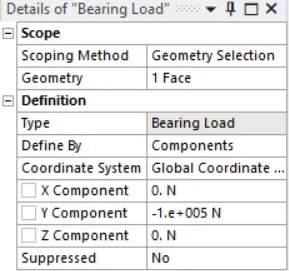
Input the value of the bearing load
9)Setting up the solutions
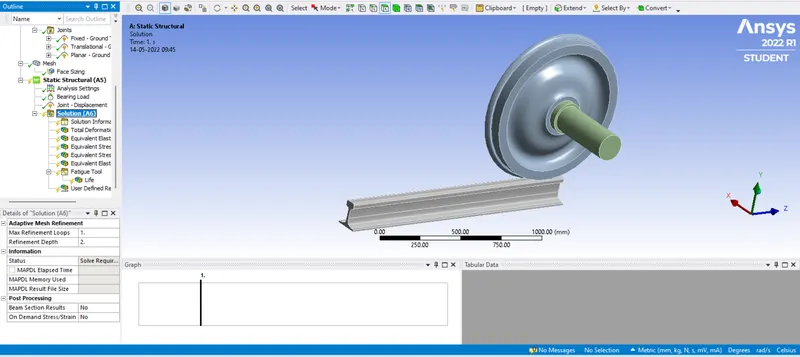
For Case 1:
a) 100000N of the bearing load
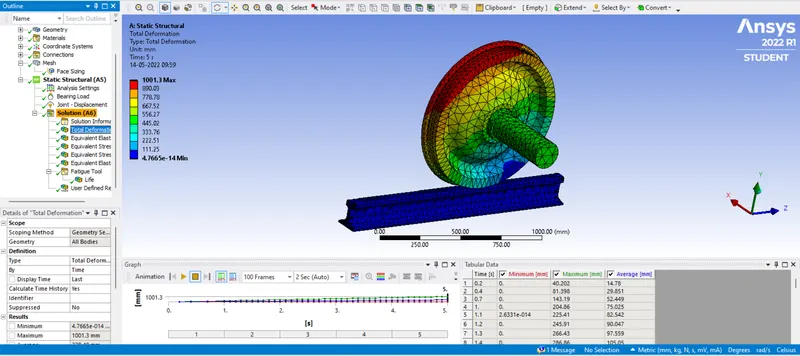
Total Deformation:
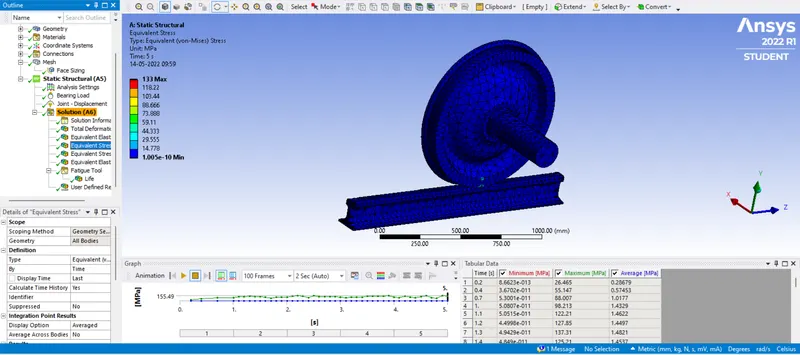
Equivalent Stress:
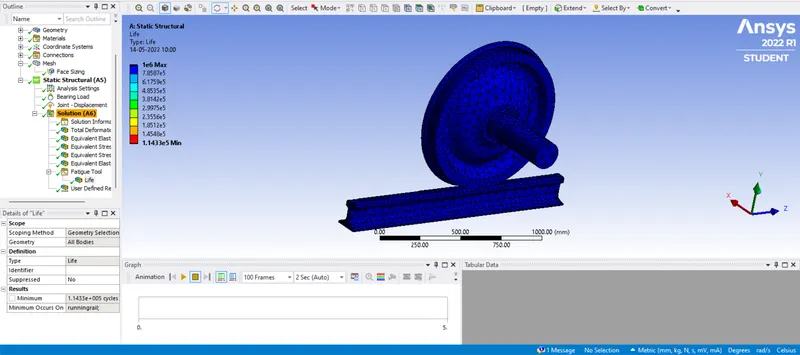
Life:
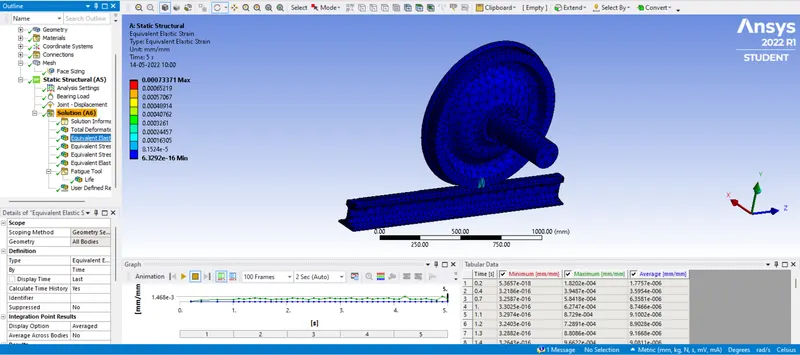
Equivalent Elastic Strain:
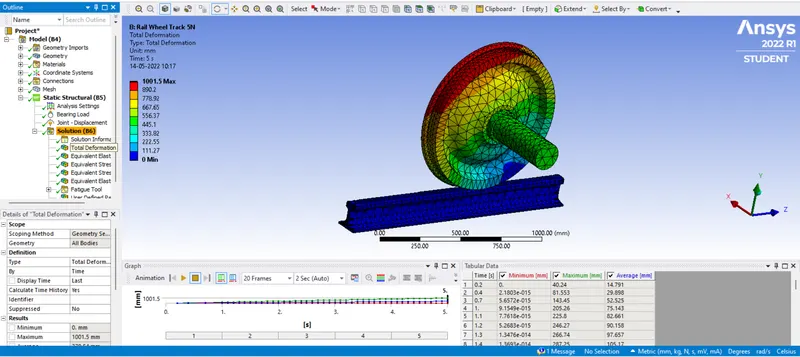
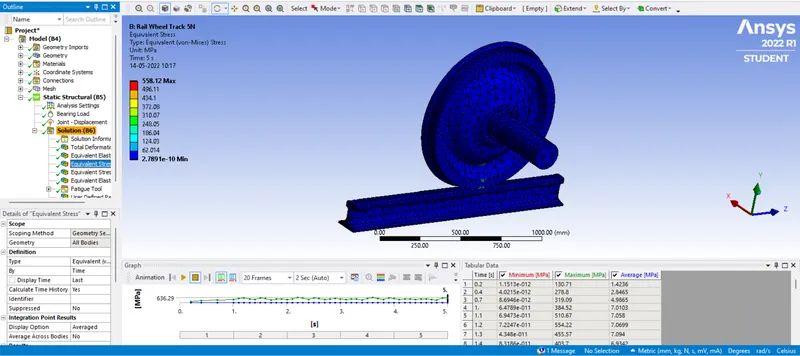
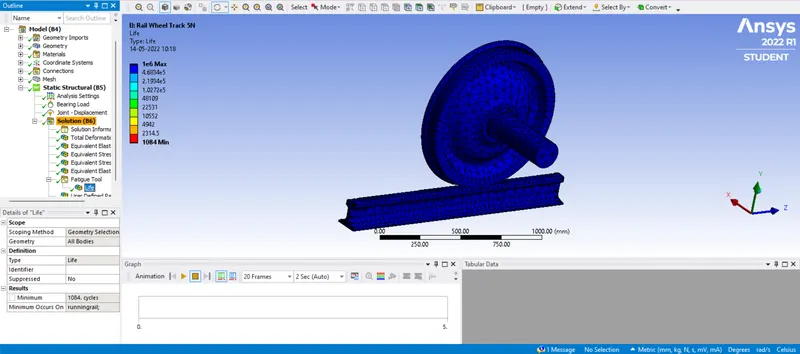
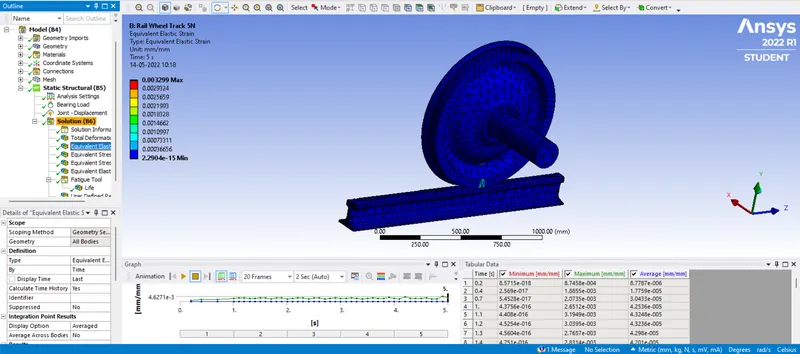
b) 500000N of the bearing load
Total Deformation:
Equivalent Stress:
Life:
Equivalent Elastic Strain:
Case 2:
User-Defined Results for Total Deformation for bearing load of 100000N:
Results:
| Sr.No | Solution Type | 100000N | 500000N |
| 1. | Equivalent stress Von-Mises (Maximum) in MPa | 133 | 558.12 |
| 2. | Equivalent stress Von-Mises (Minimum) in MPa | 1.005e-10 | 2.7981e-10 |
| 3. | Total Deformation (Maximum) in mm | 1001.1 | 1001.1 |
| 4. | Total Deformation (Minimum) in mm | 4.7665e-14 | 4.7665e-14 |
| 5. | Equivalent Elastic Strain (Maximum) in mm/mm | 0.000733 | 0.003299 |
| 6. | Equivalent Elastic Strain (Minimum) in mm/mm | 6.3292e-16 | 2.2909e-15 |
| 7. | Life (Maximum) | 1e6 | 1e6 |
| 8. | Life (Minimum) | 1.1433e5 | 1084 |
Conclusion:
- In Case 1 it is visible that the equivalent stress with 100000N is low at 133 MPa whereas with 500000N is higher at 558.12 MPa. It can bear or say withstand the load for both cases if we observe total deformation
- For Case 2, if we compare it with the previous result of total deformation it is the same as user-defined total deformation.
Note: google drive link is provided below in a text file. Please check the link for the model.
Link for Animations: https://youtube.com/playlist?list=PLh9RPDMRvgtX_KhZUsXojXMXmrL-zgJi8
Thank You...