Week 2 - Flow over a Cylinder.
AIM:
To simulate the flow over a cylinder and explain the phenomenon of Karman vortex street.
PART-I
- Simulate the flow with the steady and unsteady case and calculate the Strouhal Number for Re= 100.
PART-II
- Calculate the coefficient of drag and lift over a cylinder by setting the Reynolds number to 10,100,1000,10000 & 100000. (steady solver)
- Discuss the effect of Reynolds number on the coefficient of drag. [ Results should be validated with any standard literature and error should be within 5 %.
INTRODUCTION:
Vortex shedding is a phenomenon, when a fluid blows across a structural member, vortices are shed alternately from one side to the other, and where alternating low-pressure zones are generated on the downwind side of the structure giving rise to a fluctuating force acting at right angles to the fluid direction. A Kármán vortex street is a repeating pattern of swirling vortices, caused by a process known as vortex shedding which is responsible for the unsteady separation of a fluid around blunt bodies.
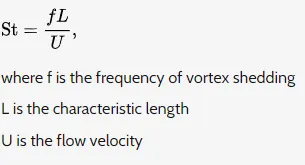
Strouhal number: The frequency of vortex shedding can be determined by Strohal number (St). The St number is dependent on the cross section of the building or object which flow passes over, and is also dependent on the velocity of the flow, or the reynolds number. It is given as:
Simulation Procedure:
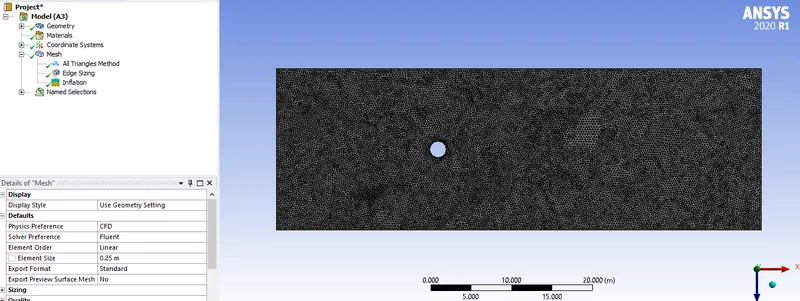
A 2D surface plate is created using ANSYS Space claim. The model is meshed using all the triangles, edge sizing and the inflation methods as shown. The element size is selected as 0.25 m
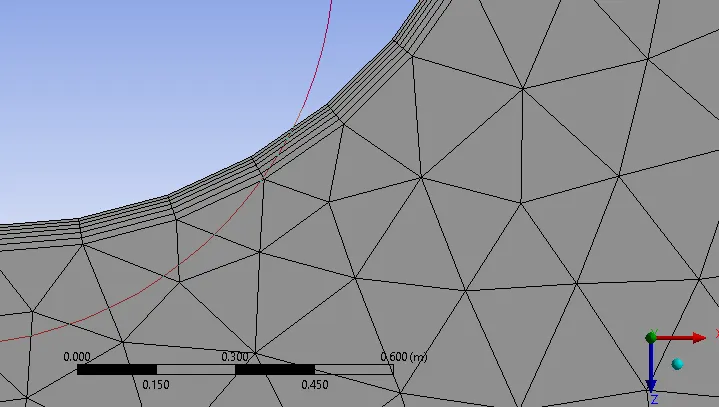
The inflation with 6 layers setup as shown in the figure is used to capture the flow field accuratley near the clinder walls.
PART 1: a) Steady state case with Re=100:
Setup the conditions as:
Inlet velocity =1 m/s; viscosity= 0.02
Number of iterations =500
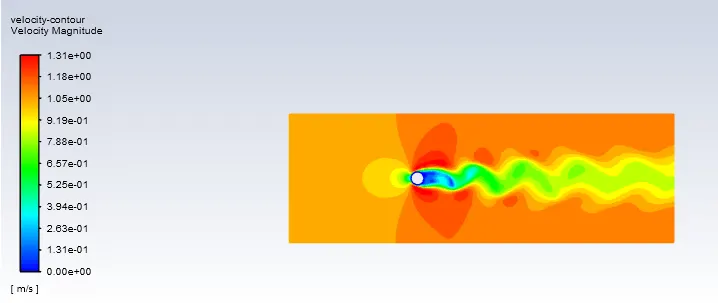
The velocity contours are shown:
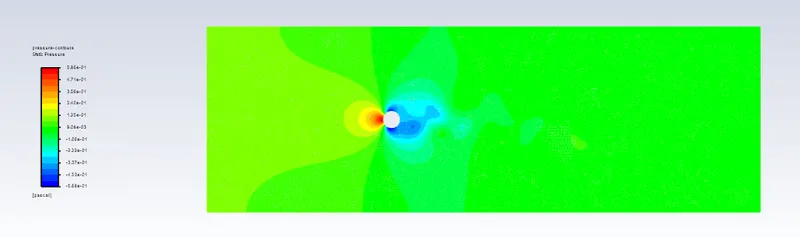
Pressure contours:
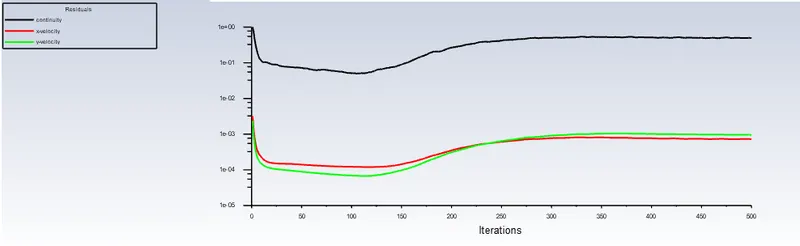
One of the important plots to verify the convergence of the solution is through residual plots. The residual plot is shown below. Notice that the error becomes constant after approximately 300 iterations.
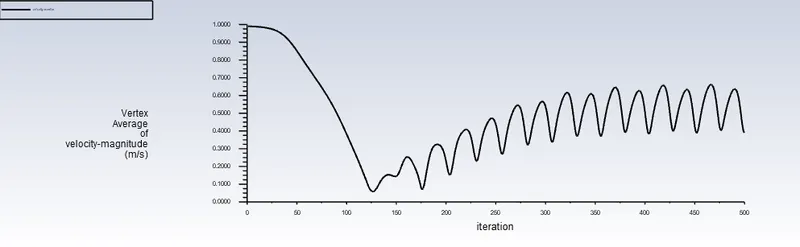
The monitor point (at a distance of 8m to the right from the cylinder) velocity plot is shown below. Notice that the fluctuations of the velocity represent that the vortex shedding is formed.
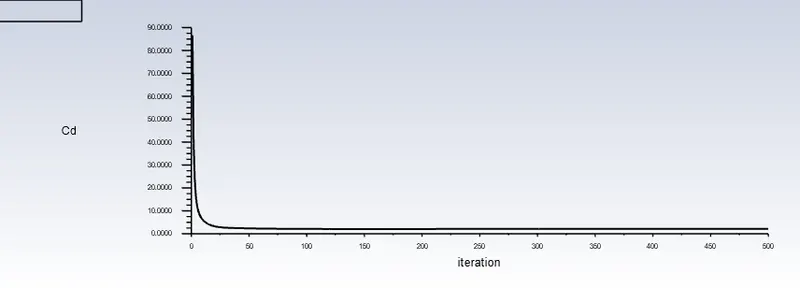
The drag and lift coefficient plots are shown below:
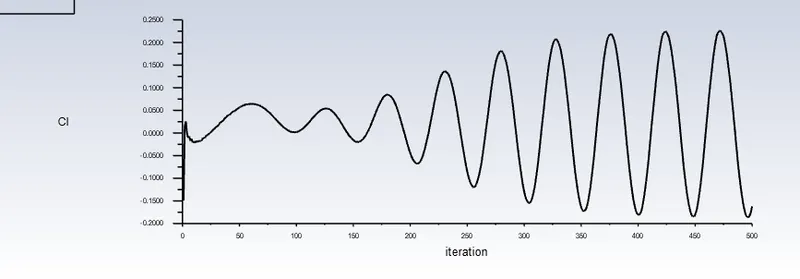
Part b) Transient solution with Re=100:
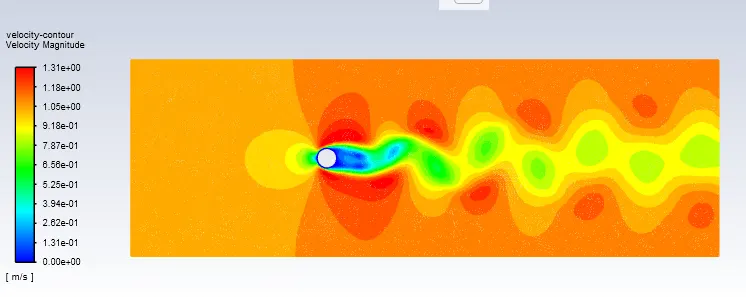
Transient simulation with total flow time of 100 seconds is simulated to capture the physics accurately.
The velocity contour is shown:
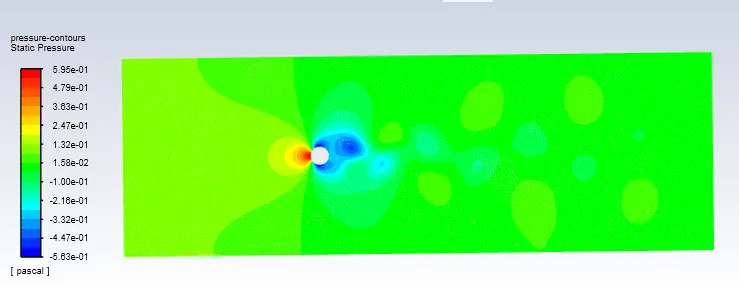
The pressure contour is shown:
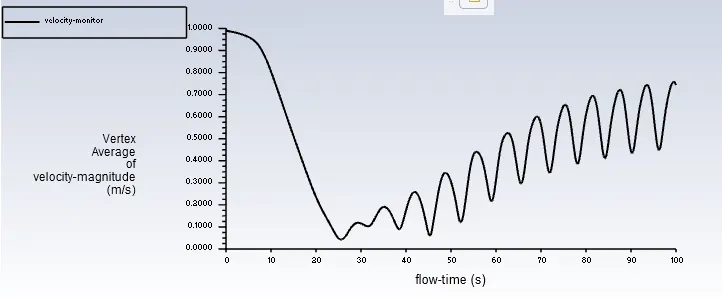
The velcoity monitor point plot is shown:
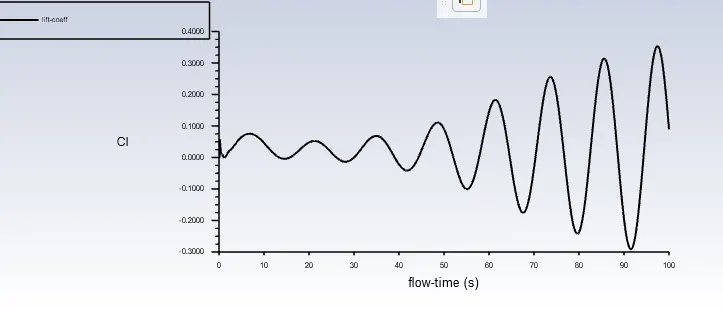
The lift coefficient plot is shown:
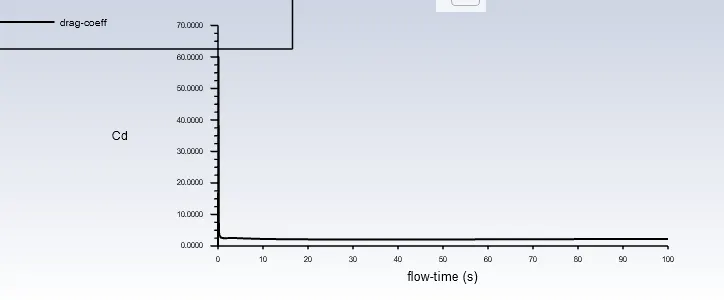
The drag cofficient plot is shown:
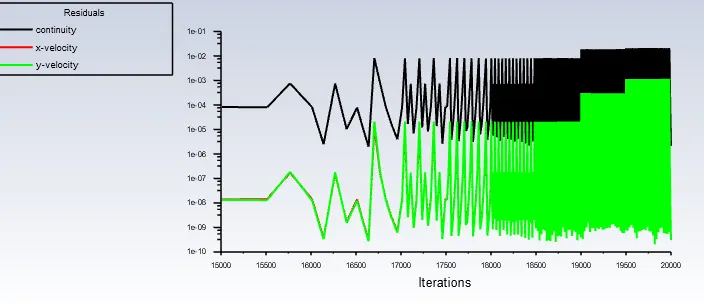
The residual plot is shown with number of iterations on x- axis:
Calculation of Strouhal Number for Re= 100:
Notice from the velcoity monitor plot that the number of velocity peaks between 80 and 100 seconds is 3. Hence the frequency can be calculated as:
3/ (100-80) = 0.15 oscillation per second, L = 2m and U= 1 m/s
Strouhal Number = fL/U = (0.15 x 2)/(1)= 0.3
Hence the strouhal number is approximately 0.3.
Observations: To capture the actual phenomenon of vortex shedding with time, transient simulation is more suitable than the steady state simulation. Also it is meaningless to monitor the residuals to say that the simulation has reached a steady state since it gives the time wise development of the phenomenon.
PART 2:
Calculation of the coefficient of lift and drag with varying the reynolds number. (steady state). The plots for lift and drag coefficient are shown for each case.
With Re=10:
For a reynolds number of 10, inlet velocity of 0.1 m/s is given. All other boundary conditions are same as before.
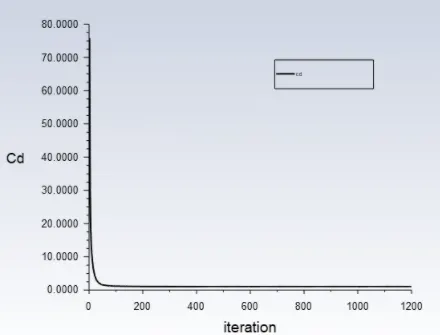
The drag coefficient plot is shown:
The lift coefficient plot is shown:
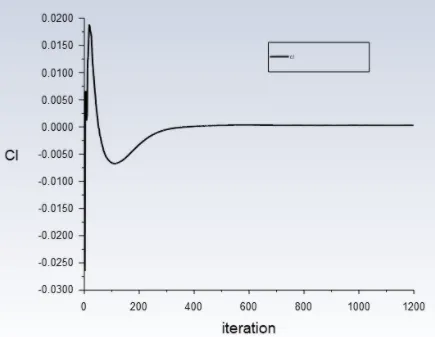
For Re=100, the inlet velocity is 1 m/s. The plots for drag and lift coefficients are shown:
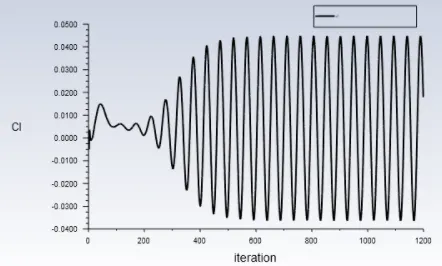
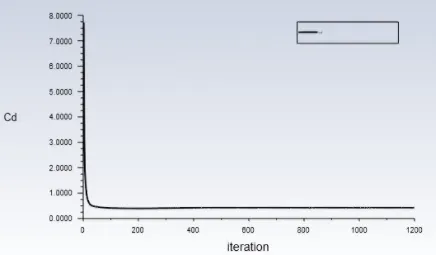
For Re=1000, the inlet velocity is 10 m/s. A steady state SST omega solve is used for this case.
The plots for drag and lift coefficients are shown:
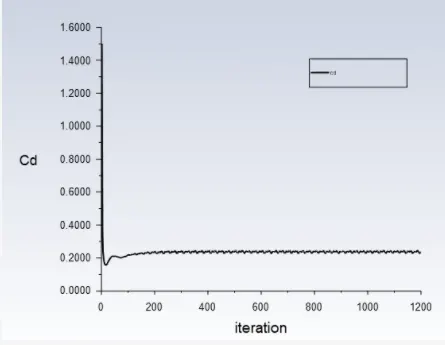
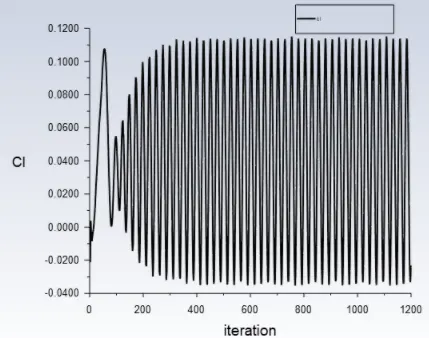
For Re=1000, the inlet velocity is 10 m/s. A steady state SST omega solve is used for this case.
The plots for drag and lift coefficients are shown:
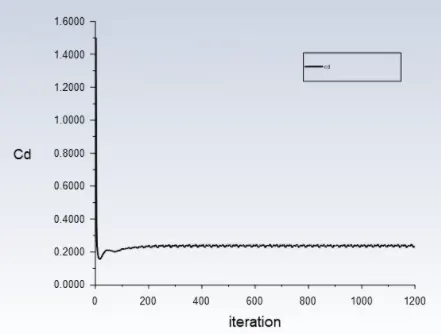
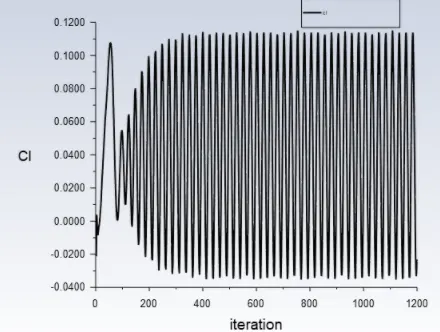
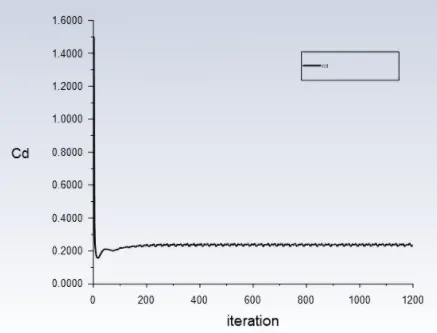
For Re=10000, the inlet velocity is 10 m/s. A steady state SST omega solve is used for this case.
The plots for drag and lift coefficients are shown:
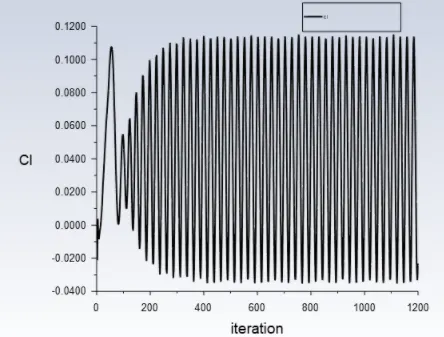
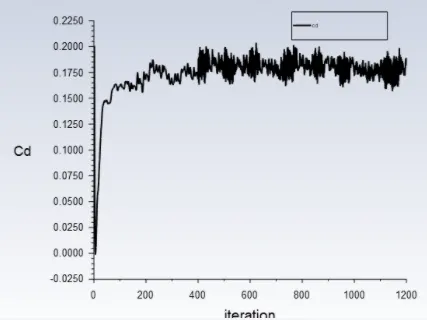
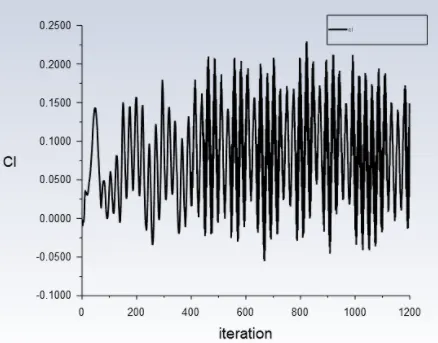
For Re=100000, the inlet velocity is 10 m/s. A steady state SST omega solve is used for this case.
The plots for drag and lift coefficients are shown:
Conclusions:
| Reynolds number | Coefficient of drag | Coefficient of lift |
| 10 | 1.06 | 0.0003 |
| 100 | 0.45 | 0.0056 |
| 1000 | 0.31 | 0.043 |
| 10000 | 0.27 | 0.11 |
| 100000 | 0.17 | 0.09 |
As the Reynolds number increases, inertial forces dominate over viscous forces. The coefficient of drag (Cd) is found to be decreasing as the reynolds number increases and the oscillatory nature of the coefficient of lift is observed. The vertex average of Velocity and coefficient of lift is found to be increasing with Reynolds number. As Re increases, the vortices are shed alternately from the upper and lower surface of the cylinder at a definite frequency which is a function of Reynolds number.
The results of coefficient of drag and lift with increasing Reynolds number are similar to that of findings of Rajani et al. [2], Notice that the results agreed reasonably well. It can be can observed that along with an increase in the Reynolds number more than 10000, the flow becomes more and more unsymmetrical. Increasing velocity eventually brings the turbulent drag up to and even higher than the laminar drag value.
References:
https://en.wikipedia.org/wiki/Kármán_vortex_street
B.N. Rajani, S. Majumdar, A. Kandasamy, Numerical simulation of laminar flow past a circular cylinder, Applied Mathematical Modelling 33 (2009) 1228–1247