Week 2 - Flow over a Cylinder.
Aim: - To simulate the flow over a cylinder and explain the phenomenon of Karman vortex street.
Objective: -
- Simulating the flow with the steady and unsteady cases and calculating the Strouhal Number for Reynold’s Number of 100.
- To calculate the coefficient of drag and lift over a cylinder by setting the Reynolds number to 10, 100, 1000, 10000 and 100000 using steady solver.
- To discuss the effect of Reynolds number on the coefficient of drag.
Theory: -
Von-Karman’s Vortex Street: It is a repeating pattern of swirling vortices, caused by a process known as vortex shedding, which is responsible for the unsteady separation of flow of a fluid around blunt bodies. The patterns can form nearly anywhere that fluid flow is disturbed by an object, As winds are diverted around these high areas, the disturbance in the flow propagates downstream in the form of vortices that alternate their direction of rotation. A vortex street will form only at a certain range of flow velocities, specified by a range of Reynolds numbers i.e., 47<`Re_d`<105 for circular cylinders where d is reference length and diameter of circular cylinder.
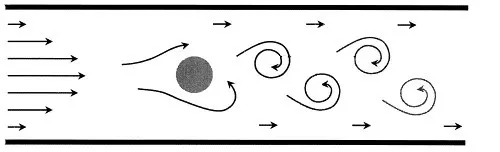
It is responsible for phenomena "singing” of suspended telephone or power lines and the vibration of a car antenna at certain speeds.
The flow of atmospheric air over obstacles such as islands or isolated mountains sometimes gives birth to von Kármán vortex streets.
Tall chimneys constructed of thin-walled steel tubes can be sufficiently flexible that, in air flow with a speed in the critical range, vortex shedding can drive the chimney into violent oscillations that can damage or destroy the chimney.
Strouhal Number: It is a dimensionless no. which represent the ratio of inertial forces due to the local acceleration to the inertial forces due to the convective acceleration of the flow. It is useful for analysing oscillating unsteady fluid flow dynamics problems.
It is associated with the oscillations of the flow due to the inertial forces relative to the changes in velocity due to convective acceleration of the flow.
The Strouhal number is often given as - `St=(f*L)/U`
where f is the frequency of vortex shedding, L is the characteristic length and U is the flow velocity.
The Strouhal Number can be important when analyzing unsteady, oscillating flow problems. The Strouhal Number represents a measure of the ratio of the inertial forces due to the unsteadiness of the flow or local acceleration to the inertial forces due to changes in velocity from one point to another in the flow field.
Case Setup:
Pre-processing step: -
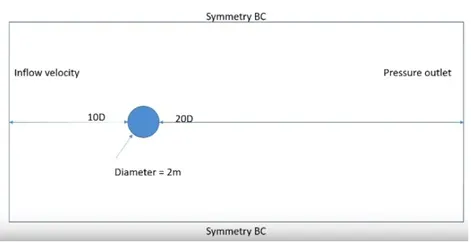
Modelling – The model is designed in Ansys SpaceClaim and have following dimensions.
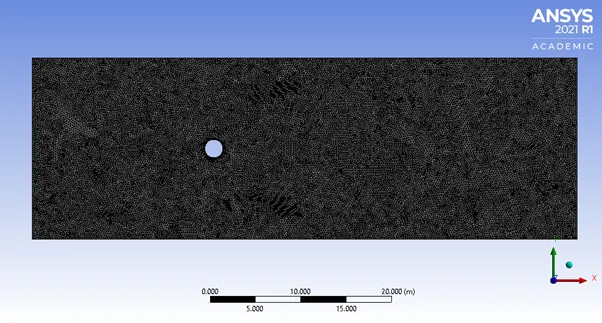
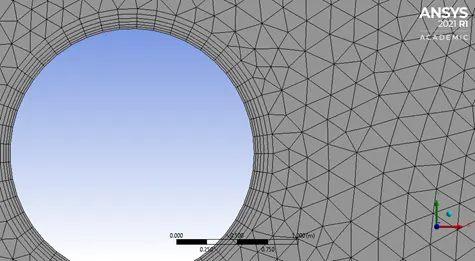
Meshing – Meshing is done with 0.2m element size with added methods such as triangulation, Edge sizing (45 division on cylinder boundary) and inflation of 6 layers with growth rate of 1.2.
Processing:
Pressure based solver with laminar model with solution setting as follow
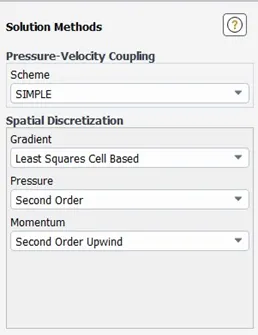
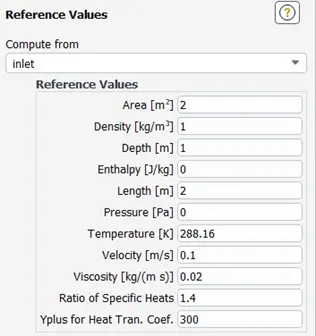
Boundary condition are set for inlet value for absolute velocity to achieve different Reynold’s Number, no slip condition and stationary condition for the cylinder is used.
The fluid used is modify so as to get desired Reynold’s Number.
|
Reynold’s Number |
Density (kg/m^3) |
Viscosity (kg/m s) |
Inlet velocity(m/s) |
|
10 |
1 |
0.02 |
0.1 |
|
100 |
1 |
0.02 |
1 |
|
1000 |
1 |
0.02 |
10 |
|
10000 |
1 |
0.02 |
100 |
|
100000 |
1 |
0.002 |
100 |
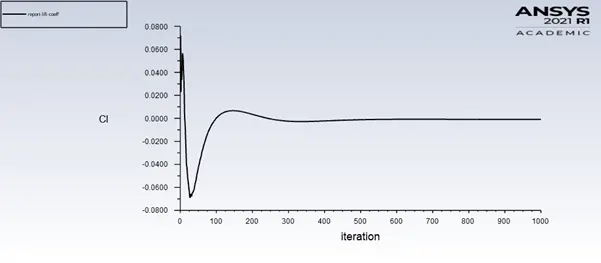
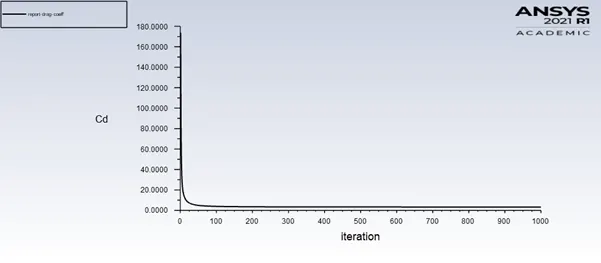
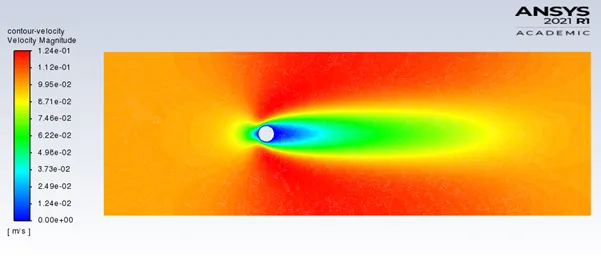
- Steady State (Re = 10): -
Residual plots-
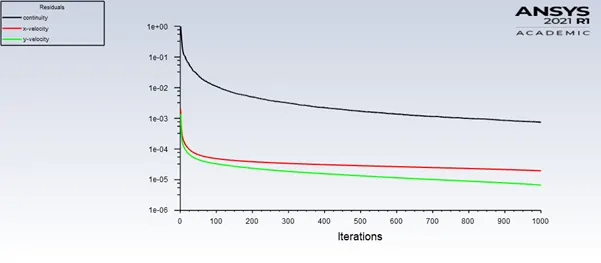
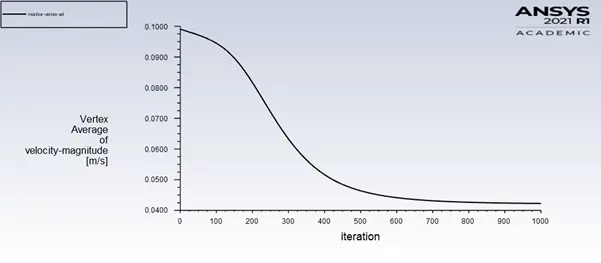
Velocity at 8 m from center of cylinder in x direction –
Lift Coefficient
Drag coefficient
Velocity Contour
Simulation Video Link - Steady(10) sim
- Steady and Unsteady simulation for Re = 100
Steady simulation
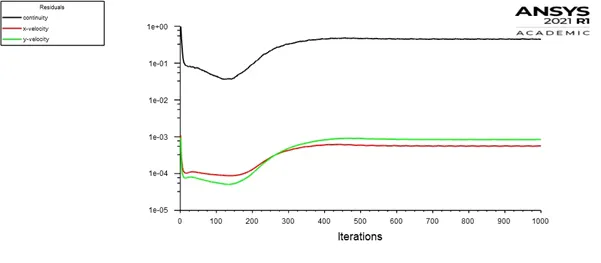
Residual plots-
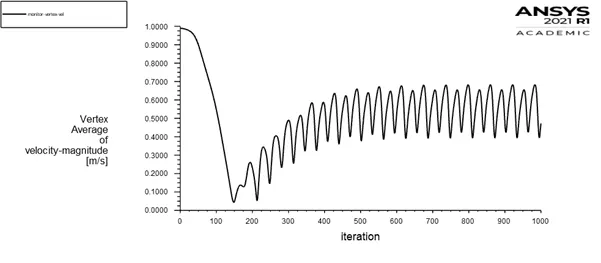
Velocity at 8 m from center of cylinder in x direction –
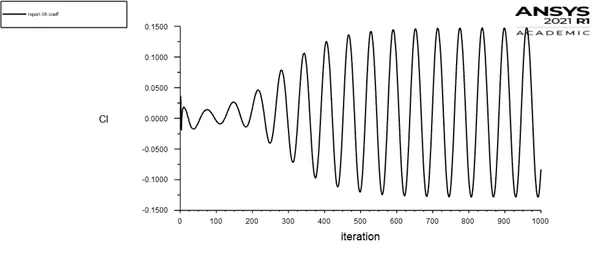
Lift Coefficient
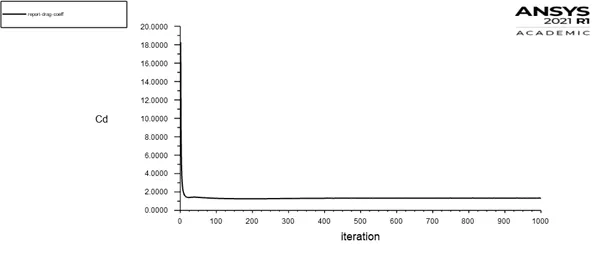
Drag coefficient
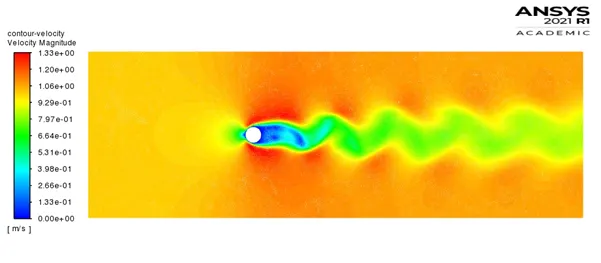
Velocity Contours:
Strouhal Number: Since steady state is independent of time so temporal acceleration is 0 hence strouhal number cannot be calculated.
Simulation Video Link - Steady(100) sim
Unsteady simulation
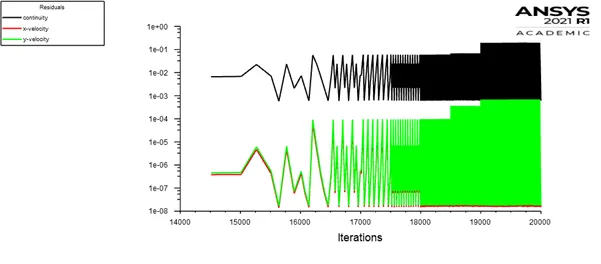
Residual plots-
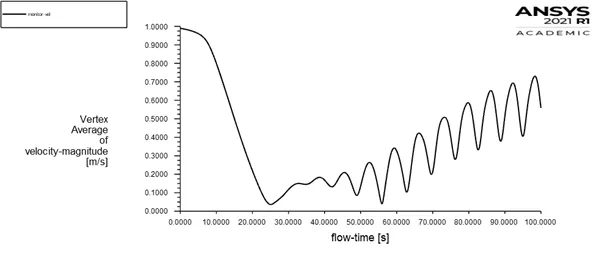
Velocity at 8 m from center of cylinder in x direction –
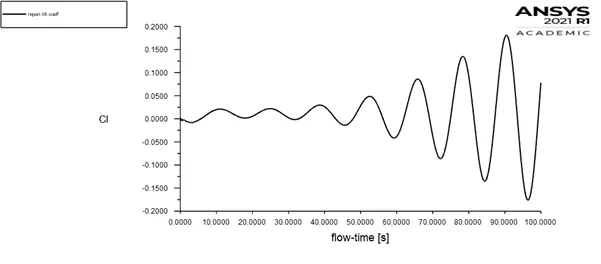
Lift Coefficient
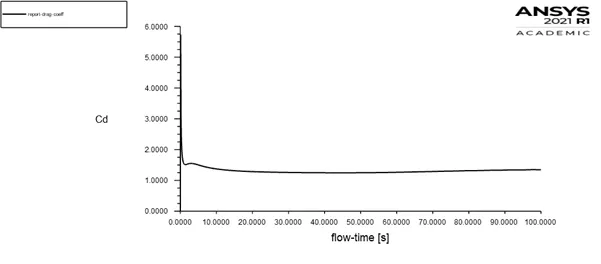
Drag coefficient
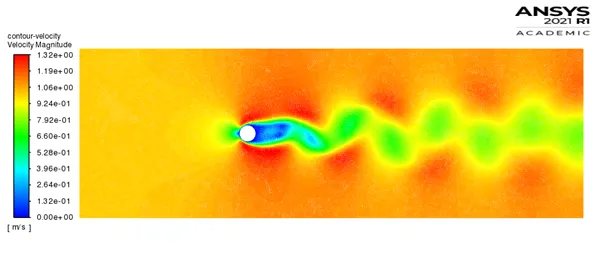
Velocity Contours:
Strouhal Number vs lift coefficient
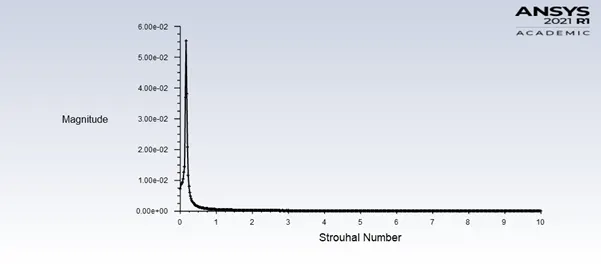
From the above Plot between Lift coefficient magnitude and Strouhal Number can be extracted.
The Strouhal no. corresponding to the maximum Lift coefficient (5.5256e-2) is 0.15984.
Simulation Video Link - Unsteady(100) Sim.
3. Steady State (Re = 1000)
Residual plots-
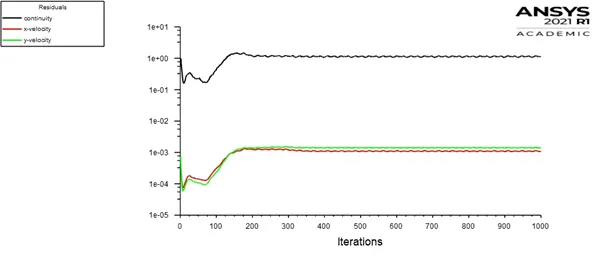
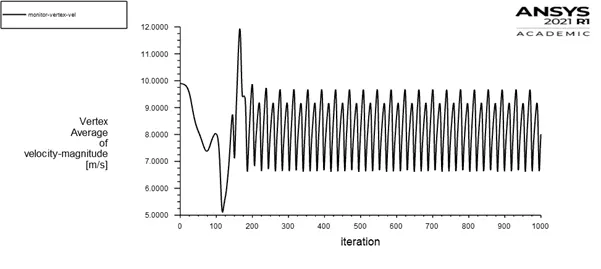
Velocity at 8 m from center of cylinder in x direction –
Lift Coefficient
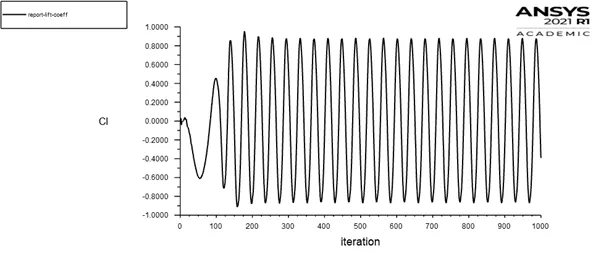
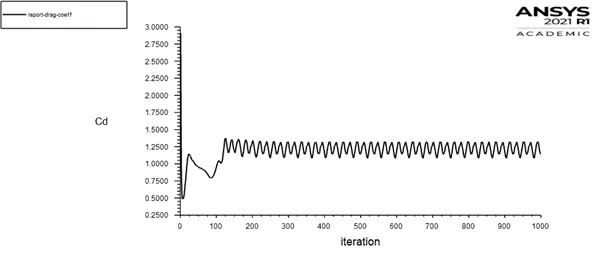
Drag coefficient
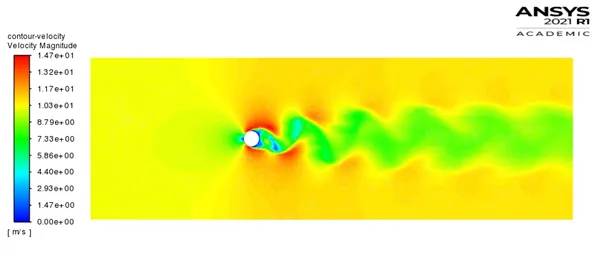
Velocity Contours:
Simulation Video Link - Steady(1000) sim
4. Steady State (Re = 10000)
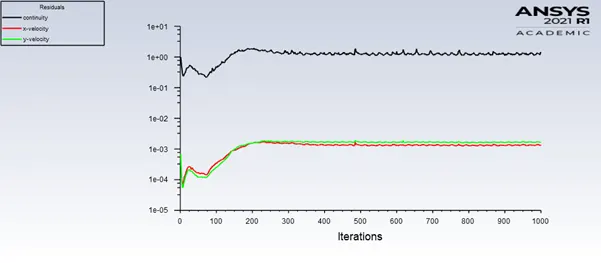
Residual plots-
Velocity at 8 m from center of cylinder in x direction –
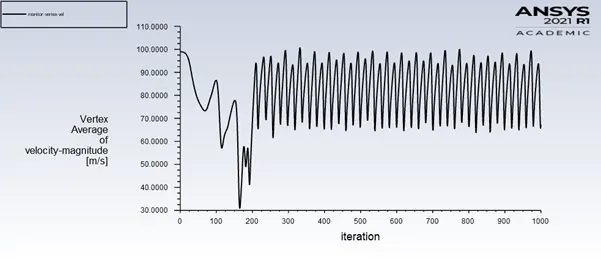
Lift Coefficient
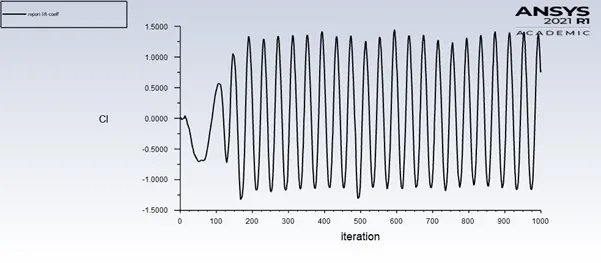
Drag coefficient
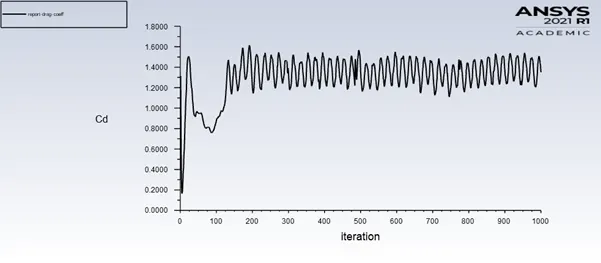
Velocity Contours:
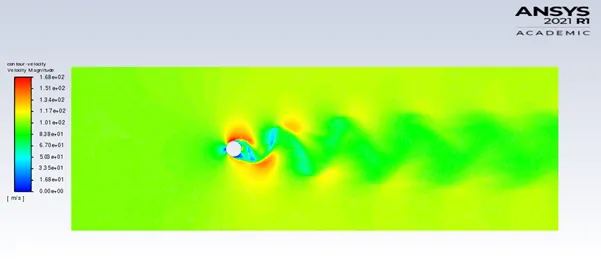
Simulation Video Link - Steady(10000) sim
5. Steady State (Re = 100000)
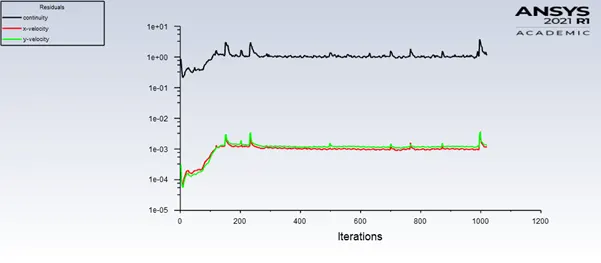
Residual plots-
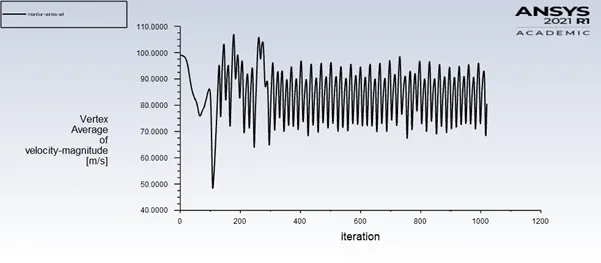
Velocity at 8 m from center of cylinder in x direction –
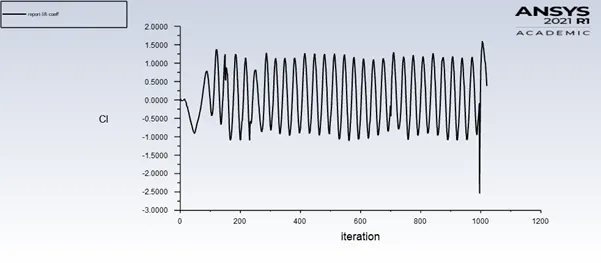
Lift Coefficient
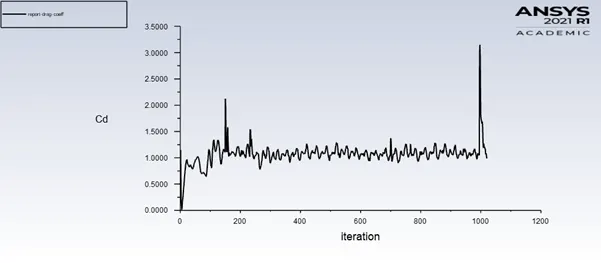
Drag coefficient
Velocity Contours:
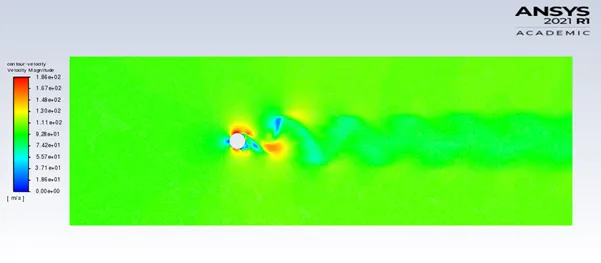
Simulation Video Link - Steady(100000) sim
Results
|
Reynold’s Number |
Drag Coeff. |
Lift Coeff. |
Velocity @point x=8m |
|
10 (Steady) |
3.330023 |
-0.000916296 |
0.0422589 m/s |
|
100 (Steady) |
1.33574 |
-0.08343491 |
0.4728128 m/s |
|
100 (Unsteady) |
1.346786 |
0.07790188 |
0.5583844 m/s |
|
1000 (Steady) |
1.144266 |
-0.3930888 |
8.013038 m/s |
|
10000 (Steady) |
1.349806 |
0.786103 |
67.1995 m/s |
|
100000 (Steady) |
0.9886206 |
0.3768055 |
80.55858 m/s |
Conclusion: -
- The Strouhal Number for Unsteady Simulation of Re = 100 is 0.1598.
- As the Reynolds No. increases the value of Drag Coefficient tends to decrease.
- At Re = 10, the vortex shedding Phenomena is not present as it can be seen around Re = 47 hence, Re = 100, 1000, 10000, 100000 respectively shows vortex shedding.