Week 2 - Flow over a Cylinder.
AIM : To simulate the flow over a cylinder with the steady and unsteady case and calculate the Strouhal Number for Re= 100. Also calculate the coefficient of drag and lift over a cylinder by setting the Reynolds number to 10,100,1000,10000 & 100000 with steady solver and discuss the effect of Reynolds number on the coefficient of drag.
THEORY : For very small value of Re, the flow completely remains laminar around the cylinder with no recirculation and no instability. For larger values of Re, a regular pattern of alternating vortices are generated and these eddies are unstable and successively leave the cylinder to propagate in the wake, to form the so called Von Karman vortex street. These vortices produce a sinusoidal force acting on the body perpendicular to the flow.
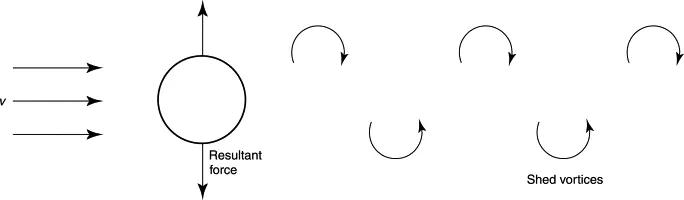 Vortex shedding
For a cylinder, the frequency ω (in Hz) of the shedding is related to the diameter D(m) and wind speed v (ms−1) via the Strouhal number S such that S = ωD / v.
PRE-PROCESSING, MODELING AND SOLVING APPROACH :
- Create a 2D geometry of the cylinder with a circular cross-section of diameter 2 m and a 2D fluid domain of 60x20 m.
- Use a mesh length of 0.25 m so as to capture all the surfaces properly and name these surfaces as inlet, outlet, wall and symmetry. Create inflation layer of 6 layers with the first length of 5 mm for the circular cross section of the cylinder so as to capture all properties of the fluid precisely.
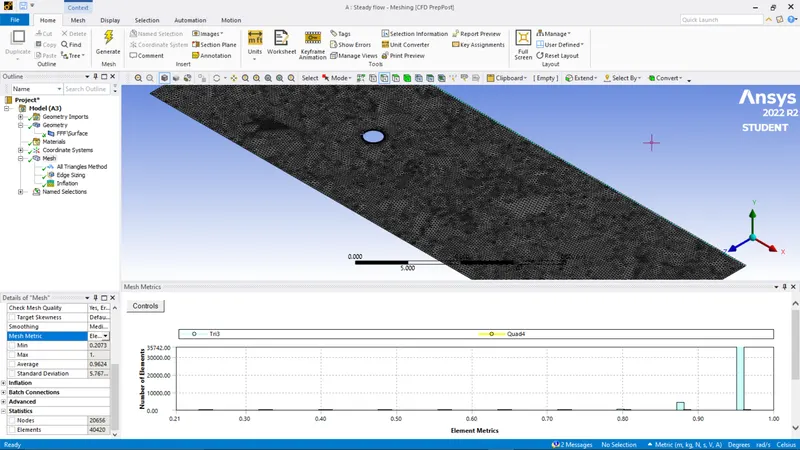
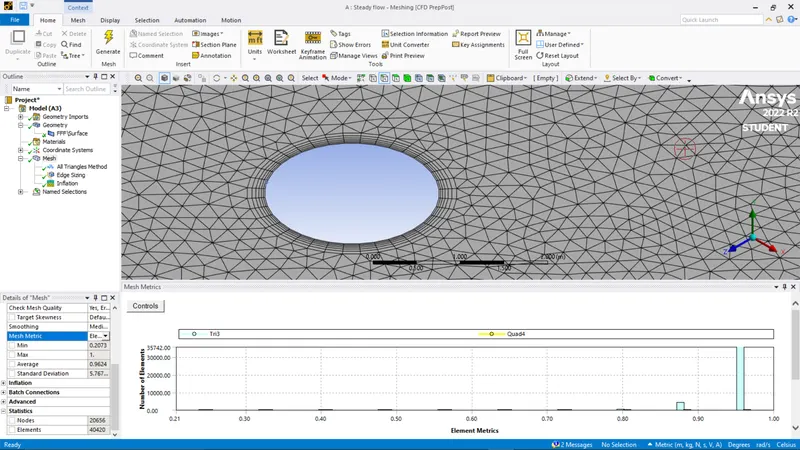
Case 1:
- For both steady and transient problem and for the given Re number of 100, set the properties of the user-defined material such as density to 1 kg/m3 and viscosity to 0.02 Pa-s.
- Assign the proper boundary conditions such as inlet velocity as 1 m/s, outlet pressure as 1 bar (atmospheric) and rest default.
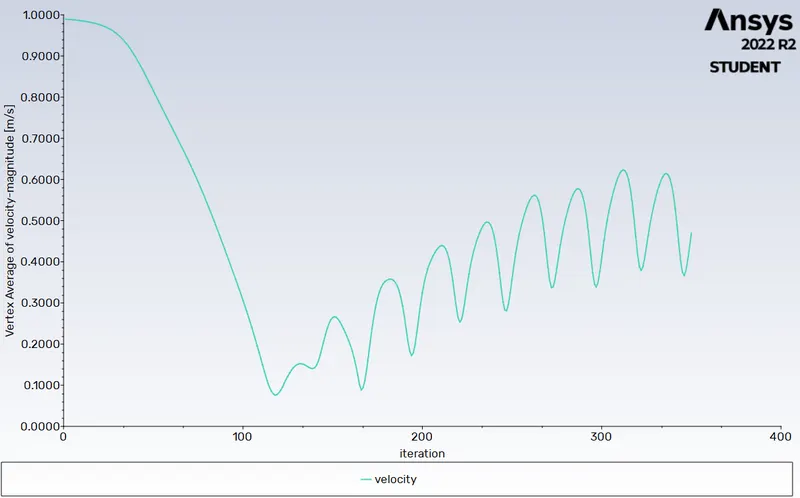
- Create a monitor-point at a distance of 8m from the centre of the cylinder at which velocity plot has to be generated.
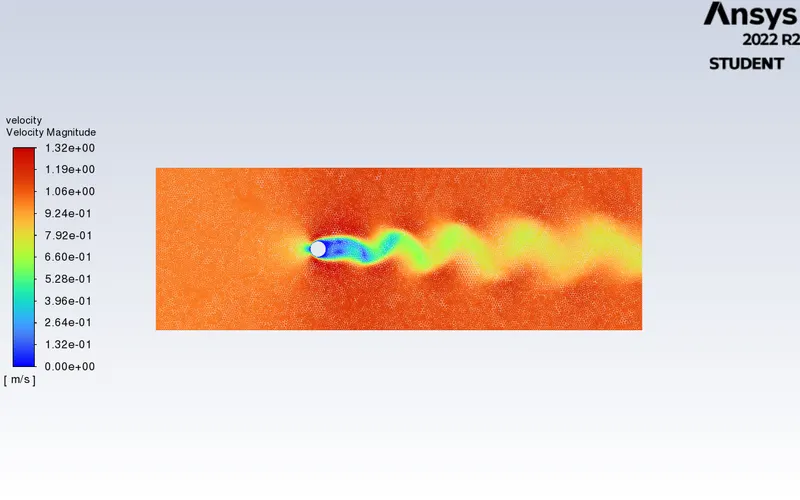
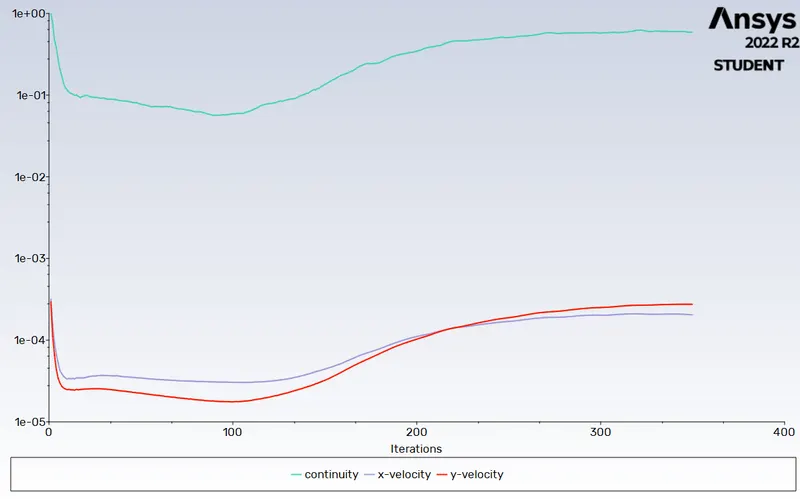
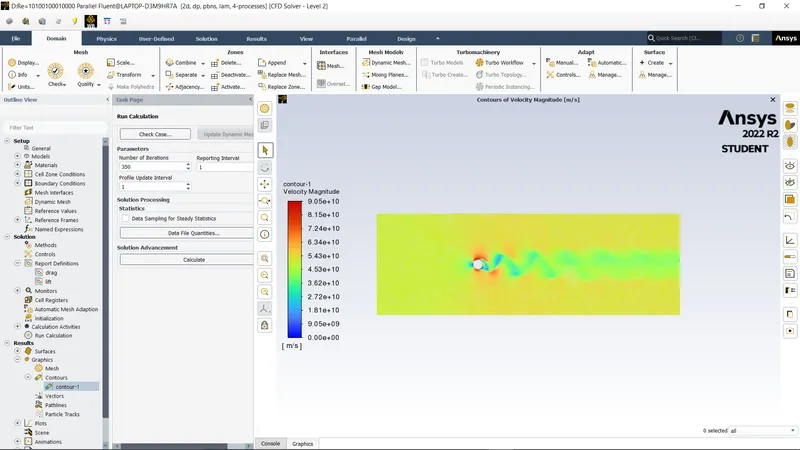
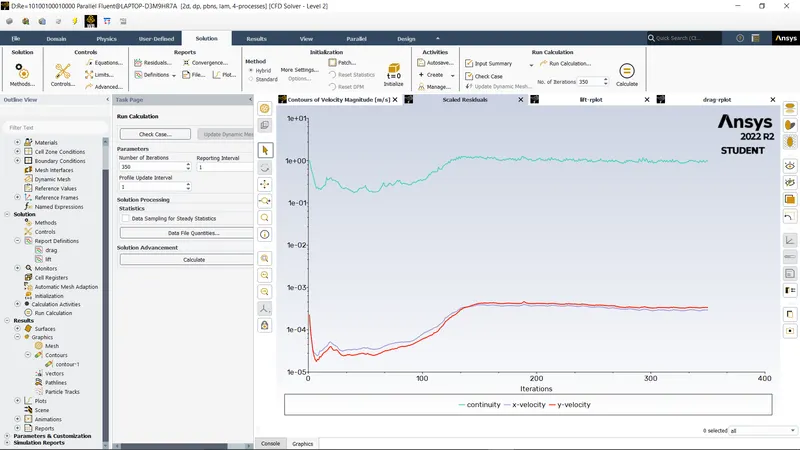
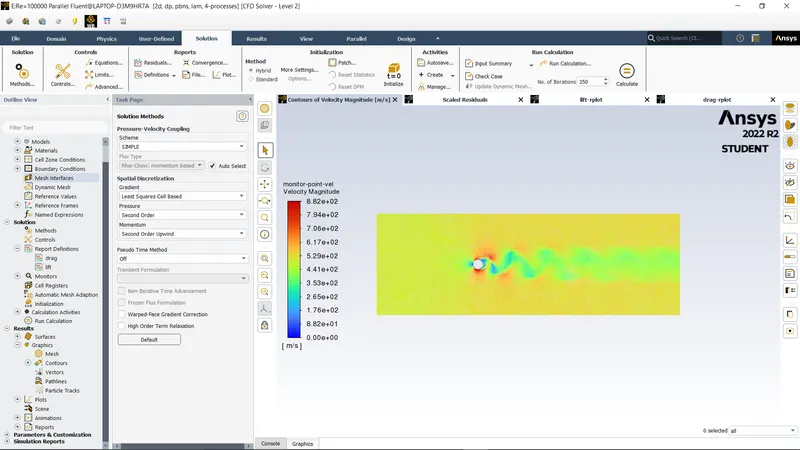
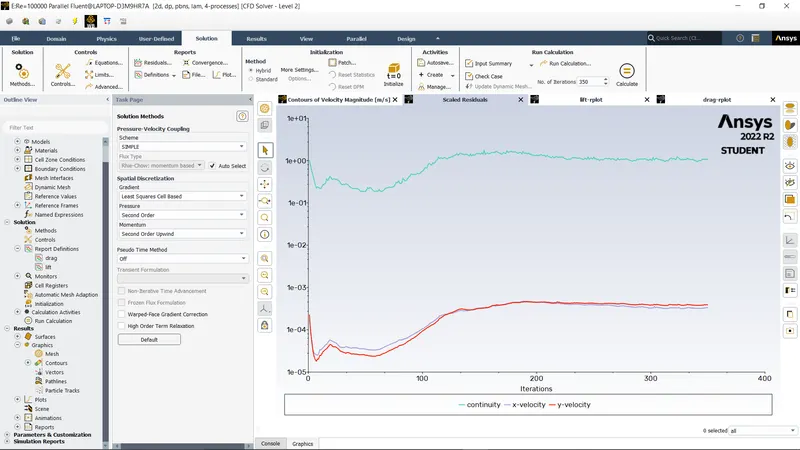
- Run the calculations for n number of iterations and carefully observe the residual plot to check if the solution has converged. Also observe velocity contour plot for vortex shedding.
Case 2:
- Now to get a Reynold's number of 10,100,1000,10000, we need to change the velocity and thus i have set the properties of air as follows : viscosity = 0.01 Pa-s, density = 1 kg/m3, velocity = 5.05e+10 and absolute pressure = 1 bar.
- Similarly vary the velocity to achieve the Reynold's number of 100000.
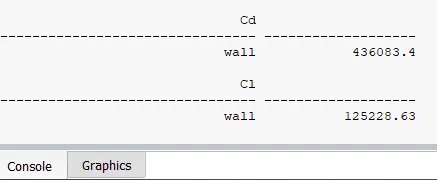
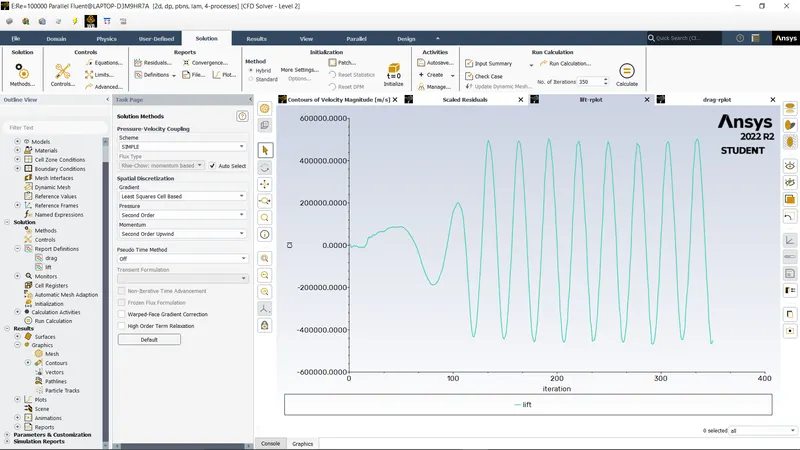
- Define the drag and lift so as to compute the coefficient of drag and lift respectively.
RESULTS :
For Re = 100, Steady flow
 |
 |
 |
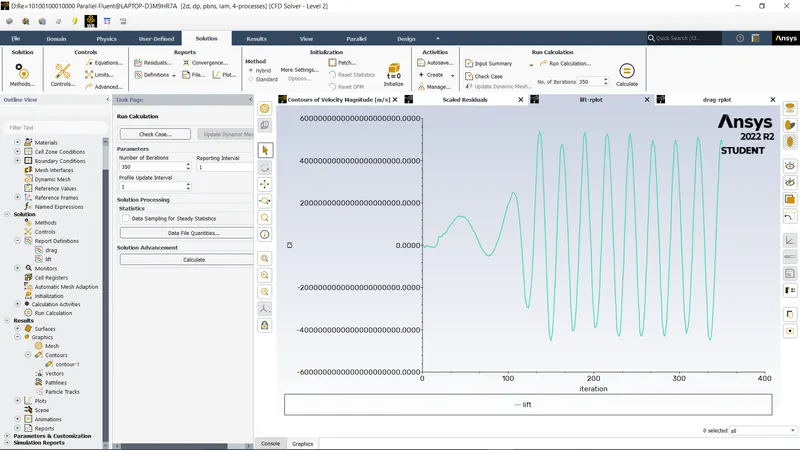
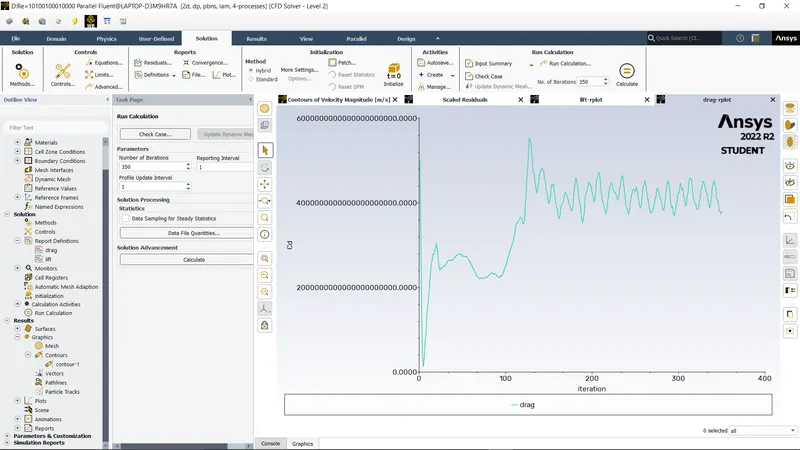
For Re = 100000,
 |
 |
 |
 |
For Re = 10,100,1000,10000,
 |
 |
 |
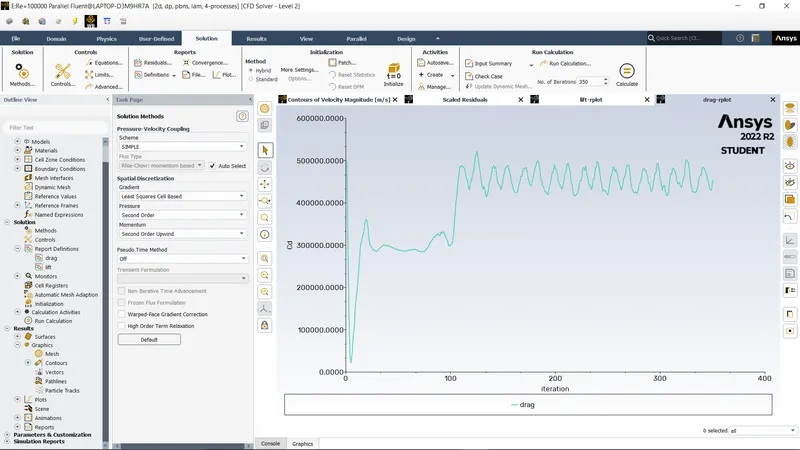 |
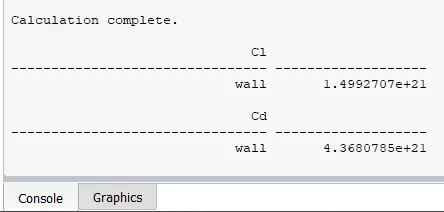
CONCLUSION : The wake structure behind the circular cylinder has been computed for two-dimensional flow using second order accurate implicit finite volume Navier–Stokes solver SIMPLE. Computations have been carried out for Reynold's numbers between 5.5 and 10,100,1000,10000 covering three different characteristic regimes creeping flow (L1), steady closed near wake (L2) and the laminar vortex shedding regime(L3). By increasing the Reynold's number beyond the critical value i.e., above 47, one can conclude that both the coefficient of drag decreases and coefficient of lift increases and we observe the same vortex shedding no matter whatsoever the Reynold's number be.
REFERENCE PAPER : Numerical simulation of laminar flow past a circular cylinder by B.N.Rajani, Sekhar Majumdar and A. Kandasamy.