Week 2 - Flow over a Cylinder.
Aim:
The aim of the challenge is to simulate the flow over a cylinder and explain the phenomenon of Karman vortex street.
Objective:
The main objective of the challenge is to simulate the flow over a cylinder.
Part I:
- Simulate the flow with the steady and unsteady case and calculate the Strouhal Number for Re= 100.
Part II:
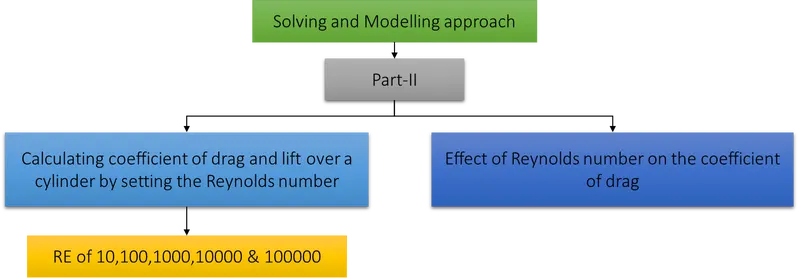
- Calculate the coefficient of drag and lift over a cylinder by setting the Reynolds number to 10,100,1000,10000 & 100000.
- Discuss the effect of the Reynolds number on the coefficient of drag. [Results should be validated with any standard literature and error should be within 5 %]
Introduction:
Flow over a cylinder:
Even after almost a century of rigorous experimental and computational research, flow around a cylinder is still a difficult subject in fluid mechanics. In-depth studies are still being conducted to understand the intricate unsteady dynamics of the cylinder wake flow. Numerous engineering applications include cross-flow that is normal to the axis of a stationary circular cylinder and the related issues with heat and mass transfer. Beyond a critical Reynolds number, experimental measurements and numerical calculations have both supported the onset of instability of the wake flow behind a cylinder, eventually leading to a type of periodic flow identified by distinct frequencies, popularly known as the Von Karman vortex street in the literature. Laminar flow past cylinders with regular polygonal cross-sections typically split at one or more sharp corners of the geometry of the cross-section itself, leaving a system of vortices on each side of the mid-symmetry plane in the aftermath. On the other hand, the mechanics of the flow are far more complicated than what its relatively simple shape may imply for a circular cylinder, where the point of flow separation is determined by the composition of the upstream boundary layer.
Von Karmen vortex sheet
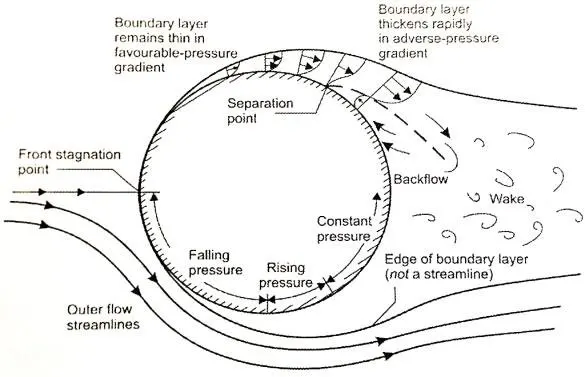
Flow over a cylinder
Reynolds number:
The Reynolds number represents the ratio of inertial forces to viscous forces and is a convenient parameter for predicting if a flow condition will be laminar or turbulent. It is defined as a characteristic length multiplied by a characteristic velocity and divided by the kinematic viscosity.
where,
Re - Reynolds number
Rho - Density
V - Velocity of fluid
D - Diameter
The range of Re values will vary with the size and shape of the body from which the eddies are being shed, as well as with the kinematic viscosity of the fluid.
Strouhal number:
he Strouhal Number is a dimensionless value useful for analyzing oscillating unsteady fluid flow dynamics problems.
The Strouhal Number can be expressed as,
St = ω l / v
where,
St = Strouhal Number
ω = oscillation frequency
l = characteristic length
v = flow velocity
The Strouhal Number can be important when analyzing unsteady, oscillating flow problems. The Strouhal Number represents a measure of the ratio of the inertial forces due to the unsteadiness of the flow or local acceleration to the inertial forces due to changes in velocity from one point to an other in the flow field. For large Strouhal numbers, viscosity dominates fluid flow, resulting in a collective oscillating movement of the fluid. For low Strouhal numbers, the high-speed, quasi-steady-state portion of the movement dominates the oscillation. Oscillation at intermediate Strouhal numbers is characterized by the buildup and rapidly subsequent shedding of vortices.
Coefficient of drag:
The drag coefficient (`C_d`) is a dimensionless number that is used in fluid dynamics to measure an object's drag or resistance in a fluid environment, such as air or water. It is employed in the equation for calculating drag, where a lower drag coefficient denotes an object with a lower aerodynamic or hydrodynamic drag. Every surface area has a unique relationship with the drag coefficient. Any object's drag coefficient combines the effects of form drag and skin friction, the two primary causes of fluid dynamic drag. The effects of lift-induced drag are also included in the drag coefficient of a lifting airfoil or hydrofoil. A full structure, like an aeroplane, has a drag coefficient that takes interference drag into account as well.
Drag = `1/2 rhov^2SC_d`
`rho` = density
V = velocity
S = surface area
C_d = Coefficient of drag
D = Drag
Coefficient of lift:
A lifting body's lift is related to the fluid density, fluid velocity, and a related reference area through the lift coefficient, which is a dimensionless coefficient. A fixed-wing aeroplane is an example of a lifting body, as is a foil or a whole foil-bearing body. CL depends on the body's Mach number, Reynolds number, and angle to the flow.
Lift = `1/2rhov^2SC_L`
`rho` = density
V = velocity
S = surface area
`C_L`= Coefficient of drag
L = Lift
Solving & Modelling approach:
Part I: Simulate the flow with the steady and unsteady case and calculate the Strouhal Number for Re= 100.
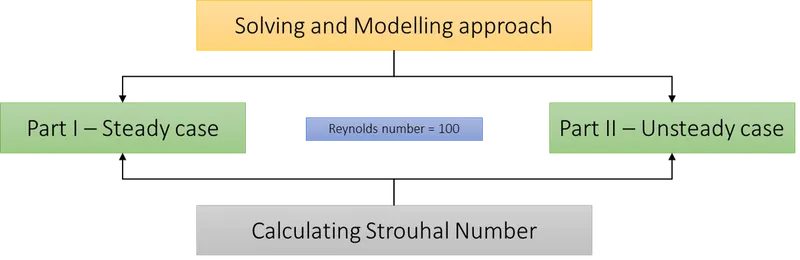
Case 1: Simulate the flow with the steady and calculate the Strouhal Number for Re= 100.
Procedure:
1. Creating the geometry for steady analysis.
The diameter of the cylinder was 2m and dimension of the domain was 20*60m.
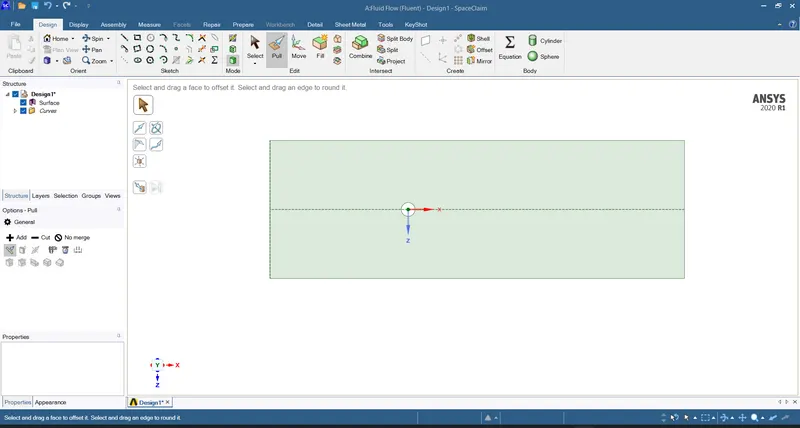
2. Close the spaceclaim and open the mesh.
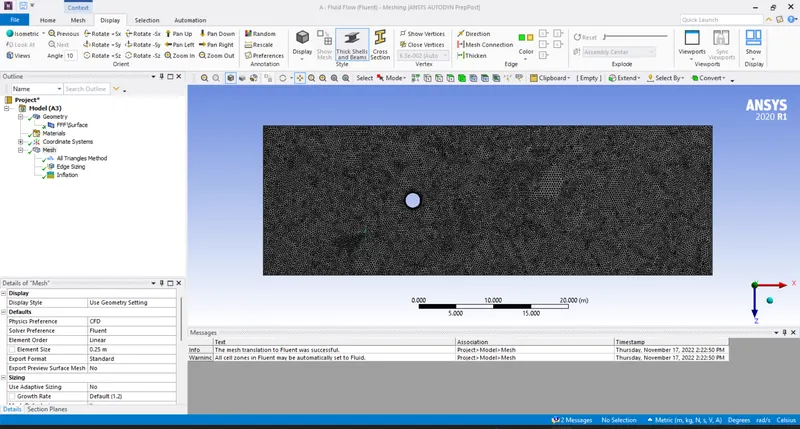
The table represent the mesh details.

The below figure represent the inflation layer of 6 and layer height of 5e-3.
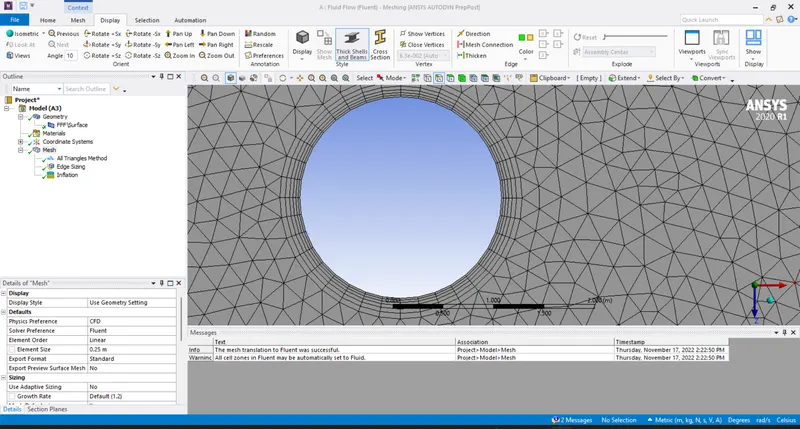
The below figure represent the fully meshed domain for analysis.
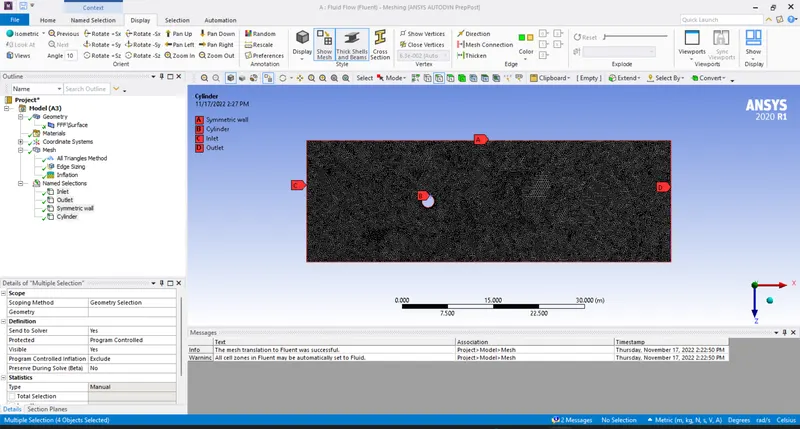
Naming the domain as inlet, symmetric wall, cylinder and outlet.
3. Open the setup after the sucessful completion of meshing process.
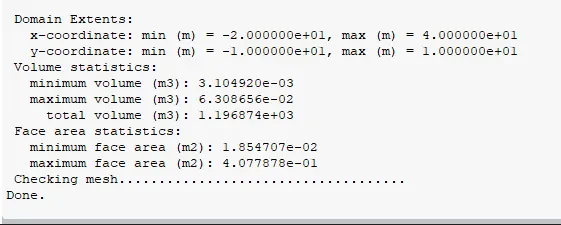
First step in the setup process is check the mesh.
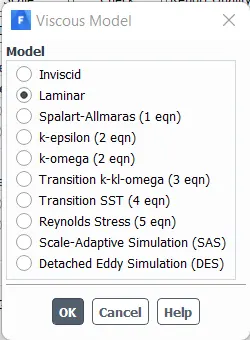
Then in physics select the solving model as laminar because the reynolds number is low.
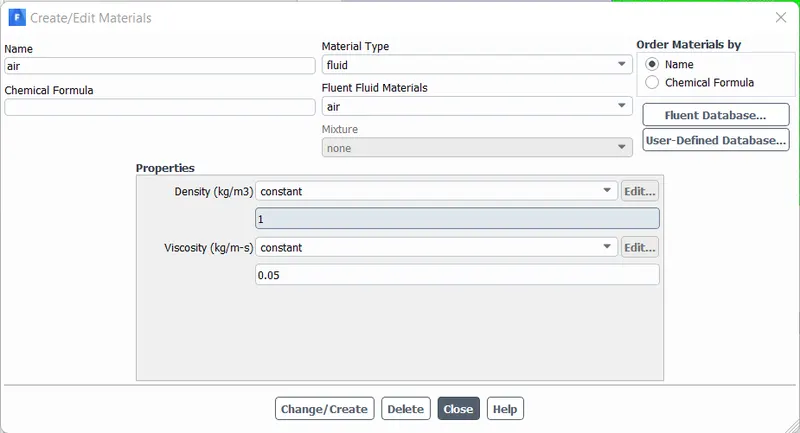
Open Materials and create a fluid that is to be used for the simulation for this case, it is air and also inputs the density and kinematic viscosity values.As we wanted to customimize material property for simulation, go to materials > fluent database > select the material (air) > copy it > rename the name of material.
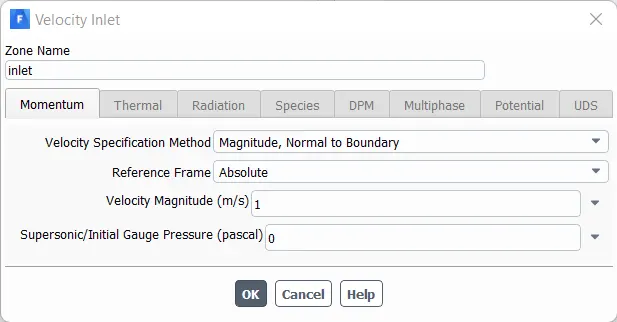
Define the boundary conditions, inlet velocity as 1m/s.
To calculate the steady state Strouhal Number for Re= 100,
- Velocity is 1m/s
- Kinematic viscosity is 0.02kg/m-s
- Density is 1kg/m3
- Diameter is 2 m.
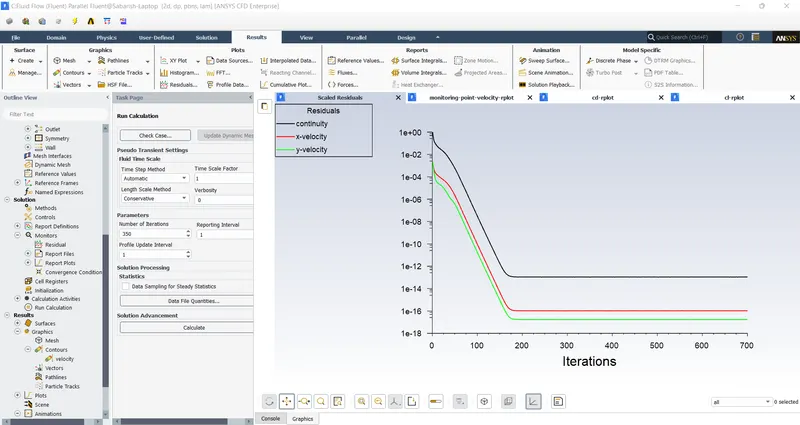
The below is the residual plot for steady state analysis,
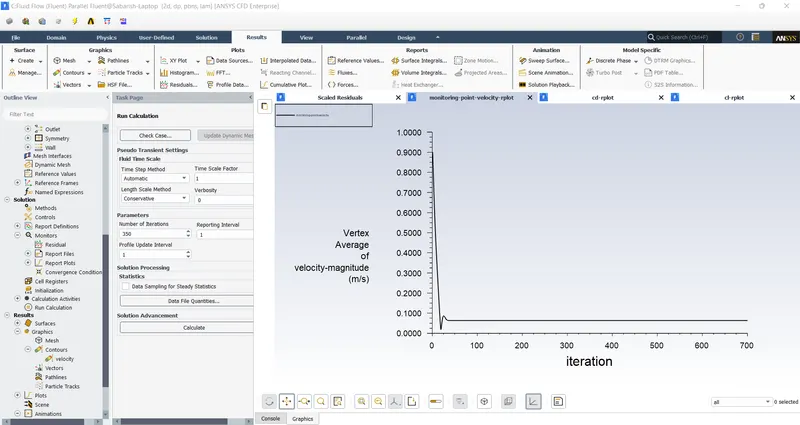
The vertex average of velocity magnitude is,
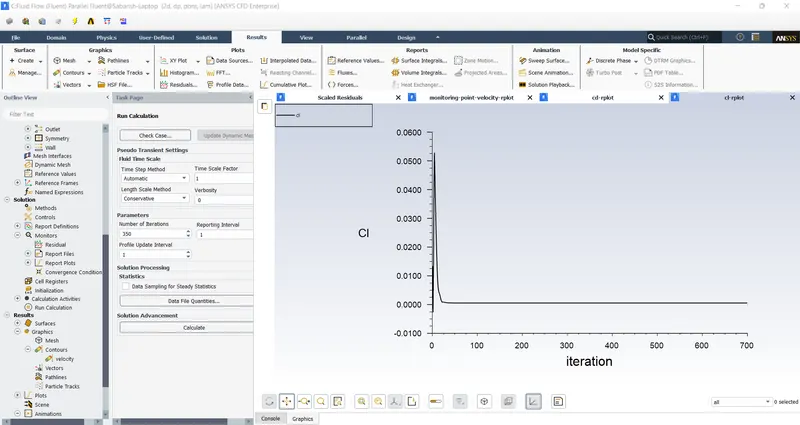
The coefficient lift is,
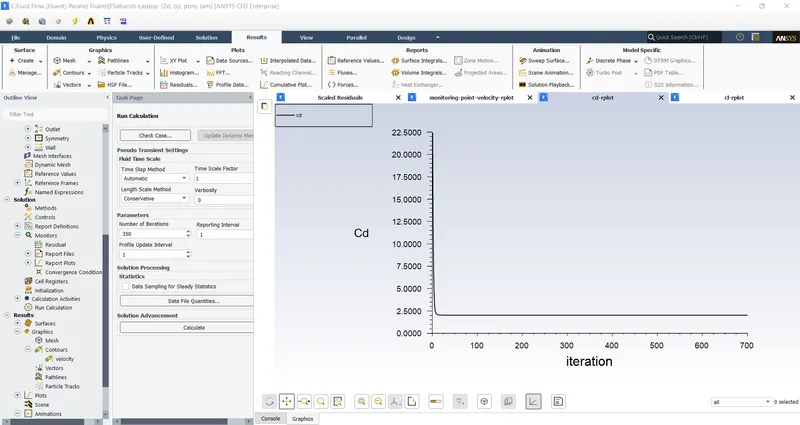
The coefficient of drag,
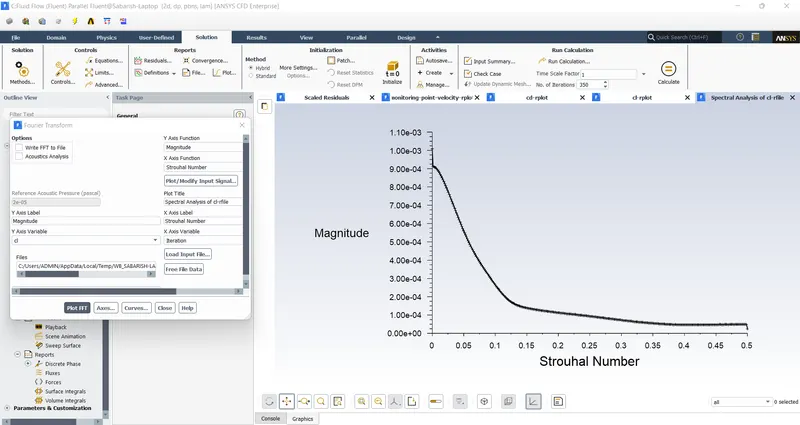
Strouhal Number vs Magnitude of steady case,
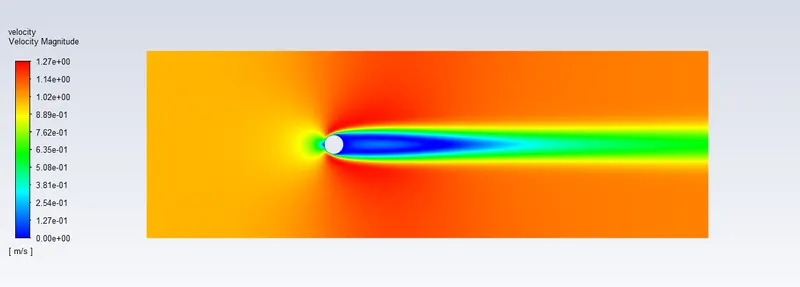
The velocity cotour of the analsysis is,
The pressure contour is ,
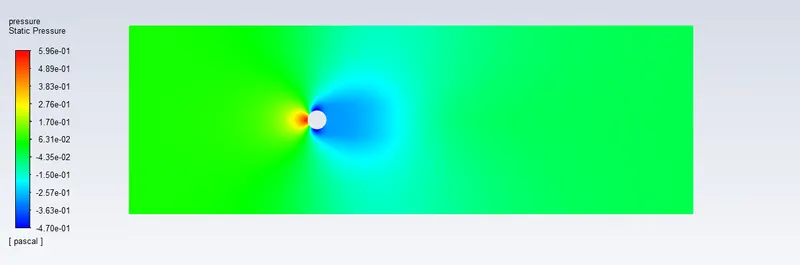
Case 1: Simulate the flow with the Unsteady and calculate the Strouhal Number for Re= 100.
Similar process is done for the unsteady flow analysis ,
To calculate the Unsteady state Strouhal Number for Re= 100,
- Velocity is 1m/s
- Kinematic viscosity is 0.02kg/m-s
- Density is 1kg/m3
- Diameter is 2 m.
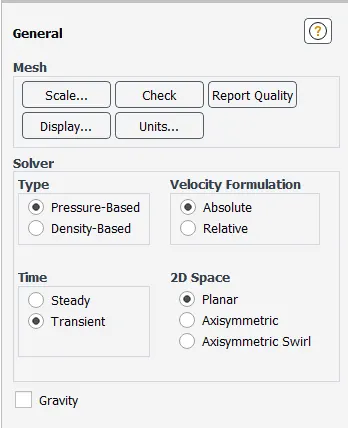
The scaled residual of the unsteady analysis is,
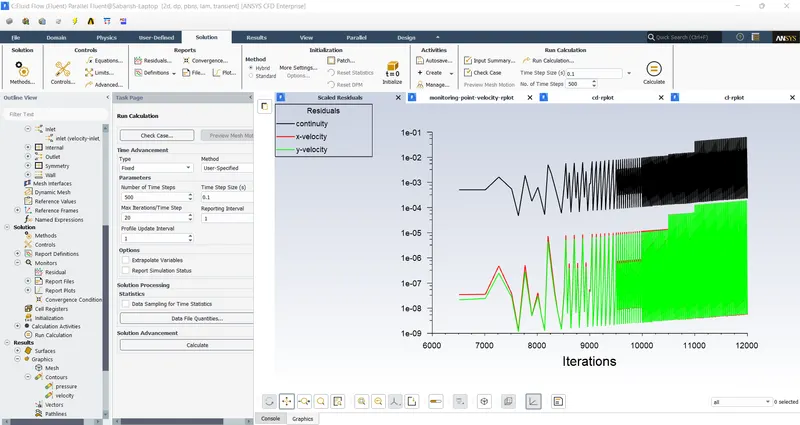
The vertex average of velocity magnitude is,
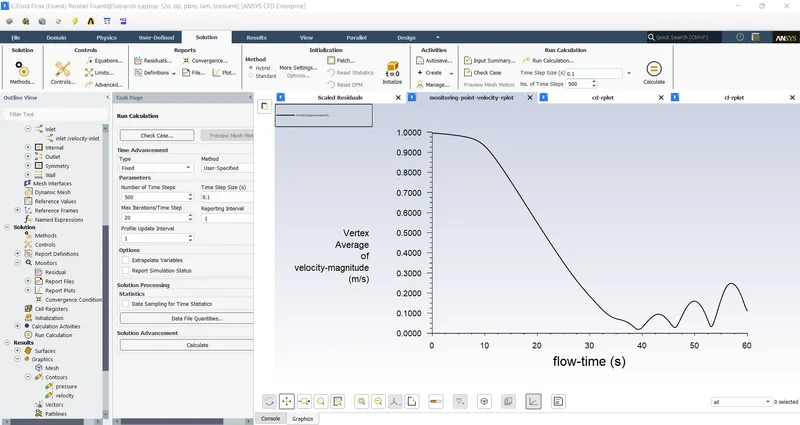
The coefficient of drag is,
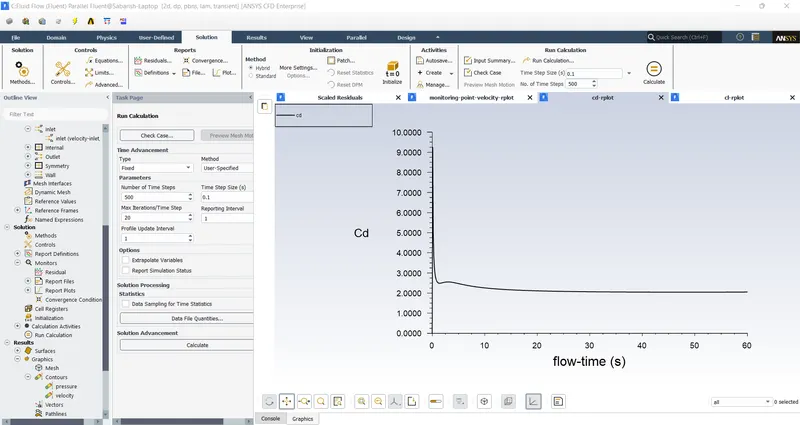
The coefficient of lift is,
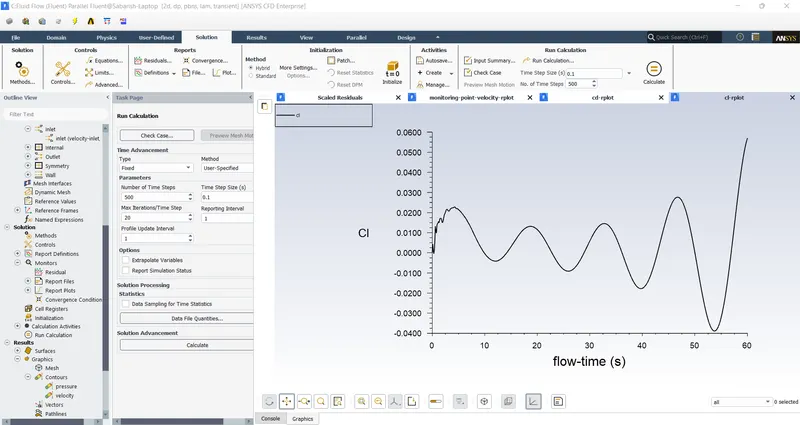
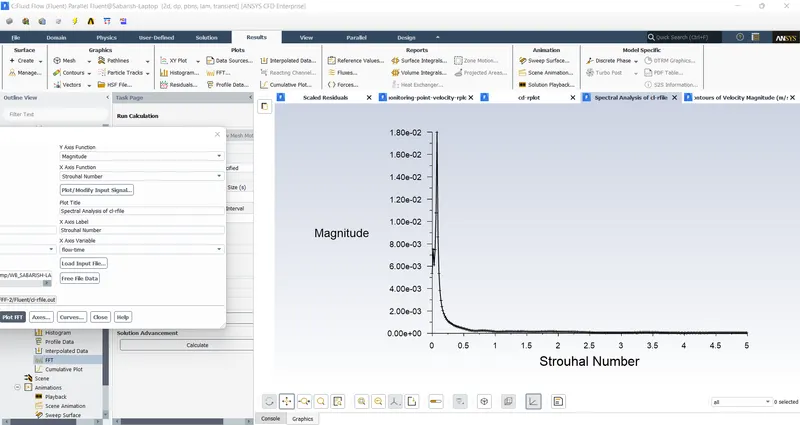
Strouhal Number vs Magnitude of unsteady case,
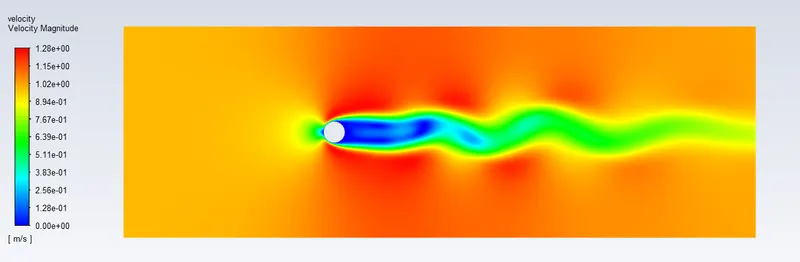
The velocity contour,
The pressure contour for unsteady flow is,
PART-II
Case 1:

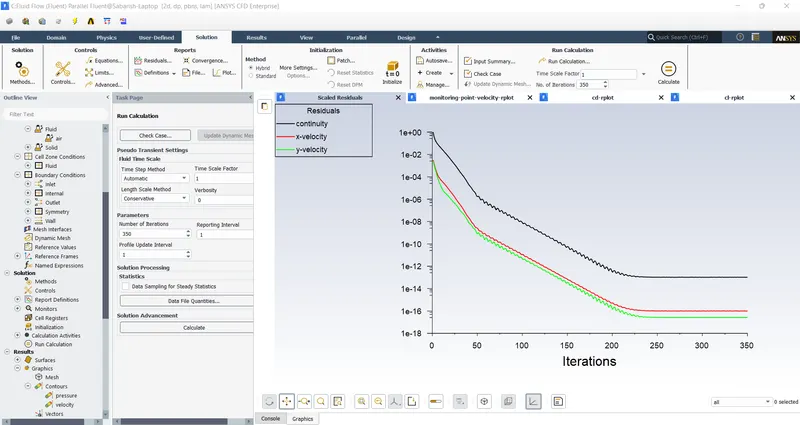
The residual plot of the case 1,
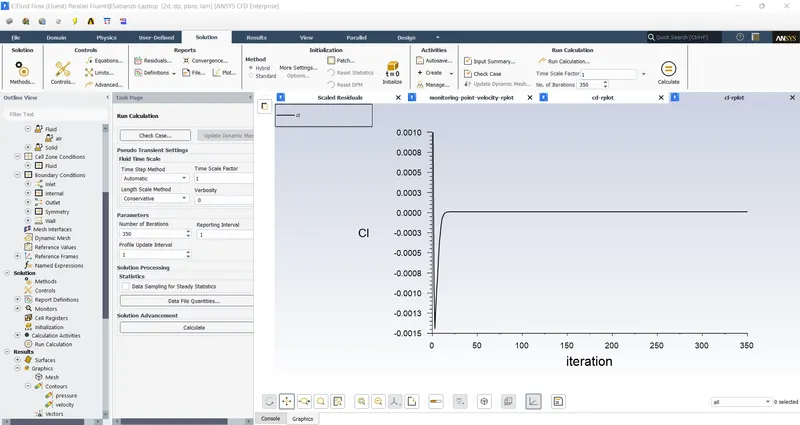
The Coefficient of lift,
The Coefficient of drag,
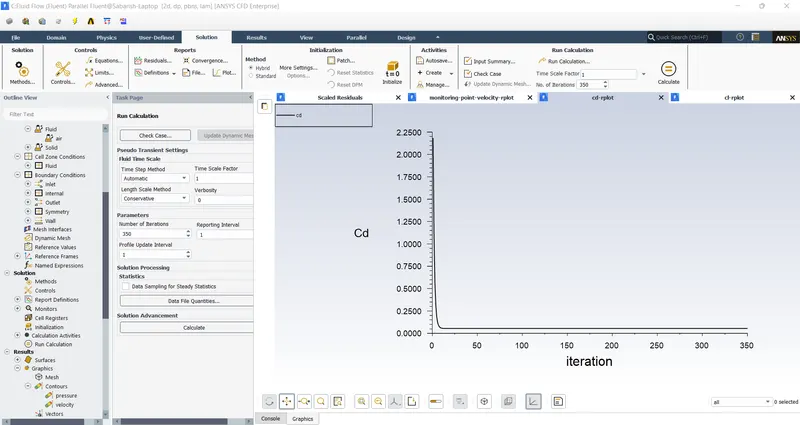
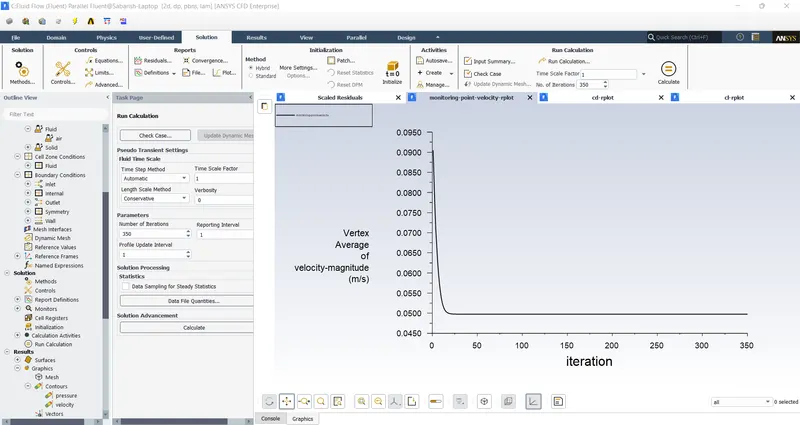
The vertex average of velocity magnitude,
The Coefficient of lift and drag values,

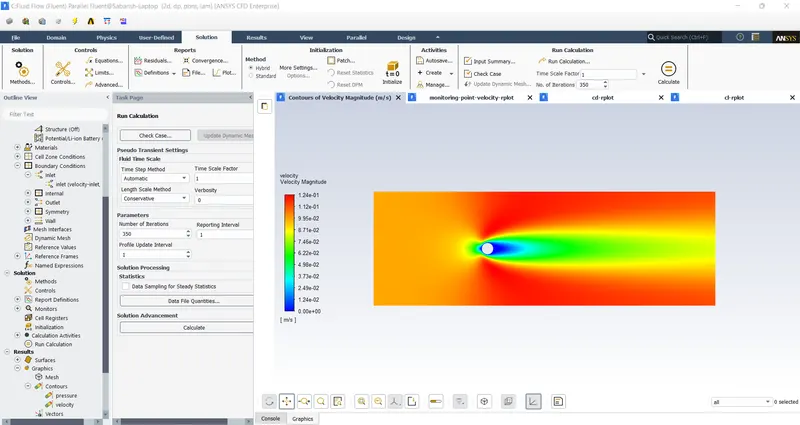
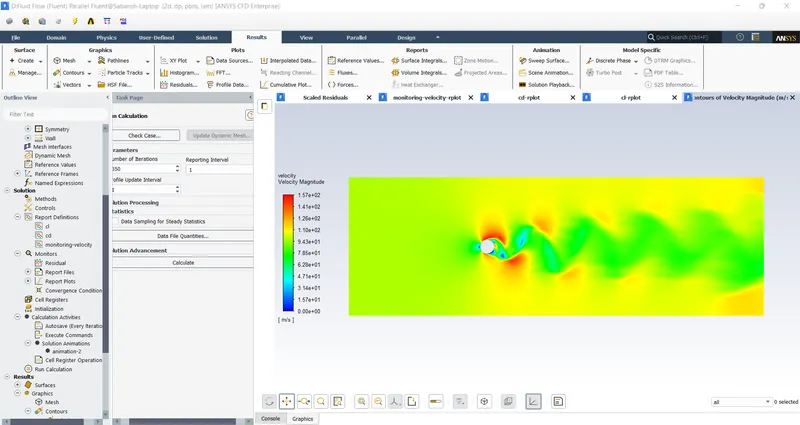
Velocity contour,
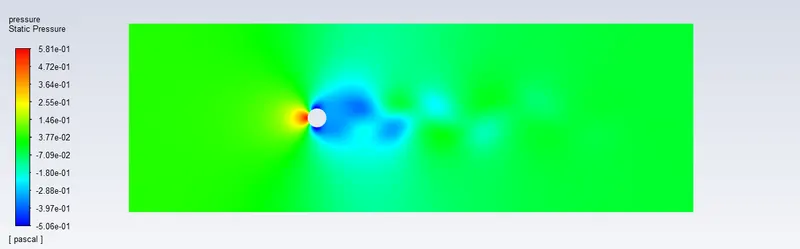
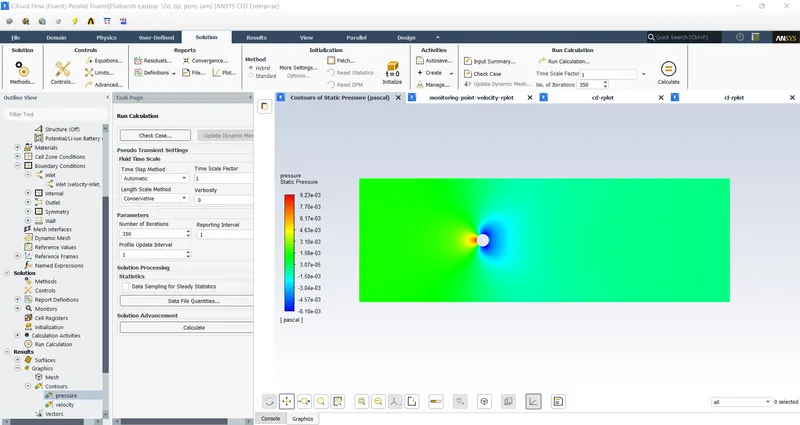
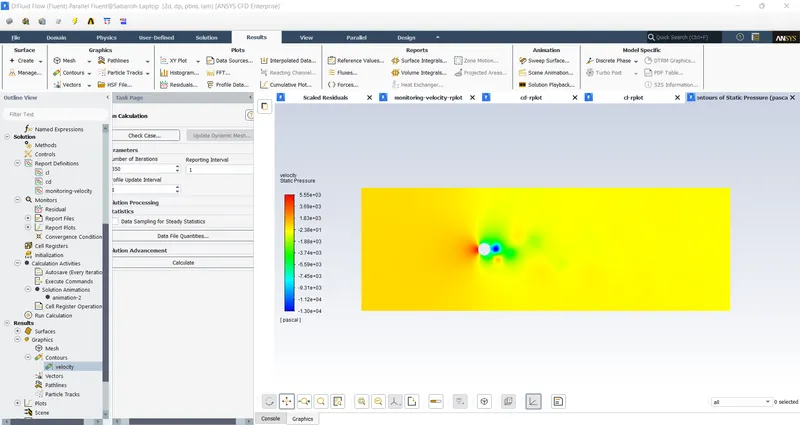
Pressure contour,
Case 2:

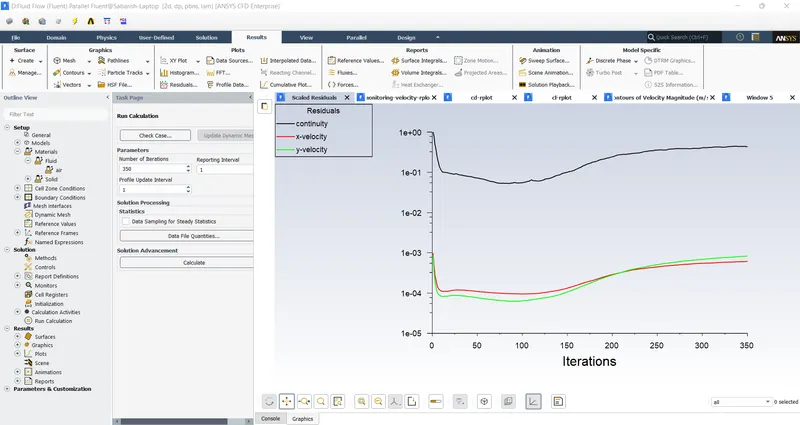
The residual plot of the case 2,
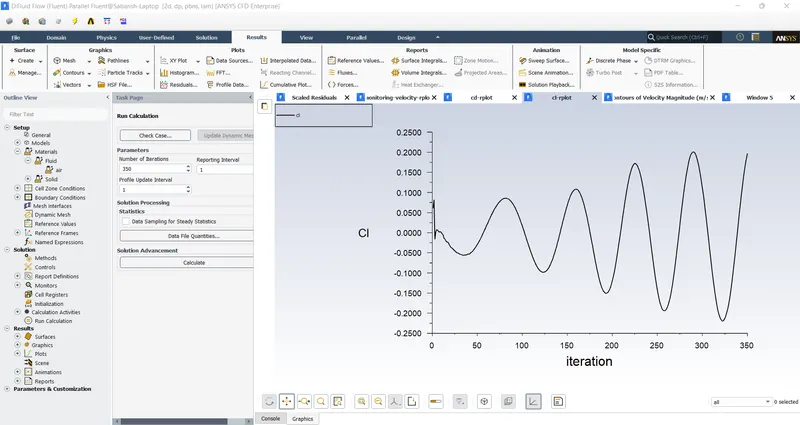
The Coefficient of lift,
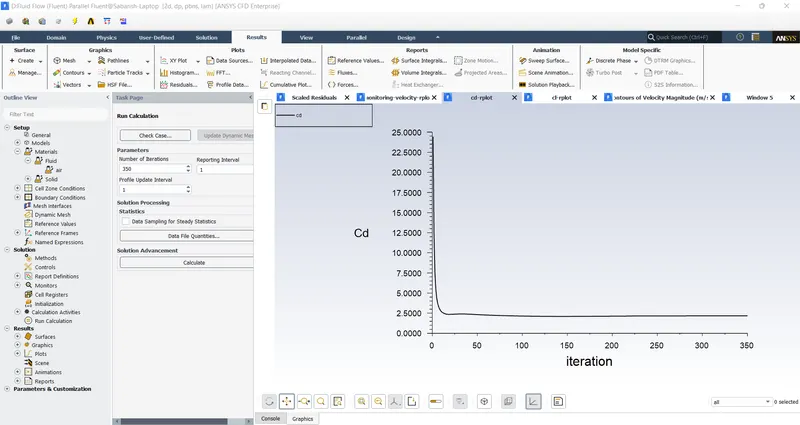
The Coefficient of drag,
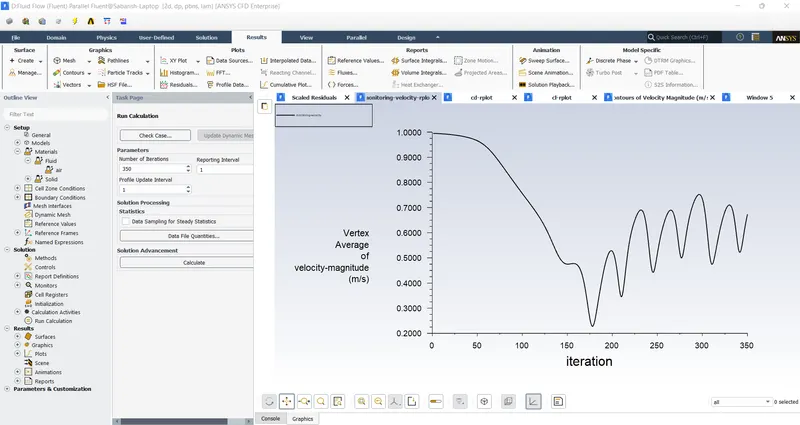
The vertex average of velocity magnitude,
The Coefficient of lift and drag values,

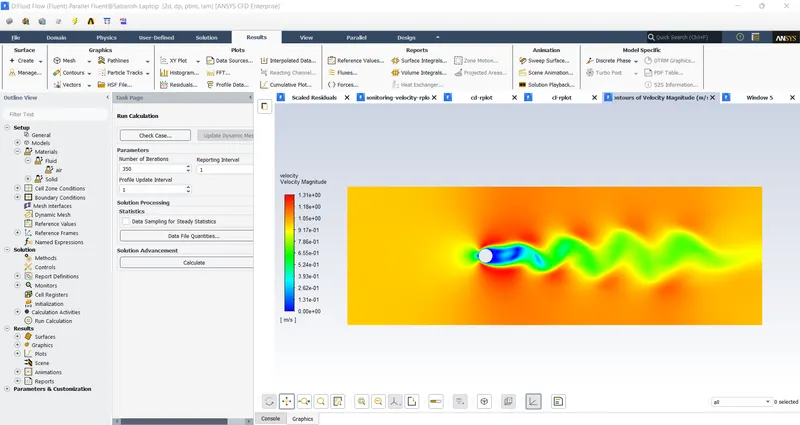
The velocity contour,
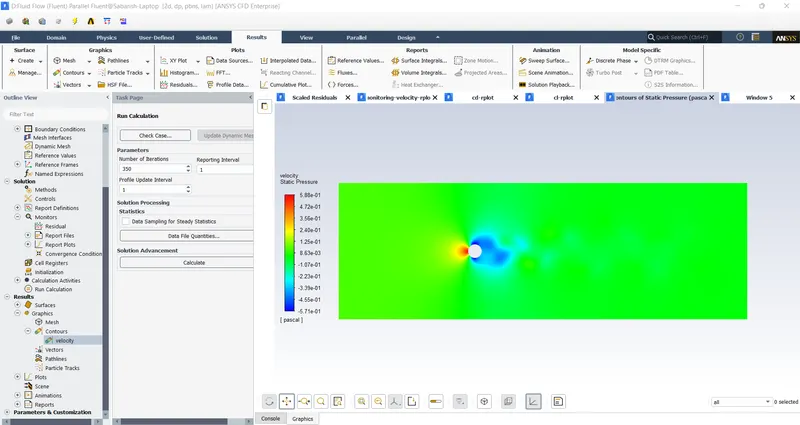
The pressure contour,
Case 3:

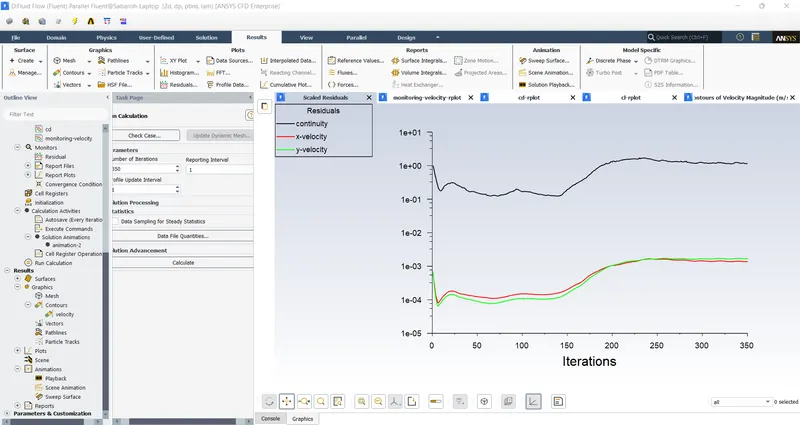
The residual plot of the case 3,
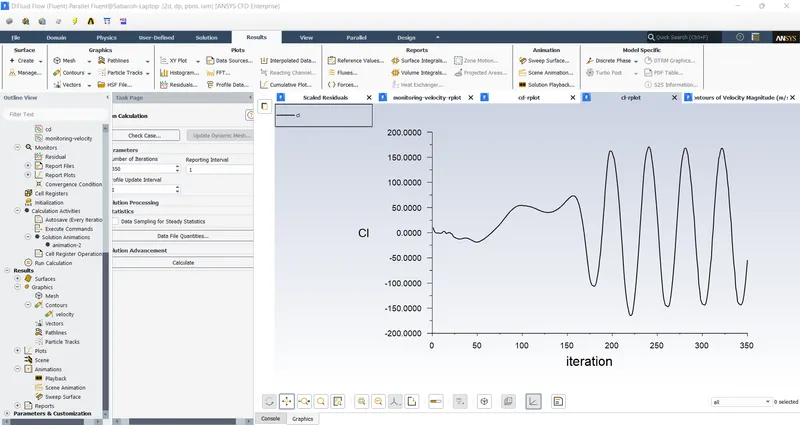
The Coefficient of lift,
The Coefficient of drag,
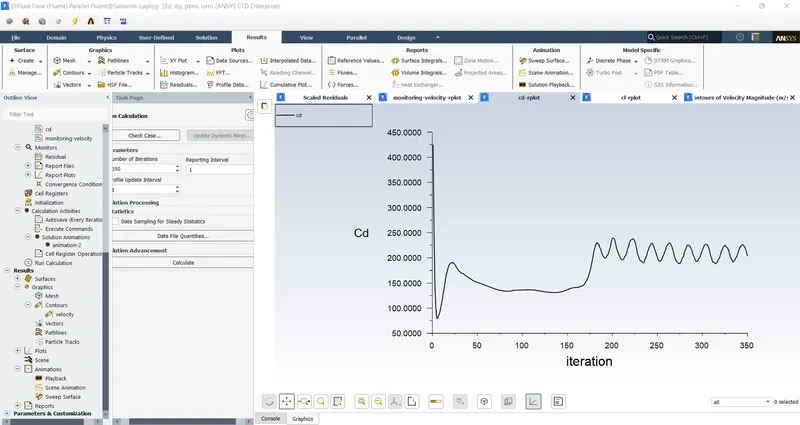
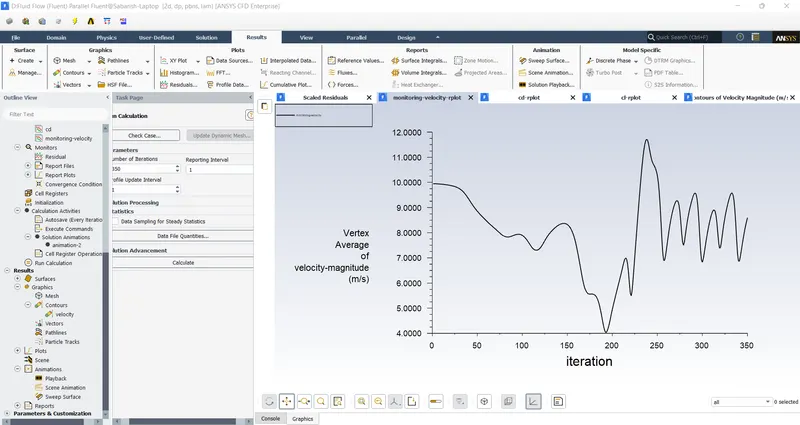
The vertex average of velocity magnitude,
The Coefficient of lift and drag values,

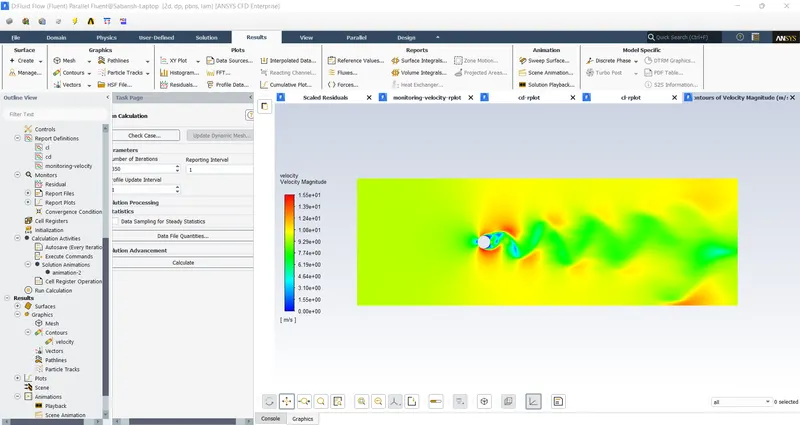
The velocity contour,
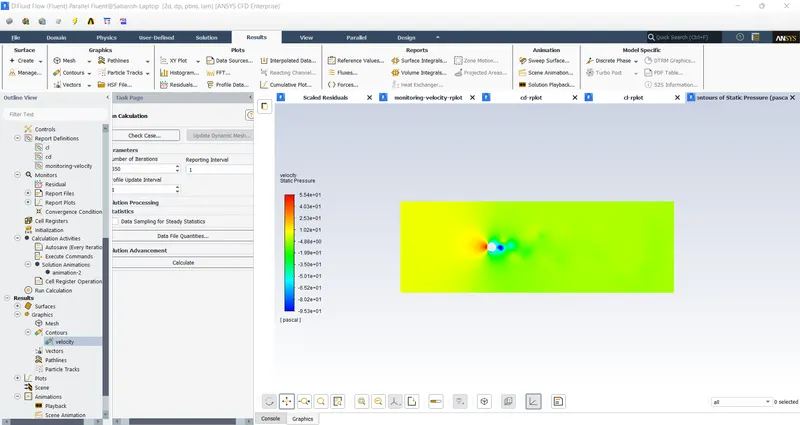
The pressure contour,
Case 4:

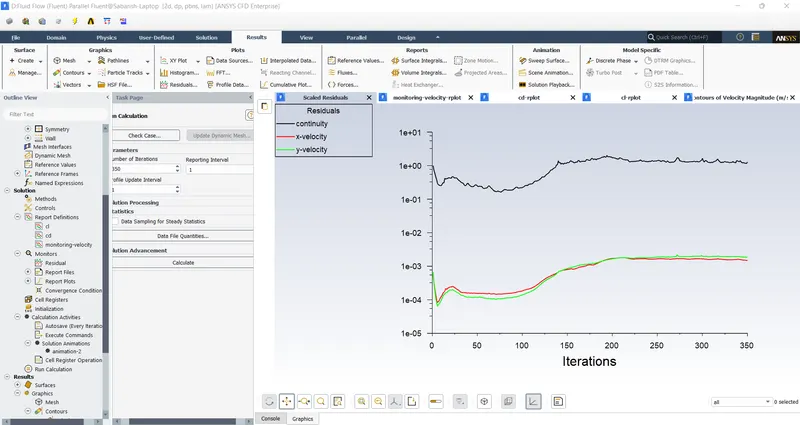
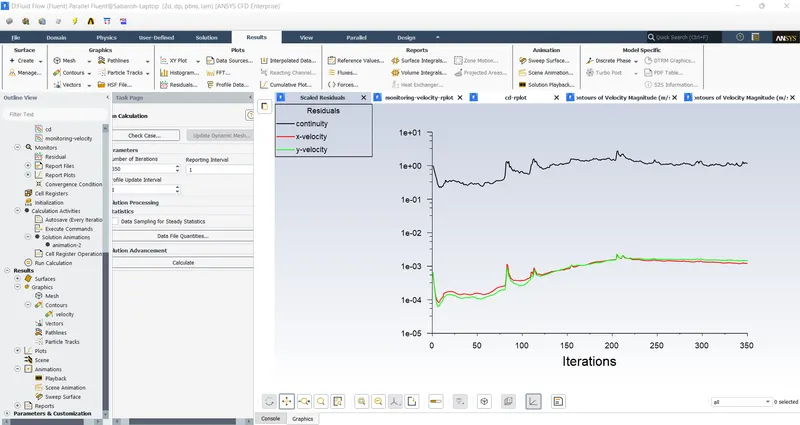
The residual plot of the case 4,
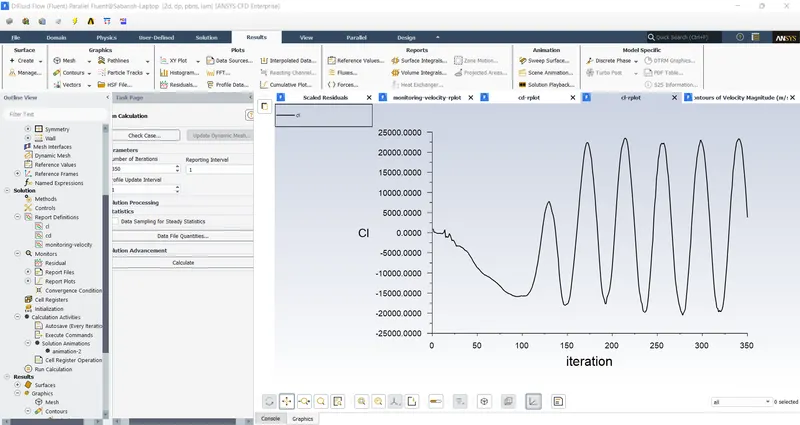
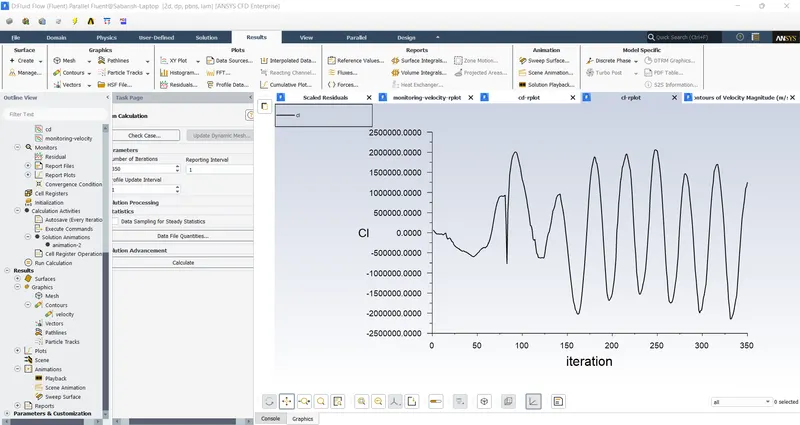
The Coefficient of lift,
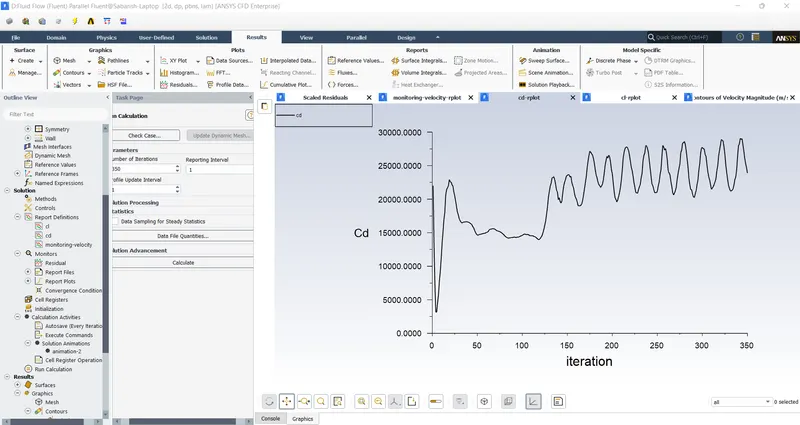
The Coefficient of drag,
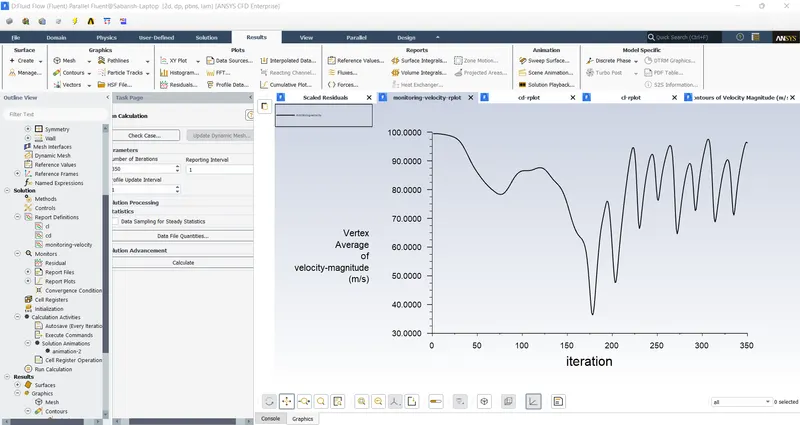
The vertex average of velocity magnitude,
The Coefficient of lift and drag values,

The velocity contour,
The pressure contour,
Case 5:

The residual plot of the case 5,
The Coefficient of lift,
The Coefficient of drag,
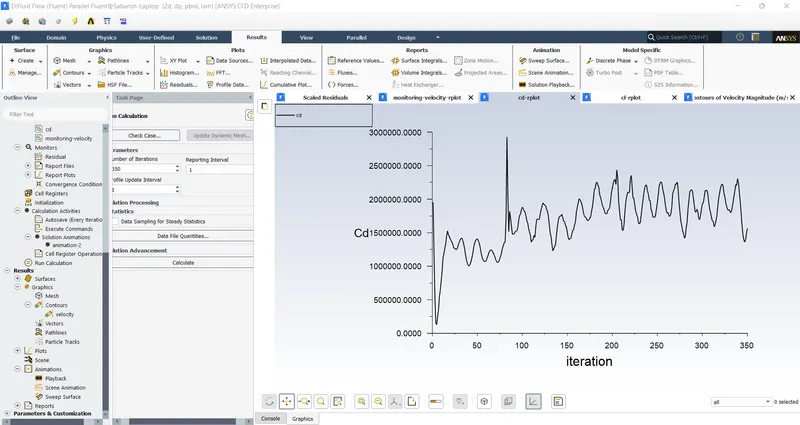
The vertex average of velocity magnitude,
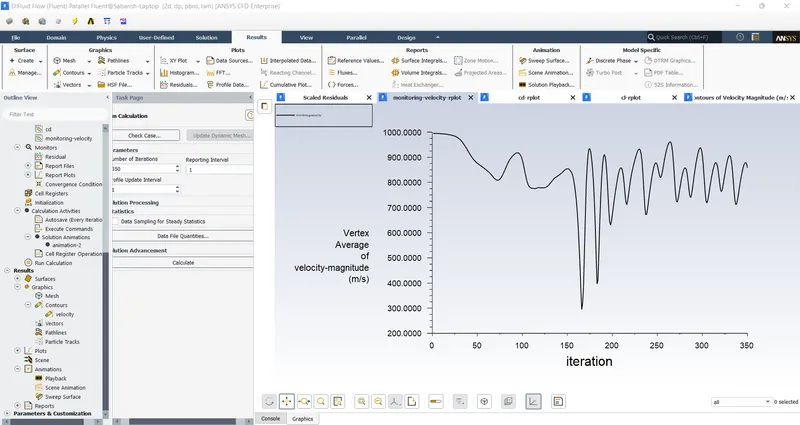
The Coefficient of lift and drag values,

The velocity contour,
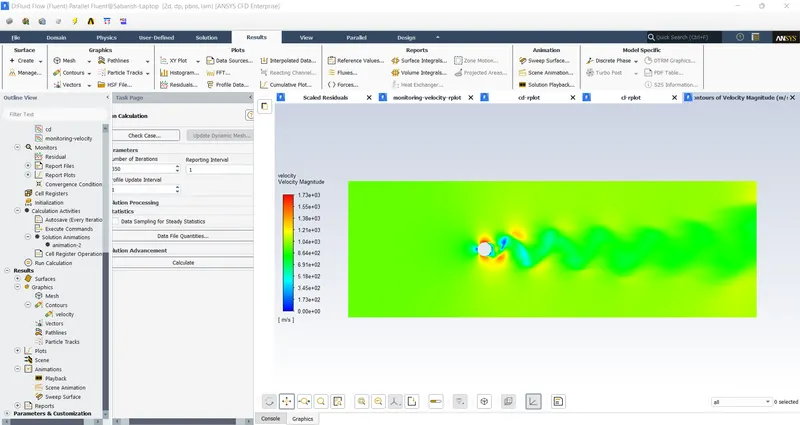
The pressure contour,
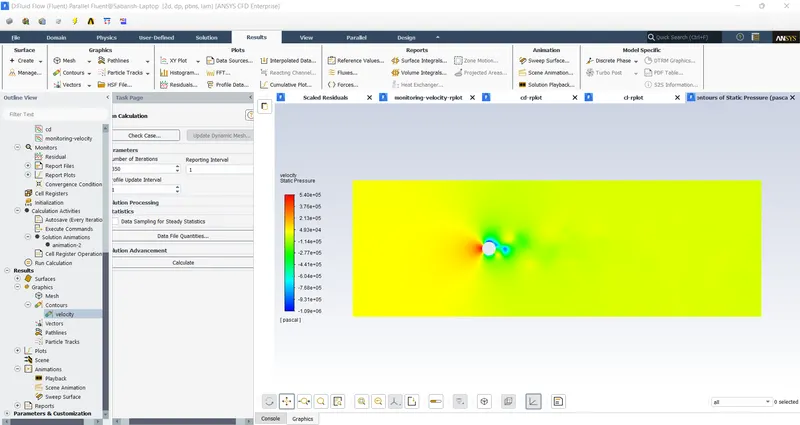
The effect of Reynolds number on the coefficient of drag:

Reference paper and textbook:
1. https://imechanica.org/files/Sato_MDAC_final_2232012.pdf - A fundamental study of the flow past a circular
cylinder using Abaqus/CFD
2. Suppression of the von Kármán vortex street behind a circular cylinder by a travelling wave generated by a flexible surface - https://www.cambridge.org/core/journals/journal-of-fluid-mechanics/article/abs/suppression-of-the-von-karman-vortex-street-behind-a-circular-cylinder-by-a-travelling-wave-generated-by-a-flexible-surface/E188C7A079F2CAC9672735CE66156DE3
3. https://aip.scitation.org/doi/abs/10.1063/1.868188 - Feedback control of von Kármán vortex shedding behind a circular cylinder at low Reynolds numbers
Conclusion:
Part-I
The flow over a cylinder is simulated in the first instance for both steady and unstable cases with Re=100, and from the outcomes, the Von Karman Vortex Street phenomenon is also observed. Plots that are necessary to see that the flow has converged and that vortex shedding is occurring are generated. To examine the flow over a cylinder, contours are created. It is possible to determine the Strouhal number by graphing magnitude vs Strouhal number.
Part-II
Six different simulations i.e (Re = 10,100,1000,10000,100000,1000000) are simulated to observe the behavior of the drag and lift coefficients by changing the Reynolds number. In order to observe the behavior of the drag coefficients for the simulations, the velocity of the flow is varied to change the Reynolds number and the rest of the parameters are kept constant. For Re=10, it is observed that there is no formation of vortex shedding and in the rest of the cases, it is clearly observed. It is conclude that the error percentage is less than 5%.