Week 2 - Flow over a Cylinder.
AIM:- Simulate the flow over a cylinder and explain the phenomenon of Karman vortex street.
OBJECTIVE:-
PART-I
- Simulate the flow with the steady and unsteady case and calculate the Strouhal Number for Re= 100.
PART-II
- Calculate the coefficient of drag and lift over a cylinder by setting the Reynolds number to 10,100,1000,10000 & 100000. (Run with steady solver)
- Discuss the effect of Reynolds number on the coefficient of drag. [ Results should be validated with any standard literature and error should be within 5 %]
THEORY:-
- Karman vortex street:-
- In fluid dynamics, a Kármán vortex street (or a von Kármán vortex street) is a repeating pattern of swirling vortices, caused by a process known as vortex shedding, which is responsible for the unsteady separation of flow of a fluid around blunt bodies.
- It is named after the engineer and fluid dynamicist Theodore von Kármán, and is responsible for such phenomena as the "singing" of suspended telephone or power lines and the vibration of a car antenna at certain speeds. Mathematical modeling of von Kármán vortex street can be performed using different techniques including but not limited to solving the full Navier-Stokes equations with k-epsilon, SST, k-omega and Reynolds stress, and large eddy simulation (LES) turbulence models,or by numerically solving some dynamic equations such as the Ginzburg-Landau equation.
- Flow over Cylinder:-
- Flow over circular cylinder still remains a challenging problem in fluid mechanics, where intensive investigations are continued even today to understand the complex unsteady dynamics of the cylinder wake flow.
-
one of the important points is Vortex shedding means in fluid dynamics vortex shedding is an oscillating flow that takes place when a fluid such as air or water flows past.
- The fluid flow past the object creates alternating low-pressure vortices on the downstream side of the object. The object will tend to move toward the low-pressure zone.
-
For very small Reynolds numbers, the flow is completely laminar around the cylinder, with no recirculation and no instability.
-
For larger Reynolds numbers, a recirculation zone appears behind the obstacle. More precisely, two eddies with opposite signs appear just behind the cylinder and remain close to it.
-
For larger Reynolds numbers, these eddies are unstable and successively leave the cylinder to propagate in the wake, to form the so called “Von Karman” vortex street.
- Reynolds Number:- The Reynolds number is the ratio of inertial forces to viscous forces. The Reynolds number is a dimensionless number used to categorize the fluids systems in which the effect of viscosity is important in controlling the velocities or the flow pattern of a fluid.
`Re=(rho*V*D)/mu`
Where, `rho=`Density of the fluid in`(kg)/m^3`
V= Velocity of the fluid in `m/sec`
D= Diameter of Pipe in m
`mu=` dynamic viscocity of fluid `(N*S)/m^2`
- Coefficient of Drag ( Cd ):- The coefficient of drag is a dimensionless quantity that is used to determine the drag or resistance of an object in a fluid environment such as air or water.
Cd= `(2*F_d)/(rho*AV^2`
Where, Cd= Drag Coeificcient
`F_d=`Drag force
`rho=`Density of the fluid in`(kg)/m^3`
A= Reference Area
V= Velocity of the flow.
- Coefficient of lift (Cl):- The coefficient of Lift is a dimensionless quantity that is used to determine the Lift of an object in a fluid environment.
`Cl= `(2*F_l)/(rho*AV^2`
Where, Cl= Lift Coeificcient
`F_l=`Lift force
`rho=`Density of the fluid in`(kg)/m^3`
A= Reference Area
V= Velocity of the flow.
-
Strouhal number (St) :- Strouhal number is a dimensionless number describing oscillating flow mechanisms. For large Strouhal numbers , viscosity dominates fluid flow, resulting in a collective oscillating movement of the fluid. For low Strouhal numbers, the high-speed, quasi-steady-state portion of the movement dominates the oscillation. Oscillation at intermediate Strouhal numbers is characterized by the buildup and rapidly subsequent shedding of vortices.
`S_t=(f*D)/V`
Where, f= vortex Frequency
D= Diameter of Pipe
V= Velocity of Fluid
PROCEDURE:-
PART I :-
- Simulate the flow with the steady and unsteady case and calculate the Strouhal Number for Re= 100.
For Steady state Re= 100 :-
STEP 1 :- Create Geometry
Dimensions For Geometry:-
Diameter of Cylinder= 2 m
Rectangular :- 20 m width and 60 m length
Geometry as shown in Below:-
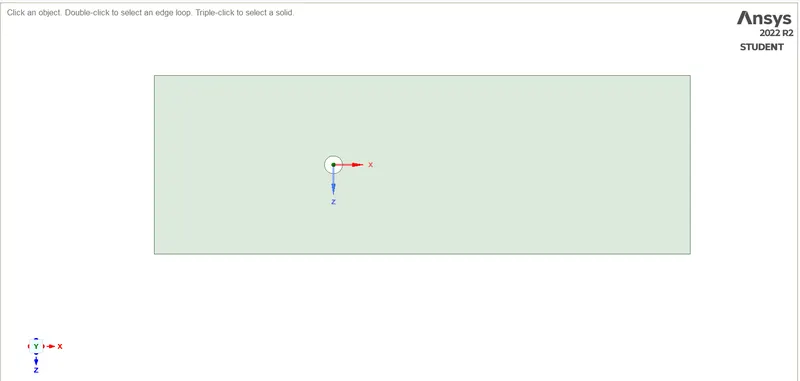
Fig. 1 Geometry
STEP 2 :- Meshing :-
In Meshing we are getting Course mesh as shown as below,
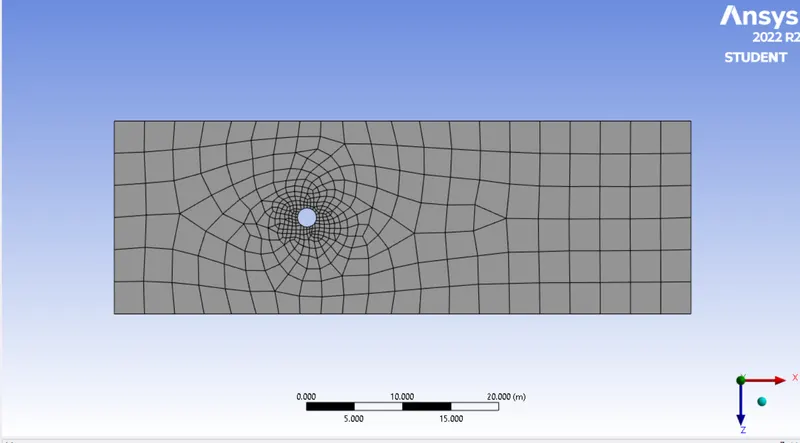
Fig. 2 Course Mesh
then we can use automatic method by inserting and follwoing changes made we used Triangles in Definition > Method > triangles.
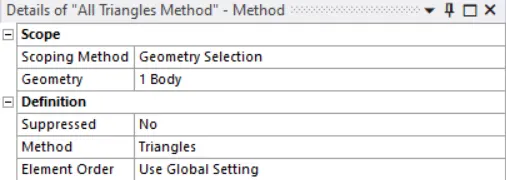
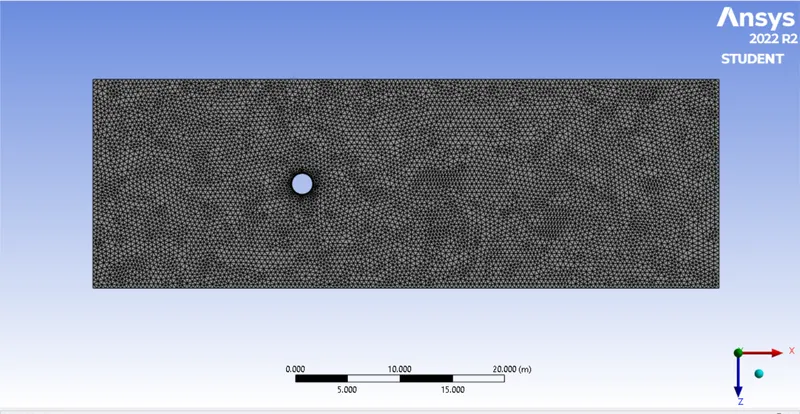
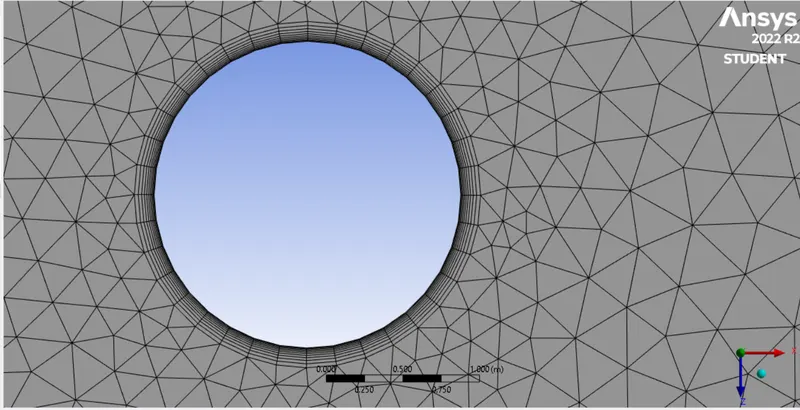
then we can use Edge Sizing and inflation for finer Mesh at Cylinder Region, The element size is 0.20 m The inflation layer is used around the cylinder. The steps are as below.
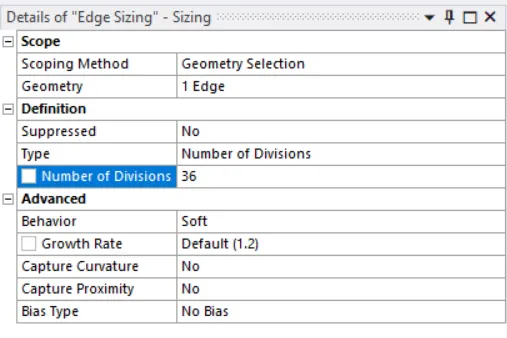
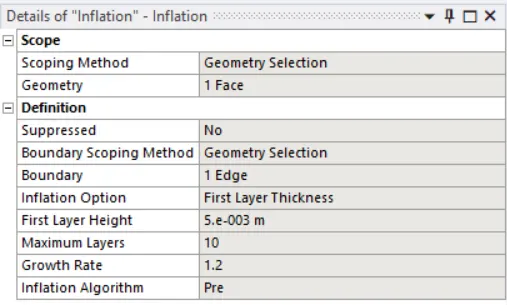
- Then we are giving the name selection to boundaries inlet,outlet,symmetry and wall (for cylinder).
Generated Mesh:-
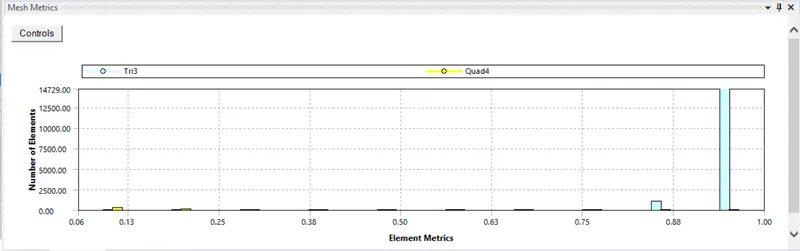
Element Quality:-
STEP 3 :- Setup :-
- Solver Type:- Pressure-based
- Velocity Formulation:- Absolute
- Time:- Steady
- 2D space:- Planar
- Viscous Model:- Laminar
- Material:- Type : fluid
fluent fluid material :User defined material
where viscosity =0.02 Kg/(m-s) ,Density=1 `(kg)/(m3)`
-
Cell zone : fff_surface fluid type: User defined
-
Boundaries : inlet(velocity inlet)
Velocity magnitude = 1 m/sec
Outlet(Pressure outlet)
Gauge pressure = 0 pa
Wall:shear condition=No Slip
Symmetry =symmetry
REFERENCE VALUES FOR SOLUTION
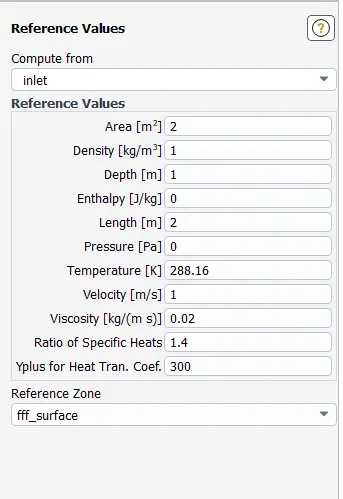
SOLUTION AND RESULTS :-
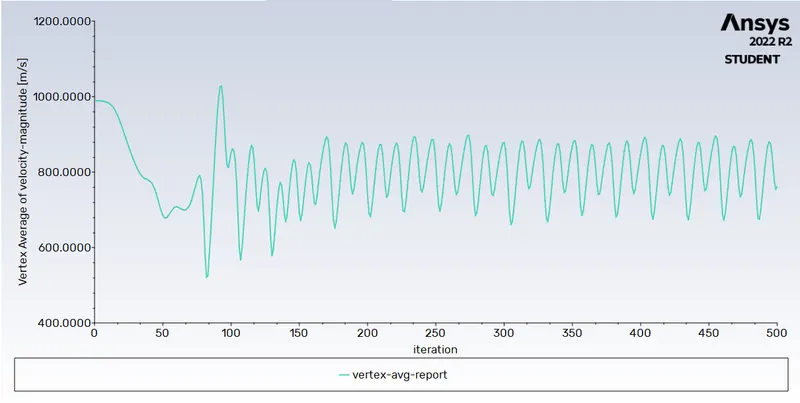
we are using SIMPLE Solution Method we are creating report for Residual plot, Vertex average velocity magnitude, Drag Coefficient, Lift Coefficient and also look the Velocity contour and Pressure contour. iterations for all resuts are 500.
We are using SIMPLE Method for solution
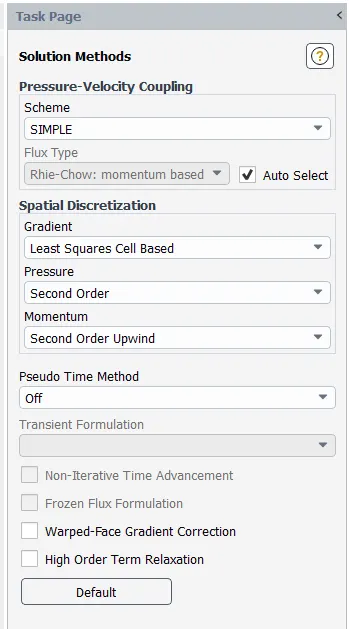
- Residual Plot:-
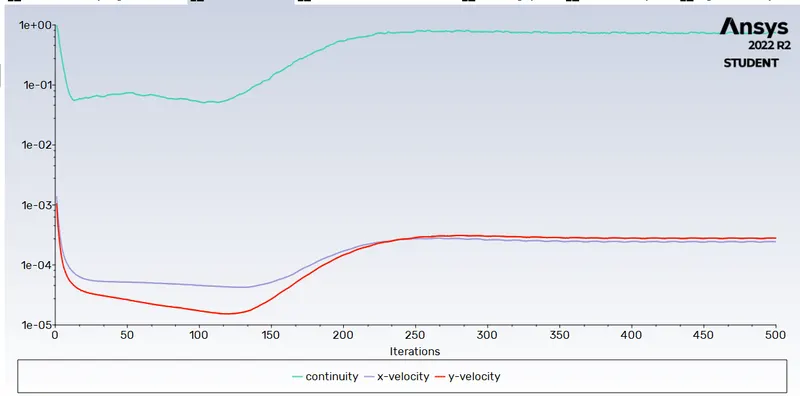
- Vertex average velocity magnitude:-
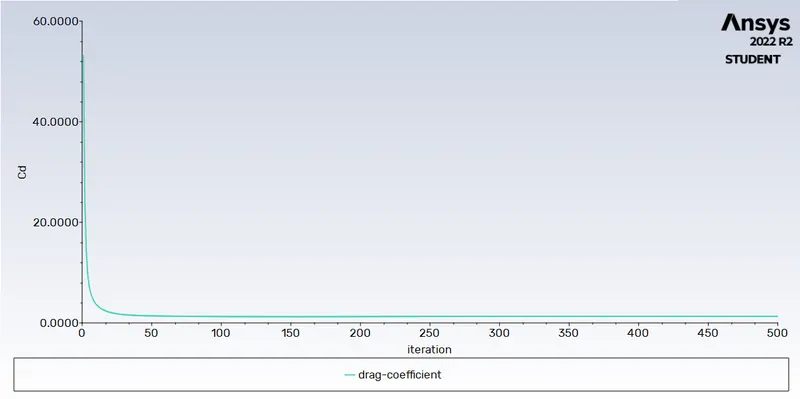
- Drag Coefficient:-
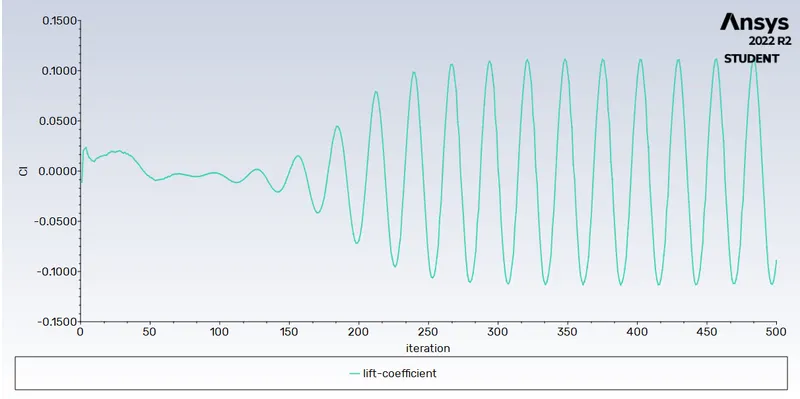
- Lift Coefficient:-
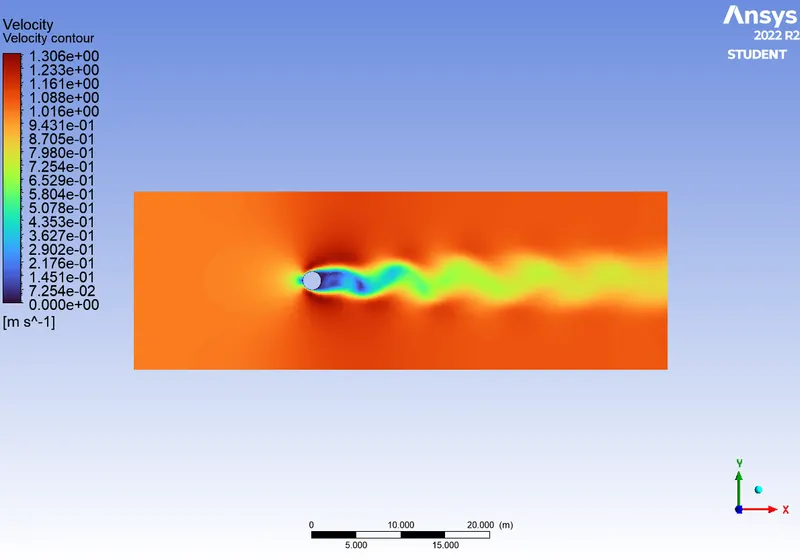
- Velocity contour Re is 100, steady state:-
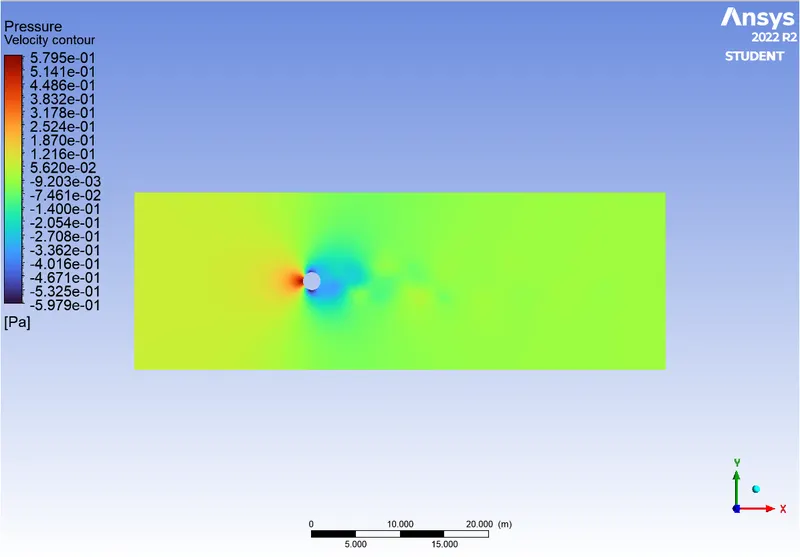
- Pressure contour Re is 100, steady state:-
Simulation of Velocity flow for the steady condition (Re=100):-
For Un-Steady state Re= 100 :-
- Solver Type:- Pressure-based
- Velocity Formulation:- Absolute
- Time:- Un-Steady
- 2D space:- Planar
- Viscous Model:- Laminar
- Material:- Type : fluid
fluent fluid material :User defined material
where viscosity =0.02 Kg/(m-s) ,Density=1`(kg)/(m3)`
-
Cell zone : fff_surface fluid type: User defined
-
Boundaries : inlet(velocity inlet)
Velocity magnitude = 1 m/sec
Outlet(Pressure outlet)
Gauge pressure = 0 pa
Wall:shear condition=No Slip
Symmetry =symmetry
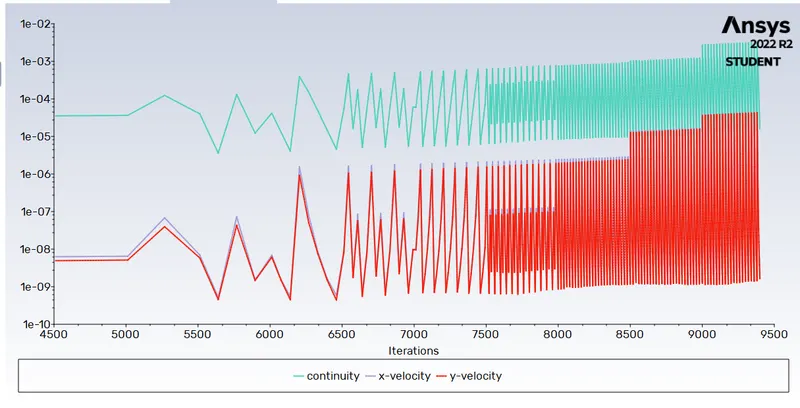
- Residual Plot:-
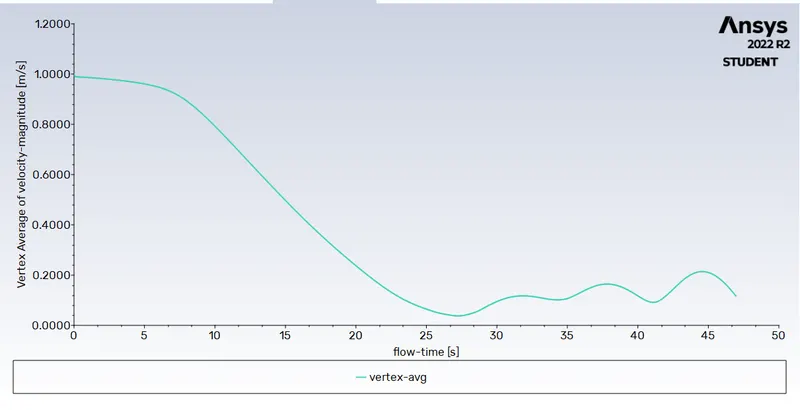
- Vertex average velocity magnitude:-
vertex-avg velocity is 0.11357106 [m/s]
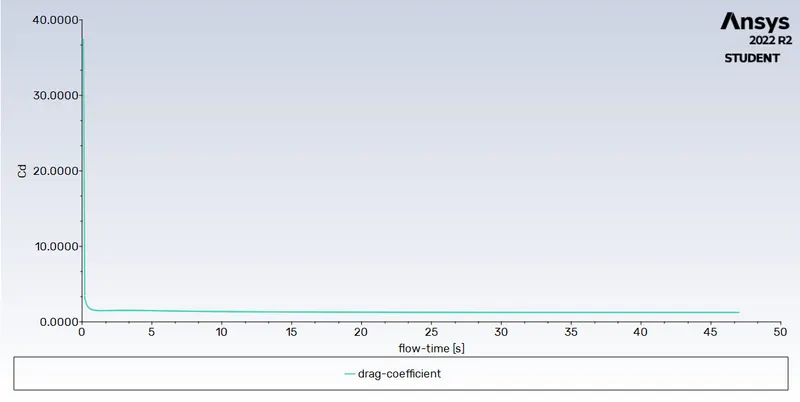
- Drag Coefficient:-
Drag-coefficient is 1.2428657
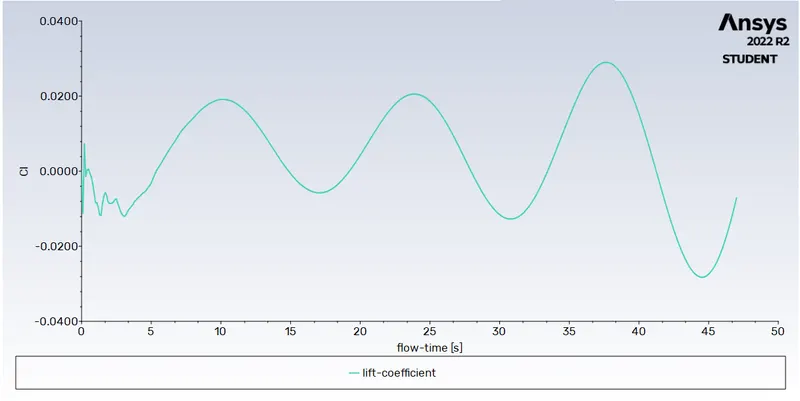
- Lift Coefficient:-
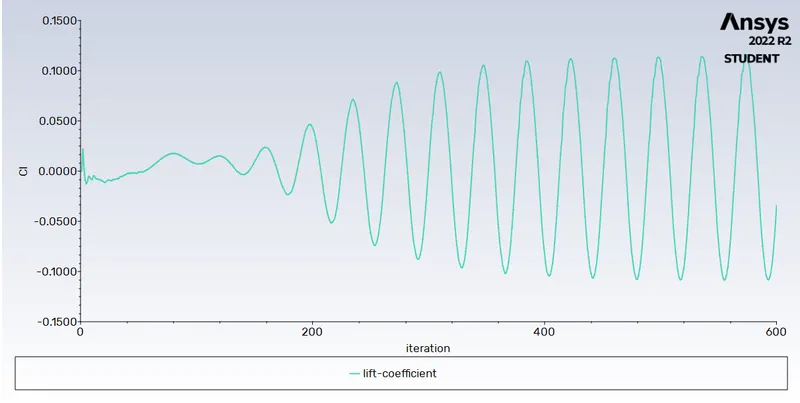
lift-coefficient is -0.0071690785
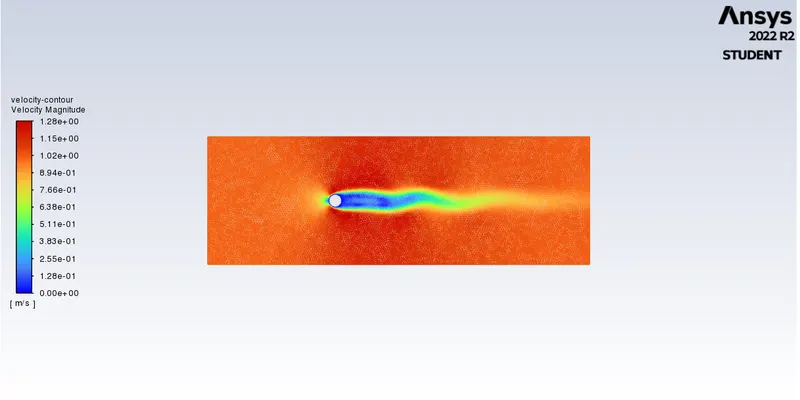
- Velocity contour Re is 100, Un-steady state:-
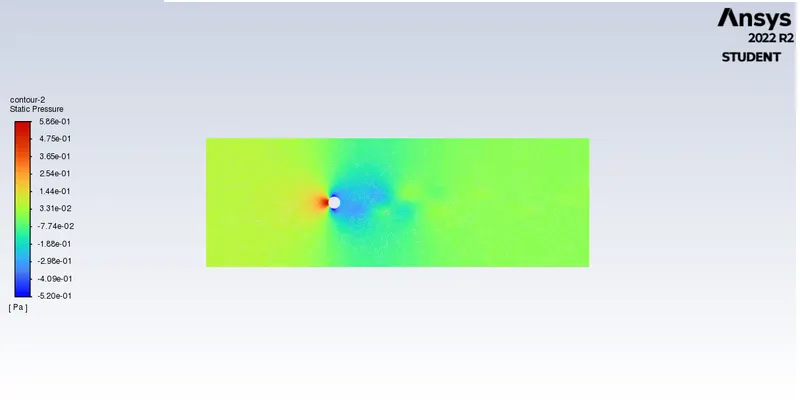
- Pressure contour Re is 100, Un-steady state:-
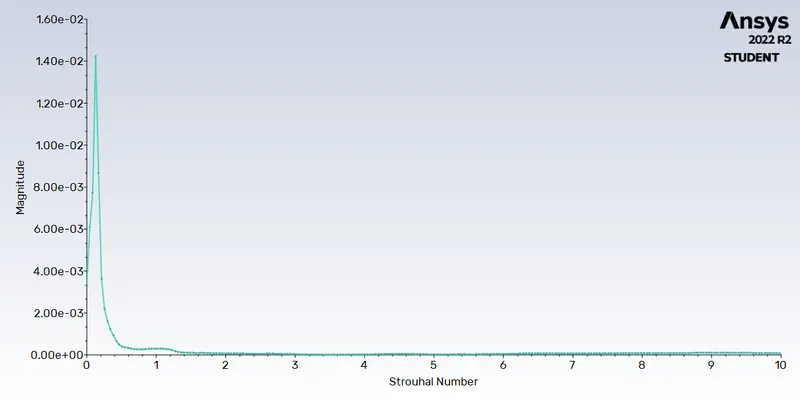
- Strouhal Number plot for Re 100:-
In Fluent, we can directly calculate Strouhal Number by using Lift calculated data and plot the results. from below plot the strouhal number is 0.1273 for Re 100.
Strouhal Number calculation:-
(title "Spectral Analysis of lift-coefficient-rfile")
(labels "Strouhal Number" "Magnitude")

((xy/key/label "lift-coefficient")
0.0000000e+00	3.3094212e-03
4.2462844e-02	6.0752989e-03
8.4925689e-02	7.7408333e-03
1.2738854e-01	1.4233467e-02
1.6985138e-01	8.6796535e-03
2.1231422e-01	3.6175982e-03
2.5477707e-01	2.1940737e-03
2.9723993e-01	1.6069792e-03
3.3970276e-01	1.2216057e-03
3.8216561e-01	9.1815967e-04
4.2462844e-01	6.6864380e-04
4.6709129e-01	4.9763510e-04
5.0955415e-01	3.9885510e-04
5.5201697e-01	3.5760103e-04
5.9447986e-01	3.3620841e-04
6.3694268e-01	3.0730857e-04
6.7940551e-01	2.7776320e-04
7.2186834e-01	2.6851462e-04
7.6433122e-01	2.6498464e-04
8.0679405e-01	2.6244117e-04
8.4925687e-01	2.7709859e-04
8.9171976e-01	2.8933751e-04
9.3418258e-01	2.9668849e-04
9.7664541e-01	3.0062252e-04
1.0191083e+00	2.9943761e-04
1.0615711e+00	3.0026774e-04
1.1040339e+00	2.9426478e-04
1.1464968e+00	2.7679972e-04
1.1889597e+00	2.5378788e-04
PART-II
- Calculation of coefficient of drag and lift over a cylinder by setting the Reynolds number to 10,100,1000,10000 & 100000. (Run with steady solver)
FOR Re =10
by changing velocity we can get Re 10 as per Reynolds Number Formulae.
Setup:-
- Solver Type:- Pressure-based
- Velocity Formulation:- Absolute
- Time:- Steady
- 2D space:- Planar
- Viscous Model:- Laminar
- Material:- Type : fluid
fluent fluid material :User defined material
where viscosity =0.02 Kg/(m-s) ,Density=1 `(kg)/(m3)`
-
Cell zone : fff_surface fluid type: User defined
-
Boundaries : inlet(velocity inlet)
Velocity magnitude = 0.1 m/sec................ by changing velocity we can get Re 10 as per Reynolds Number Formulae
Outlet(Pressure outlet)
Gauge pressure = 0 pa
Wall:shear condition=No Slip
Symmetry =symmetry
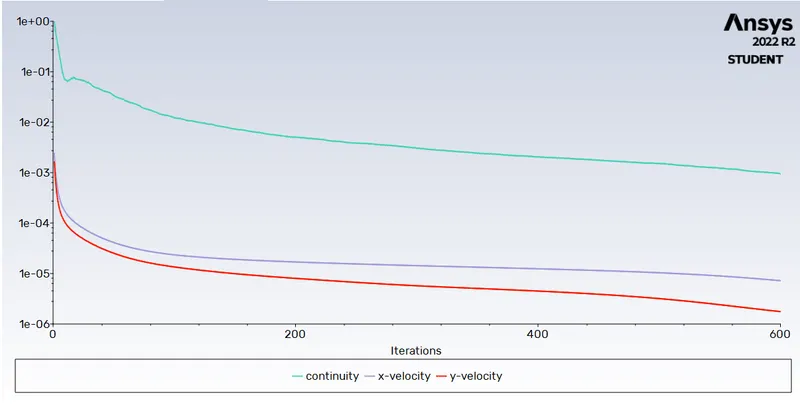
- Residual plot
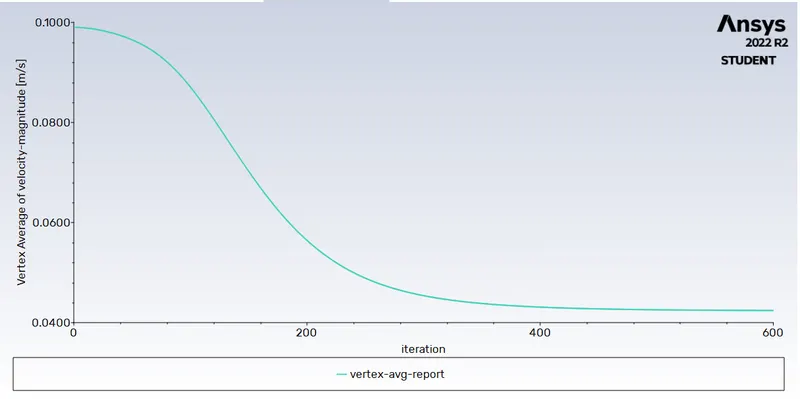
- Vertex average velocity magnitude:
vertex-avg is 0.042421799 [m/s] for Re 10
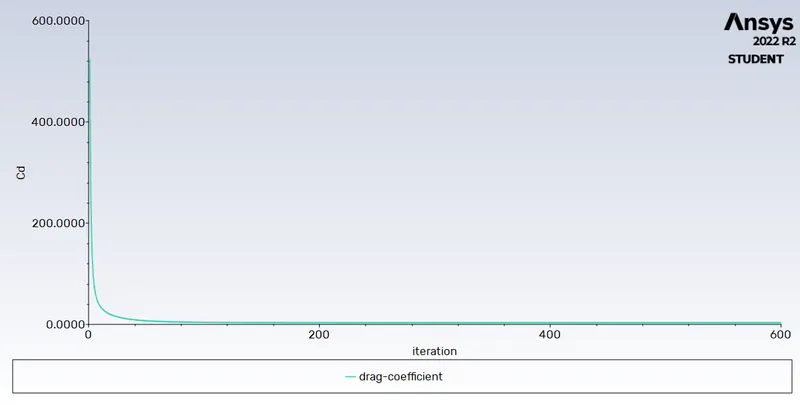
- Drag Coefficient:-
drag-coefficient is 3.3222237 for Re 10
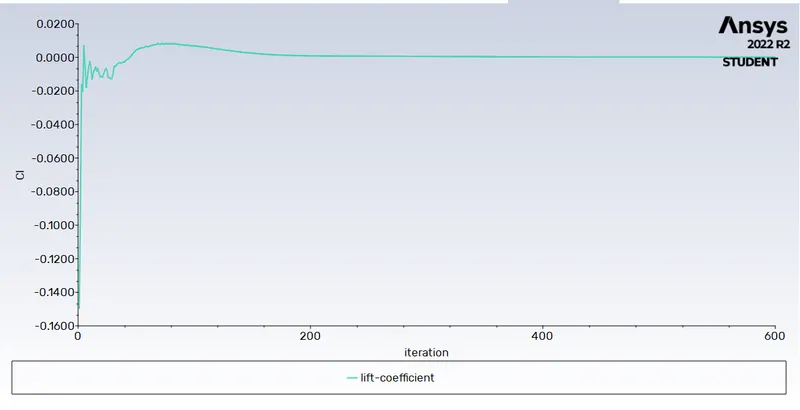
- Lift Coefficient:-
lift-coefficient is 0.00018498651 for Re 10
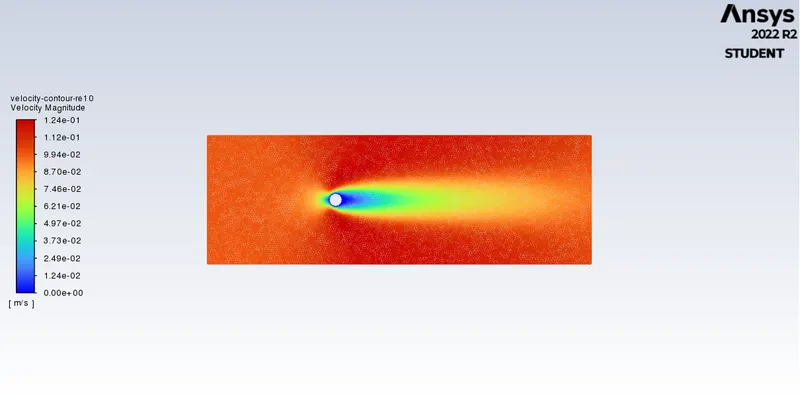
- Velocity contour Re is 10, steady state:-
- Pressure contour Re is 10, steady state:-
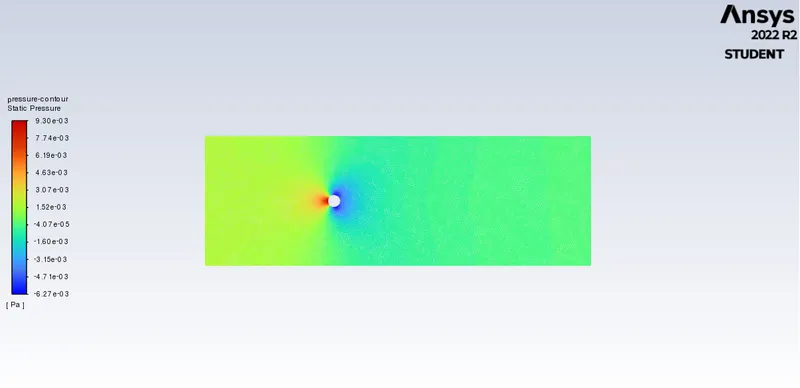
Simulation of Velocity contour Re is 10, steady state:-
FOR Re =100
by changing velocity we can get Re 100 as per Reynolds Number Formulae.
Setup:-
- Solver Type:- Pressure-based
- Velocity Formulation:- Absolute
- Time:- Steady
- 2D space:- Planar
- Viscous Model:- Laminar
- Material:- Type : fluid
fluent fluid material :User defined material
where viscosity =0.02 Kg/(m-s) ,Density=1 `(kg)/(m3)`
- Cell zone : fff_surface fluid type: User defined
- Boundaries : inlet(velocity inlet)
Velocity magnitude = 1 m/sec................ by changing velocity we can get Re 100 as per Reynolds Number Formulae
Outlet(Pressure outlet)
Gauge pressure = 0 pa
Wall:shear condition=No Slip
Symmetry =symmetry
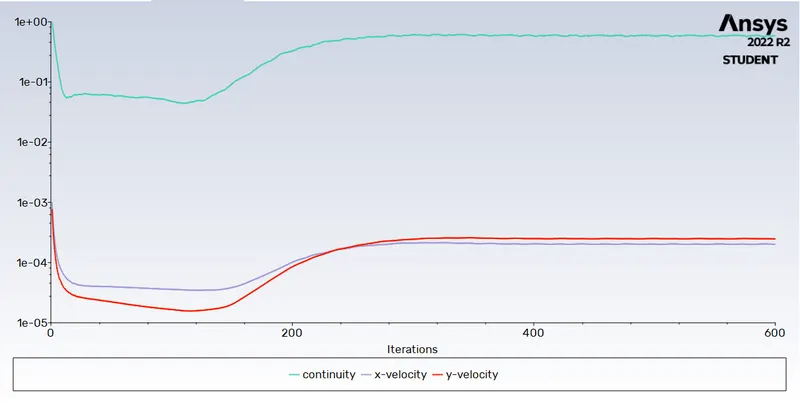
- Residual plot:-
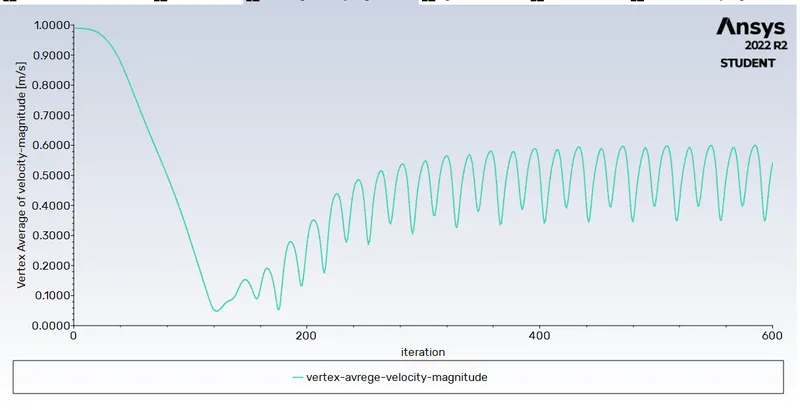
- Vertex average velocity magnitude:
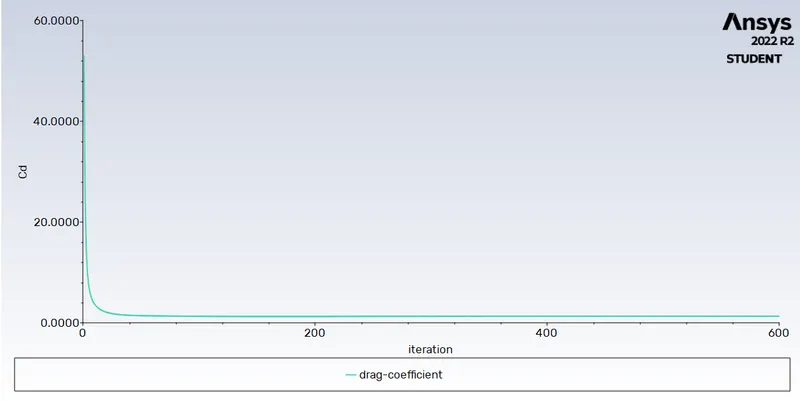
- Drag Coefficient:-
drag-coefficient is 1.3021804 for Re 100 steady
- Lift Coefficient:-
lift-coefficient is -0.034376685 for Re 100
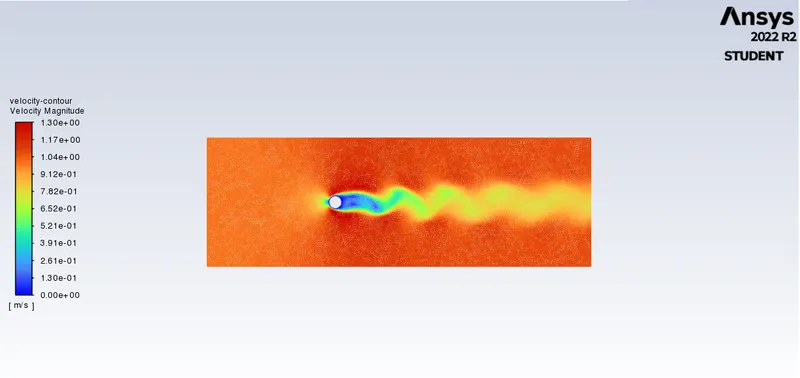
- Velocity contour Re is 100, steady state:-
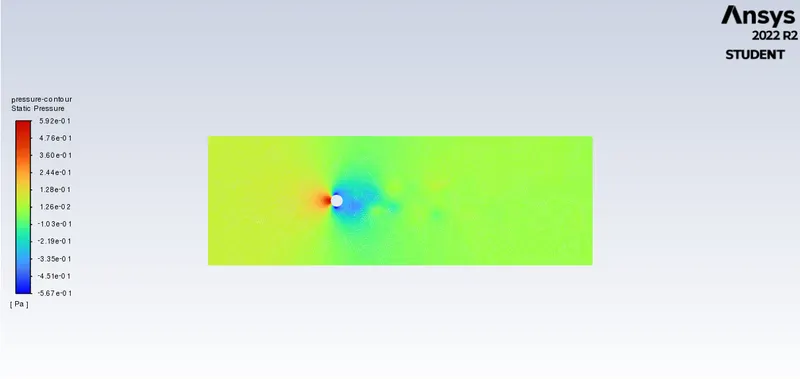
- Pressure contour Re is 100, steady state:-
Simulation of Velocity contour Re is 100, steady state:-
FOR Re =1000
by changing velocity we can get Re 1000 as per Reynolds Number Formulae.
Setup:-
- Solver Type:- Pressure-based
- Velocity Formulation:- Absolute
- Time:- Steady
- 2D space:- Planar
- Viscous Model:- Laminar
- Material:- Type : fluid
fluent fluid material :User defined material
where viscosity =0.02 Kg/(m-s) ,Density=1 `(kg)/(m3)`
- Cell zone : fff_surface fluid type: User defined
- Boundaries : inlet(velocity inlet)
Velocity magnitude = 10 m/sec................ by changing velocity we can get Re 1000 as per Reynolds Number Formulae
Outlet(Pressure outlet)
Gauge pressure = 0 pa
Wall:shear condition=No Slip
Symmetry =symmetry
- Residual plot:-
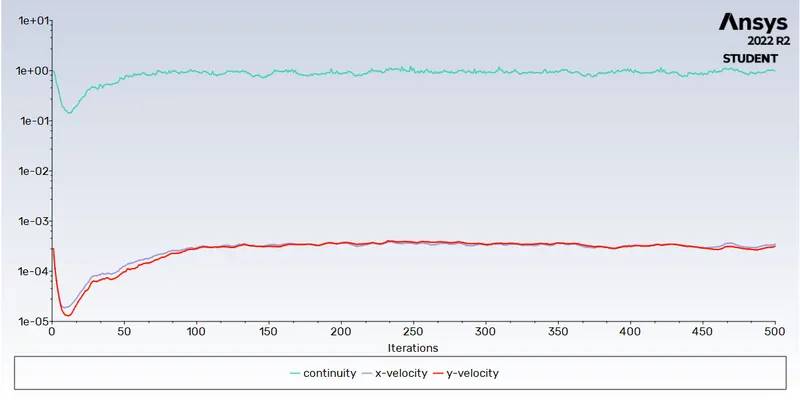
- Vertex average velocity magnitude:
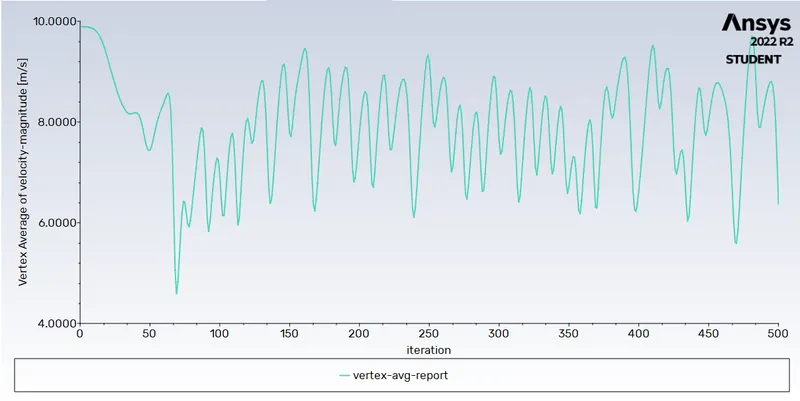
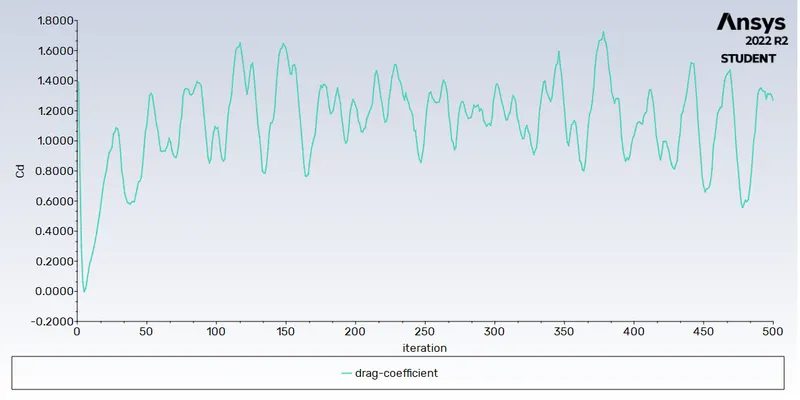
- Drag Coefficient:-
drag-coefficient is 1.2662198 for Re 1000
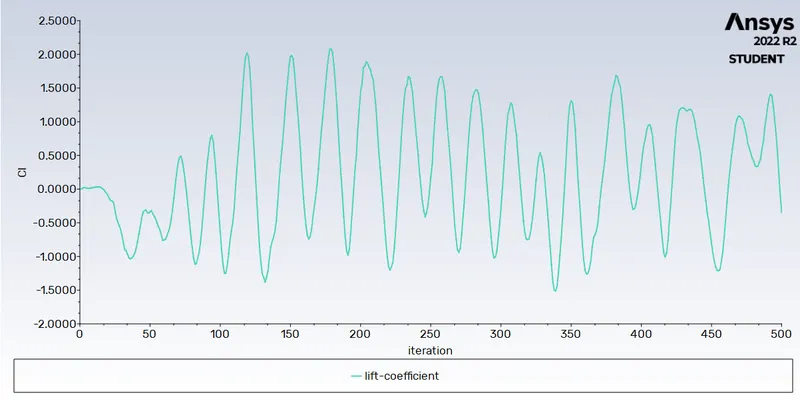
- Lift Coefficient:-
lift-coefficient is -0.34783537 for Re 1000
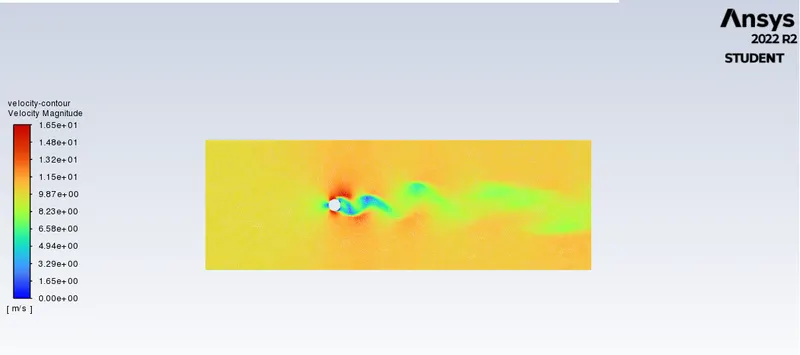
- Velocity contour Re is 1000, steady state:-
- Pressure contour Re is 1000, steady state:-
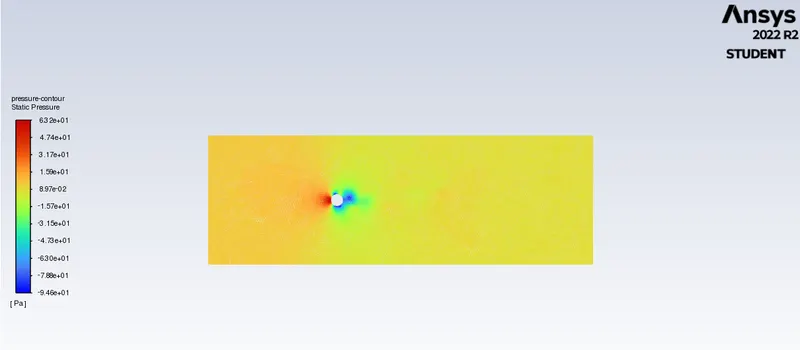
Simulation of Velocity contour Re is 1000, steady state:-
FOR Re =10000
by changing velocity we can get Re 10000 as per Reynolds Number Formulae.
Setup:-
- Solver Type:- Pressure-based
- Velocity Formulation:- Absolute
- Time:- Steady
- 2D space:- Planar
- Viscous Model:- Laminar
- Material:- Type : fluid
fluent fluid material :User defined material
where viscosity =0.02 Kg/(m-s) ,Density=1 `(kg)/(m3)`
- Cell zone : fff_surface fluid type: User defined
- Boundaries : inlet(velocity inlet)
Velocity magnitude = 100 m/sec................ by changing velocity we can get Re 10000 as per Reynolds Number Formulae
Outlet(Pressure outlet)
Gauge pressure = 0 pa
Wall:shear condition=No Slip
Symmetry =symmetry
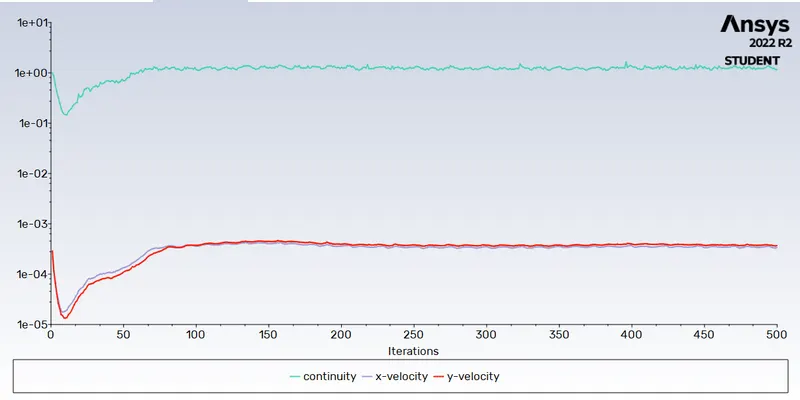
- Residual plot:-
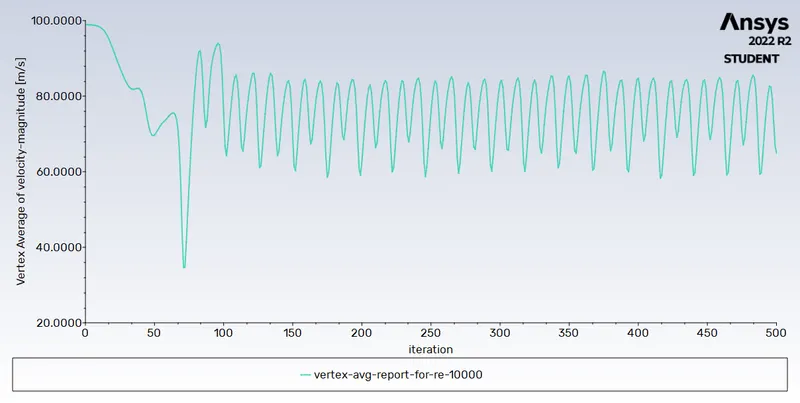
- Vertex average velocity magnitude:
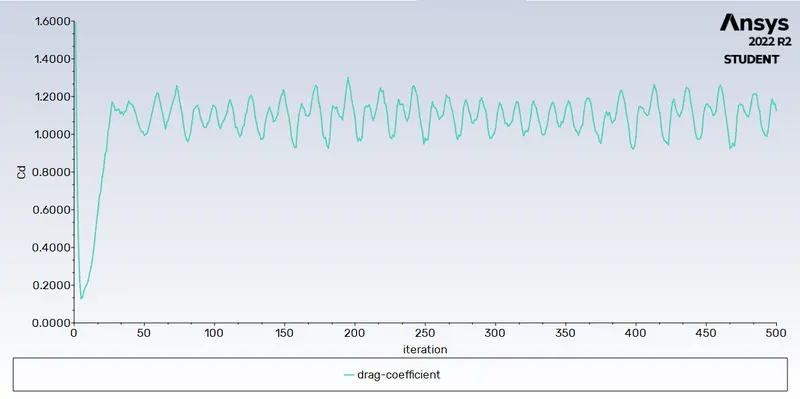
- Drag Coefficient:-
drag-coefficient is 1.1230367 for Re 10000.
- Lift Coefficient:-
lift-coefficient is -0.12573703 for Re 10000.
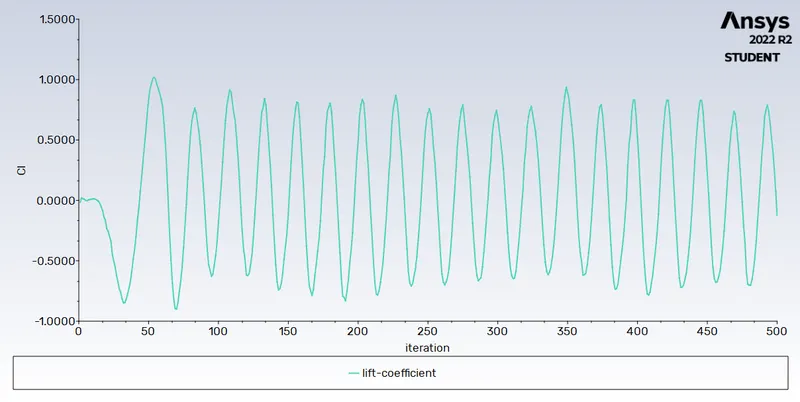
- Velocity contour Re is 10000, steady state:-
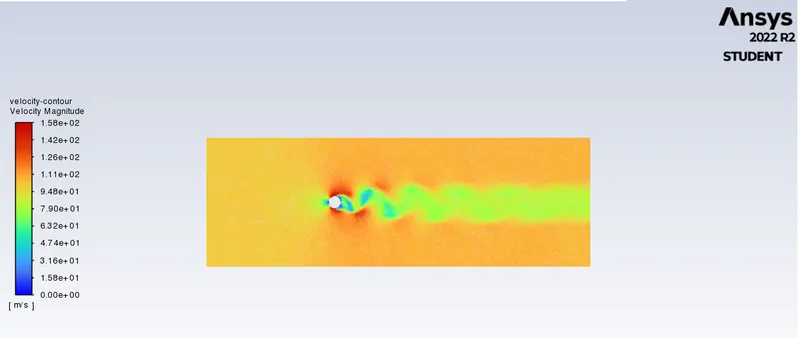
- Pressure contour Re is 10000, steady state:-
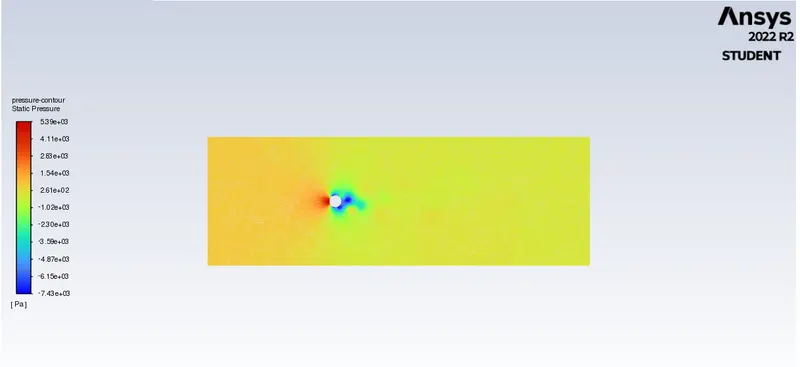
Simulation of Velocity contour Re is 10000, steady state:-
FOR Re =100000
by changing velocity we can get Re 100000 as per Reynolds Number Formulae.
Setup:-
- Solver Type:- Pressure-based
- Velocity Formulation:- Absolute
- Time:- Steady
- 2D space:- Planar
- Viscous Model:- Laminar
- Material:- Type : fluid
fluent fluid material :User defined material
where viscosity =0.02 Kg/(m-s) ,Density=1 `(kg)/(m3)`
- Cell zone : fff_surface fluid type: User defined
- Boundaries : inlet(velocity inlet)
Velocity magnitude = 1000 m/sec................ by changing velocity we can get Re 100000 as per Reynolds Number Formulae
Outlet(Pressure outlet)
Gauge pressure = 0 pa
Wall:shear condition=No Slip
Symmetry =symmetry
- Residual plot:-
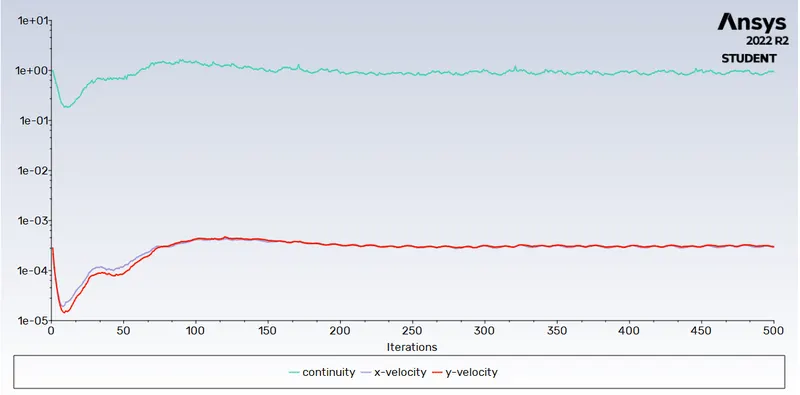
- Vertex average velocity magnitude:
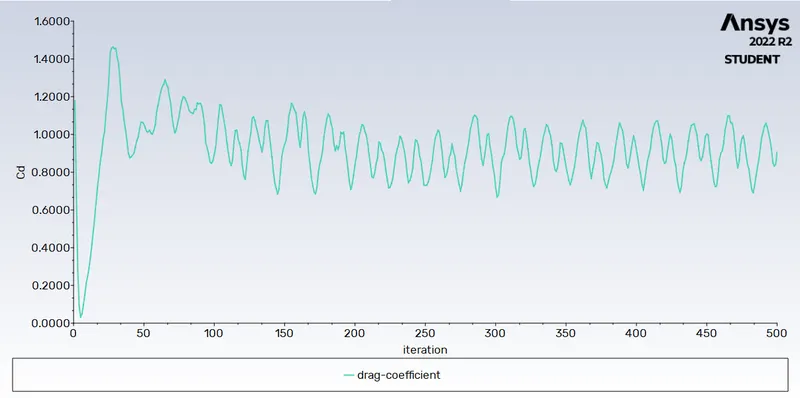
- Drag Coefficient:-
drag-coefficient 0.90718667 for Re 100000.
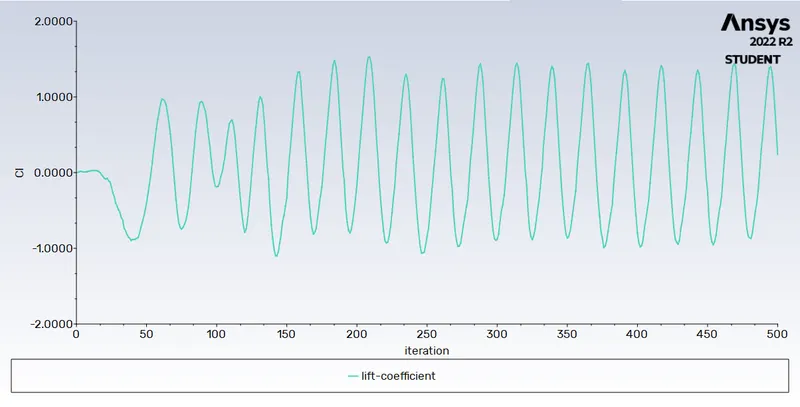
- Lift Coefficient:-
lift-coefficient is 0.22738654 for Re 100000.
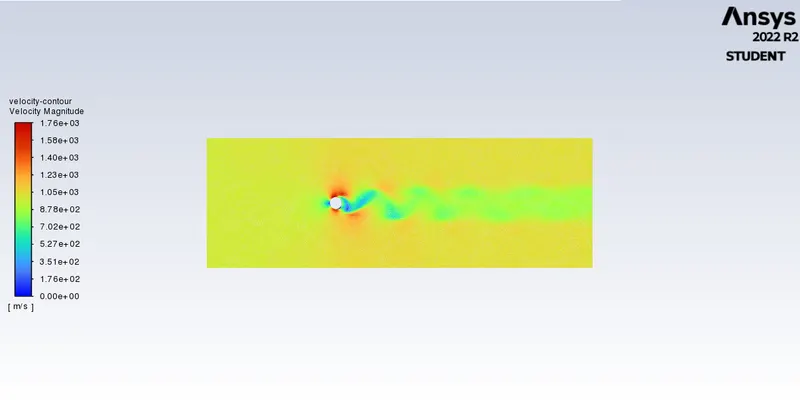
- Velocity contour Re is 100000, steady state:-
- Pressure contour Re is 100000, steady state:-
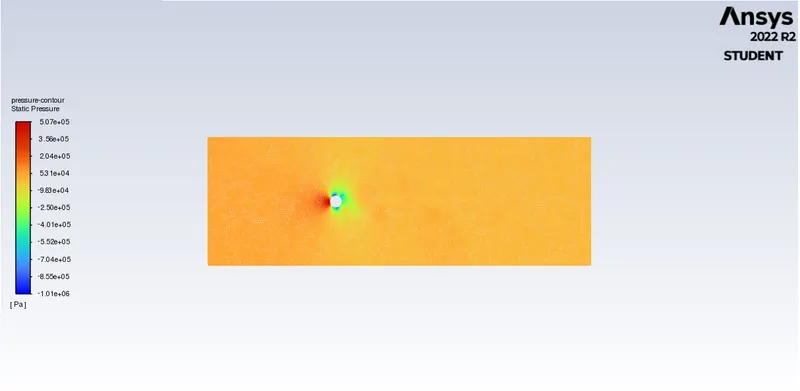
Simulation of Velocity contour Re is 100000, steady state:-
Comparison of Various Reynolds Number for Drag coefficient and Lift Coefficient as below:-
| Sr No | Reynolds Number | Drag coefficient | Lift coefficient |
| 1 | 10 | 3.3222237 | 0.00018498651 |
| 2 | 100( steady) | 1.3021804 | -0.034376685 |
| 3 | 100( Un-steady) | 1.2428657 | -0.0071690785 |
| 4 | 1000 | 1.2662198 | -0.34783537 |
| 5 | 10000 | 1.1230367 | -0.12573703 |
| 6 | 100000 | 0.90718667 | 0.22738654 |
From above table we can say that Reynolds Number increases Drag Coefficient Decreases as shown in table.
when Reynolds Number increases Lift coefficient Increasess.
CONCLUSION:-
1.When fluid flows over cylinder, wake region is formed.
- When the Reynolds number increases the inertial forces start to forces over viscous forces which leads to a significant increase in drag and also, a rise in fluctuation in the coefficient of lift.
- When Reynolds number goes above 1000 then flow becomes Laminar to Turbulant quickly, more vortices are generated over Re 1000.
- Compared valus of cd as compared to Research paper as below:-
|
Re= 100 |
Research paper value |
Simulation value |
Difference |
|
cd Steady |
1.3353 |
1.3021804 |
2.48% |
|
Strauhal Number |
0.1596 |
0.1273 |
2.02% |
Note :- Difference Should be less than 5 %
References:-
- B.N. Rajani, A. Kandasamy, Sekhar Majumdar, Numerical simulation of laminar flow past a circular cylinder, Applied Mathematical Modelling, Volume 33, Issue 3, 2009, Pages 1228-1247, ISSN 0307-904X.
- Charles H. K. Williamson ‘’Vortex Dynamics in the Wake of a Cylinder’’ Part of the Fluid Mechanics and Its Applications book series (FMIA,volume 30).