Week - 2 - Explicit and Implicit Analysis
AIM:
To use both explicit and implicit approaches to solve the problem F(u)=u3+9u2+4u">F(u)=u3+9u2+4u with a residual tolerance of 0.01.
F-Force in the bar and u-displacement in the bar form the equation.
Using both explicit and implicit analysis techniques, the problem is resolved. An incremental load control strategy is applied in both situations.
To solve dynamic problems, both implicit and explicit solutions will be used. The way that implicit and explicit analysis handles time increments vary.
GOVERNING EQUATIONS IF ANY:
F(u) = u3+9u2+4u
OBJECTCIVES OF THE PROJECT:
To plot the graph and to understand the explicit and implicit equation and using the governing equation to find out the usage of method.
BODY OF THE CONTENT:
To determine the problem, both explicit and implicit analyses are applied. In both situations, an incremental load control strategy is used. It is obvious that the example is inaccurate as it is given. Someone who is unfamiliar may find several components of this practice weird. However, the example problem is meant to illustrate a number of ideas that could come up in a normal nonlinear finite element analysis.
Here, we going to solve this both equation by using implicit and explicit method for the given governing equation. F(u) = u3+9u2+4u
Explicit method
So first consider the equation as
F(u) = u3+9u2+4u
And For K(u)=dF(u)/du= 2u3+9u+4
Step 1
U(0) is equal to 0.
k(u) equals 4.
ΔF equals 1.
ΔU1 = ΔF/Δk(u)
= 1/4 = 0.25
u1 equals U0 + ΔU1 = 0 + 0.25 =
= 0.25^3) + 9(0.025^2) + 4(0.25) = F1int
1.578125
Step-2
u1 equals 0.25
3(0.25^2) + 9(0.25^2) + 4 is K(u1)
8.6875
ΔF=1
ΔU2 = ΔF/Δ(u2)
= 1.86875"
= 0.1151
U2 = u1 = ΔU2
= 0.25 + 0.1151
= 0.3651
f2int = 0.3+651 = 0.965^2 + 0.365^3
= 2.708
Step Three
U2 is equal to 0.3651
k(u2) = 18(0.3651) + 4 + 3(0.3651^2)
= 10.97
ΔF=1
Δu3 = ΔF/k(u2)
= 0.914%
u3 is equal to u2 +
Δu3 = 0.365 + 0.09114
= 0.4562
f3int = 0.96522^2) + 4(0.4562) + (0.4652^3)
= 3.77928
|
Step |
Fi |
∆ui |
ui |
Fext |
Fint |
Resultant= Fint-Fext |
|
1 |
1 |
0.25 |
0.25 |
1 |
1.5781 |
0.5781 |
|
2 |
1 |
0.115 |
0.3651 |
2 |
2.7087 |
0.7087 |
|
3 |
1 |
0.0911 |
0.4562 |
3 |
3.792 |
0.792 |
Implicit Method
So first consider the equation as
F(u) = u3+9u2+4u
And For K(u)=dF(u)/du= 2u3+9u+4
Step 1
U(0) is equal to 0.
K(u) equals 4.
ΔF equals 1.
From k = df/du, ΔU1 = ΔF/}K(u). = 1/4 = 0.25
fint = 0.9(0.1834^2) + 4 + (0.18334^3)(0.1834) = 0.578125
For R1, f1int-f1ext equals 0.578125.
Newton-Raphson iterations have been finished since R1> 0.01.
Method of Newton Raphson It is an approach for finding roots that consistently provides improved approximations to the roots of a real valued function.
That is, x1=x0-f(x0)/f1(x0).
By doing this, we were able to
A=R1(1)/k(1U1(1)) = Δu1(1) = -0.066549
ΔU1 + u1(1) = U1(2) = 0.25 - 0.06654 = 0.1834
F1(2) is equal to 1.04249.
The Newton Raphson technique is used since R1(2) = 0.04249>0.01.
R1(2)/K(u1(2)) = ΔU1 (2) = 0.07228
U1(3) equals u1(2) + 9(0.177^) + 4(0.177) = 1.00075
R1(3) is equal to 0.000753.
which is below 0.01, indicating that the Newton Raphson approach is not necessary.
U1 thus equals 0.1772.
F1 is equal to 1.0007.
R1 is equal to 0.000753.
Step 2
u1 is equal to 0.1772.
K(u) = 18(0.1772) + 4 + 3(0.1772^2) = 7.29
ΔF equals 1.
ΔF/K(u) = 0.137 = ΔU2
U1+Δu2 = 0.3148 = u2
F2 int = 0.177^3) + 9(0.177^2) + 4(0.177) = 2.182
F1ext - F1int = 0.1822 is R2.
The Newton-Raphson technique is used since R2 > 0.01.
Δu2(1) is equal to R2(1)/K(u2(1)) = -0.018294.
U2(1) +Δu2(1) = U2(2) = 0.3148 - 0.0182 = 0.2965
F2(2) equals 2.0037.
R2(2) = 0.00327<0.01 indicates that the Newton-Raphson technique is no longer required.
Consequently
U2 is 0.2965.
F2 is equal to 2.0032.
R2 is 0.003276.
Step 3
U2 is equal to 0.2965.
3(0.2965^2) + 18(0.2965) + 4 = 9.60073 is K(u).
ΔF=1
ΔF/k(u) = Δu3 = 0.1046
U2+ΔU3 = U3 = 0.4006
(0.296^3) + 9(0.2965^2) + 4(0.2965) = F3 int
R3 = 0.111 (F1int-F1ext).
Since it is more than 0.01, the Newton-Raphson technique is applied.
R3(1)/K(U3(1)) = -0.009493 ΔU3 (1)
U3(2) equals U3(1) + ΔU3(1) = 0.3911
F3 equals 3.0008
0.00855<0.01 is R3(2).
consequently
U3 is equal to 0.3911
F3 is equal to 3.00855.
R3 is equal to 0.00855.
|
Step |
Fi |
ui |
Fext |
Fint |
Resultant= Fint-Fext |
|
1 |
1 |
0.1772 |
1 |
1.0075 |
0.000753 |
|
2 |
1 |
0.2965 |
2 |
2.003276 |
0.0032 |
|
3 |
1 |
0.3911 |
3 |
3.00855 |
0.0085 |
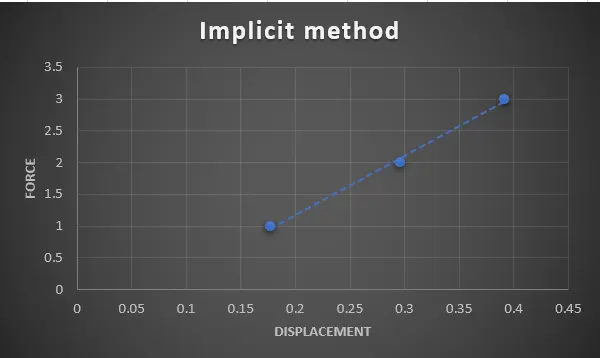
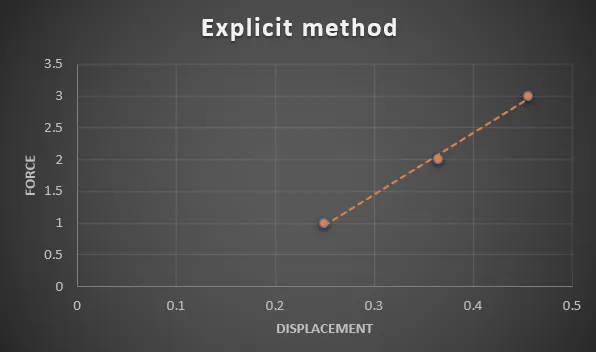
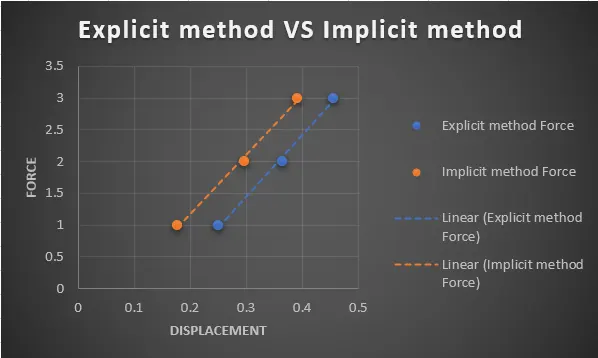
Below are all the graph
Implicit method
Explicit method
Implicit method and explicit method comparision
Conclusion
The incremental load is required for all nonlinear and non-static analyses. Implementing implicit methods can be more difficult and necessitate additional computation. However, in terms of accuracy, an implicit system with a bigger time step requires a lot less computing time than an explicit system with an unfeasible tiny time step. In extreme situations, such a car crash or a ballistic event, explicit approaches can be applied, where the materials take into account both the strain rate and the stress with regard to strain. Implicit techniques are inapplicable to problems with larger strain rates. The Implicit approach is the most effective strategy to calculate and determine the solution for the specific problem.