Week - 2 - Explicit and Implicit Analysis
Solving a given problem by using Explicit and implicit Analysis
Aim: To solve the given problem using both explicit and implicit method and plot the results.
Problem Statement: Consider the case of a simple bar in tension as shown in Figure 1. Suppose that the force in the bar is a nonlinear function of the displacement.
`f(u)=u^3+9u^2+4u`
The stiffness of the bar is `k(u)=(df)/(du)=3u^2+18u+4`
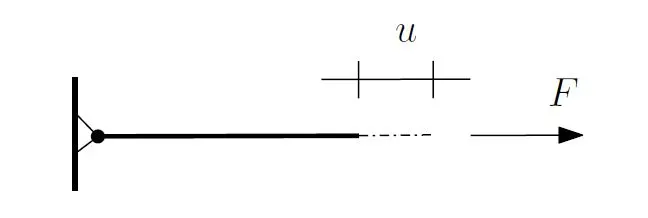
Fig.1. Bar in tension.
Solution:
Explicit Analysis:
An Explicit FEM analysis does the incremental procedure and at the end of each increment updates the stiffness matrix based on geometry changes or material changes. Then a new stiffness matrix is constructed and the next increment of load is applied to the system. This method does not enforce equilibrium of the internal structure forces with the externally applied loads.
Clearly it is possible to plot a graph of force, f, versus displacement, u, by using force equation. However, if the nonlinear force versus displacement relationship is not known, but the stiffness is known, it is possible to construct the graph of force versus displacement numerically. One method is to use an incremental explicit load control scheme. For this example three equal load increments (or steps) of `Delta F=1` unit each are used to load the tension bar. The variables used are u for displacement, f for internal force in the bar, F for external force applied to the bar and k for stiffness. Incremental displacements or incremental externally applied forces are represented as `Delta u` or `Delta F`, respectively. Use is made of the relationship `Delta F=k Delta u`. The analysis proceeds as follows:
Force function, `f(u)=u^3+9u^2+4u`
Stiffness, `k(u)=(df)/(du)=3u^2+18u+4`
Step 1
`u_0=0,`
`=> k(u_0)=3u_0^2+18u_0+4=4`
`Delta F=1,`
`=> Delta u_1=(Delta F)/(k(u_0))=1/4=0.25`
`therefore u_1=u_0+Deltau_1=0.25`
`F_(ext)=1,`
`f_(i)=u_1^3+9u_1^2+4u_1=1.5781`
Step 2
`u_1=0.25,`
`=> k(u_1)=3u_1^2+18u_1+4=8.6875`
`Delta F=1,`
`=> Delta u_2=(Delta F)/(k(u_1))=1/8.6875=0.1151`
`therefore u_2=u_1+Deltau_2=0.3681`
`F_(ext)=Delta F+Delta F=2 ,`
`f_(i)=u_2^3+9u_2^2+4u_2=2.7417`
Step 3
`u_2=0.3681,`
`=> k(u_2)=3u_2^2+18u_2+4=11.0323`
`Delta F=1,`
`=> Delta u_3=(Delta F)/(k(u_2))=1/11.0323=0.0906`
`therefore u_3=u_2+Deltau_3=0.4587`
`F_(ext)=Delta F+Delta F+Delta F=3 ,`
`f_(i)=u_3^3+9u_3^2+4u_3=3.8249`
`F_(ext)!=f_i`
Table: Summary of Explicit analysis result.
| stepi | `DeltaF_i` | `Delta u_i` | `u_i` | `(F_(ext))_i` | `(f_i)_i` | `R=f_i-F_(ext)` |
| 1 | 1 | 0.25 | 0.25 | 1 | 1.5781 | 0.5781 |
| 2 | 1 | 0.1151 | 0.3681 | 2 | 2.7417 | 0.7417 |
| 3 | 1 | 0.0906 | 0.4587 | 3 | 3.8249 | 0.8249 |
Implicit Analysis:
An implicit analysis is the same as the explicit analysis, except that at the end of each step Newton-Raphson iterations are used to enforce equilibrium before moving to the next step. Basically, an incremental force is applied to advance the solution forward at the beginning of a step. However, internal forces and external forces will not be in equilibrium unless the stiffness is linear for the given step. Hence, in order to achieve equilibrium, corrections must be made to the displacement. This is accomplished by using Newton-Raphson iterations to minimize the residual, `R(u) = f_i − F_(ext)`. Expanding the residual as a Taylor series about the current displacement `u^j` gives
`R^(j+1) = R^j(u^j) + (dR(u^j))/(du) delta u^(j+1) + ... = R^j + k(u^j)delta u^(j+1) + ...`
By neglecting higher order terms in the series, setting `R^(j+1) = 0` and solving for `delta u^(j+1)` the following correction is obtained
`delta u^(j+1) = −[k(u^j)]^(−1)R^j`
Notice that the iteration variable is j and it may take several iterations for the norm of the residual, `||R||`, to be reduced below the chosen tolerance criteria (for the given problem a tolerance of `10^(−2)` is chosen). The implicit analysis proceeds as follows
Step 1
`u_0=0,`
`=> k(u_0)=3u_0^2+18u_0+4=4`
`Delta F=1,`
`=> Delta u_1=(Delta F)/(k(u_0))=1/4=0.25`
`therefore u_1=u_0+Deltau_1=0.25`
Check the residual,
`F_(ext)=DeltaF=1`
`f_(i)=u_1^3+9u_1^2+4u_1=1.5781`
`therefore R^(0)=f_i-F_(ext)=0.5781`
Since, `||R^(0)||>0.01` ,Newton Raphson iteration is necessary.
Calculate the correction to `u_1=u_1^((0))`
`k(u_1^((0)))=3u_1^2+18u_1+4=8.6875`
`deltau^((1))=-[k(u_1^((0)))]^-1R^((0))=-0.0665`
The updated value of `u_1^((1))=u_1^((0))+deltau^((1))=0.1835`
Check the residual again,
`F_(ext)=DeltaF=1`
`f_(i)=(u_1^((1)))^3+9(u_1^((1)))^2+4u_1^((1))=1.0432`
`therefore R^((1))=f_i-F_(ext)=0.0432`
Since, `||R^((1))||>0.01` , Newton Raphson iteration is necessary
Calculate the correction correction to `u_1=u_1^((1))`
`k(u_1^((1)))=3(u_1^((1)))^2+18u_1^((1))+4=7.4040`
`delta^((2))=deltau^((1))-[k(u_1^((1)))]^-1R^((1))=-0.0723`
The updated value of `u_1^((2))=u_1^((0))+deltau_1^((2))=0.1777`
Check the residual again,
`F_(ext)=DeltaF=1`
`f_(i)=(u_1^((2)))^3+9(u_1^((2)))^2+4u_1^((2))=1.0006`
`therefore R^((2))=f_i-F_(ext)=0.0006`
Since, `||R^((2))|| < 0.01` , Newton Raphson iteration is not necessary.
The final value of `u_1=u_1^((2))=0.1777`
Step 2
`u_1=0.1777`
`=> k(u_1)=3u_1^2+18u_1+4=7.2933`
`Delta F=1`
`=> Delta u_2=(Delta F)/(k(u_1))=0.1371`
`therefore u_2=u_1+Deltau_2=0.3148`
Check the residual,
`F_(ext)=DeltaF+DeltaF=2`
`f_(i)=u_2^3+9u_2^2+4u_2=2.1823`
`therefore R^((0))=f_i-F_(ext)=0.1823`
Since, `||R^(0)||>0.01` ,Newton Raphson iteration is necessary.
Calculate the correction to `u_2=u_2^((0))`
`k(u_2^((0)))=3u_2^2+18u_2+4=9.9637`
`deltau^((1))=-[k(u_2^((0)))]^-1R^((0))=-0.0183`
The updated value of `u_2^((1))=u_2^((0))+deltau^((1))=0.2965`
Check the residual again,
`F_(ext)=DeltaF+DeltaF=2`
`f_(i)=u_2^3+9u_2^2+4u_2=2.1823`
`therefore R^((1))=f_i-F_(ext)=0.0033`
Since, `||R^((1))||<0.01` , Newton Raphson iteration is not necessary.
The final value of `u_2=u_2^((1))=0.2965`
Step 3
`u_2=0.2965`
`=> k(u_2)=3u_2^2+18u_2+4=9.6007`
`Delta F=1`
`=> Delta u_3=(Delta F)/(k(u_2))=0.1041`
`therefore u_3=u_2+Deltau_3=0.4006`
Check the residual,
`F_(ext)=DeltaF+DeltaF+Delta F=3`
`f_(i)=u_3^3+9u_3^2+4u_3=3.111`
`therefore R^((0))=f_i-F_(ext)=0.111`
Since, `||R^(0)||>0.01` ,Newton Raphson iteration is necessary.
Calculate the correction to `u_3=u_3^((0))`
`k(u_3^((0)))=3u_3^2+18u_3+4=11.6922`
`deltau^((1))=-[k(u_3^((0)))]^-1R^((0))=-0.00949`
The updated value of `u_3^((1))=u_3^((0))+deltau^((1))=0.3911`
Check the residual again,
`F_(ext)=DeltaF+DeltaF+DeltaF=3`
`f_(i)=(u_3^((1)))^3+9(u_3^((1)))^2+4u_3^((1))=3.0008`
`therefore R^((1))=f_i-F_(ext)=0.0008`
Since, `||R^((1))||<0.01` , Newton Raphson iteration is not necessary.
The final value of `u_3=u_3^((1))=0.3911`
Table: Summary of Implicit analysis result.
| stepi | `DeltaF_i` | `u_i` | `(F_(ext))_i` | `(f_i)_i` | `R=f_i-F_(ext)` |
| 1 | 1 | 0.1777 | 1 | 1.0006 | 0.0006 |
| 2 | 1 | 0.2965 | 2 | 2.0033 | 0.0033 |
| 3 | 1 | 0.3911 | 3 | 3.0008 | 0.0008 |
Results and Discussion:
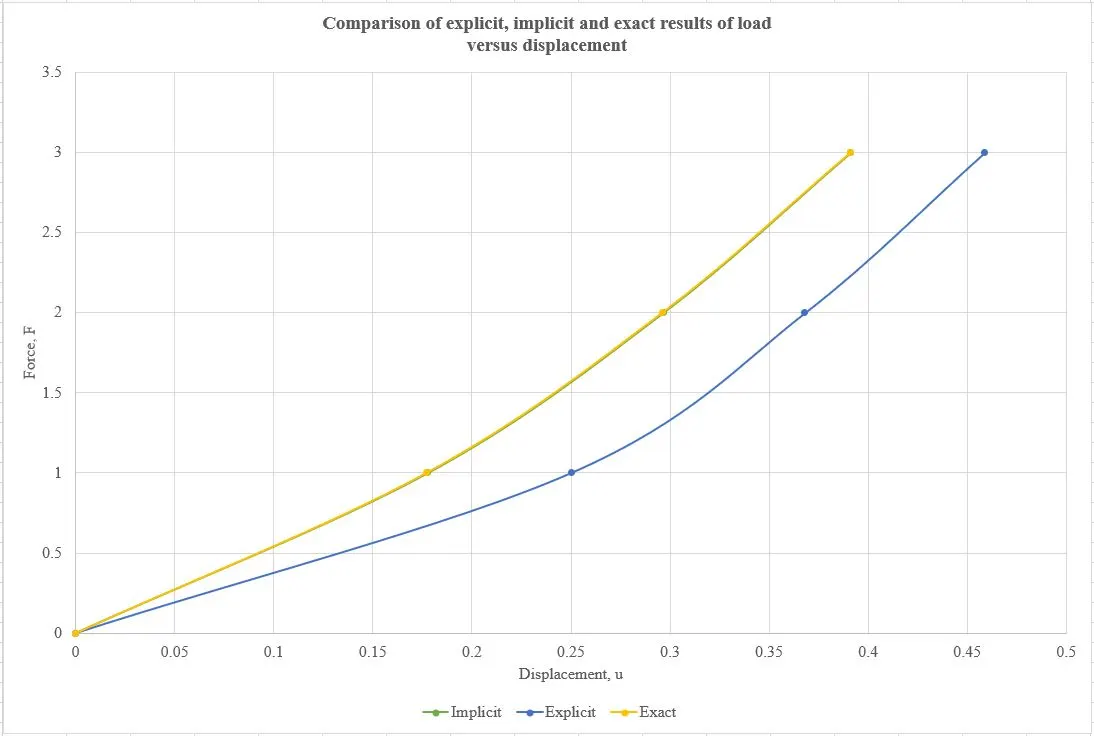
Fig.2. Single bar in tension: Comparison of explicit, implicit and exact results of load versus displacement
A plot of the results is shown in Figure 2. It is evident from the plot that the explicit analysis drifts from the exact solution.The drift from the exact solution illustrates the lack of equilibrium between the internal and external forces. To correct for this problem an implicit analysis is required.The Newton-Raphson iterations correct the incremental steps so that they land on the exact solution according to the specified tolerance. Excellent agreement is achieved with just 3 increments and in each step only two Newton-Raphson iterations are required.
Conclusion:
A nonlinear analysis is illustrated using an incremental explicit and implicit procedure. The results are plotted for comparison. It is evident from the results that the explicit analysis drifts from the true solution. To overcome this problem an implicit analysis is used, which includes Newton-Raphson iterations to enforce equilibrium between internal and external forces. The techniques demonstrated are for a load control scheme.