Week - 2 - Explicit and Implicit Analysis
Report on Explicit and Implicit Analysis
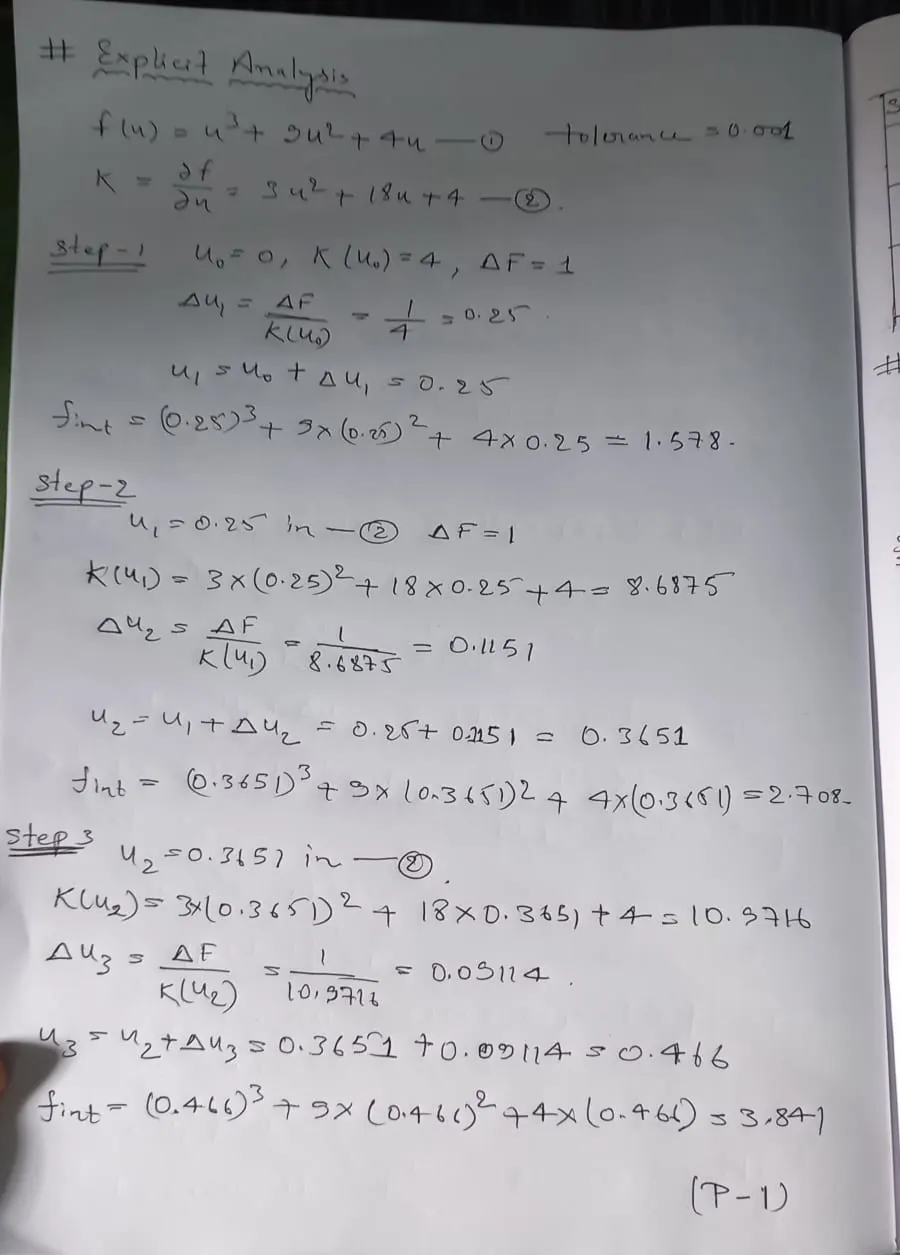
Aim:- As demonstrated in the PDF, F(u) = u3+9u2+4u use this equation and solve using both Explicit and Implicit Methods ( have a tolerence of 0.001).
Explicit Analysis:-
Explicit dynamics is a time integration method used to perform dynamic simulations when speed is important. Explicit dynamics account for quickly changing conditions or discontinuous events, such as free falls, high-speed impacts, and applied loads. Because these Non Linear are integrated into the simulation, explicit dynamics is the preferred choice for simulating highly transient physical phenomena.
In Explicit method problems are solved by Numerical methods only but it uses the slope at known time steps
e.g- Y(n+1)=Yn + Δt*Y'n (Here both Yn and Y'n are known)
Hence it is easier and faster to solve the equation in one step no further itteration is required, it will save time and cost
Use explicit dynamics when calculating highly complex and nonlinear problems involving rapid changes such as deformation or failure of material, such as:
- Drop tests.
- Impact and penetration.
- Breakage.
- Shock waves.
- Large deformations.
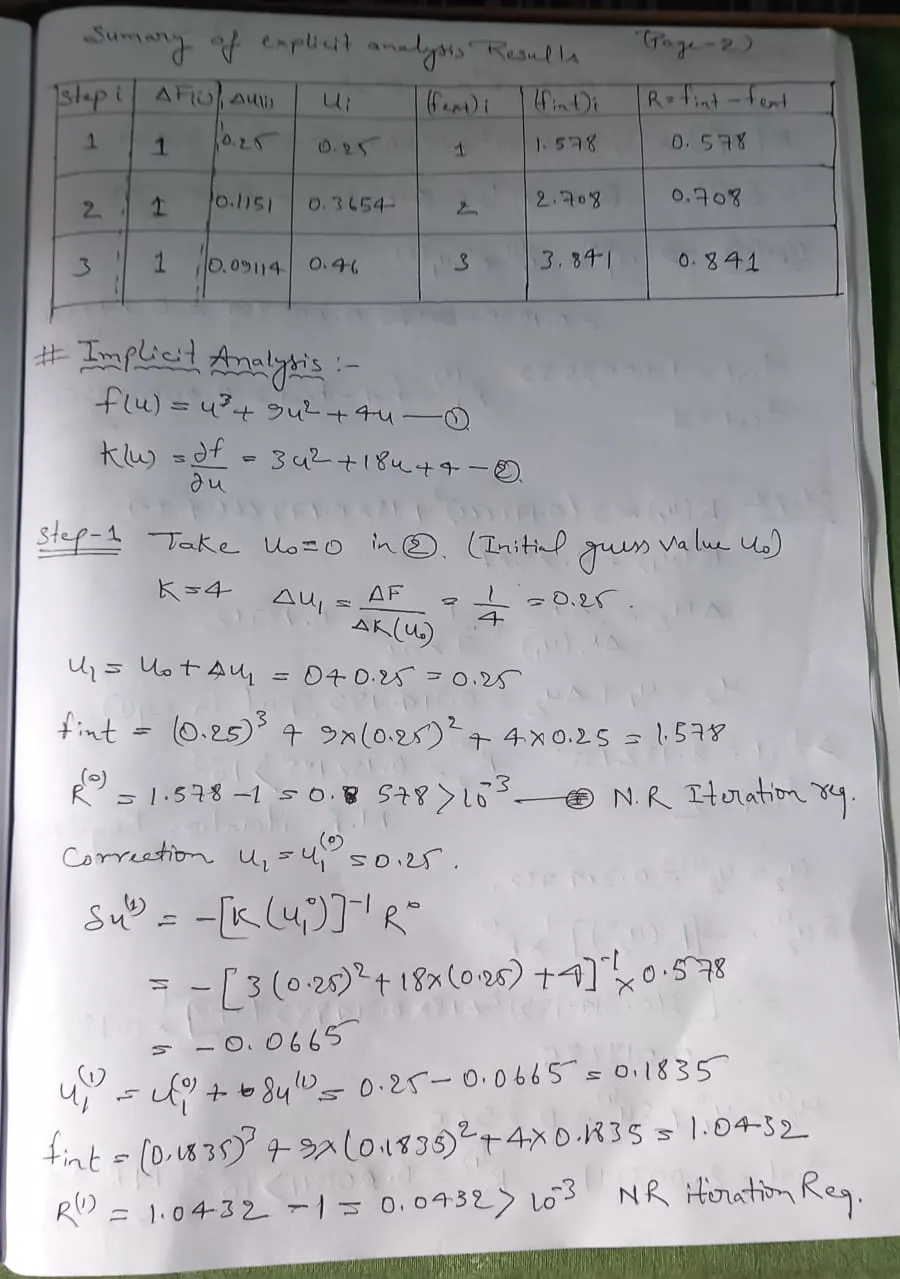
So here we have a question to be solve using Newton Raphson Method , So I uploaded the solution images and tables
which is discussed with faculty saktivel.D in group sessions
Implicit Analysis
Implicit method is also performed in same but here it uses the slope at unknown time steps
e.g- Y(n+1)=Yn + Δt*Y'(n+1) (Here Y'n+1 are unknown)
for finding unknown terms we have to guess initial value and perform newton raphson iteration as mention in the solution, after finding, we have to put the value in the equation check for residual whether it is converges to tolerance value or not , if not converges we have to do further iteration until covergence
Hence implicit method is lengthier method it will consume time and cost but is will give most accurate solution
Use implicit dynamics when solving for dynamic Finite Element Analysis problems that involve mild nonlinearity and when large timesteps can be used. This includes:
- Static equilibriums.
- Slow, linear, and mildly nonlinear processes.
- Large time increments.
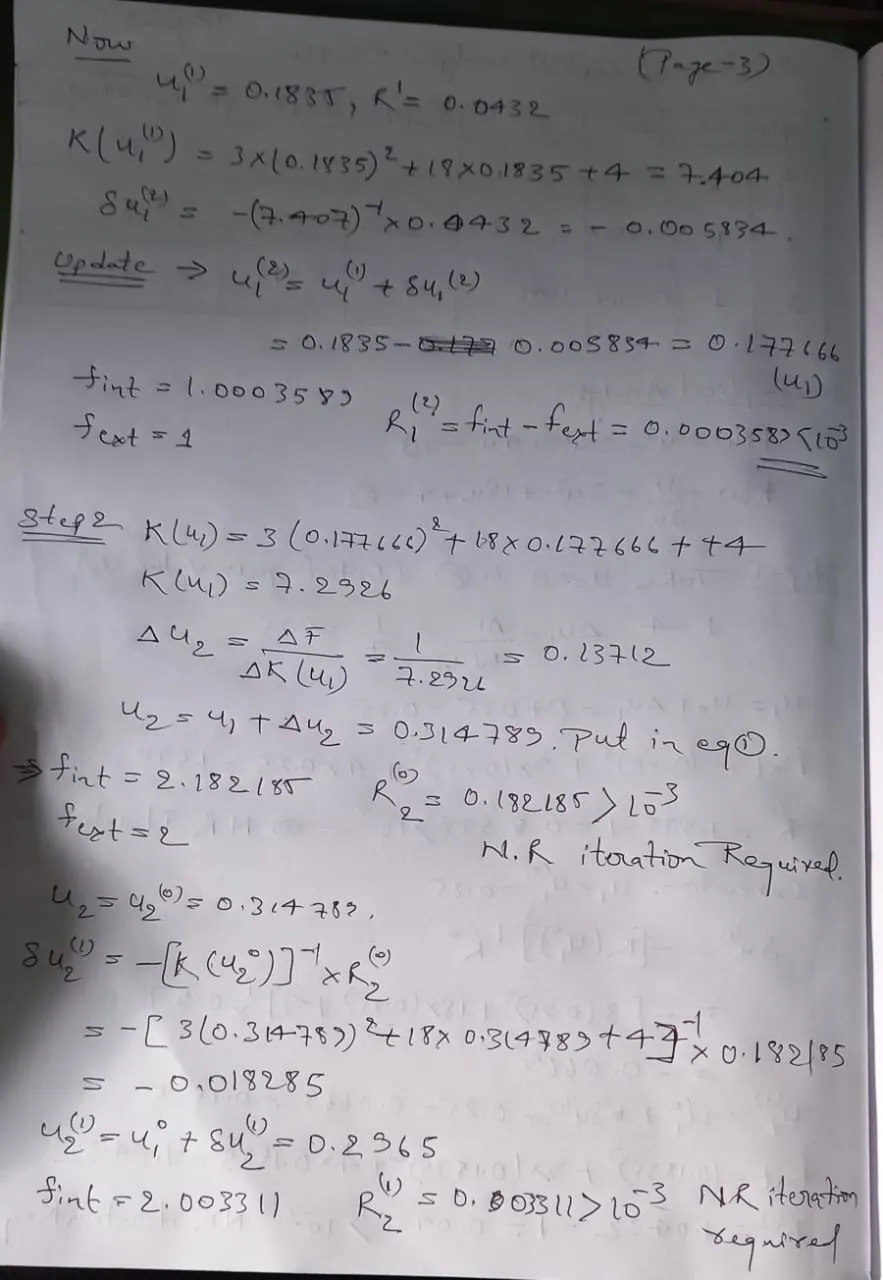
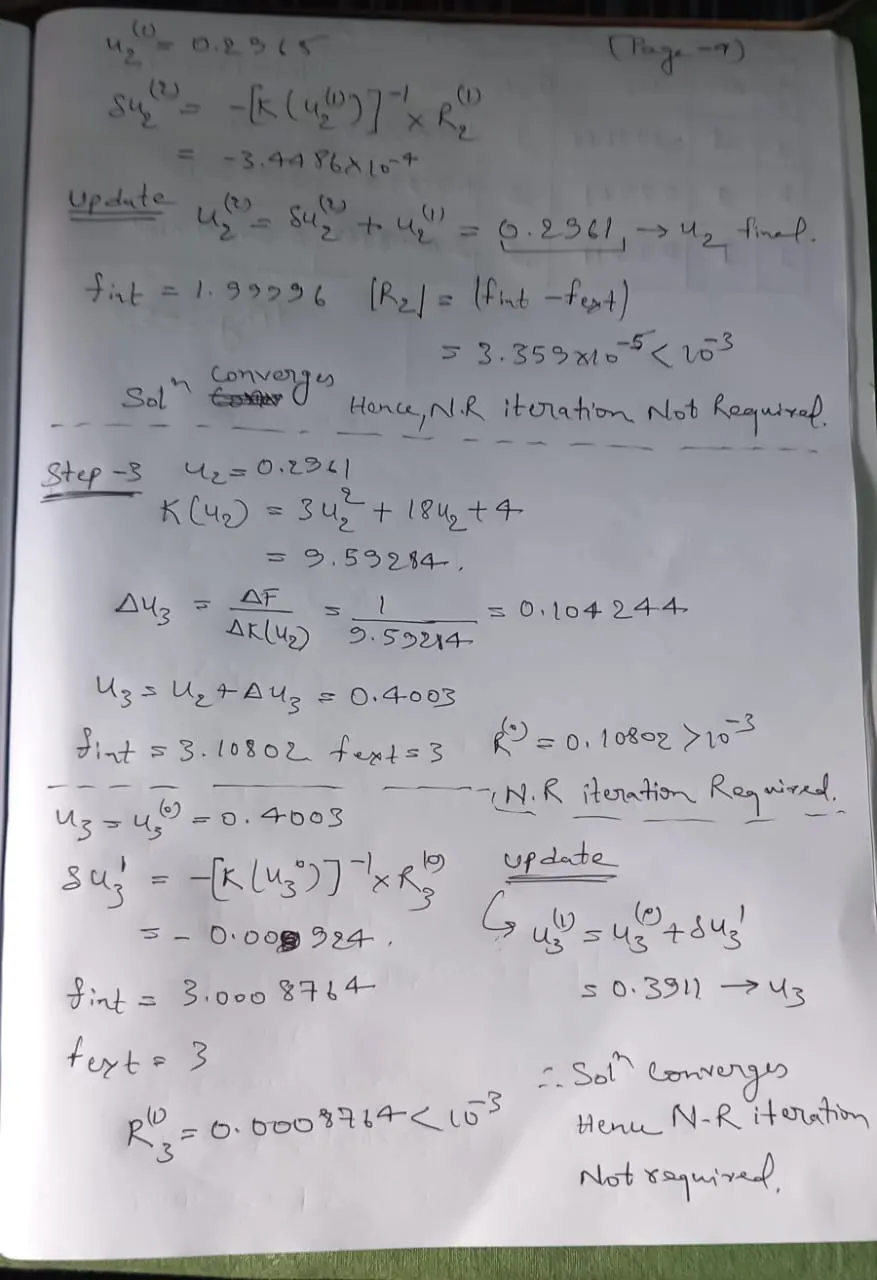
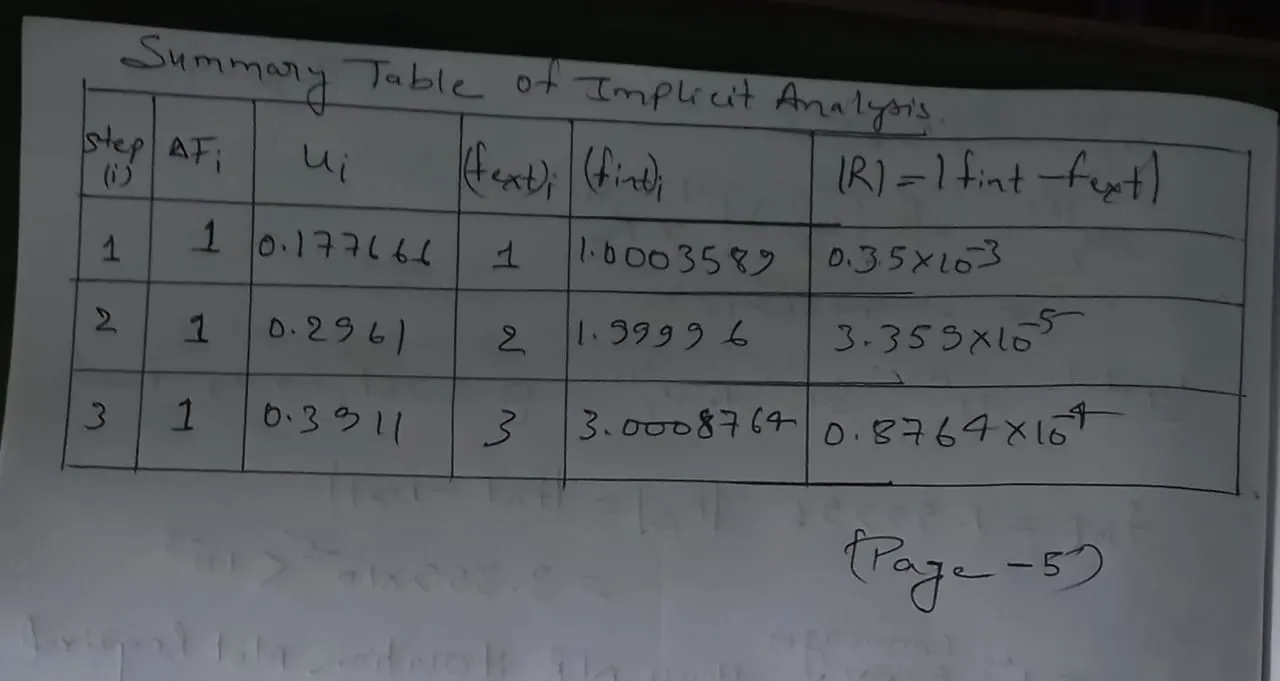
Conclusion:- we can compare both the output tables and we found that implicit method is most accurate than explicit but it lengthier and time consuming process , hence we are using Explicit method in most of the softwares
I had discussed with the saktivel.D in group session they allow me to upload the results in images