Week - 2 - Explicit and Implicit Analysis
AIM: Write a detailed report about the Implicit and Explicit methods and solve the equation `u^3+9u^2+4u` using both Implicit and Explicit Methods.
PROCEDURE:
Implicit & Explicit method
There are two types of approaches are there to solve the Finite element analysis problems, they are Implict and Explicit analysis. Implicit and Explicit analysis differ in the approach to time incrementation.In Implicit analysis each time increment has to converge for example Static structural, Harmonic, Modal analysis etc. but you can set pretty long time increments. Explicit on the other hand doesn't have to converge each increment, but for the solution to be accurate time increments must be super small for example crash, blast, Imact etc.
Implicit Method:
In implict analysis, the displacement is not a function of time (i.e.X=constant), hence the velocity and accelerations which are time derivations of displacement turn out to be Zero, mass and Damping factors can be negleted, the impilict method based on Newark's method, Newton Raphson Method etc., In order to solve an FEM problem using Implict Method, Inversion of Stifness Matrix is Required. Static analysis is done using an implicit solver in LS-DYNA. Dynamic analysis can be done via the explicit solver or the implicit solver.
In nonlinear implicit analysis, solution of each step requires a series of trial solutions (iterations) to establish equilibrium within a certain tolerance, Implicit analysis requires a numerical solver to invert the stiffness matrix once or even several times over the course of a load/time step. This matrix inversion is an expensive operation, especially for large models.
Implict methods are mainly used in softwares like ANSYS,ABACUS,NASTRAN etc.
Explicit Method:
In explicit dynamic analysis, nodal accelerations are solved directly (not iteratively) as the inverse of the diagonal mass matrix times the net nodal force vector where net nodal force includes contributions from exterior sources (body forces, applied pressure, contact, etc.), element stress, damping, bulk viscosity, and hourglass control. Once accelerations are known at time n, velocities are calculated at time n+1/2, and displacements at time n+1. From displacements comes strain. From strain comes stress. And the cycle is repeated. In explicit analysis, no iteration is required as the nodal accelerations are solved directly.
In nonlinear problems-those with large deformations and/or nonlinear material response-the highest frequency of the model will continually change, which consequently changes the stability limit. Explicit has two strategies for time incrementation control,fully automatic time incrementation (where the code accounts for changes in the stability limit) and fixed time incrementation.
LS DYNA is one of the software which used to solve the EXPLICIT analysis problem for CRASH,impact,Penetration etc...
ABAQUS,PAMCRASH also used for explict analysic problems.
| Implicit Method | Explicit Method | |
| Deformation | small | large |
| What causes large deformation | Force and dynamic | velocity, acceleration with mass and inertia |
| K matrix inversion | yes | no |
| Time step size | large | small |
| What limits the time step | accuracy | stability |
| Cost per time step | large | small |
| What dominates the cost | Matrix Inversion | Element process |
| Parallel process | Possible | not possible |
Given Equation:
Given equation `f(u) = u^3+9u^2+4u`
`k(u) = (df)/(du) =3u^2+18u+4`
where,
u= displacement
f = internal force
k = stiffness
f = external force
`grad`u = incremental displacements
`grad`F = incremental external load.
Explicit method:
step1:
`u_{o} =0,`
`k(u_{0}) = 3 * (u_{0}) ^ 2 + 18(u_{0}) + 4 = 4`
`DeltaF = 1`
`Delta u _1 = (Delta*F)/(k(u_{0})) = 1/4 = 0.25`
`u_{1} = u_{0} + Delta*u_{1} = 0.25`,
Step2:
`u_{1} = 0.25`
`k(u_{1}) = 3 (0.25) ^ 2 + 18(0.25) + 4 = 8.6875`
`DeltaF = 1`
`Deltau_{1} = (Delta*F)/(k(u_{1})) = 1/8.6875 = 0.1151`
`u_{2} = u_{1} + Delta*u_{2} = 0.3651`
Step3:
`u_{2} = 0.3651`
`k(u_{2}) = 3 * (0.3651) ^ 2 + 18(0.3651) + 4 = 10.9716`
`DeltaF = 1`
`Deltau_{2} = (Delta*F)/(k(u_{2})) = 1/10.9716 = 0.09114`
`u_{3} = u_{2} + Deltau_{3} = 0.46`
Finally from the above results the following results are obtained,
`F_(ext) = Delta F+ Delta F+ Delta F=3`
`f_(i) =(0.46)^ 3 +9(0.46^ 2 )+4(0.46)=3.79`
From the above results internal and external forces are not equal hence they are not in equilibrium.
Implicit Method:
Tolerance: 10e-02
Step1:
`u_{0} = 0,`
`k(u_{0}) = 3 * (0) ^ 2 + 18(0) + 4 = 4`
`DeltaF = 1`
`Deltau_{1} = (DeltaF)/(k(u_{0})) = 1/4 = 0.25`
`u_{1} = u_{0} + Deltau_{1} = 0.25`
Checking the residual
`F_(ext) = Delta F=1,`
`f_i =(0.25)^ 3 +9(0.25)^ 2 +4(0.25)=1.578,`
`R^ 0 =f_i -F_(ext) =1.578-1=0.578>10^ -2 .`
Therefore, Newton-Raphson iterations are necessary.
Calculate the correction to `u_{1} = u_{1} ^ 0`,
`deltau^ 1 =(-[k(u_1 ^ 0 )]^ -1 )R^ 0 =(-[3(0.25^ 2 )+18(0.25)+4]^ -1 )0.578=-0.0665`
Updated, `u_{1} ^ 1 = u_{1} ^ 0 + delta u ^ 1 = 0.25 + (- 0.0665) = 0.1835`
Checking residual again,
`F_(ext) = Delta F=1,`
`f_i =(0.1835)^ 3 +9(0.1835)^ 2 +4(0.1835)=1.042`
`R ^ 1 = 1.042 - 1 = 0.0428 > 10 ^ - 2`
Therefore, another Newton-Raphson iteration needed.
Calculate the correction to `u_{1} = u_{1} ^ 1`
`delta u ^ 2 = delta u ^ 1 - [k(u_{1} ^ 1)] ^ - 1 * R 1 = - 0.0723`
Updated, `u_{1} ^ 2 = u_{1} ^ 0 + delta u ^ 2 = 0.25 - 0.0723 = 0.178`
Checking residual again,
`F_(ext) = Delta F=1`
`f_i =(0.178)^ 3 +9(0.178^ 2 )+4(0.178)=1.00032`
`R ^ 2 = 1.00032 - 1 = 0.00032 < 10 ^ - 2`
Therefore no further iterations are necessary,
Therefore, final `u_{1} = 0.178`
Similarly, the same process is followed for `u_{2}` and `u_{3}.`
RESULTS:
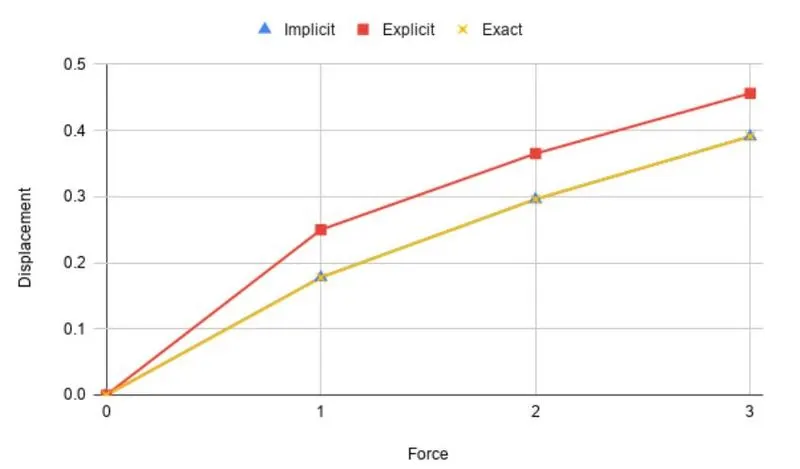
Figure1
From the plot, we can observe that the implicit method gives a solution very close to the exact solution while the explicit method drifts away from the exact solution. The drift from the exact solution illustrates the lack of equilibrium between the internal and external forces. However, with smaller time steps, the explicit method would close the gap between its solution and the exact solution.
CONCLUSION:
Explicit method is much simple and fast than the implicit method. And, it becomes very important for large non-linear problems such as crash analysis. In such problems, the explicit method is preferred and for remaining Implicit method should be used.