Week - 2 - Explicit and Implicit Analysis
OBJECTIVE: Explain the explicit and implicit methods in detail and solve the given equation using both methods and plot the necessary graphs.
PROCEDURE:
Explicit method: Explicit method evaluates the spatial derivative at 'n' time interval, equilibrium is setup for current time 't'.
it is mainly used in dynamic problems which has variables displacement, velocity , acceleration. the residual for the solution is non zero.
given equation is F(u)= u^3+9u^2+ 4u.
then F'(u) = 3u^2+18u+ 4.
`implies` K(u) = 3u^2 + 18u + 4`
now let us assume f= internal force , F(u)= external force at displacement u , u(n)= displacement at 'n' step. K(u) is stiffness matrix at displacement 'u', `Delta`F = force step, R = residual force`
step 1:
then u(1)= u(0)+ `Delta`F * 1/ k(u(0)).
`implies` u(1) = 0 + 1*1/4
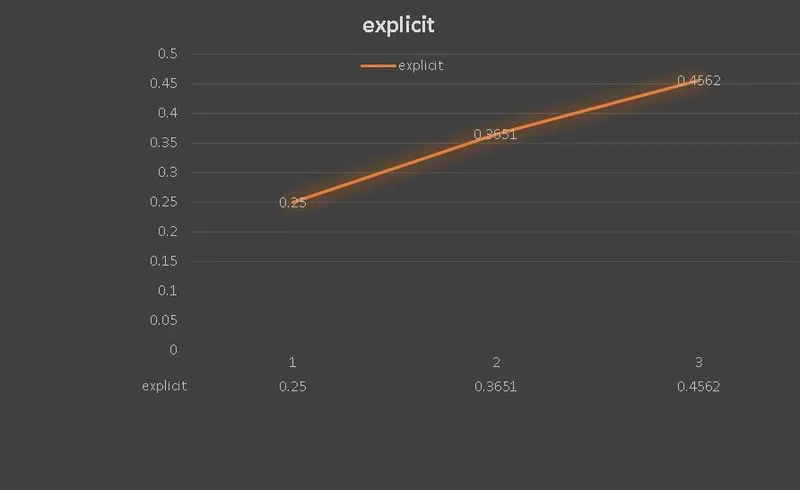
U(1) = 0.25.
`f(1)= 0.25^3 + 9* 0.25^2 +4*0.25`
f(1) = 1.578.
`implies` R = f(u) - F
R = 1.578 - 1.
R = 0.578.
as above calculate the given values by incrementing the `Delta`F.
step 2:
u(2)= u(1)+ 1* 1/k(u(1)).
`u(2) = 0.25 + 1/ 8.688`
u(2) = 0.25 + 0.1151.
u(2) = 0.3651.
`implies` f(u(2))= 2.709.
then R = 0.709
step 3:
`u(3) = u(2) + 1* 1/10.97`
`u(3) = 0.3651 + 0.0911`
u(3) = 0.4562.
then,
f(u(3)) = 3.793.
R= 0.793.
| Step no. | u(i) | F(u) | `Delta`F | `Delta`u | f(u) | R |
| 0 | 0 | 0 | 0 | 0 | 0 | 0 |
| 1 | 0.25 | 1 | 1 | 0.25 | 1.578 | 0.578 |
| 2 | 0.3651 | 2 | 1 | 0.1151 | 2.709 | 0.709 |
| 3 | 0.4562 | 3 | 1 | 0.0911 | 3.793 | 0.793 |
below is the graph for Displacement vs External force.
Implicit method:
In this method the spatial derivative is evaluated at 'n+1' interval equilibrium is set for new time 't(n+1)' .
Residual is zero and used for static and small deflection problems. Iterations are required for achieving the equilibrium.
it has no convergence problem.
given the equation is f(u) = `u^3+9u^2+4u`
and f'(u) = k(u) = `3u^2+18u+4`
then by implicit method
let's assume u(0)=0 , f(0) = 0 and F(u) = external force. `R^(n)`= residual at 'n' iteration and `deltau^(n)` = change in displacement at 'n' iteration.
now
u(1) = u(0) + `DeltaF * 1/(K(u())` ( `deltau^(0) = DeltaF * 1/(K(u(0))` )
u(1) = 0+ 1/4
`u^0(1)` = 0.25.
then f(1) = `0.25^3 + 9* 0.25^2 + 4*0.25`.
`(1) = 1.5781`
then `R^0 = f-F`
`R^0 = 0.5781 > 0.001`
newton-raphson iteration is required
then `deltau^(j+1) = -(K(u^j))^-1 * R^j`
`implies` `deltau^1 = -(K(u^0(1)))^-1 * R^0`
`implies` `deltau^1 = - (K(0.25))^-1 * 0.5781`
`deltau^1 = - ( 0.1151) *0.5781`
`deltau^1 = -0.0665`
now, `u^1(1) = u(1) + deltau^1`.
`implies` `u^1(1) = 0.25 - 0.0665 = 0.1835`
then `f(u^1(1)) = 0.1835^3 + 9*0.1835^2 + 4*0.1835`
`f(u^1(1)) = 1.0432`
`R^1` = 1.0432-1 = 0.0432 >0.001
Iteration is necessary
then `deltau^2 = deltau^1+`correction factor`
`deltau^2 = deltau^1 + -K(u^1(1))^-1 *R^1`
`deltau^2 = -0.0665 - (0.1350 *0.0432)`
`deltau^2 = -0.0723`
`u^2(1) = u^0(1) + deltau^2`
`u^2(1) = 0.25 + (-0.0723)`
`u^2(1) = 0.1778`
then
`f(u^2(1)) = 0.1778^3 + 9* 0.1778^2 + 4*0.1778`
`f(u^2(1)) = 1.0013`
then `R^2` = 1.475- 1 = 0.0013 > 0.001
Iteration is necessary.
then
`deltau^3 = deltau^2 + (- K(u^2(1)))^-1 *R^2`
`deltau^3 = -0.0723 + ( - 0.1371) * 0.0013`
`deltau^3= -0.0724`
then
`u^3(1) = u^0(1) + deltau^3`
`u^3(1) = 0.25- 0.0724`
`u^3(1) = 0.1775`
then
`f(u^3(1)) = 0.1775^3 + 9*0.1775^2 + 4*0.1775`
`f(u^3(1)) = 0.9991`
then
`R^3 = 0.9991-1 = 0.0008 < 0.001`
no Iteration is necessary
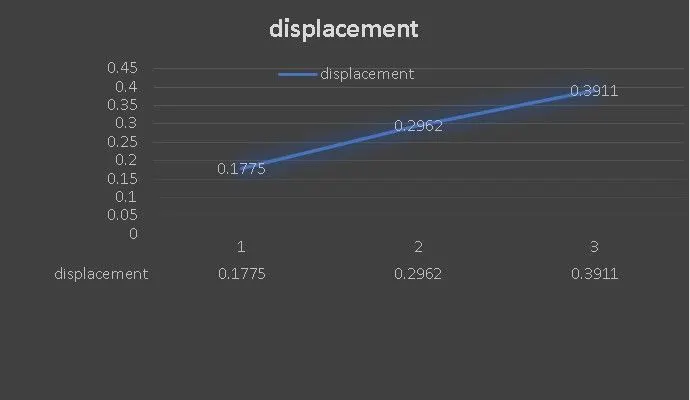
the final u(1) value is `u^3(1) = 0.1775`
repeat these steps and iterations for F= 2 and F=3.
and we get
for F=2 , u(2) = 0.2962
for F=3 , u(3) =0.3911
| step no. | External force | internal force | u(i) | `delta u(i)` | Residual |
| 1 | 1 | 0.9991 | 0.1775 | 0.1775 | 0.0008 |
| 2 | 2 | 2.0004 | 0.2962 | 0.1187 | 0.0004 |
| 3 | 3 | 3.0008 | 0.3911 | 0.0949 | 0.0008 |
graph for displacement vs external force :
comparison of both methods
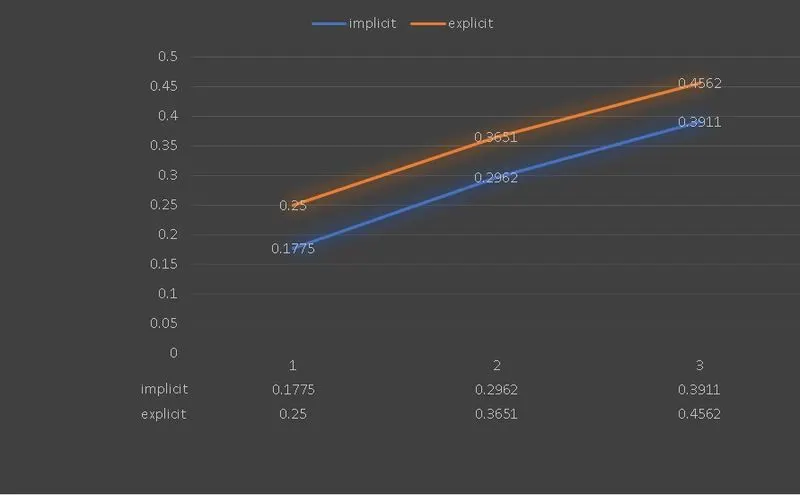
We can see the difference between the two methods implicit is more accurate but time consuming and explicit is less accurate but computational time is less.
CONCLUSION:
In this challenge I have worked on the implicit and explicit methods and how they function.
implicit used for static problems and explicit is used for dynamic problems
learnt the accuracy differences in both methods.