Week - 2 - Explicit and Implicit Analysis
EXPLICIT AND IMPLICIT ANALYSIS
EXPLICIT ANALYSIS are generally used for the problem which has dynamic and inertia effect.It is most helpful in solving high deformation time-dependent problem like Crash,Drop,blast,Impact.etc..It is Non-equilibrium that means sum of all Forces=Mass x Acceleration.
IMPLICIT ANALYSIS are used for static problem where no inertia effect in which equilibrium problem where sum of all forces are zero.In this method of analysis all types of Non-linearity can be defined.Implicit approach is useful in problems in which time dependency of the solution is not an important factor.(eg). Static,Vibration,Oscillation,Structural,Harmonic etc..
DIFFERENCE BETWEEN EXPLICIT & IMPLICIT:
|
IMPLICIT |
EXPLICIT |
|
More accurate |
Less accurate |
|
Highly time Consuming for Large Models |
Computationally efficient for large models with relatively short dynamics response time |
|
Implicit means we cannot discriminate |
Explicit means we can discriminate |
Explicit doesn't need any iteration scheme.
Implicit need iteration scheme,where we cannot solve directly.
Both Implicit & Explicit schemes are used for solving dynamic events.Implicit scheme is incremental as well as iterative process(ie) it satisfy the equilibrium conditions at every time step and very unconditionally stable due to which we also choose very large time steps,while in Explicit scheme is only incremental process not iterative(ie) it doesn't satisfy equilibrium conditions at every time step which means if any error occurs during the tme step it will keep on magnifying so it is only conditionally stable.
CALCULATION:
GIVEN
F(u) = u3+9u2+4u use this equation and solve using both Explicit and Implicit method
EXPLICIT METHOD:
F(u) = u³+9u²+4u
For stiffness,
K(u)=df/du=3u²+18u+4
The variables used are u for displacement, f for internal force in the bar, F for external force applied to the bar and k for stiffness. Incremental displacements or incremental externally applied forces are represented as Δu or ΔF, respectively.
From the above, the relationship made is ΔF = kΔu.
STEP 1:
For initial conditions where, ΔF=1
u0= 0, => k(u0) =3(0) ²+18(0) +4
k(u0) = 4
Δu1= ΔF/k(u0) = 1/4
Δu1=0.25
u1=u0+Δu1=0+0.25
u1=0.25
STEP 2:
k(u1) = 3(0.25) ²+18(0.25) +4
= 8.687
Δu2= ΔF/k(u1) = 1/8.687
Δu2= 0.115
u2=u1+Δu1=0.25+0.115
u2= 0.365
STEP 3:
k(u2) = 3(0.365) ²+18(0.365) +4
= 0.399+6.57+4
k(u2) = 10.969
Δu3= 1/10.969
Δu3= 0.091
u3= u2+Δu3= 0.365+0.091
u3= 0.456
From the above calculation,
Fext= ΔF + ΔF + ΔF= 1+1+1=3
f1, f2, f3 are Fint (i.e., Internal forces)
f1=u1³+9u1²+4u1 = 0.25³+9(0.25) ²+4(0.25)
= 0.015+0.562+1
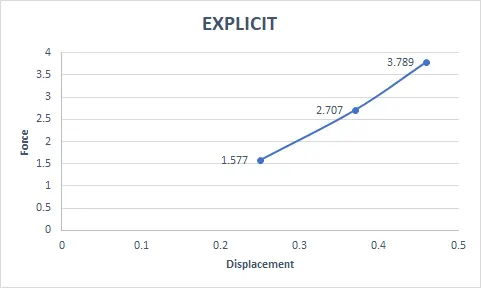
f1= 1.577
f2= u2³+9u2²+4u2 = (0.365) ³+9(0.365) ²+4(0.365)
= 0.048+1.199+1.46
f2= 2.707
f3= u3³+9u3²+4u3 = (0.456) ³+9(0.456) ²+4(0.456)
= 0.094+1.871+1.824
f3= 3.789
The table below summarizes the main results for the explicit analysis
|
STEP |
ΔF |
ΔU |
U |
Fext |
Fint |
Fint- Fext =R |
|
1 |
1 |
0.25 |
0.25 |
1 |
1.577 |
0.577 |
|
2 |
1 |
0.115 |
0.365 |
2 |
2.707 |
0.707 |
|
3 |
1 |
0.091 |
0.456 |
3 |
3.789 |
0.789 |
GRAPH PLOT:
IMPLICIT METHOD:
STEP 1:
Given tolerance is 0.01
u0=0.0 => k(u0) = 4, ΔF= 1, Δu1= ΔF/ k(u0) =0.25,
u1= u0 + Δu1= 0.25
Checking the residual,
Fext = ΔF = 1
Fint = u13+9u12+4u1 = (0.25) ³+9(0.25) ²+4(0.25)
Fint = 1.578
R (0) = Fint - Fext =1.578 -1
R (0) = 0.578
R (0) > 10-2 => Newton-Raphson iterations are necessary
Calculate the new total correction to u1=u1(0)
δu (1) = −[k(u10)]-1R0 = - [3(0.25) ²+18(0.25) +4]-1 * 0.578
= - (8.687)-1*0.578 = - (0.115) * 0.578
δu (1) = -0.06647
updating value u11= u0 + δu (1) = 0.1835
Checking again
Fext = ΔF = 1
Fint = u3+9u2+4u = (0.1835) ³ +9 (0.1835) ² +4(0.1835) = 1.043
R (1) = Fint - Fext = 0.043
R (1) > 10-2 => so, Newton-Raphson iterations are necessary
Calculate the new total correction to u1=u1(0)
δu (2) = δu (1) − [k(u11)]-1R1 = -0.06647 - [3(0.1835) ²+18(0.1835) +4]-1 * 0.043
δu (2) = -0.07227
u12= u1(0) + δu (2) = 0.25 -0.07227
u12 = 0.1777
Checking the residual,
Fext = ΔF = 1
Fint = u13+9u12+4u1 = (0.177) ³+9(0.177) ²+4(0.177)
Fint = 1.0006
R (2) = Fint - Fext =1.0006 -1
R (2) = 0.0006
R (0) < 10-2 => Newton-Raphson iterations are not necessary
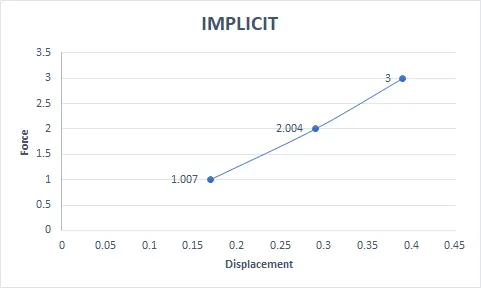
Therefore, the final value is u1= u12 = 0.1777
STEP 2:
u1=0.1777 => k(u1) = 7.293, ΔF= 1, Δu2= ΔF/ k(u1) =0.137,
u2= u1 + Δu2= 0.3148
Checking the residual,
Fext = ΔF + ΔF = 2
Fint = u23+9u22+4u2 = (0.137) ³+9(0.137) ²+4(0.137)
Fint = 2.182
R (0) = Fint - Fext =2.182 - 2
R (0) = 0.182
R (0) > 10-2 => Newton-Raphson iterations are necessary
Calculate the new total correction to u1=u1(0)
δu (1) = −[k(u20)]-1R0 = - [3(0.137) ²+18(0.137) +4]-1 * 0.182
δu (1) = -0.0182
updating value u21= u20 + δu (1) = 0.3148 -0.0182 = 0.2966
Checking the residual,
Fext = ΔF+ ΔF = 2
Fint = u3+9u2+4u = 2.004
R (1) = Fint - Fext = 2 – 2.004 = 0.004
R (1) < 10-2 => Newton-Raphson iterations are not necessary
Therefore, the final value is u2= u21 = 0.2966
The above procedure has been followed to solve Step 3,
The final value is u3 = 0.3911
The table below summarizes the main results for the Implicit analysis
|
STEP |
ΔF |
ΔU |
U |
Fext |
Fint |
Fint- Fext =R |
|
1 |
1 |
0.25 |
0.17 |
1 |
1.007 |
0.0071 |
|
2 |
1 |
0.137 |
0.29 |
2 |
2.004 |
0.0042 |
|
3 |
1 |
0.104 |
0.39 |
3 |
3.000 |
0.0008 |
GRAPH PLOT:
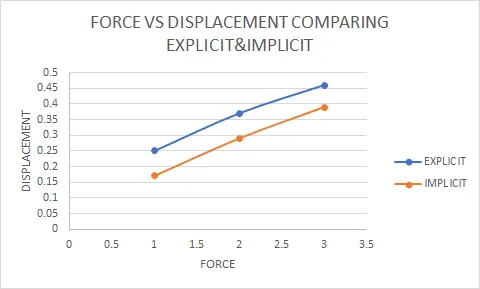
COMPARING EXPLICIT AND IMPLICIT:
CONCLUSION:
Hence we have explained about explicit and implicit analysis,calculation has been done separately for both the method.we defines the Graph of Explicit and Implicit method and compared both the result from that we have come to a conclusion that Implict method are accurate but time consuming,Whereas Explicit is not that much accurate.