Week - 2 - Explicit and Implicit Analysis
AIM: To understand the difference between explicit and implicit analysis by solving the given equation.
PROCEDURE:
EXPLICIT ANALYSIS:
Explict analysis are mostly used when the analysis is time dependent.The time step in explicit analysis must be less than the Courant time step which is the time taken for the sound wave to travel across the element.An explicit method uses only known information to calculate the unknown value (i.e) it calculate the state of a system at a later time from the state of the system at the current time.In large models, the inversion of the matrix is not difficult as it is a diagonal matrix and needs inversion of the terms on the diagonal only.Hence it does not need advance solver.But the solutions are not as stable as implicit analysis and since it is time dependent it has smaller time step.
SOLVING THE EQUATION:
F(u) = u3+9u2+4u
three equal load increments (or steps) of ∆F = 1 unit each are used to load the tension bar. The variables used are u_ for displacement, f_ for internal force in the bar, F_ for external force applied to the bar and k for stiffness.
k(U) = (∆F/∆u)
∆u = ∆F/k(u)
∆u1 = ∆F/3u02+18u0+4
Now take U0 = 0 and ∆F = 1
∆u1 = .25
U1 = U0 + ∆u1
U1 = 0 + .25 = .25
∆u2 = ∆F/u12+18u1+4
Now take u1 = .25 and ∆F = 1
∆u2 = .115
u2 = U1 + ∆u2
U2 = .25 + .115 = .365
∆u3 = ∆F/u22+18u2+4
Now take u1 = .25 and ∆F = 1
∆u3 = .0911
u3 = u2 + ∆u3
u3 = .365 + .0911 = .46
FEXT = ∆F1+∆F2+∆F3 = 3
FINT = u3+9u2+4u
By sybstituting the value of u1,u2 and u3 we get f1,f2 and f3
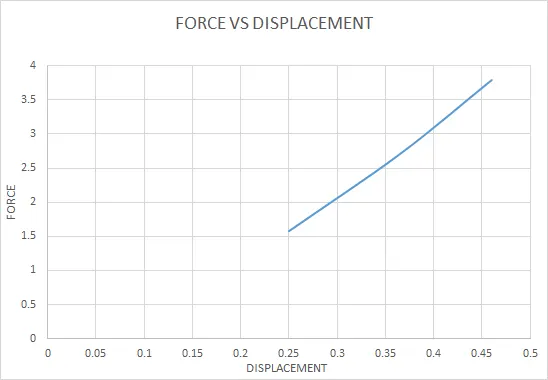
F(INT)1 = 1.578, F(INT)2 = 2.708, F(INT)3 = 3.841
since FEXT and FINT are not equal we need to find residue which is
R = FINT - FEXT
| ∆F | ∆U | U | F(ext) | F(int) | R |
| 1 | 0.25 | 0.25 | 1 | 1.5781 | 0.5781 |
| 1 | 0.115 | 0.365 | 2 | 2.7087 | 0.7087 |
| 1 | 0.0911 | 0.46 | 3 | 3.7928 | 0.7928 |
IMPLICIT ANALYSIS:
Explict analysis are mostly used when the analysis is not time dependent.This is because the load acting on the model may be very slow that the acceleration effects are negligible.Implicit analysis find a solution by solving an equation involving both the current state of the system and the later one.For large models, inverting the matrix is highly expensive and will require advanced iterative solvers.These solutions are unconditionally stable and facilitate larger time steps. Despite this advantage, the implicit methods can be extremely time-consuming when solving dynamic and nonlinear problems.
SOLVING THE EQUATION:
F(u) = u3+9u2+4u
three equal load increments (or steps) of ∆F = 1 unit each are used to load the tension bar. The variables used are u_ for displacement, f_ for internal force in the bar, F_ for external force applied to the bar and k for stiffness.
k(U) = (∆F/∆u)
∆u = ∆F/k(u)
∆u1 = ∆F/3u02+18u0+4
Now take U0 = 0 and ∆F = 1
∆u1 = .25
U1 = U0 + ∆u1
U1 = 0 + .25 = .25
FEXT= 1
FINT = u3+9u2+4u = 1.57
R = .57
since R > 10-2 newton Raphson iterations are necessary
δu1 = -[k(∆u1)]-1*R
= -.0665
U1 = U0 + ∆u1 = .184
FEXT= 1
FINT = u3+9u2+4u = 1.043
R = .043
since R > 10-2 newton Raphson iterations are necessary
δu2 = -[k(∆u2)]-1*R
= -.0714
U1 = U0 + ∆u1 = .178
FEXT= 1
FINT = u3+9u2+4u = 1.0071
R = .0071
since R < 10-2 newton Raphson iterations are not needed.
Hence the above step is repeated to find the remaining values of U2,U3 and F2,F3
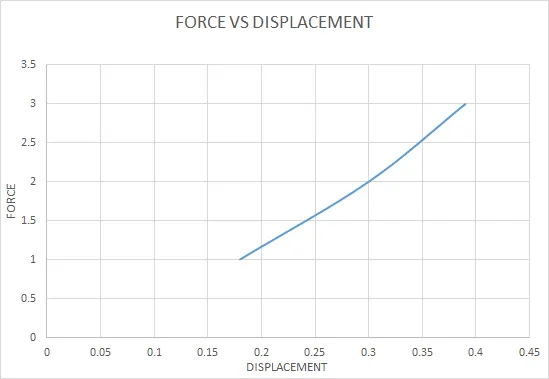
U2 = .296, U3 = .391, F2 = 2.004, F3 = 3.0008
| ∆F | ∆U | U | F(ext) | F(int) | R |
| 1 | 0.25 | 0.18 | 1 | 1.007 | 0.007 |
| 1 | 0.1374 | 0.3 | 2 | 2.004 | 0.004 |
| 1 | 0.1041 | 0.39 | 3 | 3.0008 | 0.0008 |
CONCLUSION:
From the give value we could find that the time step is small for explicit analysis than the implicit analysis.But the internal forces are slightly greater than the implicit analysis.Thus the equation is solved for both the implicit and explicit analysis and the first 3 time step has been calculated.