Week 2 - Converging diverging nozzle
Converging-Diverging nozzle:
The flow area decreases with decrease in pressure and increase in velocity and at the throat,Area is constant where Mach number becomes 1 and then flow area increases with rapid decrease on flow density due to the density parameter pressure also reduces with increase in velocity. Converging-diverging nozzles used by Swedish Engineer Carl G.B. de Laval in 1893 to support the steam turbine
important relation that change in area is related to the pressure ,velocity ,density,Mach Number will helps to determine the geometry whether it is a nozzle or diffuser.The relation is given below
`frac{dA}{A}=frac{dP}{rho*v^2}*(1-Ma^2)`
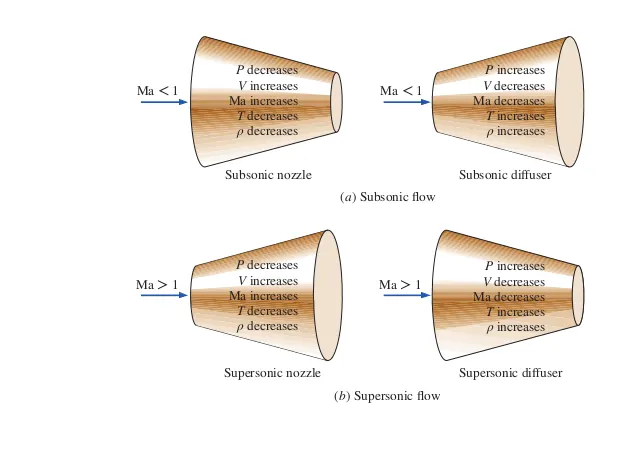
For subsonic flow,change in area and pressure in the same sign,i.e.,decrease in area will leads to decrease in pressure and vice versa
For supersonic flow,change in area and pressure would be in opposite sign,i.e..,decrease in area will leads to increase in pressure and vice versa
Nozzle increases the velocity by reducing the pressure through adiabatic process.
Diffusers increases the pressure by decreasing the velocity through adiabatic process.
For convergent nozzle,extending the nozzle will never increases beyond sonic velocity ,it will simply decrease the massflow rate.
There are some of relations derived by assuming a compessible fluid such as air through the isentropic process for nozzles or diffusers.Assuming fluid is an ideal gas
`frac{underset(0)(T)}{T}=1+frac{gamma-1}{2}*Ma^2`
`frac{underset(0)(rho)}{rho}=[1+frac{gamma-1}{2}*Ma^2]^frac{1}{gamma-1}`
`frac{underset(0)(P)}{P}=[1+frac{gamma-1}{2}*Ma^2]^frac{gamma}{gamma-1}`
Back pressure refers to pressure opposed to the desired flow of a fluid in a confined place such as a pipe. Back pressure is not pressure traveling in the opposite direction, it is actually the remnants of pressure in the desired direction of movement.
behaviour of flow in nozzles or diffusers can also determined by one more parameter such as back pressure.Due to back pressure some of the parameters are affecting they are mass flow rate at subsonic flow,creation of shock waves at supersonic flow.shockwaves will increases the pressure and drops the velocity
Normal shock waves yields a subsonic after fluid passed through shock wave . but oblique shocks yieds a sonic,supersonic,subonic flows after passing through oblique shock waves and bow shock wave will find on the blunt body shapes where the deflection angle is greater then wedge angle and it is combination of both normal and oblique shock waves.expansion waves is opposite to the shock waves,it increases the velocity and decreases the pressure.
Objective:
To observe variations in velocity ,pressure,temperature and mach number on the computational domain
Domain:
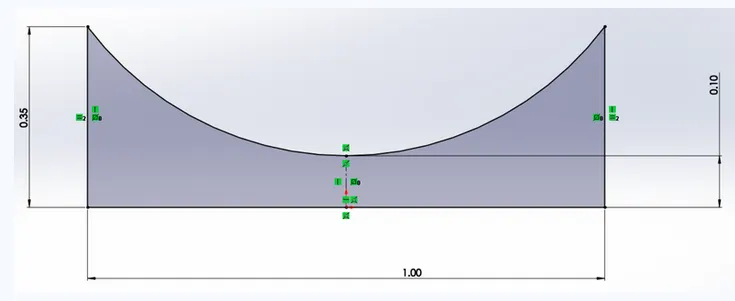
Boundary conditions:
- At Inlet, Pressure = 1atm and Temperature = 300K. The outlet pressure= 0.027 atm.
- In the operating conditions, consider the reference pressure to be zero.
Procedure:
To compute the parameters on the whole domain Ansys fluent solver is used.To utilise the Ansys fluent solver there is a standard workflow will be followed.
Geometry creation:
Selected the sketch mode in the spaceclaim software .Using line,arc and dimension options geometry created in 2D
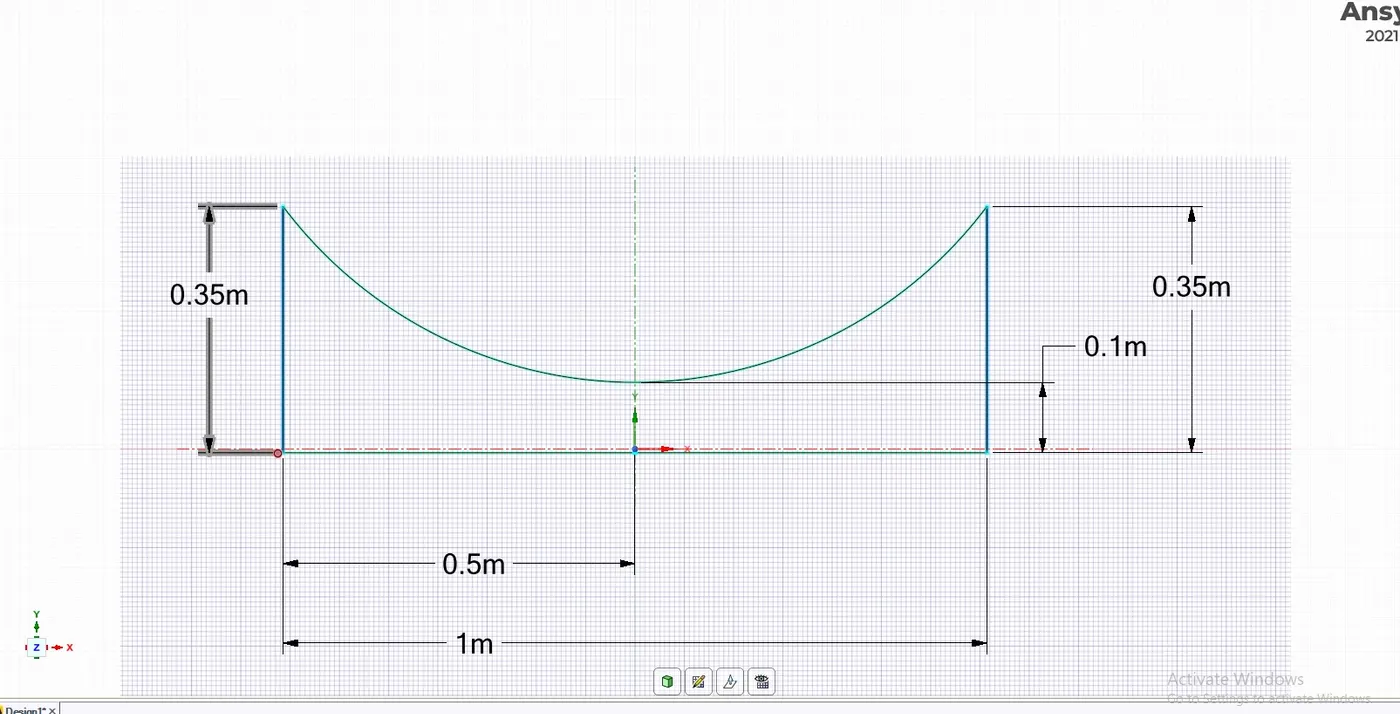
After selecting exit sketch,surface is created
Meshing:
To generate a mesh,element size 1mm is selected.Quad type of elements are presented more in the generated mesh.
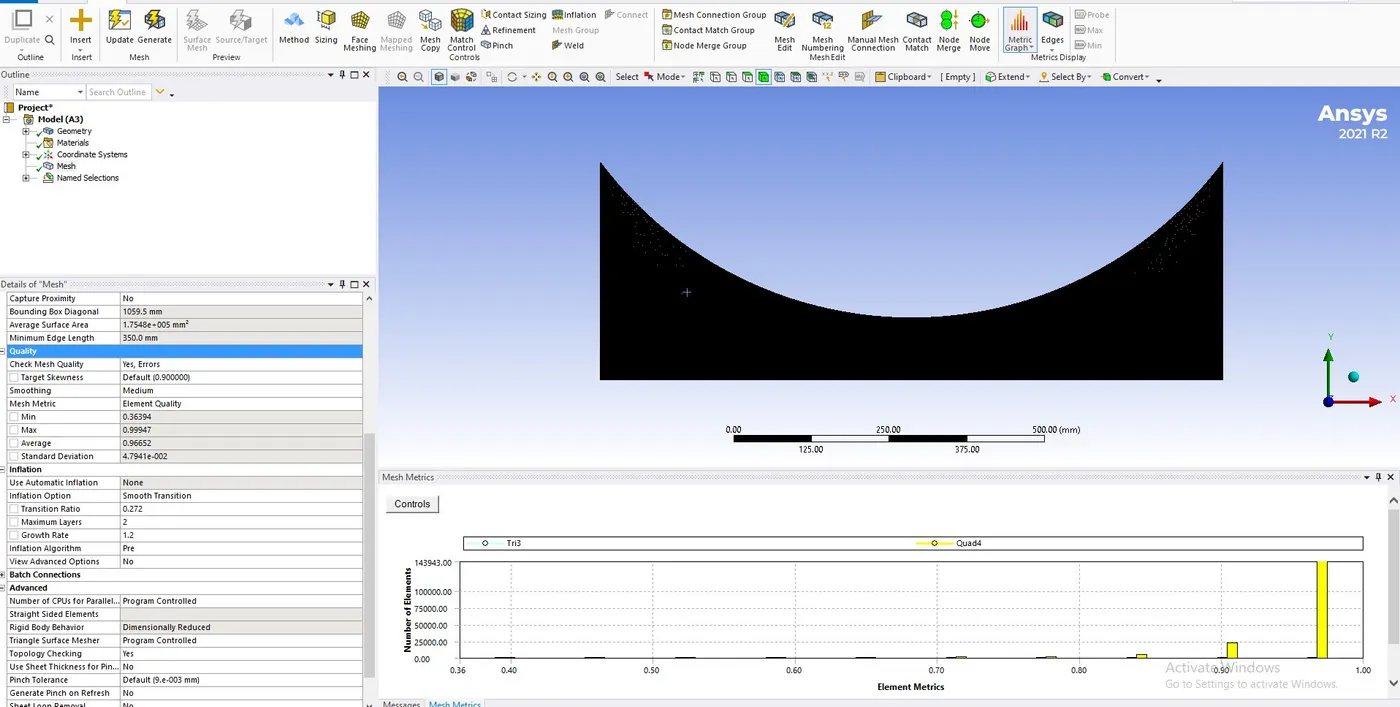
Once mesh is generated then selected element quality under the mesh metric,to understand the quality of the created mesh and then updated.
Solver:
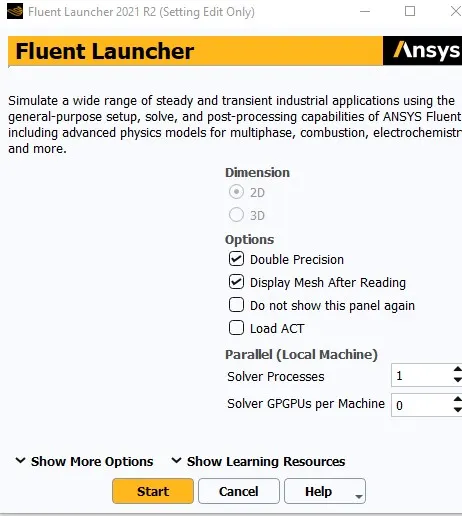
- Fluent Launcher window appears,on that choose 2D (or)3D and for precise output ,checkmark for double precision and number is entered on the no of processors availale for solver and then click start.
- Domain->check->perform mesh chesk will be selected ,to determine the mesh quality

- Domain->Quality->evaluate mesh quality will be selected,will determine orthogonal quality and aspect ratio

- under the general task page.Density-Based,Axisymmetric,absolute and steady is selected.
For compressible flow density based solver is needed.
Axisymmetric is selected due to nozzle parameter symmetric about axis and solver should use axisymmetric cordinates in the governing equations
Global cordinate system is used for parameters ,absolute is selected
Steady state is obtained after the transient state.selecting steady will provide solution for minimal computational cost.
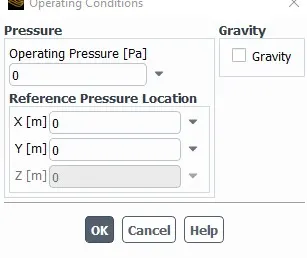
- Operating conditions are selected then operaring pressure is said to be 0 and then click ok.
if we use guage pressures then to calculate absolute pressure by adding guage pressure and operating pressure.
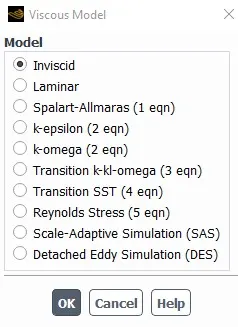
- To include a temperature as described, then energy is checked and to solve the problem for understand the theory inviscid model is selected.
- selecting flowing material as air in the CD nozzle,due to compressible flow the gas parameters will change based on the ideal gas so that for density it is assumed to be ideal gas
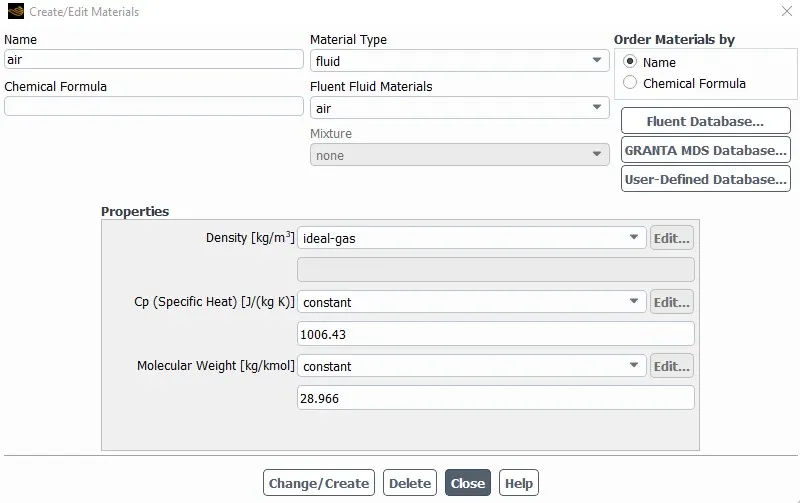
- Assigned this material for the surface under the cellzone conditions
- Under the boundary conditions there is set of names ,it is created before creating the mesh.Assumed boundary type for the names is given below
pressure inlet for inlet
Pressure outlet for outlet
interior for surface
wall for the curved line
axis for the center line
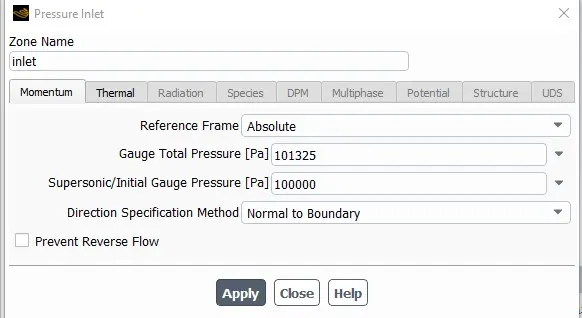
- Pressure of fluid is entering the nozzle at 1 atm , temperature 300 K and pressure of the fluid exiting the nozzle with 0.027 atm.by converting values from atm to Pa and then entered in inlet and exit Boundary conditions ,on inlet Boundary condition 100000 is given for initialising purpose.
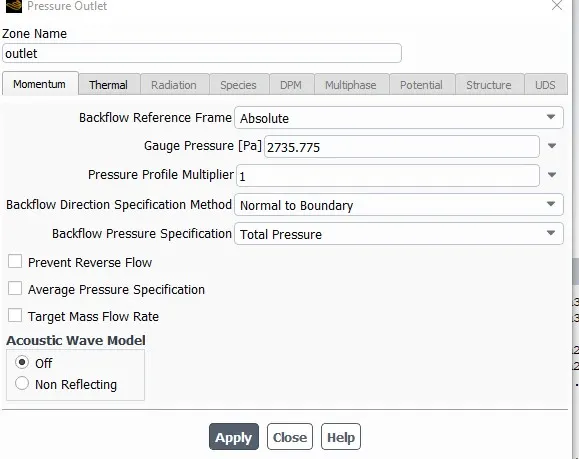
creating reports to determine the simulation reached convergence
hybrid intialisation after intialising utilising fmg intialisation

- Run for 11500 iterations ,it is based upon scaled residuals and machno at the outlet for checking the convergence
Plot:
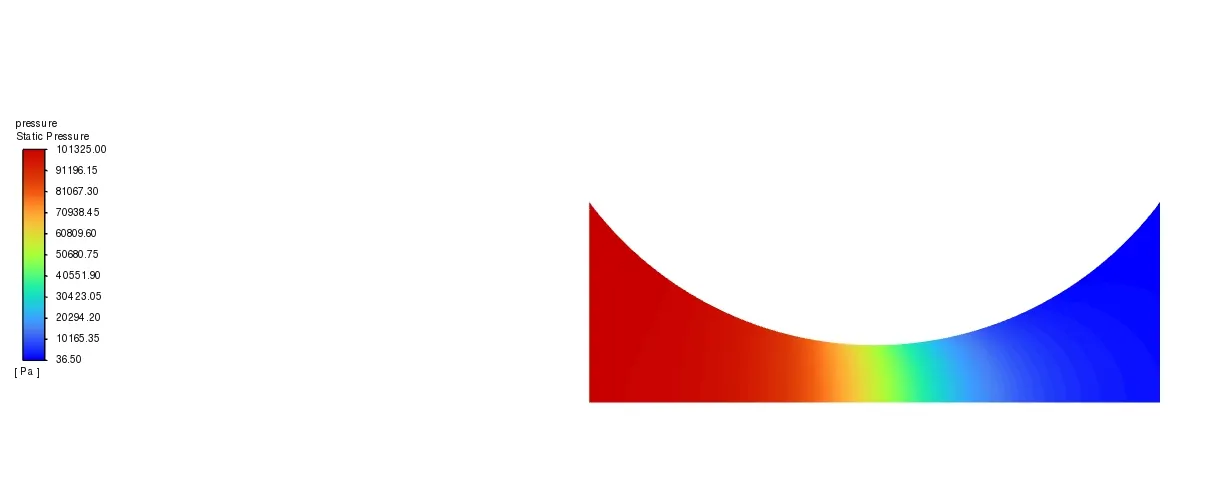
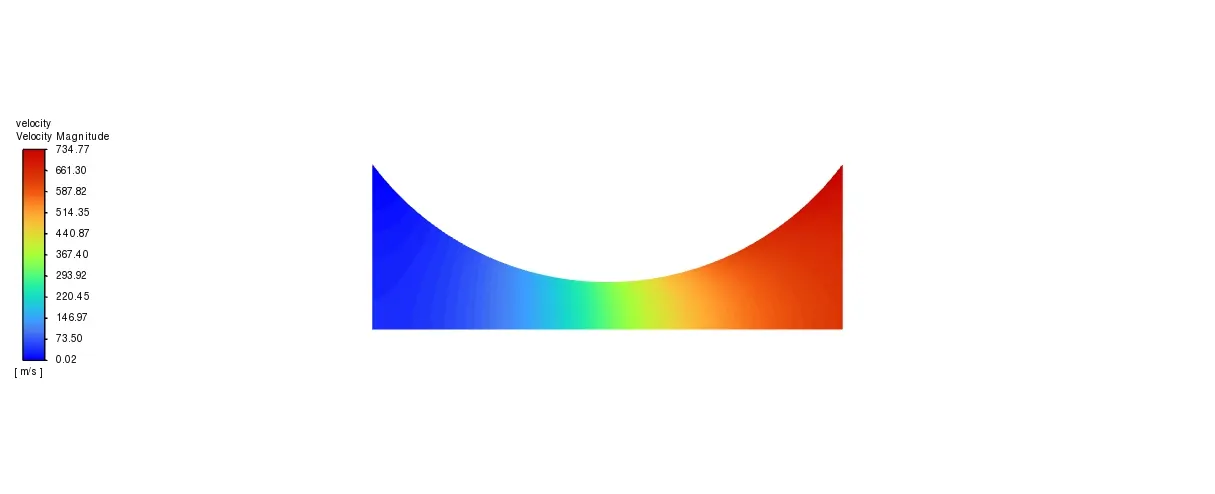
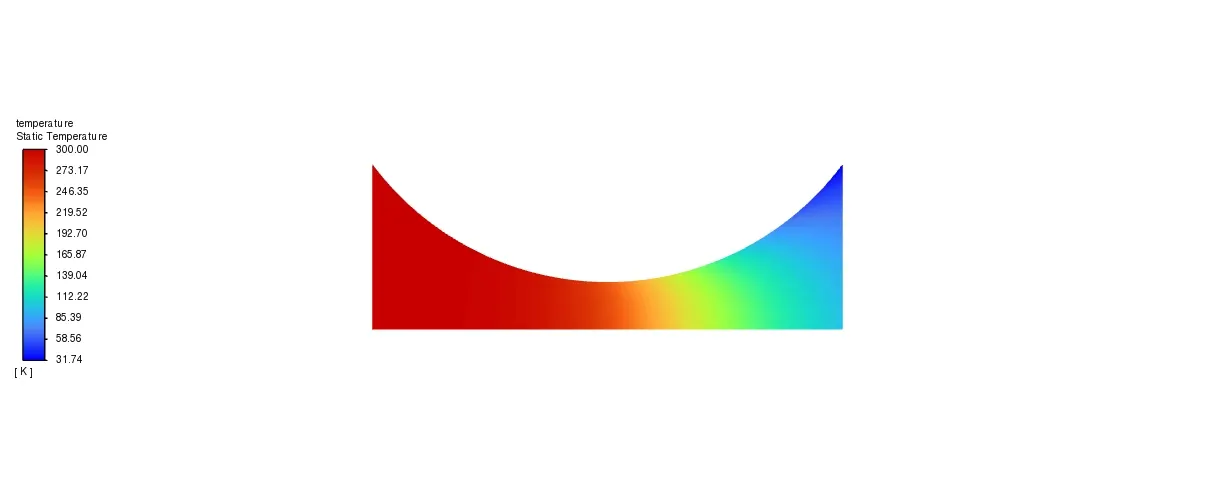
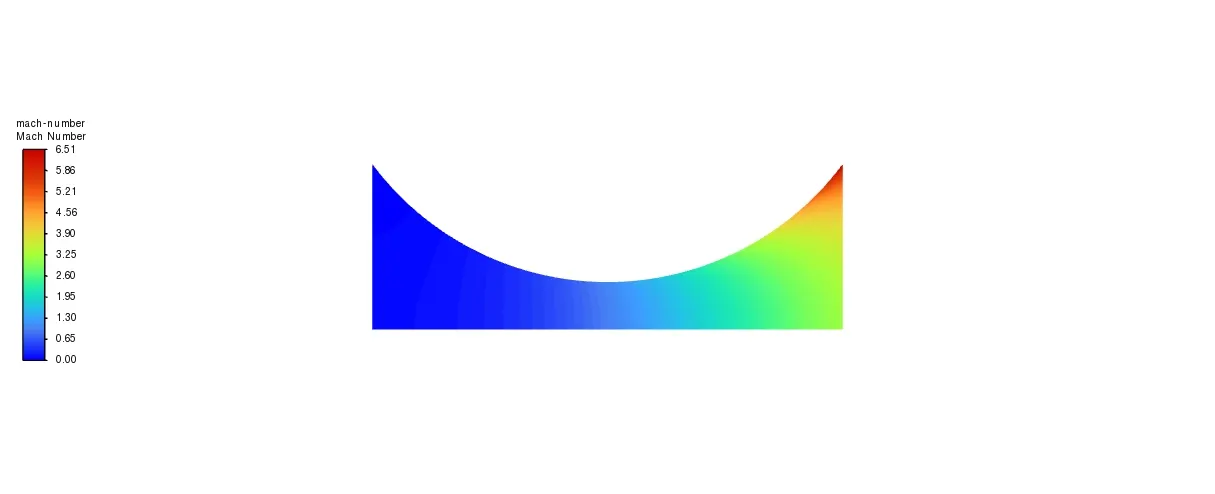
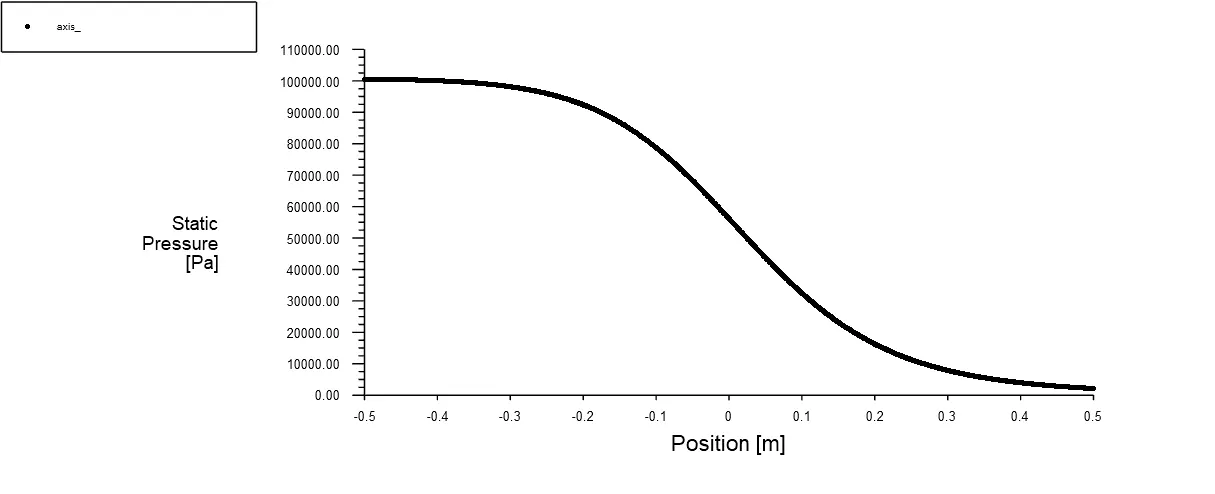
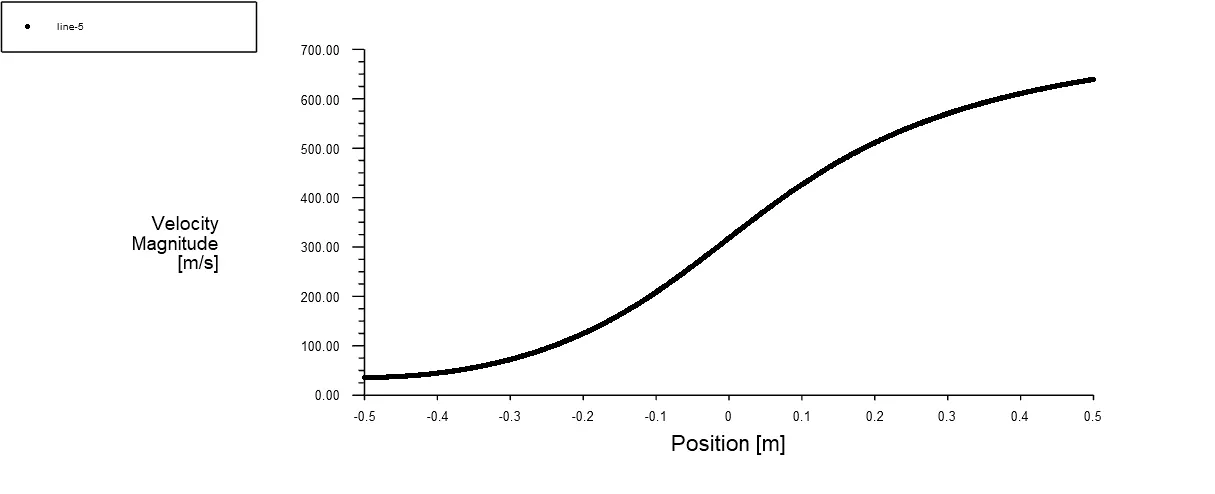
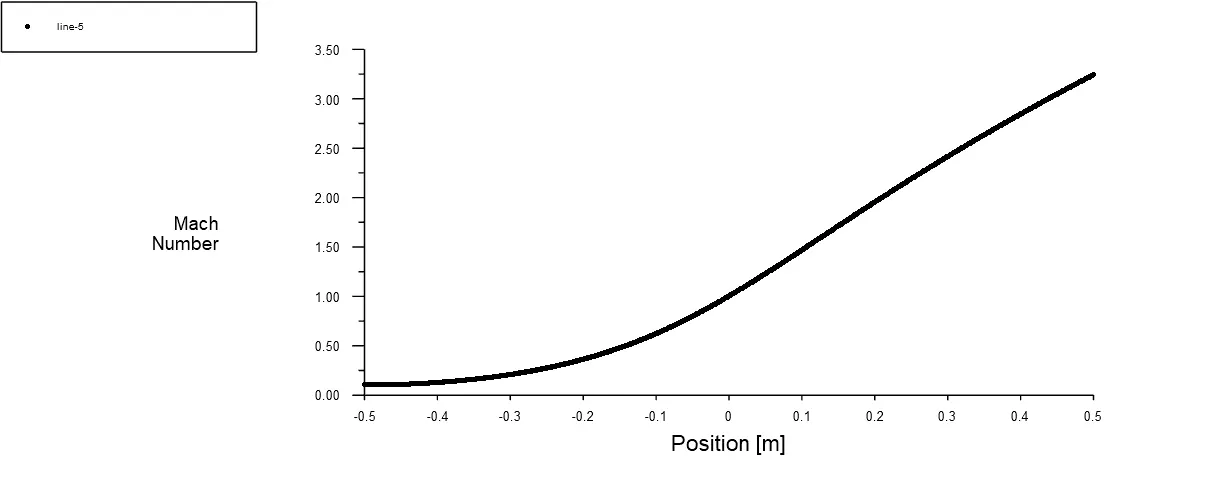
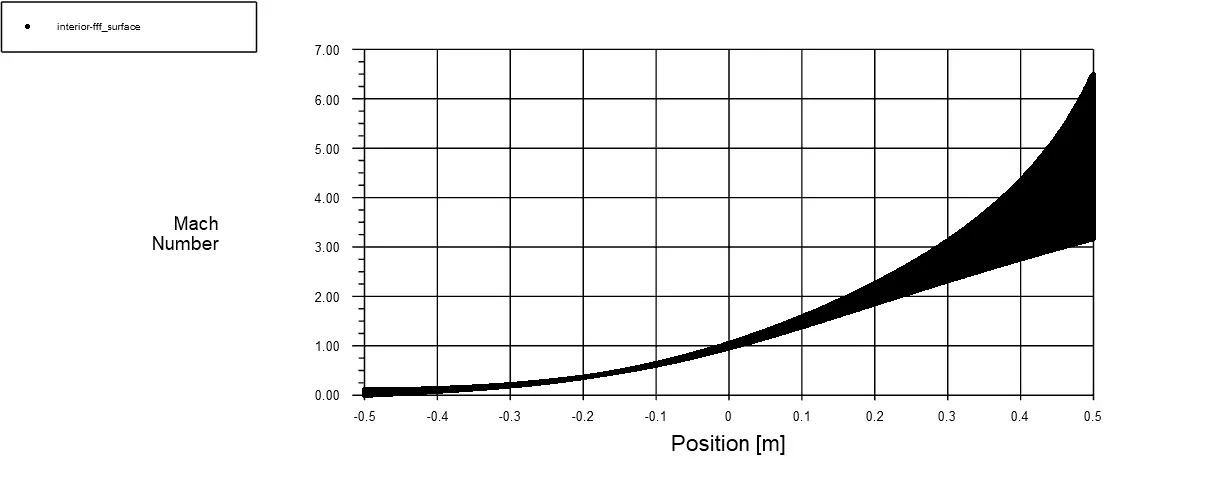
To determine the distance from the inlet ,the flow becomes supersonic by observing the graph plot
Conclusion:
1.Plot gives a idea to start of supersonic flow region is 0.53 m away from the inlet
2.Differentiating and dividing the mass flow rate equation ,we obtain
`frac{d rho}{rho}+frac{dA}{A}+frac{dV}{V}=0`
Equation is obtained by considering isentropic flow and then
`frac{dP}{rho}+V*dV=0`
Then the above two equations are joined and manipulated
`frac{dA}{A}=frac{dP}{rho}*(frac{1}{V^2}-frac{drho}{dP})`
substituting `underset(s)((frac{drho}{rho}))=frac{1}{c^2}` im above equation
`frac{dA}{A}=frac{dP}{rho*V^2}*(1-Ma^2)`
substituting `rho*V=-frac{dP}{dV}`in above equation
`frac{dA}{A}=-frac{dV}{V}*(1-Ma^2)`
Based on the above equation
for subsonic flow, as mach Number increases the change in area decreases
for supersonic flow,as mach number increases the change in area increases
upto 0.5 m area will decreases and after 0.5 m area will increases.
From the plot it is observed that mach no increases with area decreases until mach no becomes 1 after that machno increases with increase in area
3.Pressure is high on the converging part and pressure is decreasing more on diverging part
4.velocity is started to increase and reaches maximum at outlet.
5.As velocity increases mach number increases
6.Density will behave similar to pressure.
7.Area at throat=`pi*(0.1^2)`=0.03141 `m^2`
max mass flow rate=Area at throat*Stagnation pressure*`sqrt(frac{1.4}{287.052*300})`*`(frac{2}{1.4+1})^(frac{1.4+1}{2*(1.4-1)})`
stagnatiom pressure-101325 pa
max mass flow rate=`0.03141*101325*sqrt frac{1.4}{287.052*300}*(frac{2}{1.4+1})^(frac{1.4+1}{2*(1.4-1)}`=7.42 `frac{Kg}{S}`
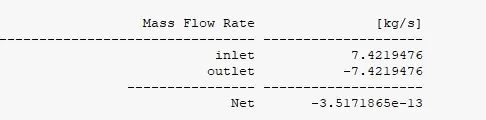
Analytical Maximum mass flow rate=7.42 `frac{Kg}{s}`
Simulation Mass flow rate=7.421 `frac{Kg}{s}`
8.Some of the plots represent the behaviour of the fluid in the nozzle centerline