Week 2 - Converging diverging nozzle
Aim: To calculate the Velocity, pressure, temperature, and Mach number distribution in the nozzle using Ansys Fluent.
Introduction:
Convergent -Divergent Nozzle: It is a nozzle with varying cross-section across its length, with decreasing crossectional area until throat (It is the smallest crossectional area in the nozzle)and again increasing the crossectional area to its end.
Need for the analysis on the converging-diverging nozzle:
The nozzle is a device used to accelerate or decelerate flow by varying its cross-section. Nozzles are widely used in aerospace propulsion systems. The chemical potential energy produced in the combustion chamber (rocket motor) is converted into kinetic energy by the nozzle. The nozzle converts high pressure, high temperature, and low velocity (subsonic) gases into low pressure, low temperature, and high velocity (supersonic) gases, hence producing high thrust(which is based on newtons third law). So there is a need to study the Converging diverging nozzle to obtain the optimum efficiency and performance. This is partially done by performing simulation on the 2d nozzle in the Ansys Fluent.
Problem-solving and modeling approach:
- Geometry creation in the space claim.
- Perform Meshing
- pre-processing (setting up the parameters and solvers, def and contours for report needed)
- Initialize and run the fluent solver
- check for the convergence
Geometry:
- Create the required geometry of the converging-diverging nozzle in the XY plane using a three-point arc. we are going to perform a 2d axis-symmetric simulation as the nozzle is axisymmetric. so the nozzle portion above the axis is enough to create to perform simulation.
- After creating the geometry use 3d option to display a solid object.
Meshing:
- Meshing is performed by inserting face meshing and select method quadrilaterals.
- set the element size to 2mm, and name the boundaries as ( pressure inlet, pressure outlet,axis-symmetric, nozzle wall)
- Then generate the mesh.
Pre-processing:
Setting up physics:
Solver: Density-based solver
A density-based solver is selected because the flow is compressible flow, so there will be variation in the density.
2D space: Axisymmetric
Energy: ON In the flow we deal with the temperature, so energy is on.
Viscous Model: Inviscid Flow is considered as the Inviscid flow to obtain the max efficiency of the nozzle.
Fluid air is set to ideal gas
Boundary conditions:
Pressure inlet: 101325pa
Operating conditions: reference pressure is set to zero
The explanation for setting operating pressure to zero is because the flow is, high Mach number compressible flow the pressure changes are larger than in the low Mach number flows so there is no need to worry about roundoff errors which are more significant in the low Mach number flows. ansys normally subtracts the operating pressure from absolute pressure to eliminate the roundoff errors, so operating pressure is set to zero to make gauge pressure and absolute pressure equal.
Pressure outlet: 2533.125pa
Solution methods: Implicit,least-square cell-based,second-order flow
Initialization Methods: standard initialization calculated from the pressure inlet
Required plots and contours are defined and simulation is run with the 600 iterations.
PLots:
Temperature plots:
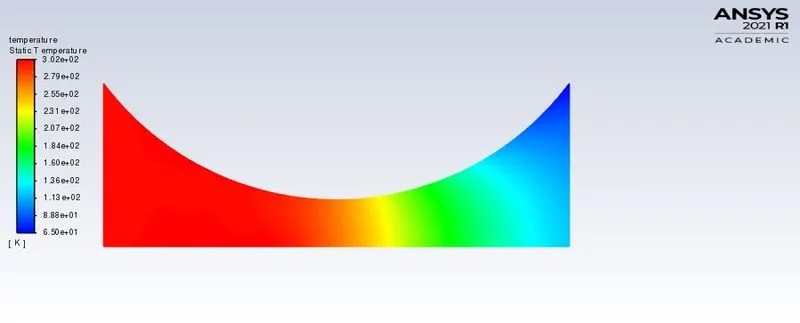
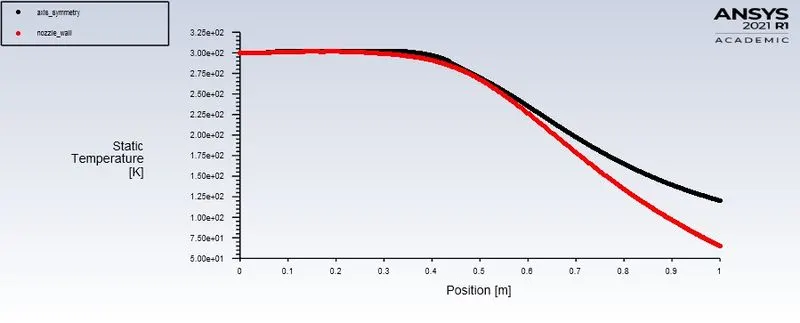
The temperature decreases as the velocity of the flow increases and pressure decrease this happens because the gases expand causing temperature drop.
Pressure plots:
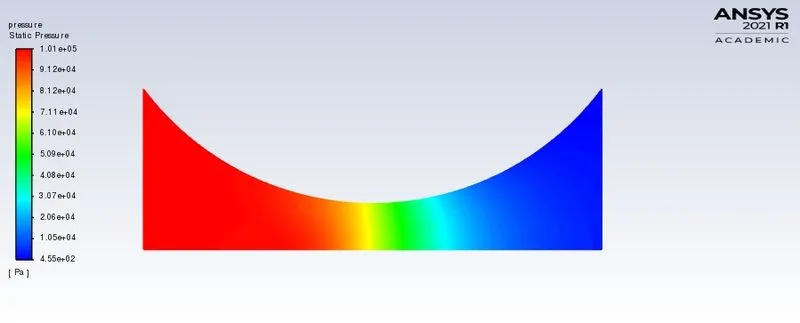
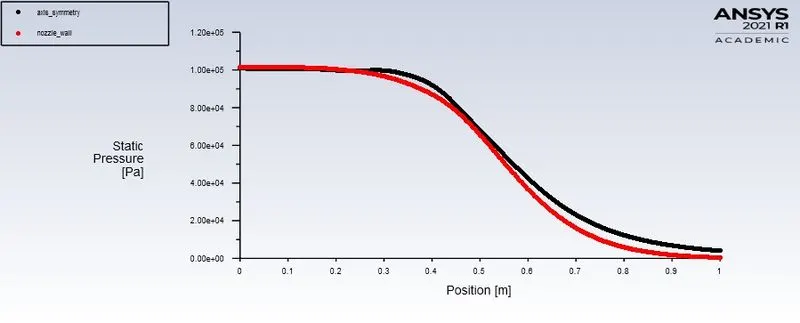
The pressure is atmospheric pressure at the start of the nozzle and pressure drops towards the throat and decreases further away from the throat.
Velocity Plots:
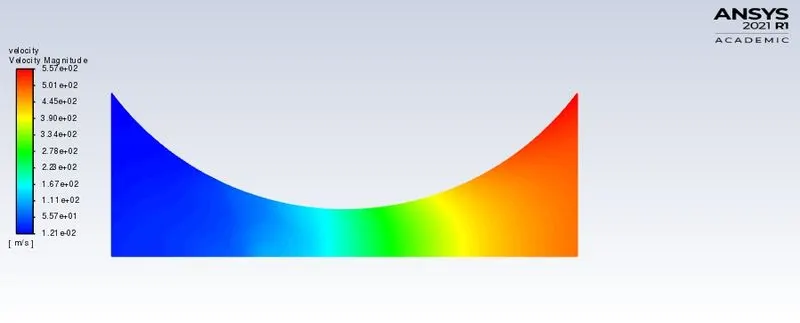
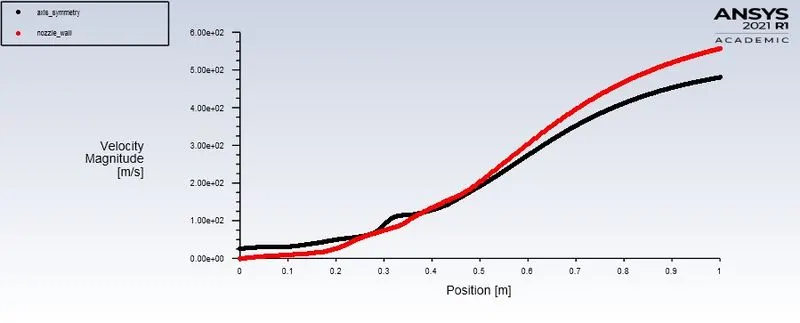
From the plots, we can see that the velocity increases until the throat and velocities reach supersonic velocities after the throat.
Variation of Mach no across the nozzle:
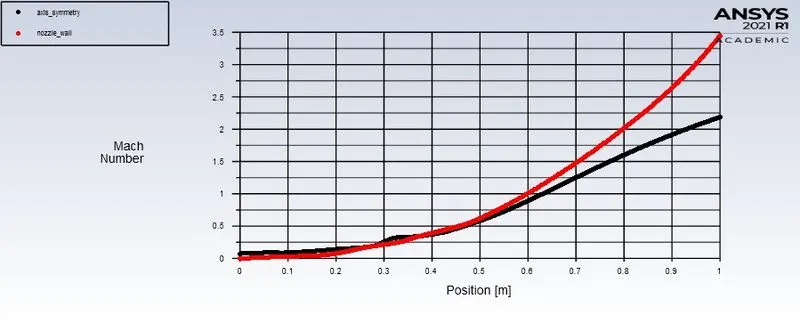
From the above plot, it is clear that the flow becomes supersonic at 0.65m from the inlet of the nozzle.
In quasi - one dimensional flow for this converging-diverging nozzle the expression which gives the relation between Mach number velocity and Area is below.
`(dA)/A = (M^2-1)(dc)/c`
In subsonic flows (M<1) with the increase in an area the velocity decreases and with a decrease in area velocity increases. For supersonic flows (M>1) with an increase in an area the velocity increases and with a decrease in the area the velocity decreases. Considering the above explanation following arguments were made
We assume that the Mach number at the inlet will be subsonic and accelerating until at the minimum nozzle area (the throat) the flow becomes sonic with M = 1. At that point, we expect that since the nozzle starts to diverge the flow will continue accelerating until at the exit, the flow continues as supersonic.
To get more precise analytical explanation
The nozzle can be divided into three portions like converging portion, throat, and diverging portion
Converging portion:
`(dA)/(dc) = (M^2-1)A/c`
The area decreases (dA -ve)and the velocity increases (dc +ve) thus making the LHS-ve, so from the LHS = RHS equation rule the RHS needs to be negative, for the RHS to be negative the Mach number should be less than 1. Thus it is subsonic flow.
Throat portion:
At the throat portion, it is just a point, so the dA is zero so for RHS to be zero Mach number, needs to be zero.
Diverging portion:
In the diverging portion,The area Increases (dA +ve), and the velocity increases (dc +ve) thus making the LHS+ve, so from the LHS = RHS equation rule the RHS needs to be Positive, for the RHS to be positive the Mach number should be greater than 1 .Thus it is Supersonic flow.
References:
https://etasr.com/index.php/ETASR/article/download/3140/pdf/