Week 2 Challenge
1.
| Proton Exchange Membrane | Solid Oxide Fuel Cell | Alkaline Fuel Cell | Direct Methanol Fuel Cell | |
| Advantages |
1. Solid electrolyte reduces corrosion and electrolyte management problems. 2. Low temperature 3. Quick start-up and load following |
1. High efficiency 2. Fuel flexibility 3. Solid electrolyte 4. Suitable for power & heating |
1. Wider range of stable materials allows lower-cost components. 2. Low temperature 3. Quick start-up |
1. Ease of fuel delivery & storage 2. Low cost of methanol 3. Operation at low temperature |
| Challenges |
1. Expensive catalysts 2. Sensitive to fuel impurities |
1. High-temperature corrosion & breakdown of cell components 2. Long start-up time 3. Limited number of shutdowns |
1. Sensitive to CO2 in fuel and air. 2. Electrolyte management 3. Electrolyte conductivity |
1. Still emits CO2 2. Sluggish kinetics of methanol oxidation, much slower than that of hydrogen 3. Methanol crossover reduces cell voltage |
| Applications |
Distributed generation, Backup Power, Portable Power, Transportation, and Special vehicles. |
Auxiliary power, Electric utility, Distributed generation. |
Military, Space, Backup power, Transportation. |
Portable Electronic equipment like charging laptops, cell phones, etc. |
2.
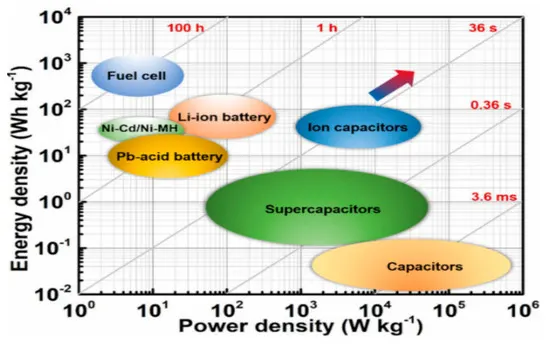
Power density indicates how much power a battery can deliver on demand. The focus is on power bursts, such as drilling through heavy steel, rather than runtime.
Energy density is a measure of how much energy a battery can retain or store. The higher the energy density, the longest the possible runtime.
Now let us understand the different types of batteries in detail:
i. Lithium-ion batteries
- The lithium-ion batteries (LIBs) are the best source for a wide range of electric vehicles (EVs). The working principle of LIBs is the exchange of lithium ions between a cathode and an anode.
- LIBs have higher specific energies than batteries made from other materials, such as zinc and lead, due to them being low-density and relatively lightweight.
- Lithium is silver in color and is a very soft metal. It is softer than lead and has a body-centered cubic crystal structure. It is so light, with a specific density of approximately half of the water. Its density is 0.534 grams per cubic centimeter, and that of water is 1.000 grams per cubic centimeter. The melting point of lithium is 180.54 °C and the boiling point is 1342 °C.
- The lithium-ion batteries also have more-stable overcharge/discharge cycles, because the radii of the lithium-ion are small and cause fewer disruptions to the electrode structure during ion transfer.
- In low-power applications, they are the best option, e.g., earbuds, earphones, mobiles, laptops, and microelectronic gadgets.
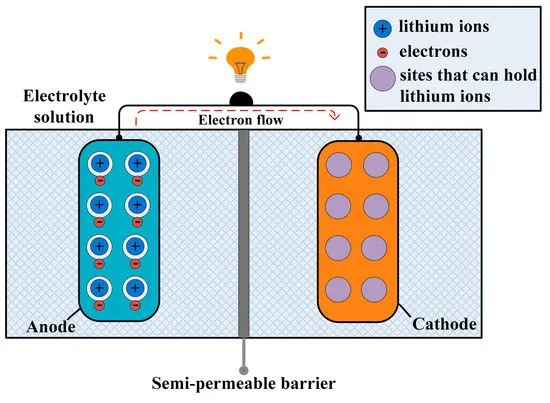
ii. Lead Acid Battery:
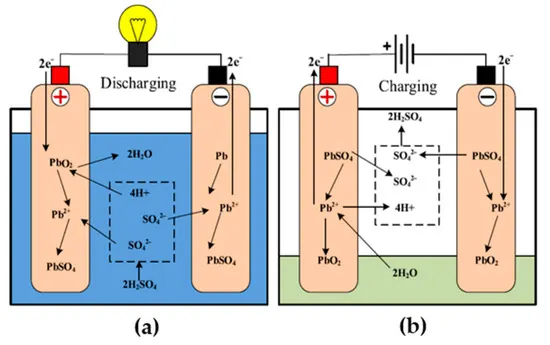
- The normal voltage of lead-acid batteries is approximately 2 V/cell; for six cells, the total voltage is 12 V.
- The battery fatherly discharges when a load is connected between its electrodes. Here, the electrodes are built of lead mixed with the alloy of 5 to 10% of antimony, which limits the positive terminal’s polarization corrosion.
- The main advantages of lead-acid batteries are the following: large current capacity, tolerance to abuse, tolerance to overcharging, for rechargeable cells, lower cost per unit capacity, and cheap manufacturing of the battery.
- The main disadvantage of lead-acid batteries is overcharging and overheating. The disadvantages include the following: the life span is typically 300 to 500 cycles, the corrosion of the electrodes can cause the burning of people and corrosion of metalwork, lead is not environmentally friendly, the acid must be treated with care, it is not suitable for fast charging, and the charging efficiency is only 70%.
- The overheating and overcharging of lead-acid batteries are the main reasons for their failure. This problem can be overcome by the application of an intelligent voltage source charger. This intelligent source will first charge the battery at a constant voltage, then join later with a constant current. This source will also give protection against overcurrent, which will help to set the level of battery capacity and battery voltage.
- The benefit of these batteries is their low cost, high efficiency, and surge capacity.
iii. Ni-Cd Battery:
- Ni-Cd battery cells are the mature technology of low-cost batteries and are famous for low-cost microelectronic devices.
- The nickel-cadmium (Ni-Cd) battery contains nickel oxide, metallic cadmium as the cathode and anode, respectively, and potassium hydroxide as the electrolyte.
- Nickel is a silver-white metal, and one of the four elements that are magnetic at room temperature. Above 355 °C it is nonmagnetic. Nickel has a crystal structure and it is hard, malleable, and ductile. Its melting point is 1453 °C, and its boiling point is 2732 °C. On the other hand, cadmium is a silver-white metal and is very similar to zinc and mercury. Its melting point is 321 °C, and its boiling point is 766.8 °C.
- Ni-Cd batteries are a developed technology and are used in difficult environmental conditions and in places where long service life is required.
- Due to the low internal resistance, Ni-Cd is useful where a high initial power is required for a very short duration.
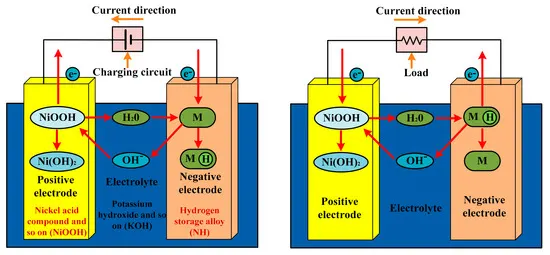
- It has a good reputation for its low cost and powerfulness. Based on their powerfulness, these batteries can be charged at a higher rate in a short time. The main drawback of these batteries is the memory effect; they can lose capacity if they are recharged without completely discharging.
- Ni-Cd batteries are used in portable electronic devices, toys, garden solar lights, etc. These are very useful batteries, but they have limitations, due to memory effects, periodic maintenance, relatively high discharging as compared to other batteries, and use of toxic materials.
iv. Ultracapacitor:
- The ultra-supercapacitor (UC) is a double-layer capacitor with high capacitance.
- UC has a very fast charge-discharge transient response, typically in the range of microseconds.
- Since batteries have a slow charge/discharge profile, UC is capable of harvesting a lot of regenerative energy quickly and efficiently.
- The UC is also very good for peak power assistance where a lot of power is required during acceleration.
- Over two million vehicles on the road featuring Continental Automotive Systems Stop Start powered by Maxell Technologies Ultracapacitors.
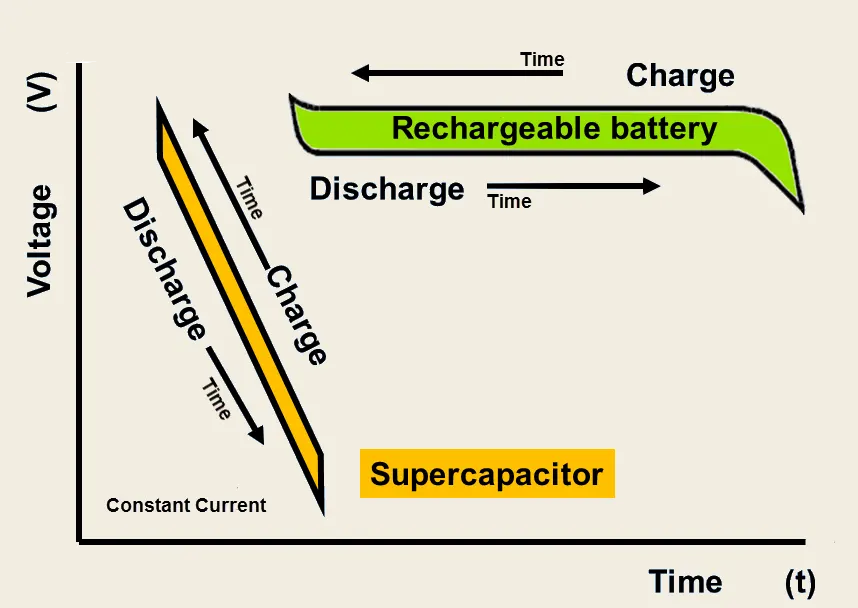
- The basic mechanism for storing energy in UC is fundamentally different from batteries.
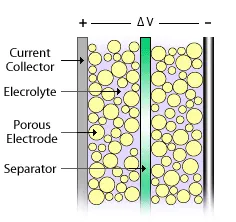
- UCs have two terminal that attracts the negative ions from the electrolyte and a positive terminal that attracts the negative ions.
- So, the UC stores charge on the terminals. UC has much power density as compared to battery because of the terminals storing charge.
v. Fuel Cells
- The basic principle of a fuel cell is to oxidise a fuel.
- This electrochemical process creates electricity which powers the load connected to it.
- Fuel is supplied to the anode side of the fuel cell.
- This is where primarily hydrogen is exposed to the reaction on the anode side.
- The air from the surrounding from which primarily oxygen is derived comes up in the cathode side.
- Hydrogen and oxygen undergo a reaction releasing electrons and forming water as a by-product.