Week 2 Challenge
Question 1:
Compare four different types of fuel cells and state their applications.
answer:
There are several different types of fuel cells, each with their own unique characteristics and applications. Four types of fuel cells that are commonly used include:
-
Polymer electrolyte membrane (PEM) fuel cells: These fuel cells use a proton-conducting polymer membrane as the electrolyte and are typically used in vehicles and portable power applications. They have a relatively low operating temperature, which makes them well-suited for automotive applications, and they have a relatively fast response time, which makes them well-suited for portable power applications.
-
Alkaline fuel cells (AFC): These fuel cells use an alkaline solution as the electrolyte and are typically used in aerospace and industrial applications. They have a relatively high efficiency and a relatively long life, which makes them well-suited for use in spacecraft, where the weight and size of the power source are critical.
-
Phosphoric acid fuel cells (PAFC): These fuel cells use phosphoric acid as the electrolyte and are typically used in stationary power generation applications. They have a relatively high efficiency and a relatively long life, which makes them well-suited for use in power plants, where the power source needs to be reliable and efficient.
-
Solid oxide fuel cells (SOFC): These fuel cells use a solid oxide ceramic electrolyte and are typically used in stationary power generation and industrial applications. They have a relatively high operating temperature and a relatively high efficiency, which makes them well-suited for use in power plants and industrial processes, where heat is a byproduct of the power generation process.
| Type of Fuel Cell | Electrolyte | Applications | Operating Temperature | Efficiency | Response Time | Durability |
|---|---|---|---|---|---|---|
| Polymer electrolyte membrane (PEM) | Proton-conducting polymer membrane | Vehicles, portable power | Low | Medium | Fast | Medium |
| Alkaline fuel cells (AFC) | Alkaline solution | Aerospace, industrial | Medium | High | Medium | High |
| Phosphoric acid fuel cells (PAFC) | Phosphoric acid | Stationary power generation | Medium | High | Medium | High |
| Solid oxide fuel cells (SOFC) | Solid oxide ceramic | Stationary power generation, industrial | High | High | Slow | Medium-High |
The applications mentioned in the table are as follows:
-
Vehicles: PEM fuel cells are well-suited for use in vehicles because of their low operating temperature and fast response time. This means that they can start and stop quickly, and can be used in a wide range of temperatures. They are also lightweight and compact, making them suitable for use in vehicles where space is limited.
-
Portable Power: PEM fuel cells are also well-suited for portable power applications. They have a fast response time and can be used in a wide range of temperatures, which makes them well-suited for use in portable power generators, such as portable power banks and backup power supplies.
-
Aerospace: Alkaline fuel cells are well-suited for use in aerospace applications because of their high efficiency and long life. They can be used in spacecraft, where the weight and size of the power source are critical, as they are relatively lightweight and compact.
-
Industrial: Alkaline and SOFC fuel cells are well-suited for use in industrial applications because of their high efficiency and long life. They can be used in power plants and industrial processes, where heat is a byproduct of the power generation process.
-
Stationary power generation: PAFC and SOFC fuel cells are well-suited for use in stationary power generation applications because of their high efficiency and long life. They can be used in power plants, where the power source needs to be reliable and efficient.
===============================================================================
Question 2:
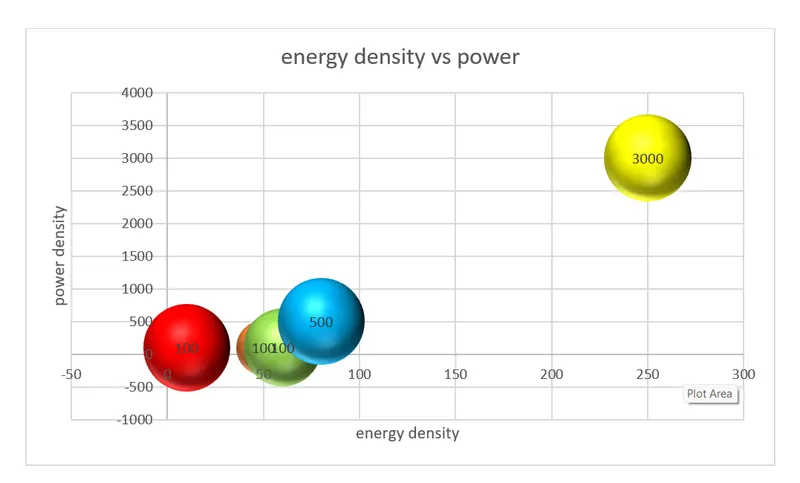
Using a plot with energy density and power density on the X and Y axis, arrange various battery types like lithium ion, lead acid, Nickel Cadmium, Ultracapacitor, fuel cell.
answer :
The energy density of a battery is a measure of how much energy it can store per unit volume or weight. The power density is a measure of how much power it can deliver per unit volume or weight.
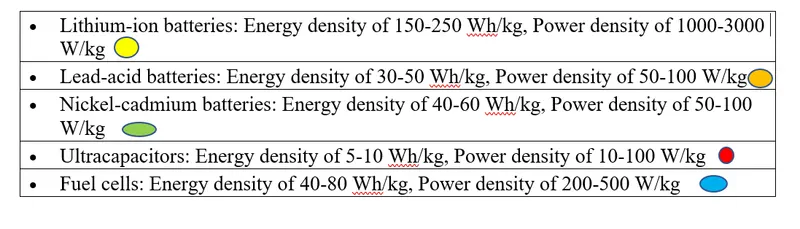
the energy density and power density of different battery types:
- Lithium-ion batteries: Energy density of 150-250 Wh/kg, Power density of 1000-3000 W/kg
- Lead-acid batteries: Energy density of 30-50 Wh/kg, Power density of 50-100 W/kg
- Nickel-cadmium batteries: Energy density of 40-60 Wh/kg, Power density of 50-100 W/kg
- Ultracapacitors: Energy density of 5-10 Wh/kg, Power density of 10-100 W/kg
- Fuel cells: Energy density of 40-80 Wh/kg, Power density of 200-500 W/kg
===============================================================================